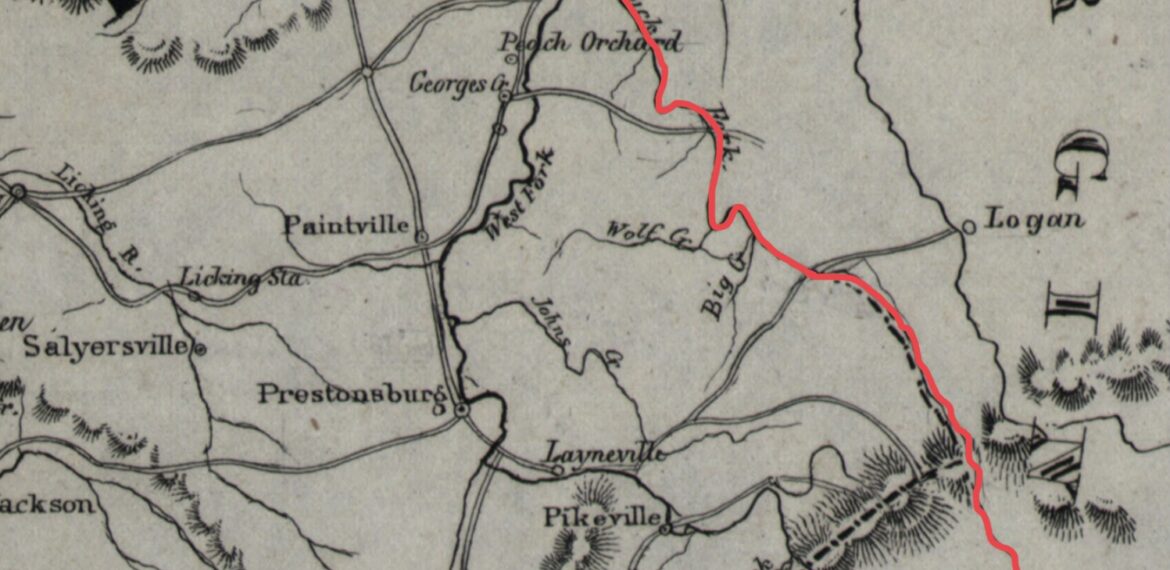
The following is a transcription of a journal from Lyman C. Draper to the Virginia Historical Register And Literary Companion: Volume V, Number II, in April of 1852.
All Spellings and grammar are exactly as originally transcribed and were not altered.
The expedition of the Virginians against the Shawanoe
Indians, in 1756, is an event of some importance and still
more interest in the annals of the State. As yet, however,
we have no proper and sufficiently satisfactory account of it
before the'public. Neither Marshall, Burk, the Campbells,
father and son, nor Howison, have given us, in their res-
pective works, any particulars of this border enterprise.
Reliable data were probably not at their command. It is
true the expedition proved abortive, and sufficiently morti-
fying to all concerned in it; yet composed as it was, with
the exception of a small band of friendly Cherokees, cn-
tirely of Virginia troops, conducted by one of Virginia's
border heroes, it well deserves something more than a mere
passing notice in any work illustrative of the history of the
Old Dominion. The publication of Morton's Diary in the
Virginia Historical Register, for July, 1851, has, at length,
shed some little light upon it, but hardly sufficient to dispel
the darkness that has hitherto concealed it from our view.
Indeed, the information it gives us is so imperfect that it
has even led one of our best antiquaries to inquire whether
" the expedition to which this Diary refers, is the same
with that styled the Sandy Creek expedition;"
-a question
which I have answered in the affirmative in the last number
of the same work. But to complete the proof on this
point, and to give a fuller account of this affair than has
ever yet been submitted to the public, I shall now proceed
to give an outline of this enterprise, drawn from an unpub-
lished journal of the expedition, kept by Captain William
Preston, one of the actors, and some other manuscript pa-
pers in my possession. These ancient witnesses will serve
to place this whole affair in quite a different light from the
traditionary accounts of Withers, and other writers; and
fully corroborate the authority of Lieut. Morton's Diary.-
I ought, perhaps, to say here, that no man ever bore a fairer
reputation than Captain, afterwards Colonel William Pres-
ton; he distinguished himself at the battle of Whitsell's
Mills, in March, IT81, at the head of a regiment of fron-
tier riflemen, and died at the close of the Rerolution. His
descendants are amongst the most talented and patriotic
in our country.
The place of rendezvous was Fort Frederick, on the
western bank of New River, and probably at or near the
well known locality of Ingle's Ferry. Maj. Andrew Lewis
had the chief command, and under him were Captains Wil-
liam Preston, Peter Hog, (such was Captain Hog's or-
thography of his name, as original signatures of his prove;
the name is modernized with the addition of a final e.)
John Smith, Archibald Alexander, [ Robert?] Brecken-
ridge, Woodson, and Overton, whose companies appear to
have been already engaged in guarding the frontiers when
called upon for this new service; together with the volun-
teer companies of Captains Montgomery and Dunlap, and
Captain Paris, at the head of a party of friendly Cherokees.
In the latter part of 1755, one hundred and thirty Chero-
kee warriors had come to the assistance of the Virginians ;
whether all these were engaged in this enterprise does not
distinctly appear, though all were ordered by Gov. Dinwid-
die to join it; and Preston's Journal mentions that a de-
tachment of forty was ordered out on a scouting excursion
on one occasion during the expedition. Old Outacité, the
Round O, and the Yellow Bird were the war leaders of the
party~-the two latter having been commissioned Captains
by Major Lewis. Col. David Stewart, of Augusta, accom-
panied the troops on this perilous adventure, and seems to
have acted as commissary. The whole force, including the
friendly Cherokees, amounted to 365 men, of whom 340
went upon the campaign, while Lieut. Tyler and some 24
men remained to garrison Fort Frederick, and protect the
neighboring frontier--an indispensable service, as while the
men were rendezvousing for the expedition, two persons
were killed by the savages on Red Creek, within a few
miles of Fort Frederick.
On Monday, the 9th February, 1750, Captain Preston,
with his two Lieutenants, Audley Paul and David Robin-
son, and twenty-five privates, left Fort Prince George, in
pursuance of the orders of Major Lewis of the 4th of the
same month, and marched for Fort Frederick, having under
their charge a waggon load of 2000 lbs. of dried beef.-
They reached the place of rendezvous on the night of
Wednesday, the 11th; and it is added, " Captain Hog's
company is but a little behind us."
On Friday, the 13th,
at noon, a general review of the troops took place by Maj.
Lewis, at which, including the friendly Indians, about 340
men appeared-and among these were Captain Hog and
his company.
The next day Captain Dunlap, with his
company of volunteers, 25 in number, arrived; and these
made up the complement, Several days were requisite to
procure a suficiency of horses, and to prepare packi-sad-
les for them, with which to transport the provisions, am-
munition, and other necessaries.
During this delay, the
Reverends John Craig and John Brown, pioneer Presbyte-
rian clergymen in the Virginia Valley, preached twice re-
spectively to the soldiery, and one of each of their efforts
is, by Captain Preston, denominated a « Military Sermon."
Major Lewis marched from Fort Frederick, on Wednes-
day, February 18th, with the advance--and among them
Capt. Hog's company; Captains Preston and Paris brought
up the rear the following day. Passing the Bear Garden
on the North Fork of Holsten, they proceeded on over two
large mountains to Burke's Garden, where they arrived on
the 24th, and where they found plenty of potatoes in the
deserted plantations; it snowed that night. Thence they
steered for the head of Clinch, which they reached the
26th; «that day," says Capt. Preston, "I bought a little
horse of Lieut. Smith for €4, to carry me out of the Shaw-
nee Towns;" and that night it rained. The next day, « a
very great rain" compelled the troops to remain in camp,
except a few hunters who killed three or four bears.
On the
28th, the march was resumed, when passing several branches
of Clinch, they at length reached the head of Sandy Creek,
where they met with great trouble and fatigue, occasioned
by a very heavy rain and the driving of the pack-horses
down the creek, which was crossed and re-crossed twenty
times that evening; the hunters that day killed three buffa-
loes and some deer.
On Sunday, the 29th, the troops
crossed and re-crossed the creek, which proved to be very
crooked, sixty-six times in the space of fifteen miles: «I
passed the creek," says Capt. Preston, "sixteen times on
foot; the Sabbath day was spent very disagreeably."
On Monday, March 1st, they experienced " a great gust
of thunder, hail and rain;" and Capt. Preston adds, " I
bathed in ye river at nine o'clock;" signs of the enemy
were seen, as on former occasions. On the 2d, they were
put upon half allowance of beef, which was almost exhaust-
ed. Their rations on the 3rd, were reduced to half a
pound of four per man, and no meat, except what they
could kill, and that was very scarce; no food for the
horses, which occasioned many of them to stray away; a
few bears were killed; nine miles were gained that day,-
After a tedious search for the strayed horses, some of which
could not be found, the toilsome march was resumed on
the 4th, and about six miles only were gained; the addition
of several branches very much increased the volume of the
stream, and rendered it difficult for the foot men to wade,
which they had to do sixteen times that day; the hunters
had no success, and " nothing but hunger and fatigue"
stared them in the face. On Friday, the 5th, fifteen miles
were accomplished with painful difficulty, " the river being
very deep, and often to cross, almost killed the men, and
the more so as they were in the utmost extremity for want
of provisions: " Capt. Preston records in his journal,
" this day my €4 horse expired, and I was left on foot with
a hungry belly, which increased my woe; and this was in-
deed the case with almost every man in. the company:",
Rained hard, all night; and "no appearance of a level
country though it was wishfully looked for;" and encamp-
ed near the Forks of Sandy.
The troops did not move on Saturday, the 6th, till eleren
o'clock, and then only to cross the South East Fork and
encamp. The Cherokees proposed to make bark canoes
to. carry themselves down the river, which was immediately
put in practice; Major Lewis, at the same time, set men
to work to make a large canoe to carry down the ammuni-
tion, and. the small remains of the flour, then almost ex-
hausted; ' the men murmured very much for want of pro-
visions, and numbers. threatened to return home."
When this was told to Maj. Lewis, he was " very much concerned,
and had no other way to please them but to order a cask
of butter to be divided among them, which was no more
than a taste to each man: it rained very hard all that
night, which still added to our misfortunes, as we had no
tents, nor indeed hardly any other necessary for such
a
journey."
The morning of Sunday, the 7th, was raining,
yet the men continued to work at the canoes, and it was
agreed upon by the officers, that Captains Smith, Preston,
Breckeuridge, Dunlap, and Lieut. Morton, with their com-
panies, and part of Montgomery's volunteers, making a
total of 130 in number, with nearly all the horses, should
proceed down the creek fifteen miles, and no further, in
search of hunting ground, there to await the arrival of
Major Lewis, with the remainder of the men, who tarried
to complete the canoes.
A single pound of four to each
man was the only subsistence allotted to this advance de-
tachment, and that to last until Major Lewis and the re-
mainder of the men could overtake them.
Although this party marched at 9 o'clock in the morning,
yet so difficult was it to find a passage over the mountain
for the horsemen, and to secure which they had to leave
the creek some distance, that at sun-set they had accom-
plished but about six miles, and encamped on the bank of
the stream.
No game was found; hunger and want in-
creased. The mountains seemed very high, and no ap-
pearance of a level country, which greatly discouraged the
men. A great number of them resolved to break off home-
ward next morning, justifying this unmilitary movement by
declaring, that their daily allowance of half a pound of
flour per man was insuffcient for their support, and even
this inadequate supply would soon cease; that they were
faint and weak, and could not travel the mountains, or
wade the rivers as they had done; and, finally, that there
was no game in the mountains, nor any prospect of a level
country ahead.
Capt. Preston proposed to kill horses for
food. This they refused to do, saying it might answer if
they were returning to support them home, but that it was
not proper diet to sustain men encountering every hard-
ship on a long march against an enemy.
Captain Preston
then urged them to make a further trial the next day down
the river, to which they at length agreed with some reluc-
tance.
It rained hard that night.
At 8 o'clock on the morning of Monday, the 8th of
March, the movement down the creek was recommenced,
and continued about three miles, where the rugged moun-
tains so completely closed in upon the streams as to pre-
clude a passage between them. It became necessary to
bear off some distance from the creek, pursue up a branch,
over a high mountain, and down another branch; here two
elks were discovered, seven shots fired, but all unfortunately
without effect. Now passing another high mountain, they
came upon the head of a branch, down which they follow-
ed some miles, where they met with some of the volun-
teers who had kept nearer the stream, and had [luckily
killed two elks within a mile of Sandy.
Arriving there,
after a tedious march of seven miles, camp was struck upon
the bank of the creek, one of the elks was brought in and
divided among that portion of the men associated
with
Captain Preston, to the no small joy of every man.
" By
that time," says Captain Preston, " hunger appeared in all
our faces, and most of us had become weak and feeble, and
had we not got that relief, I doubt not but several of the
men would have died of hunger; their cries and complaints
were pitiful and shocking, and the more so as the offi-
cers could not afford them any help, for they were in equal
want with their men."
The volunteers had the good fortune to kill two buffaloes
and an elk on the morning of Tuesday, the 9th, which af
forded still furtherrelief, The men, however, still continued
to murmur; no further advance movement was attempted,
as it was thought that the limited distance of 15 miles be-
low the Forks had been attained: A great number of the
young men went out that day to hunt and view the coun-
try; some of whom went seren or eight miles down the
river and returned that night, reporting that they had
climbed a very high mountain in order to survey the coun-
try, and that there seemed to be several prodigious moun-
tains before them, compared with which the country behind
appeared level; that the creek seemed to bear to the west-
ward, and no probability of being able to travel with
horses beside it; and that they saw no game. This report
very naturally dispirited the men more than ever; in short,
they agreed almost to a man to set out on their return home
next morning.
Capt. Preston, with a full knowledge of
this determinatien, convened the officers, and it. was con-
cluded that each Captain should exert his best efforts to
prevail on his men to stay until Major Lewis should arrive
with the remainder of the troops.
It rained very hard that
night; and Capt. Preston confesses, that his mind was in
a very confused and perplexed state to think of the men.
returning in such a manner, " which would infallibly ruin
the expedition."
Atthough. the men, on the morning of the 10th, were pre-
pared to commence their return, yet an appeal from Capt.
Preston to his company, that should they go before Major
Lewis' arrival, his own character would suffer by it, induced
them, as well as the other companies, to stay, until a letter
could be sent to the Major. Lieut. Morton was immediate-
ly despatched, with two men, with a letter, wherein Capt.
Preston set forth the confusion and disorder prevailing
among the men, and their determination to return home;
that the meat was consumed, and that nothing
remained
on which the men could subsist, and earnestly begged Maj.
Lewis to come down that evening or next morning, if pos-
sible.
During the afternoon McNutt and another person
arrived from the camp in the Forks with intelligence that
the canoes were to set off that morning, that a horse had
been killed to support the men, who were almost perished
with hunger, and very uneasy.
Notwithstanding the promises of the men to remain un-
til the Major's arrival, they were bent on marching home-
wards on Thursday morning, the 11th; but after many ar-
guments and persuasions by Capi. Preston, they consented
to remain that day for the Major's coming, as also for An-
drew Lynam, who had been out three days making what
observations he could.
A little venison was procured for
the support of the men that day. About noon two Indians
came down in a canoe from Major Lewis' camp, reporting
that the upper companies would be down that night.
In
the afternoon Andrew Lynam and William Hall returned
with the information, that they had been fifteen miles down
the stream; saw a large buffalo path, and fresh signs of
buffaloes and elks; that they saw great numbers of turkies,
and were of opinion that game was plenty; that they found
an old fort which they believed was a hunting fort built by
the Indians; that they thought the main mountain was not
more than two miles beyond the farthest point to which
they penetrated, but did not wait to make further discove-
ries, as they judged these would be sufficient to encourage
the men to prosecute their journey. While this report
greatly pleased and cheered the officers, it rather increased
than quieted the mutiny among the men; for they looked
upon it as formed only to draw them still farther from
home; that were the game ever so plenty, they said it was
utterly impossible to support 340 men by it, as there was
nothing else to depend on; and if they proceeded any far-
ther, they must inevitably perish with hunger, which they
looked upon to be more inglorions than to return and be yet
serviceable to their country, when properly provided for.
" These and many other weighty arguments," says Captain
Preston,
"they made use of, but through the whole they
laid great part of our misfortunes on the com-
-es for
not providing necessaries for such a number of men, as
we had not above fifteen days provisions when we left Fort
Frederick, to support us on a journey of near 300 miles,
as we suppose."
Lieut. Morton returned, and informed
Captain Preston that he had delivered his letter to Major
Lewis, who could hardly credit the contents, and said that
he had often seen the like mutiny among soldiers, and it
might easily be settled, &c.
Eight of Capt. Smith's
men went off, and two others with them.
It rained very
much all night.
The next morning, Friday, the 12th, Capt. Preston des-
patched Lieut. Paul to meet Major Lewis, and hasten him on.
The soldiers being in readiness to march up the creek,
eight or ten of Capt. Preston's men had their bundles on their
backs and were about to start with them; Capt. Preston
reasoned with them some time to no purpose, and was
finally obliged to disarm them, and take their blankets by
force.
Half an hour afterwards five of them were found to
have gone off privately; Lieut. Robinson and one soldier
were sent in pursuit, and soon overtook and brought the
deserters back to camp.
Capt. Woodson now arrived with
some of his company, with the intelligence, that his canoe
overset, and he had lost his tents, and every thing valuable in
it; that Major Lewis' canoe was sunk in the river, and that the
Major, Capt. Overton, Lieut. Gun, and one other man had to
swim for their lives, and that several things of value were lost,
particularly five or six fine guns. Major Lewis and two others
soon after made their appearance, and gave information
that being shipwrecked was the cause of so long detaining
the Major, who left Capt Hog with his company to bring
down the canoes and baggage, for which latter horses
would hare to be sent. The party of ten men who left the
day before for home, were met by Major Lewis, and pre-
tended that they went with the consent of their offcers,
who would have gone with them but for fear of their supe-
riors.
One of the men who came with Major Lewis
brought in a little bear, which he took to Capt. Preston's
tent, where the Major lodged that night;
« by which," says
Preston, "I had a good supper and breakfast- a rarity."
On Saturday morning, the 13th of March, Major Lewis
gave orders to each Captain to call his company together
immediately, which was done, when the Major told the
soldiers that he was informed of their design to go home,
and that he was much surprised at it; he hoped they would
alter their intentions of mutiny and desertion, and pursue
the journey. He also set forth the ill-consequences that
would certainly attend such conduct; he felt confident
that they would be well supported when they reached the
hunting ground, which he thought must be very near, and
horses would support them for sometime. Notwithstand-
ing all that could be said, the men appeared obstinately
bent on going home; for, they said, if they went forward
they must perish or eat horses, neither of which they were
willing to do,
Then Major Lewis stepped off some yards,
and desired all who were willing to serve their country and
share his fate, to go with him.
All the offcers, and some
of the privates, not above twenty or thirty, joined him; up-
on which Montgomery's volunteers marched off, and were
immediately followed by Capt. Preston's company, except
the Captain, his two Lieutenants, and four privates; Cap-
tain Smith's company also followed these bad examples, -
Captain Woodson kept his company together all day under
a pretence of marching down the country against the
Shawanoes some other way, which was only to drew one
day's provision for them-_for a buffalo had been killed.
Major Lewis spoke to old Outacité, who appeared much
grieved to see the men desert in such a manner, and said
he was willing to proceed; but some of the warriors and
young men were yet behind, and he was doubtful of them,
but would send off a messenger to them to bring them
down-which he did. The old chief added, that the white
men could not bear abstinence like the Indians who would
not complajn of hunger.
Capt. Paris and Colonel Stewart came to the camp that
morning with the information that one of Capt. Brecken-
ridge's men got drowned the evening before, in attempting
to cross the stream for some meal.
Indeed," says Pres-
ton's Journal, " hunger and want were so much increased
that any man in the camp would have ventured his life for
a supper.
A small quantity of wet meal was brought in ; I
saw about one pound given to twelve men, and one of them
bought a share for which he gave two shillings. One Jesse
Mayo offered thirteen days hire as a pack-horseman for
two pounds of bear's meat; so that it is impossible to ex-
press the abject condition we were in, both before and after
the men deserted us, except when a little fresh meat was
procured, which would not last any time, nor had it any
strength to support men, as the salt was all lost. Lieut.
Paul was ordered off with a party of men to Capt. Hog to
bring the baggage, and on his way killed a buffalo. Mr.
Dunlap's volunteers went off in the afternoon."
Here abruptly ends Capt. Preston's Journal. There can
be no doubt, though Capt. Preston, Lieutenants Paul and
Robinson, Old Outacité, and a patriotic few, resolved to
share Maj. Lewis' uncertain fortunes, that all hope of ac-
complishing any thing at all adequate to the great sacrifi-
ces they would necessarily have to make, with so diminish-
ed a force, was now deemed utterly impracticable; and
that to adrance further would be but a reckless waste of
life and energies; and, consequently, the further prosecu-
tion of the expedition was reluctantly abandoned, and all
made the best of their way home. They must hare been
well nigh two weeks in reaching the settlements, as Sparks
mentions their being " six weeks in the woods,' and Wash-
ington speaks of their return, under date Winchester, the
7th of April. We can only conjecture their sufferings on
their homeward march; that horses were very likely killed
for food, buffalo tugs devoured, and shot-pouch flaps eaten,
to satisfy in part the cravings of long-protracted hunger.
With what inexpressible joy must these half-famished men
have beheld the first inhabited cabins upon the out-skirts
of the settlements !
It is difficult-even with our new light on the subject-
to ascertain the precise object or design of this ill-starred
expedition.
Taylor and Withers affirm that it was the de-
struction of the Roanoke settlement.
From the com-
mencement of hostilities to the period of the marching of
Major Lewis's little army, seventy persons had been killed,
wounded, or captured on Holston, New, and Greenbrier
rivers, while but a single individual was disturbed on the
Roanoke, and he taken prisoner. This fact is derived from
a manuscript account kept at the time by Capt. William
Preston. But I have yet no certain means of determining
the particular destination of the troops. Taylor and With-
ers say the plan was to attack the Scioto Shawanee towns,
and to establish a fort and garrison at the mouth of Big
Sandy. A manuscript letter before me of Gov. Dinwiddie,
dated Williamsburg, Dec. 15th, 1755, addressed to Capts.
Preston and Smith, mentions that they are to march to the
attack of the Shawanesse towns; and Capt. Preston speaks
in his Journal of the design to go " to the Shawne Towns."
Washington's Letters indicate « the Shawanese Town" as
the point of attack, and Mr. Sparks says that it was situa-
ted at the mouth of the great Kenawha. To be a little
more precise, its locality was on the Southern bank of the
Ohio, just above Old Town Creek, three miles above Point
Pleasant, and was known as the Upper Shawanoe Town at
the mouth of the Scioto. Inasmuch as the mouth of Sandy,
where Lewis designed to strike the Ohio, was about mid-
way between these two important Shawanoe Settlements,
it would appear probable that either or both were intended
objects of attack, as circumstances might favor. Major
Lewis in a letter to Capt. Preston now before me, dated
Jan. 28th, 1756, says, he has received his "instructions
from his Honor; they are not particular; he has left almost
every thing to my management."
It is impossible as yet
to be more particular on this point.
The faithfulness of the noble old Cherokee Chief, when
timidity and desertion swayed the minds of so many, very
naturally inspires a wish to know something more concern-
ing him.
With some pains I have brought together, from
various sources, the following sketch:
OUTACITE, OR THE MAN-KILLER, was among the most
noted Cherokee chiefs of his day. The name he bore was
the highest honorary title among the Cherokees, conferred
as the reward of uncommon valor.
As early as 1721, he
was known as King of the Lower and Middle Cherokee
settlements, and treated with Gov. Nicholson, of South
Carolina; and in 1730, he was one of the Cherokee em-
bassy, who visited England under the superintendence of
Sir Alexander Cumming, and made a treaty with King
George II. In 1755-'56, we find him in the service of the
Colonies on the Virginia frontiers, serving patiently on
Lewis' disastrous Shawanoe Expedition, and probably par-
ticipating in the defeat of Donville's party; and, in 1757,
he joined Col. Washington at the head of twenty-seven
warriors.
What part he took, if any, in the Cherokee out-
break of 1758, we are ignorant ; he was, however, one of
the signers of the short-lived treaty of peace with Gor.
Lyttleton, in Dec. 1759. From about this period he is gen-
erally mentioned as Outacité, or the Judd's Friend, in con-
sequence of having saved, from the fury of his countrymen,
a white man of the name of Judd, who was probably a tra-
der. It was a richly deserved commemoration of a gene-
rous deed.
When, in 1760, the Cherokees succeeded in obtaining
the surrender of Fort Loudon, in the Cherokee country,
and treacherously fell upon Capt. Demeré and his fellow
prisoners, Outacité made powerful exertions for the salva-
tion of the whites, and but for his unwearied efforts none
would probably have escaped the massacre.
"He went
around the field," say the newspaper accounts of the time,
" ordering and calling to the Indians to desist, and the
representations he made to them stopped the further pro-
gress and effects of their barbarous and brutal rage. He
declares it as his opinion and resolution, that if they can
now obtain peace, "there never shall be more war as long
as the old warriors live.' »
Out of about two hundred cap-
tives, Capt. Demeré and twenty-five others were inhumanly
slaughtered--the large proportion saved, is a lasting com-
mentary on Outacité's noble promptings of humanity at a
time when all others seemed completely under the infu-
ence of the demon of blood.
In 1764-'65, we find him at the head of a party of Chero-
kees making a foray to the Mississippi, where he intercep-
ted two French batteaux ascending the river, loaded with
amunition designed for the Shawanoes, and with them cap-
tured two French emissaries. He was a signer of the
treaty of Lochabar, near Ninety-Six, in South Carolina, in
Oct. 1770; in July, 1'777, his name figures at the treaty of
the Long Island of Holston, and, as we hear no more of
him, he probably died soon after. He must, at this period,
hare been fully eighty years of age; and no Cherokee
chieftain, except Attacullaculla or the Little Carpenter, has
left behind him a more deservedly distinguished name.
Of the RoUND O, and YELLOW BIRD, who also accom-
panied Maj. Lewis on the Shawanoe Expedition, little is
known- the former is said, in the newspapers of that day,
to have died among his people of small pox, early in 1760;
and a Cherokee chief bearing the name of the latter, sign-
ed the treaty of Hopewell in 1786, and that of Holston,
in 1791.

Lyman C. Draper