The Building Of Consolidation City
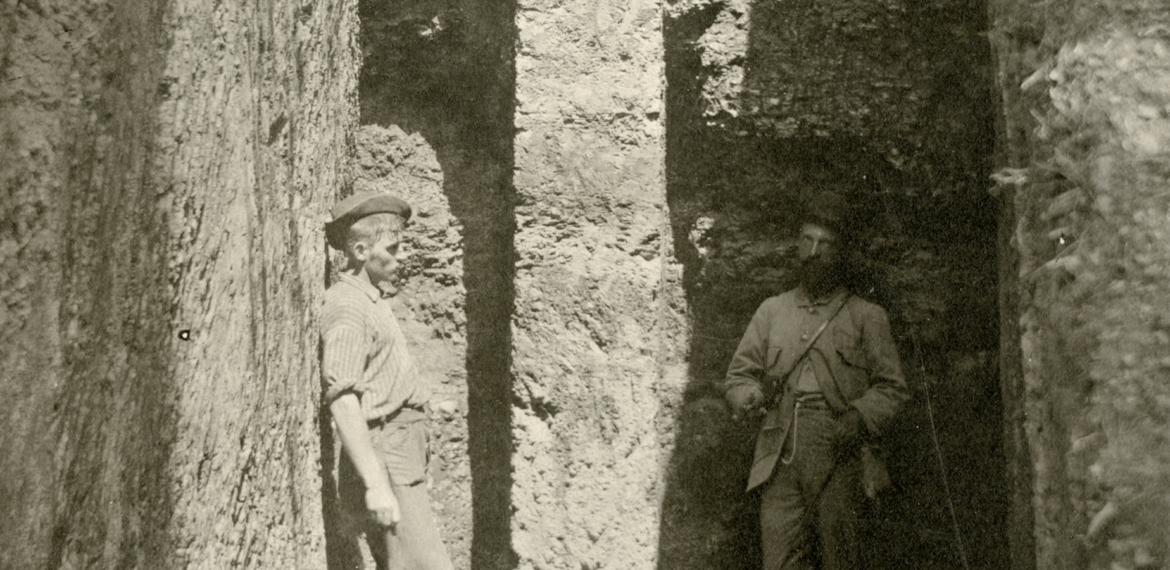
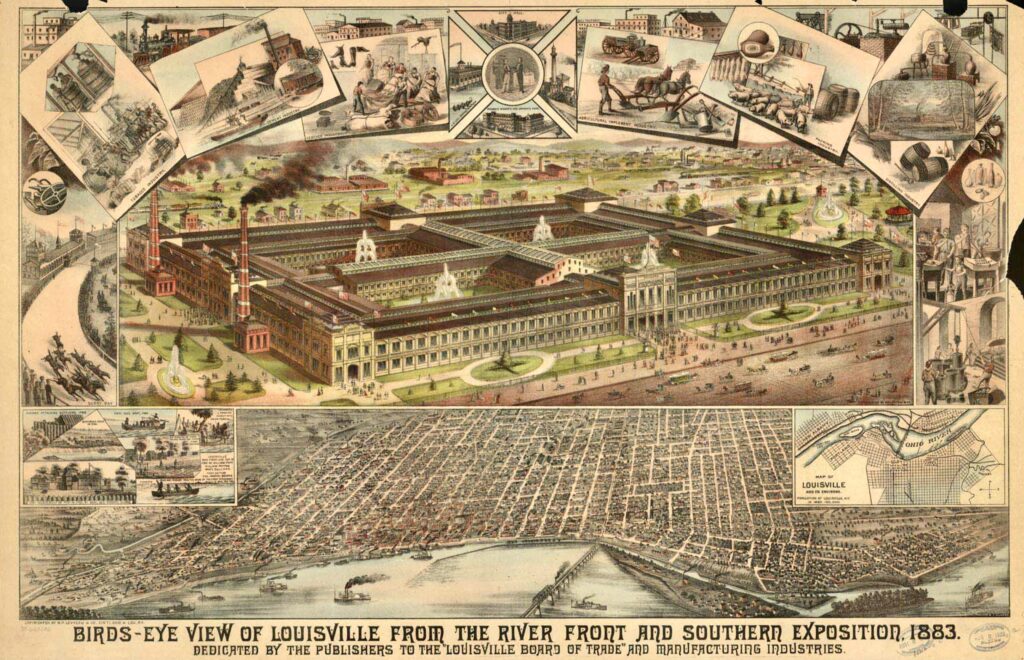
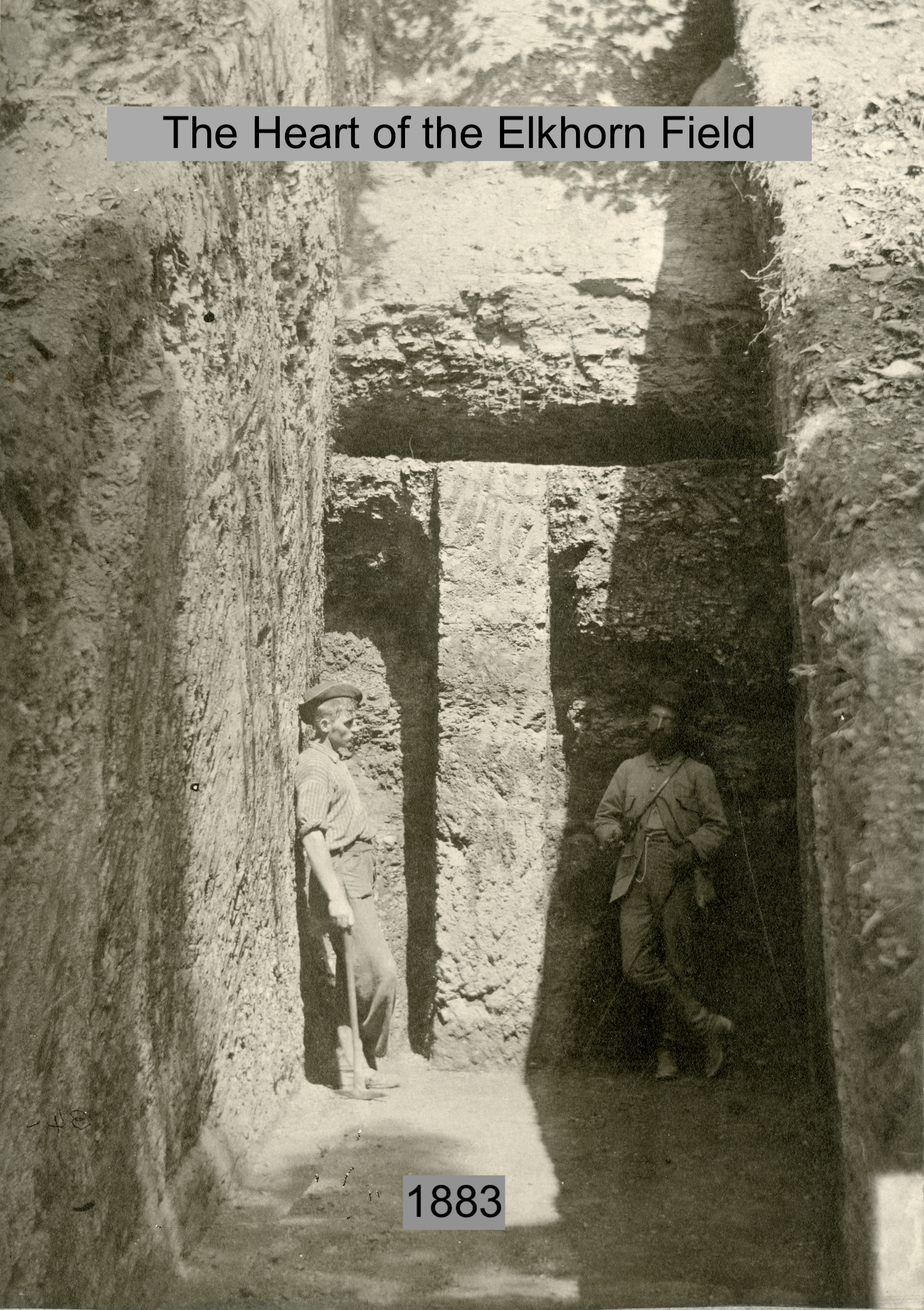
Before any Modern City can be built, there is a massive amount of planning and set up in what’s its ulitmate purpose. In this particular story the planning for Consolidation City, it started 144 years ago when a venture seeking engineer by the name of Richard Broas started exploring the upper reaches of Elkhorn Creek, what was then still located in Pike County, Kentucky, in the year of 1883. At this particular era in mineral exploration Richard Broas was well financed by Simpkins’ from the Northeast. Working at least a couple survey crews or maybe three. While opening up several large coal prospect channels across Upper Kentucky River, Shelby Creek, Beaver Creek and Elkhorn Creek, Broas caught the attention of the cash strapped Kentucky Geological Survey Crew. Their leader was Albert Crandall, Assistant to the Director of KGS. But Richard Broas had the money and man power to explore any coal seam. A .R. Crandall’s crews were limited to an old coal bank open by local residence, those coal banks were far and few in between. Crandall had originally meet Richard Broas earlier in 1881 down on Daniels Creek, a tributary on Johns Creek near the Johnson / Floyd County line. One of the coal openings Crandall and the KGS had assisted Richard Broas on happen to be a rectangular block of coal excavated and ship down river to be presented at the Southern Exposition at Louisville in 1883/84.
–
The first Kentucky Geological Survey headed by then Director David Dale Owens made an observation the Elkhorn Coal Seam in the same geographical area of present day, Eastern portion of Letcher County, noted by only thick coal bloom at the Head of the Kentucky River, Owens would be the first Kentucky employed official to note the footage in elevation height from an a point at Laurel Fork on the Kentucky River, to the center of the state road in Lonesome Cove Gap. The crude method obtaining footages was probably measured earlier concept of a earlier type of hand level.
The Southern Exposition in Louisville is what got National attention, highlighting the Elkhorn Coal Field in 1883. Richard Broas would eventually tie up a massive amount of coal reserves in Letcher and Pike County for the Simpkins’ over the next several years. Richard Broas would ultimately secure 16,000 acres for the Simpkins’.
The year was 1888, a young man with a teacher’s salary started to enter the picture, his name was John CC Mayo. Over the next the 5 years John CC Mayo would a mass several thousands acres of Mineral Reserves that would end up involving a sale of valuable mineral sale to Merritt’s of Minnesota. The Merritt would fail financially because short comings involving John D Rockefellow. John D Rockefeller would take full possession of the Merritt’s valuable Mesabi Iron Range, but for some reason John D Rockefeller was not interested in Merritt’s valuable coal lands purchase from F.A Stratton in Marshall Branch, near the present day Letcher and Pike County line. John CC Mayo was interested, eventually picking up the Merritt’s mineral near the heart of the Elkhorn Coal Field on Sheriff sale.
John CC Mayo would continue in picking up thousands of acres of mineral deeds and options in Eastern Kentucky over the next 7 years. With John CC Mayo financial backing was always max out, he was fortunate enough to land some investors from Sharon, Pennsylvania, which ultimately formed a wonderful friendship and the beginnings of Northern Coal and Coke Company.
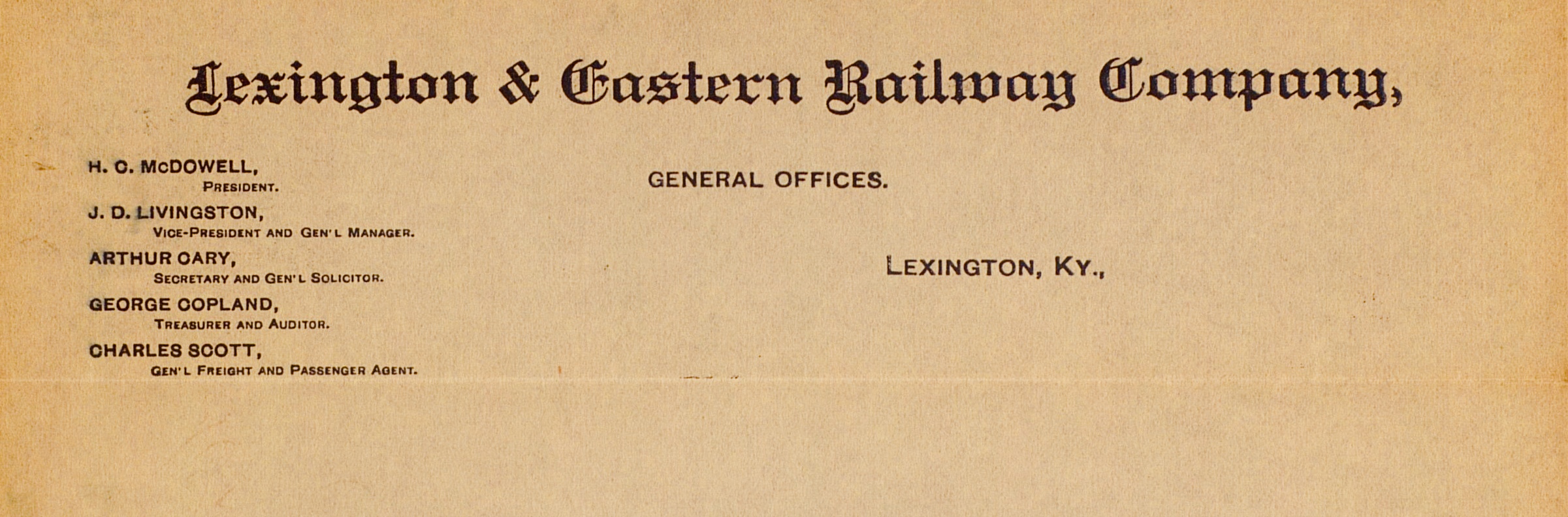
1900 the mineral business was starting to explode regionally around the Triangle of Kentucky, West Virginia and Virginia. L & N Railroad had made its way up the headwaters Powell and Clinch River. N & W Railroad had forged its path the Mouth of Pond Creek and Lexington and Eastern Railroad had landed in Jackson, Kentucky. Kentucky was getting ready to be over run by the thousands of Surveyors, Engineers, well dressed Lawyers, and Bankers from Philly, Boston and New York City. Fancy well spoken Geologist, Assayers and Chemists from Chicago, and Harrisburg, Pennsylvania. Steel man from Pennsylvania and Wisconsin.
In the beginning of the century newspapers are the most popular source of who is selling and who’s buying in the virgin coal fields of Eastern Kentucky. In the summer 1901 the Ohio & Big Sandy Land Corporation, the business arm of Northern Coal and Coke with going around from farm to farm offering at that time more money than most Eastern Kentucky People had every seen in their lifetime. B.F. Johnson and G.B. Vaughn were going all over Shelby Creek, the head of Elkhorn Creek, Left Beaver and Rockhouse Creek, packing the personnel check book John CC Mayo. Usually BF Johnson a commissioned land agent for Mayo, would pay 10% down on a total agreed price, providing their land title checked out alright. The balance was normally paid out in 6 month according to Broad Form Deed Contract.
Even Local Story Tellers and Book Authors were getting in on the action as well, telling of great riches that was being invested in Kentucky, many rumors floating around from the lower reaches across the Virginia State line, in the growing city of Big Stone Gap, most forks still called Mineral City.
Great speculation is being discussed about The Big Sandy Railway, starting soon, dreams of hearing the distant screams of steaming jack hammers chiseling their way up the river from Buchanan to Shelby, a distance of 95.5 miles. The cost and milage estimates were projected by John C C Mayo’s engineer and long time dear friend, J.F. Prindible.
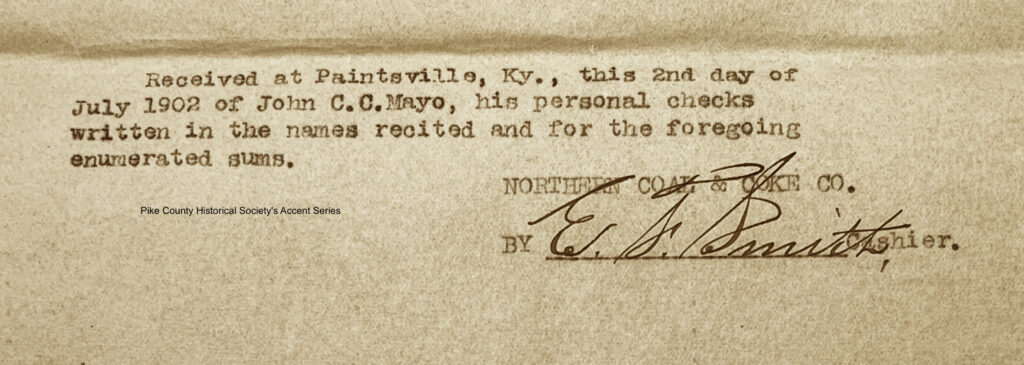
Shown below inter company statement from John C C Mayo’s personal check book to Northern Coal and Coke Company. There are more than 350 check entries from August, 1901 through June, 1902
Building of Consolidation City has been a wonderful research project, plenty of detailed history. Tons of drama had taken place even long before investing partners decided to build Consolidated City. Part of this historical addition to the “Building of Consolidation City” would partially or Indirectly involve the Fox Brothers, and their quest looking for that ultimate piece real estate on the Kentucky, Virginia boarder. The Fox Boys were from Stoney Point, Kentucky, near Paris . They all seem to join together on certain investment ventures, from the middle 1880s to the latter part of the 1890s were not very profitable for the Fox family. Investments into coal and land, and the resultant headaches and monetary responsibilities that such ventures incurred, frayed the nerves of every family member. It was not necessarily bad judgment on their part that caused them the most trouble. More than anything else, it was simply bad luck, and perhaps not enough monetary capital to see them through the difficult times such investments required. The Proctor Coal Company at Red Ash, Kentucky, on the northern edge of Jellico, was one of those investment in 1880s and 1890s. James – John Jr.’s half-brother — was a director and sometimes salesman for the company along with about six others. John worked in the offices, taking care of the paper end of the coal business, and he was young, and it is not unlikely that he felt the importance of his position all out of proportion to his actual status, and although John Jr. did not appear on the company’s letterhead in any capacity, he probably felt responsible for his brother’s business when James was not there, which was often. In any event, trouble, possibly brewing long before John Ir. arrived in Jellico, broke out between himself and the store keeper, Joe Wilson, who, by the way, did appear on the letterhead of the company, which in the pecking order of such things, seemed to give Mr. Wilson a little more status. There were multiple disagreements that started to develop with the top of tier management. In January 1889 the Fox’s next big move to relocate to Big Stone Gap, to cash in on the expected boom in real estate there would come next year, but for the time being, preparations had to be made to make their family’s move more accommodating for every-one, especially their mother and father. So, in the meantime, things went on much the same as they had before in and around Paris. John found himself once more teaching with his father, and hated it, not just for the teaching, but for the sheer boredom of classroom work. He hated it with such a passion, that he was unable to keep his feelings from his brother James, but he apparently was able to conceal those feelings from his father. Just seven years before John Fox Jr. was finishing up his Harvard education with finical assistance from James. Leaving Paris was coming to ahead when John Jr’s. brother Horace had already taken a surveyors job at the Big Stone Gap, John Fox Jr. sent a letter to Horace to tell him to buy a house, the rest of the family was coming during spring. Soon after the Fox brothers got settled in at Big Stone Gap they started taking interest in buying town lots.
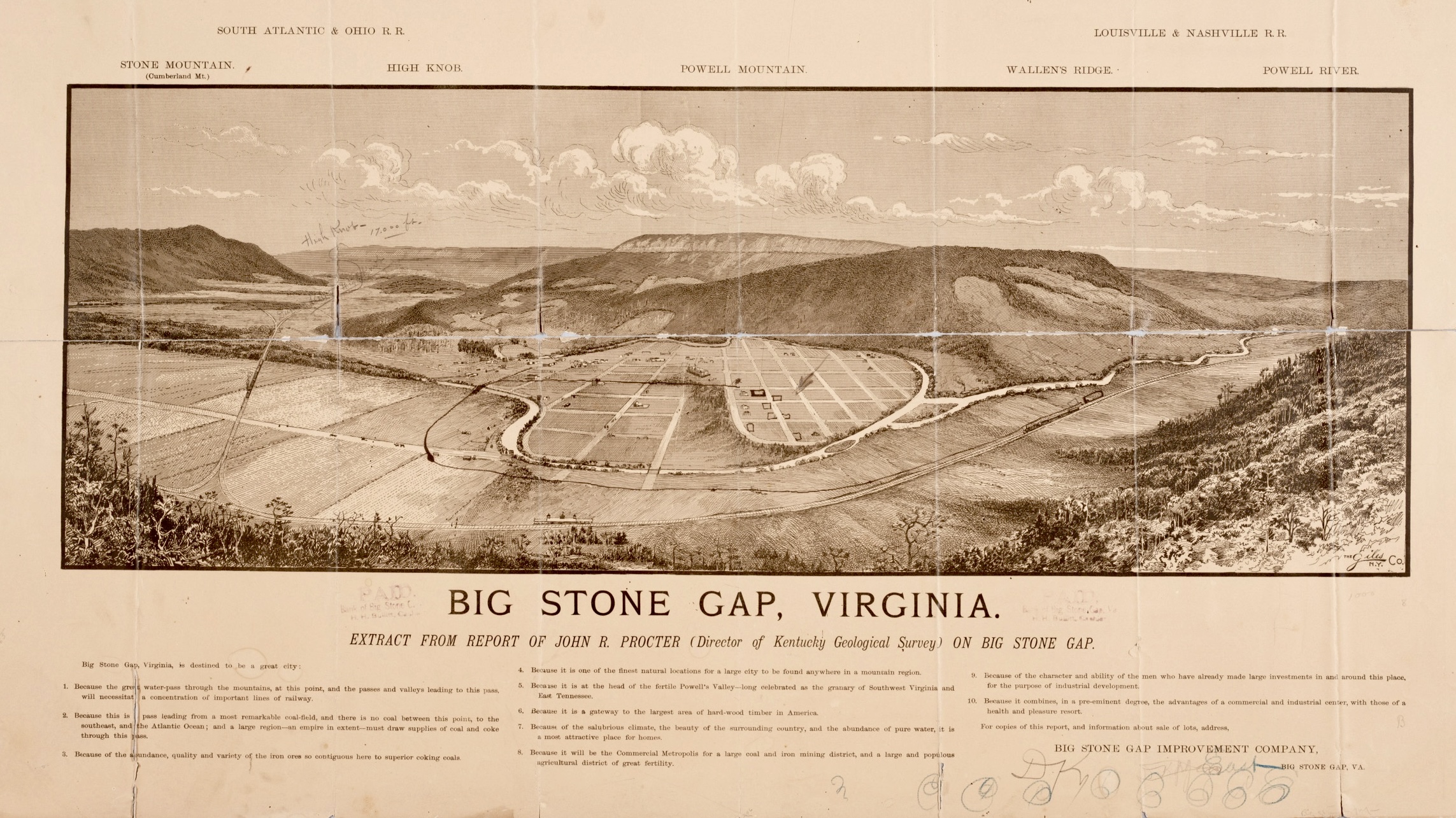
Big Stone Gap, Virginia, then as now, is a community hemmed in by mountains of the steepest sort. John would write incessantly about the isolation of the mountaineer and what that isolation denied those people he wrote about. This time, he neglected to imagine that a town could become as isolated as the people who lived there before the Foxes and all the rest of the newcomers had arrived. He had forgotten, or refused to think about, the first three universal rules of business: location, location and location. The simple truth was that the Gap was not in a good, accessible place. It was hard to get to. Roads were few and primitive. More than once, John would write of seeing mules trapped in the mud holes in the street, and drowning there. The railroads would eventually build to the town, but even that could not negate the fact that Big Stone Gap, despite all the promotional brochures, was simply a mountain town, and was almost certainly predestined for trouble and failure. But they all tried hard to bring civilization – at least their conception of civilization to the Gap, and for a time, they succeeded. With the advent of the first railroad to reach the town, life became somewhat easier for them all.
–
The Fox brothers – James, Horace and John Jr., started looking for a more profitable venture and opened an office in Big Stone Gap, and by the end of January 1890, John was able to write to James to tell him that there are lots for sale within the city limits, when they found one lots were selling for as much as $2,500 each, and the Fox’s made their very first town lot purchase, they turned it around overnight and cleared a $250 on one lot.
The Fox Boys would struggle after their first profitable sale trying turn a profit in Big Stone Gap, for the most part the city lots they bought in Big Stone were purchased at or near market price. when the real estate market dip, they struggled even to pay interest. Seldomly we find the Fox Gang venturing in Kentucky trying to turn dollar. John Fox Jr. had a gift for writing and really enjoyed the outdoors, fishing was his favorite pass time.
John Fox Jr’s first short story “Mountain Europa”was released September 15, 1892
1900: Published Crittenden, his novel based on the Spanish-American War. Published by Scribner’s who had become John Jr’s publisher after his leaving Harper’s.1900: Publishes “Down the Kentucky on a Raft” for Scribner’s magazine for June, “Man Hunting in the Pound” for Outing magazine for July and “To the Breaks of the Sandy” for Scribner’s magazine for September. While John Fox Jr. was serving as War Corespondent in Cuba is most likely where he met Fess Whitaker and Morgan T Reynolds from Letcher County while fighting with Teddy Roosevelt.
1901: Wrote “The Southern Mountaineer” for Scribner’s magazine for April-May,
“The Hanging of Talton Hall” for Outing magazine for October, and “Christmas Eve on Lonesome” for Ladies Home Journal for December. John Fox was even on Guard duty during Talt Hall’s murder trial at Wise, Va.
1901: Published Bluegrass and Rhododendron which included “The Southern Mountaineer,” “The Kentucky Mountaineer,” “Down the Kentucky on a Raft,” “After Br’er Rabbit in the Bluegrass,
” “Through the Bad Bend,” “Fox-Hunting in Kentucky,” “To the Breaks of Sandy,” “Br’er Coon in Ole Kentucky,” “Civilizing the Cumberland,” “Man Hunting in the Pound.” “Christmas Eve on Lonesome” was not included in this volume.
John Fox Jr. dedicates his book, “Blue Grass and Rhododendron,” to “The First Three Captains of The Guard.” They were Joshua Fry Bullitt (Jr.)., Henry Clay McDowell and the brother of John Fox, Horace Ethelbert Fox. The Blue Grass and Rhododendron is written from part of a collection published in 1900 and several stories are base in conjunction withe Pine / Cumberland Mountain territory from Pound Gap down to the Breaks. fishing and enjoying the outdoors with Joshua Fry Bullitt, Henry Clay McDowell and William is John fox Jr. brother, Horace Fox. Fox also writes about the narrow shale flats trail just wide enough for wagon. This would be the same narrow path that Kentucky Route 80 runs high above a couple hundred feet above the Russell River today.
The Fox brothers were men that came to the area to enrich themselves with coal properties around the vast natural resources of Wise County and Kentucky through out Letcher, Knott and Pike County. John Fox Jr. and his family wanted to be heavily invested in the coal, timber and iron business in Virginia and Kentucky.
His brother, Horace Ethelbert Fox and John Fox Jr. himself were members of The Guard which was a self appointed police force consisting of those men who came to Kentucky to exploit its resources for personal gain. With all bases covered including among them, lawyers, judges, engineers, John William Fox Jr. a Harvard graduate and a writer could manipulate the media, I’d say they had it all tied up in a pretty little bow. One has to ponder why a lawyer with L & N Railroad Stock, plus representing the coal companies had to establish a self appointed police force.
While living at Big Stone Gap, Wise Co VA, John Fox Jr. along with two dozen or more other what he called “college bred men” engaged in timber and mining. He took part in organizing a vigilante or self imposed police force which John Fox sometimes called a “volunteer police-guard” in that area. John Fox Jr. told a reporter in 1900 that “I have known members of the force to protect a Negro from a mob while he was on territory in which they were sworn to preserve the peace,” and join the mob in lynching him after he was taken beyond our jurisdiction where the oath had no binding effect.” In his articles and books, he often portrayed himself and his cohorts as superior to the locals and took much credit for “civilizing” the area with “The Guard”. The Guard provided security over Talton Hall during trial and waiting for him to be hanged at Wise, Virginia.
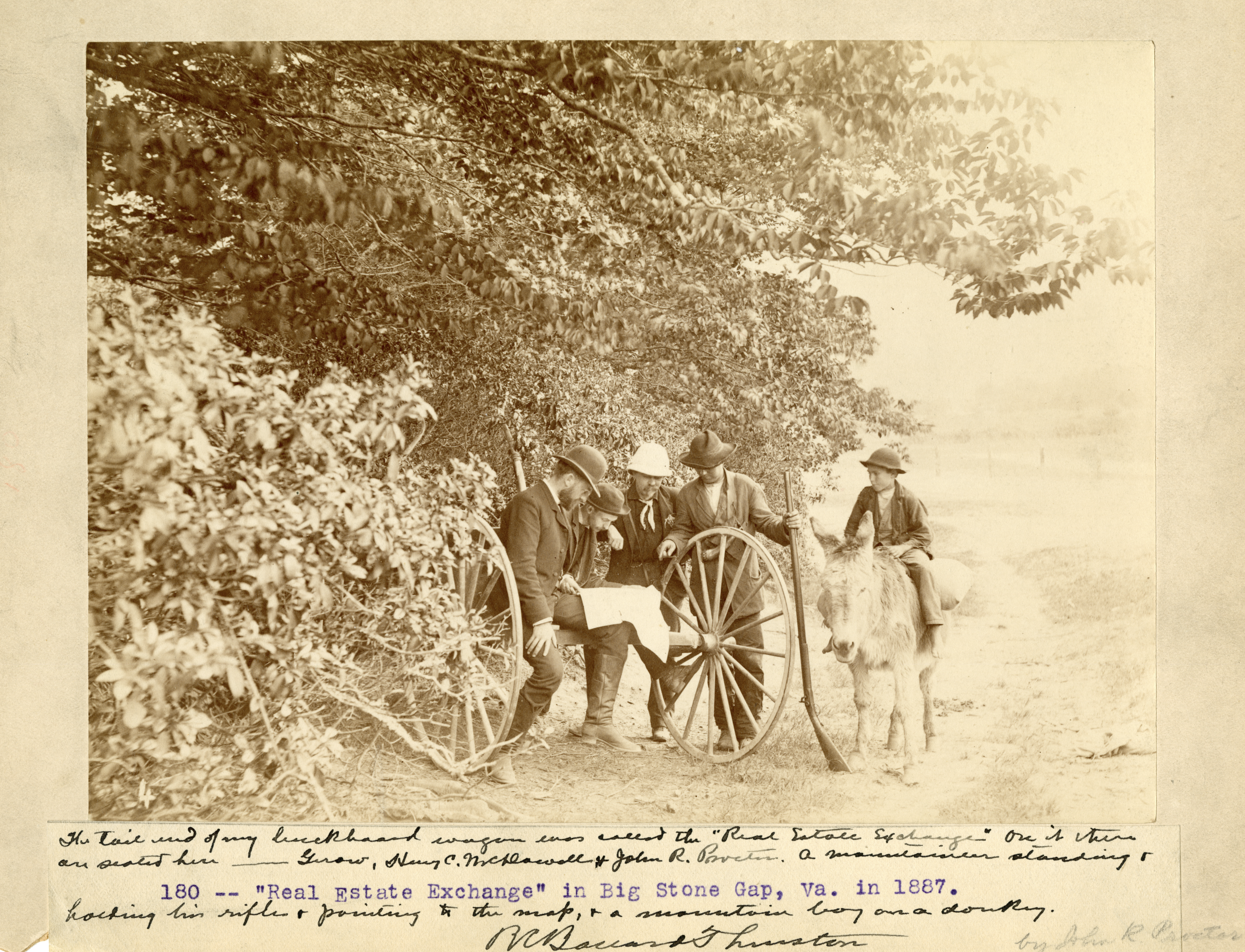
John Fox, Jr. was one of many guests at Mayo Mansion and while he visited there he worked on one or more of his manuscripts. Fox was gearing up for more exciting novels and short stories about life in the Kentucky Mountains and Bluegrass area, including The Little Shepherd of Kingdom Come and The Trail of the Lonesome Pine. This was noted in the National Registry of Historical Places. The Fox boys were present during several photo op sessions with John CC Mayo.

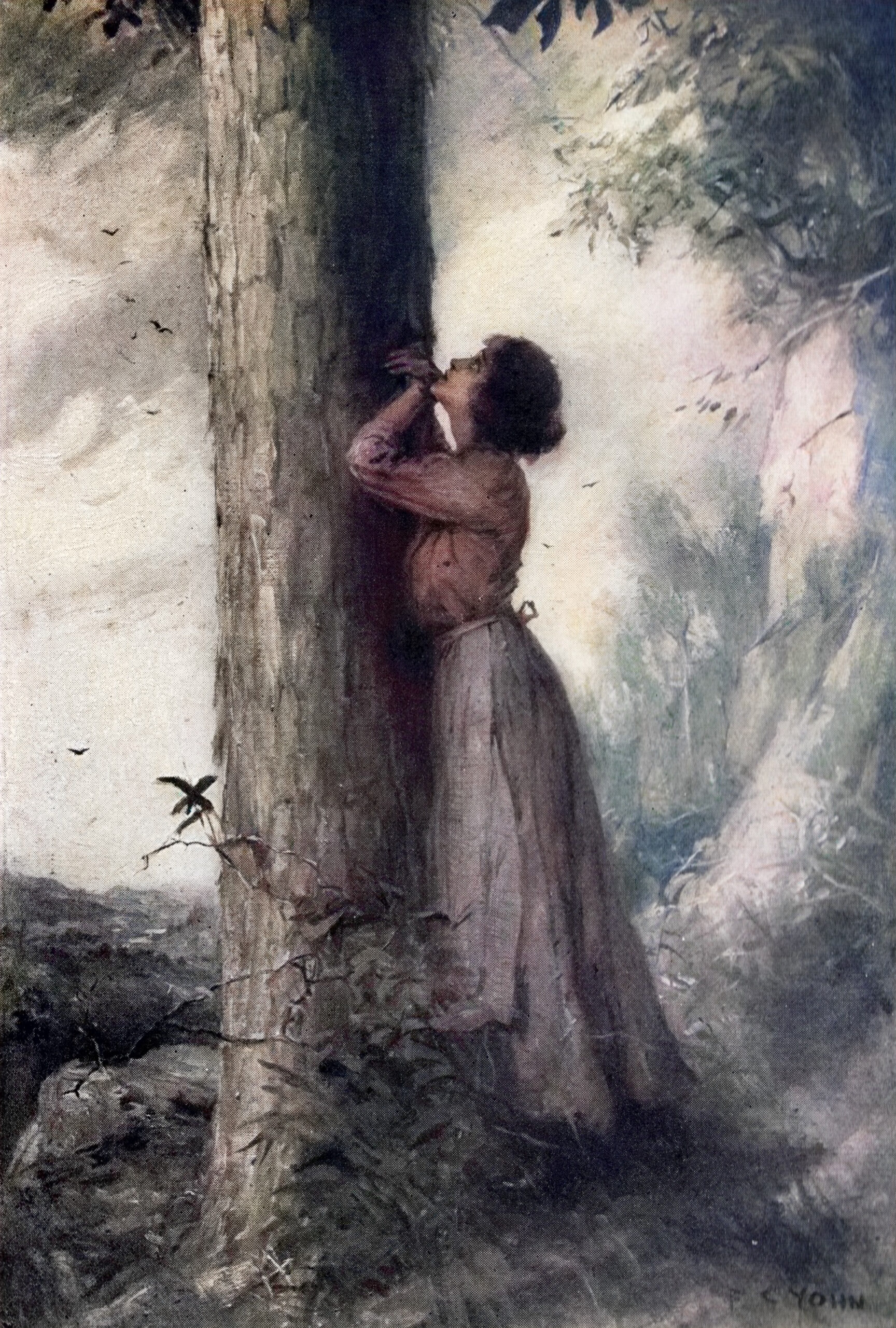
Who are the real life characters in The Trail of the Lonesome Pine
The Trail of the Lonesome Pine was peopled with characters from real life, as was the best of his writings before 1908. Not that they were all living, breathing people on whom his characters had been based — though many were – but they were believable enough most of the time, and to the readers of Lonesome Pine they became real, and made the book a success.
The people and places, and the time of Lonesome Pine, provide perhaps a clearer picture of what life was like for the Fox family after their move to the Gap in 1890. John had written about their misadventures before – several times, in fact – but it is in the fictionalization of those people and times that seems most real. The story of lack Hale and June Tolliver, the Gap and a huge towering pine tree, that god-like, was given power of protection over the star-crossed lovers, captured the hearts and imagination of readers, and quickly made the story a favorite and again placed the name of John Fox, Ir, on the best-seller lists.
Much of the novel’s unromantic content had been previously published in Bluegrass and Rhododendron (1901). “The Red Fox of the Mountains, “The Hanging of Talton Hall,” and “Civilizing the Cumberland” were all used, sometimes transcribed directly into the storyline.
Strangely enough, as popular as the human characters of the novel were, it was the third principal character of the book that garnered as much attention as Jack Hale and June Tolliver and the rest including Devil Judd Tolliver is the Winchester caring feudsman Devil John W Wright . Even thought Talton Hall was hung at the end of a rope at Wise County, Virginia September 29, 1892 he was very much part of this story, he was portrayed as Bad Rufe Tolliver. Talton Hall was a very close friend to Devil John W Wright. The Gap above Lonesome Cove, is known as today Pound Gap. The Red Fox character living in the Gap was Marshall Benton Taylor, enemy of Devil John W Wright, was hung October 27, 1893 for the murder of Ira Mullins, his wife and gang at Killing Rock, just past the Gap on the Virginia side. both Taylor and Hall was guarded by the “Guard” John Fox Jr. and brothers.
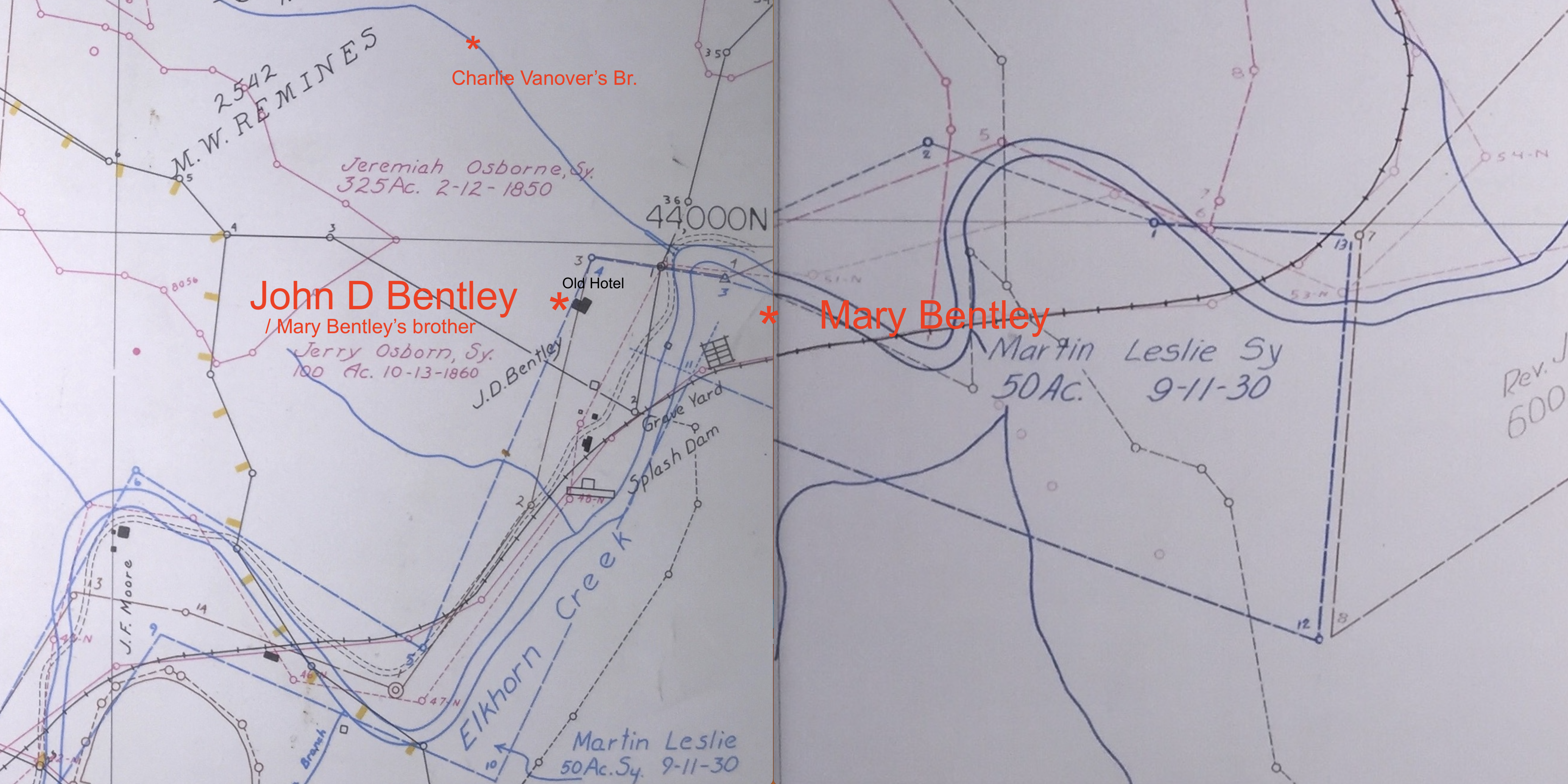
Even the hotel that had been spoken about in “The Trail of the Lonesome Pine was the Old Hotel of Jerry Osborne, later owned by John D Bentley.
The Brick Plant, Boarding House was written into The Trail of the Lonesome Pine because John Fox Jr. saw first hand Survey Crews with Northern Coal and Coke were already laying out engineered plats for Consolidation City. John Fox Jr.: John Fox writes about how Lonesome Cove is cut off from communication from the outside civilization.
Now let us try to out figure out who are the characters Jack Hale and June Tolliver. Several writers over the years have had their opinions on who were the real life Jack Hale and Devil Judd Tolliver daughter June. RC Ballard Thruston in a couple paragraphs written in the Towering Pine is quoted knowing the characters Jack Hale and June Tolliver. In a interview with Ballard states I had purchased for the Interstate Investment Company, of Louisville, Ky., a lot of mountain lands along both sides of the Kentucky and Virginia state line in Lee and Wise Counties, Virginia, and Harlan County, Kentucky. At a certain time I employed Mr. James M. Hodge, born in Plymouth, Mass., a graduate of Boston Tech, a member of the Kentucky Geological Survey for some years and afterward a resident of Big Stone Gap, Virginia, to do certain prospecting in the coal veins on our property. There was a little girl, the daughter of a man named Morris, living on our property. Hodge thought that she was a very bright girl and wanted to educate her. She became the character, June, in the work, but the mountaineers got it in their heads that Hodge was educating her to become his wife, and he had to abandon completing her education. Fox, however, did not stop the story there but carried it on through.
“The character Hale was a composite one, and almost every incident that Fox mentions in this book was an actual incident that occurred in the life of one of the three persons whose characters and experiences went to make up the character Hale in that work.” They were Henry C. McDowell, Jr., late Judge of the US District Court for the Southern District of Virginia; Mr. James M. Hodge and myself.
“The name of the book was obtained from a pine tree that stood in the yard of a man named Moore, the only such tree between Pine Mountain on the north and Cumberland Mountain on the south in that section.”
Mr Moore’s daughter married a man named W. S. Palmer, who came to the Gap in Boom days. and later was the agent of the company I represented, looking after our lands and possessions and paying taxes. The number of people who went to his home to see that ‘lonesome pine’ was annoying, so much so that Mr.
Palmer had the pine cut down. I think Mr. Palmer is still living, and living in the old Moore house near Keokee, Virginia. He and I are probably the only two survivors who were at all active in the boom days in Big Stone Gap territory.
On a fishing trip John Fox Jr. become very ill, quickly develops into pneumonia. taken back to Big Stone Gap were he died July 8, 1919. an article written in the Freeling, Virginia Newspaper. The death of John Fox Jr. , which occurred at his home at Big Stone Gap, Virginia, during the past week calls to mind vividly the sense and characters of his stories, some odd which along to , virtually,, to the past generation, are, therefore, beginning to be forgotten or at least, are not so well known to the younger novel readers as. of his earlier works.
The best known story from the pen of the noted author in this section (his home) “The Trail of the Lonesome Pine”, for the reason that the scenes are laid out here, and the characters for the most part drawn from real personage, while the others lack stimulus. The other scenes of this story is laid out on big Elkhorn Creek, just across the Virginia, Kentucky border, or Jack Hale meets June Tolliver, then a mere lass and her bare feet, also her father, David Judd Tolliver. The original of Devil Judd is known as to be John Wright, in-by on days referred to as “Devil John.” He who designates by the chief executive of the state of Kentucky to handle the Klu-Klux-Klan situation, which threatens the welfare of Letcher County in 1900.
From the manner in which he dealt with the laws element, he was given this name. As to June Tolliver, she is somewhat mythical, so far as being the daughter of the regional devil Judd, he live in only with one daughter known as Myrtle right. Scarcely had existence been thrust upon her when the events from which material for the story was drawn transpired, she, however, likes to claim the distinction of being the original June Tolliver. Hall, the desperado who was executed at Wise, Virginia, in 1892 for the murder of policeman Hylton at the city of Norton, was the original bad Rufe Tolliver.
The old log house Devil Judd lived is now the site of present day Jenkins, the most noted mining town in all the area covered by the Elkhorn Coalfield. The scene of the story alternate between big Elkhorn Creek and the Gap. Some past comments think storyline is talking about Big Stone Gap, but no the main scenery portrays Lonesome Cove and “The Gap” known as Pound Gap today. Doubtless many may have read the story and have the book tucked away, need to draw it from it’s resting in place, dust away the particles of years from its cover and refresh their faded memories of the imaginary scenes along the Trail of the Lonesome Pine, since the author has passed to that born from whence voyager ever returns.
Almost immediately any readers that begins searching for “the” lonesome pine that figured prominently in the story.
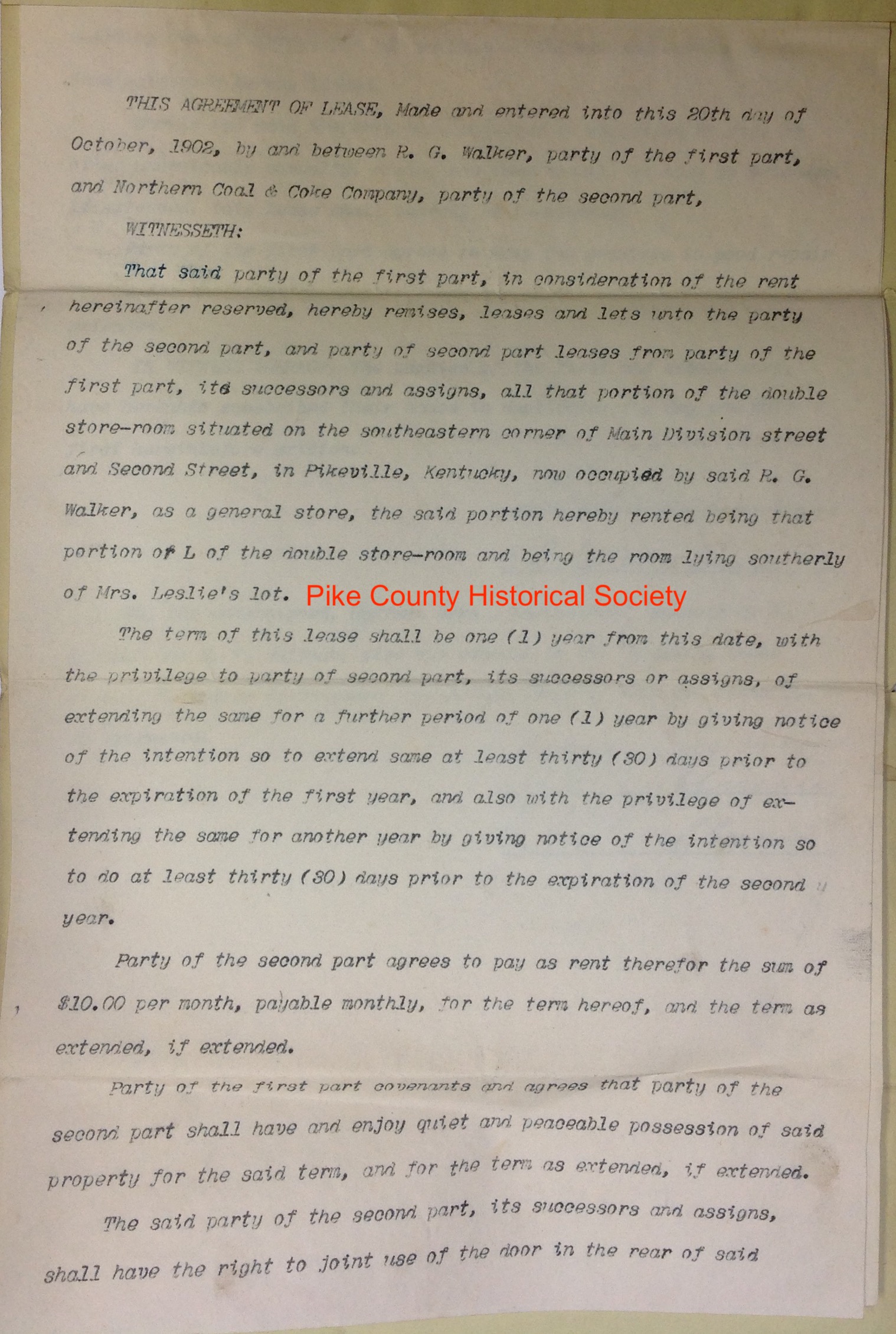
Northern Coal & Coke Company undersigned lease from WT & NT Huffman / Huffman Brothers October 20, 1902, Pikeville Central Office
–
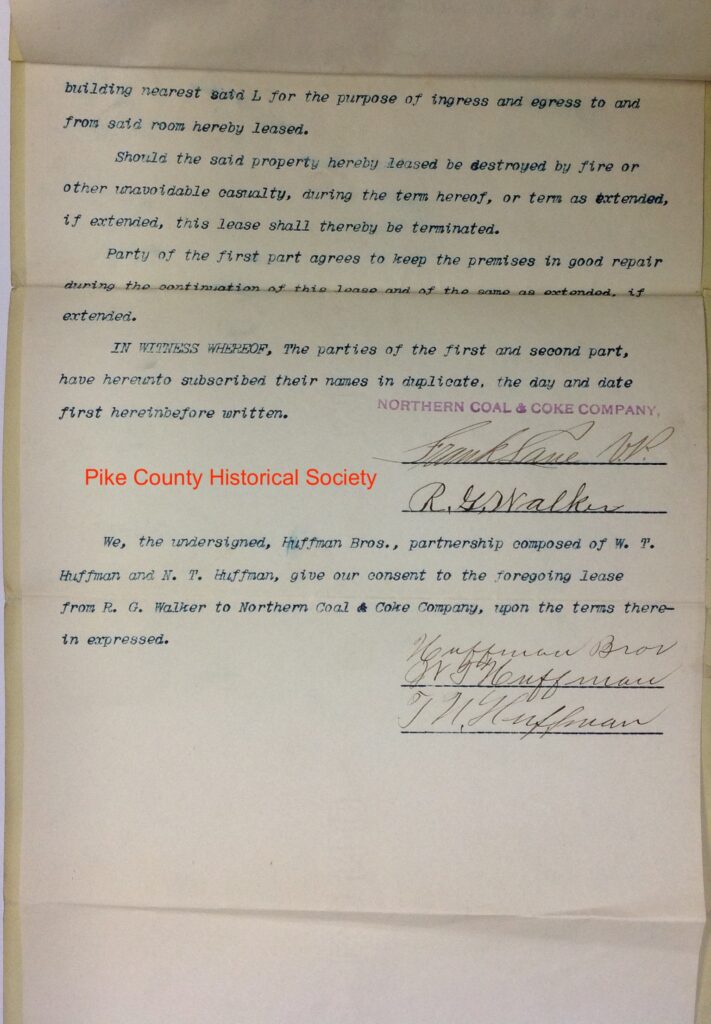
March 6, 1903 Pikeville Independent Newspaper
The Northern Coal & Coke Co., is making extensive improvements in their ground floor offices in the Huffman Block. New floors and large rear windows have been put in. The wood work has been repainted and the walls beautifully papered. In the rear a large two-story fire-proof brick vault has been constructed. In it will be stored the immensely valuable maps, plates and other papers of the Company. The first floor will be occupied by the Engineering and Drafting Department, in charge one of the personal was Chief Engineer Burlingame. The second floor will contain the general offices as at present.
–
April 28, 1903
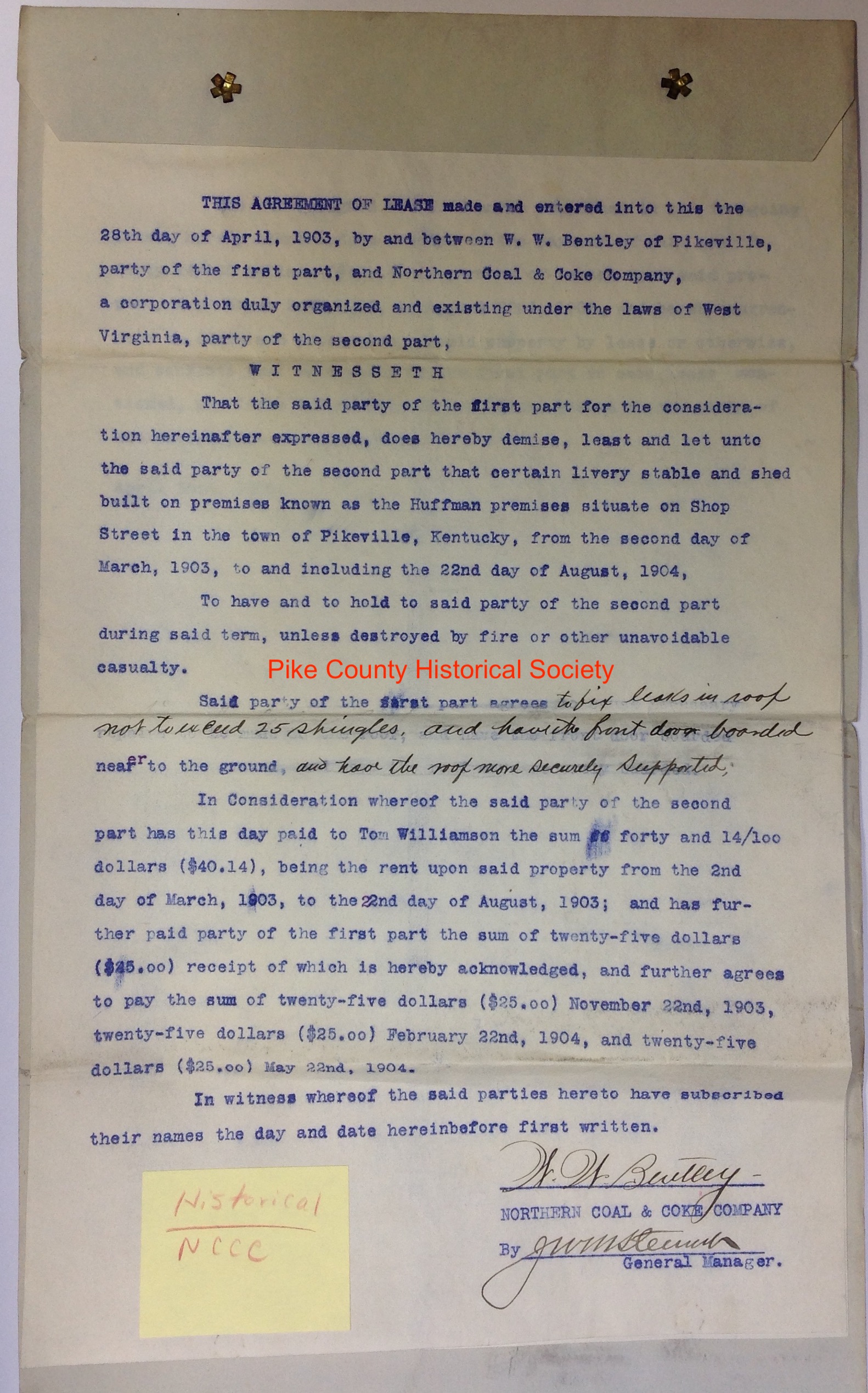
The Big Sandy News, September 4, 1903 reports J.J. Johnson heads up abstracting department of the Northern Coal and Coke Company in Pikeville, Kentucky. He is assisted by D.W. Gardner, Charles Atkinson and John F. Prater of Salyersville, Kentucky.
June 1, 1906
The Northern Coal & Coke Company, a West Virginia Corporation, Capital Stock $2,500,000, fully paid, with no water, owns 270,000 acres of land in eastern Kentucky by deeds for each several tracts averaging about 100 acres to the tract. Of this amount probably 25,000 acres is in fee; the remainder is in mineral, being deeds conveying the coal and all tother minerals, with extensive privileges, railroad rights of way, use of timber, mining outfit, and everything necessary to mine, ship and coke the coal. The actual capital stock June 1, 1906, cash value of Assets was $2,504,122, 63. This included stock in Sandy Valley & Elkhorn Railway Company, Interstate Telephone & Telegraph Company and Pikeville Ice Company.
Of this 270,000 acres about 100,000 to 125,000 are situated on the head waters of Beaver Creek, Shelby Creek and Elkhorn Creek which are tributaries of the Big Sandy River and the head waters of the north fork of the Kentucky River, including Boone, Thornton, Millstone, Rockhouse and the main head of the river in the Counties of Pike, Floyd, Knott and Letcher. The remainder of the 270,000 acres are either in some of the counties above named or in other counties. While these 100,000 to 125,000 acres are not in one absolve compact body, a person could walk over 90% of it without getting off the Land owned by the Company. Upon this 100,000 to 125,000 acres, which I will designate as the Elkhorn Field is situated what 1st known as The Elkhorn Coke and Coal Bed No. 3, underneath which are the veins l and 2, each about four feet thick on which are hard splint coals and not coking coal.
These two beds, Nos. 1 and 2 are persistent over the entire field and cover a much larger area than No. 3, but Nos. 1 and 2 do not always exist at the same place, but No. 3, or the coking seam, is persistent over the entire field.
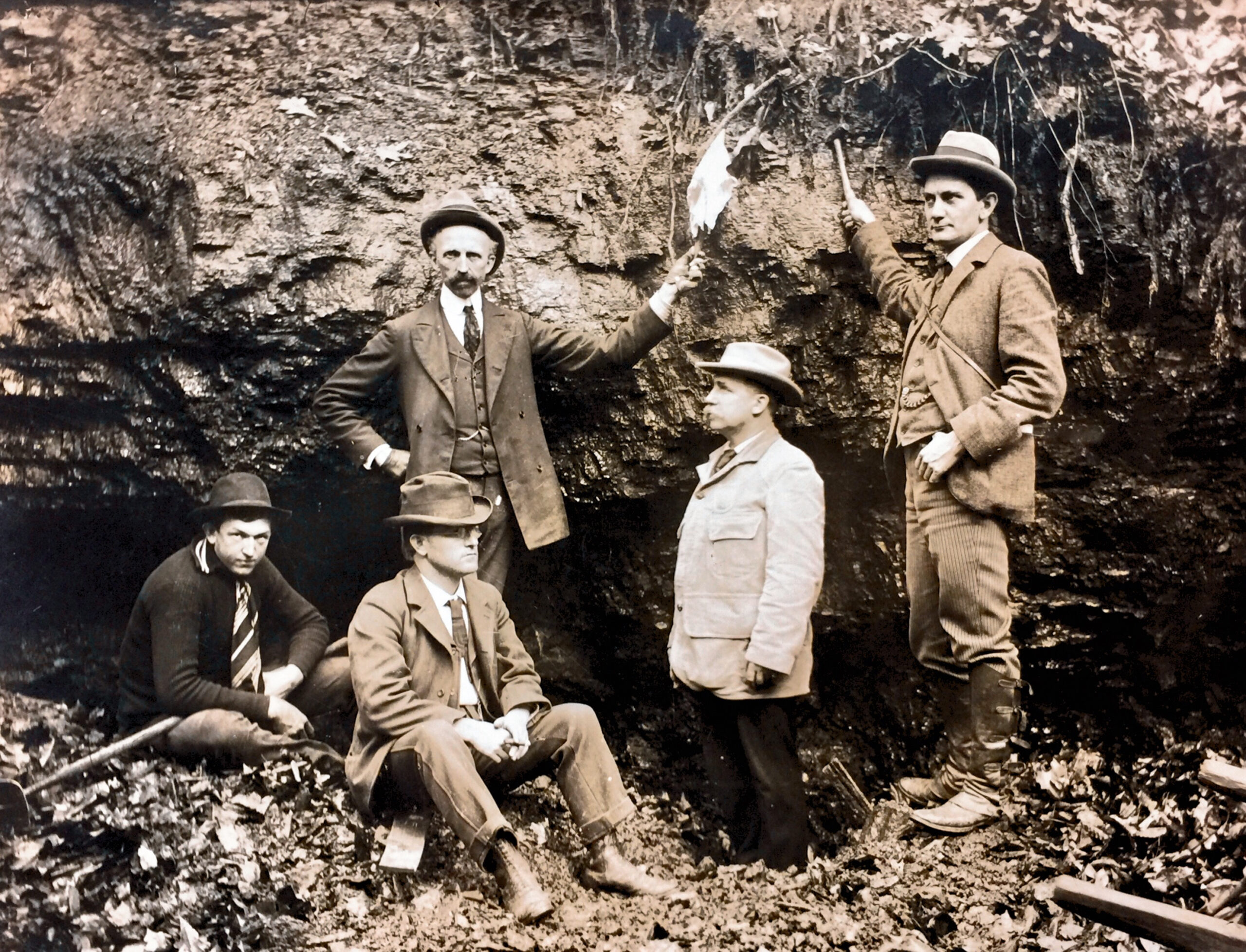
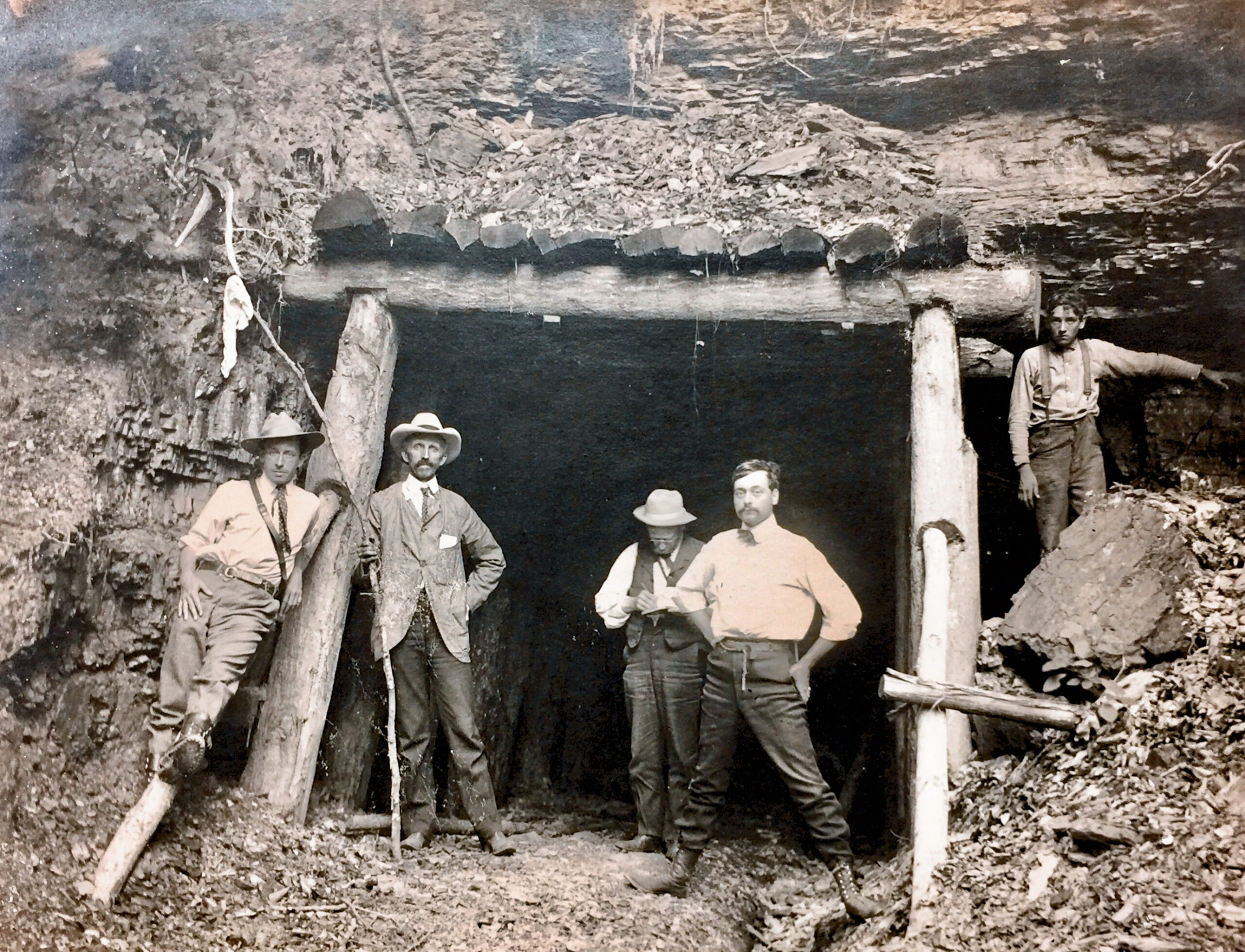
This photo was taken on Camp Branch on Rockhouse Creek, the three men standing from left to right: Holding white cloth James Fox Sr., Anderson Hays & James Fox Jr., the year 1903. James Fox is the half-brother to John Fox Jr., Camp Branch was very much part of the Elkhorn Field.
–
The Doc Mason Farm sold to Northern Coal & Coke
A story written in the Mt. Sterling’s Richmond Climax. Northern Coal & Coke Co. has just purchased the Doc Mason Farm on Camp Creek, Letcher County. October 1905. The property contains several thousand acres and is on the Lexington & Eastern Railway’s Future extension plans. It is the purpose of the company to build several coke ovens and open new mines. A few years ago these lands were offered for sale at $2 per acre. This purchase gives the Northern Co. the cream of the famous Elkhorn Coal Fields.
In August 1906 The Big Sandy News reported Col. James (Jim) W Fox Sr. having made a quiet tour of the Upper Sandy in search of the facts pertaining to the natural resources of the country.
August 17, 1906 James W. Fox a brother to John Fox Jr was making his tour of the Upper Sandy Valley searching for facts on its coal resources has finally returned home. Big Stone Post
The Elkhorn Field No. 3, the Coal Seam Bed is from 4 feet 6 inches to 9 feet thick, the thickest part being at the extreme heads of the various streams above mentioned, decreasing in thickness as you recede from the height of land. This variation in thickness is not irregular but is gradual from the thickest to the thinest. The Northern Coal & Coke Company owns inside of this area, including as above stated, from 100,000 to 125,000 acres, about 80% of the entire territory and can make arrangements to acquire practically all of the remainder if so desired. To develop this 100,000 acres of land would require the building of about 30 miles of railroad from the mouth of Shelby Creek at the Big Sandy branch of the Chesapeake and Ohio, up Shelby to its head through a low gap requiring no tunnel to Elkhorn Creek about half way between the head and the mouth of the Elkhorn; thence up the Elkhorn to its very head, which is the heart of the field. But it would require two tunnels on Shelby Creek
The present stockholders of the Northern Coal & Coke Company desire to develop this 100,000 acres. To accomplish that purpose they propose the plan shown in details on the accompanying papers.
Accompanying this statement, in addition to said papers, are also several reports showing the character of the coal, cost of mining, etc. In reading these reports eliminate all property therein referred to as the Peter Creek property, consisting originally of about 45,000 acres which the Company two years ago sold and does not now own, and by this sale reduced its acreage to the 270,000. Is to assist the financing of this proposition, the remaining holdings of the Northern Coal & Coke Company, to wit: about 170,000 acres are to be used; that is to say, The Northern Coal & Coke Co. is to underwrite part of the preferred stock which is to be sold to raise the $1,350,000 referred to in this statement.
All this 270,000 acres, and of course this including the 100,000 acres, have been purchased, paid for by and deeded to the Northern Coal & Coke Company and upon which there is no lien whatsoever nor bond issue of any kind. Because of question as to the title to certain interests in certain tracts there may have been some of the considerations with-held, the total amount of which, however with respect to this 100,000 acres will not exceed $100,000 for extra considerations.
The above statement is made to be presented solely to Picands, Mather & Company, of Cleveland, Ohio, for the purpose of ascertaining whether or not they would desire to become interesting in the financing of the proposition along the lines indicated in the accompanying papers, or to become associated with the new company in regard to selling in regards to selling the output in the territory or territories to be later laid open.
Over the next three years Northern Coal & Coke Company would pickup addition lands, most of future lands that would come through stock and mineral swaps involving John CC Mayo taking on many different investing partners, involving numerous Mineral Holding Companies that John CC Mayo intently held from Northern Coal & Coke Co. (Corporate Records)
Thursday, June 24, 1909 John Fox Jr. is shown resting at the Mountain View Hotel in Whitesburg on Monday night. Heading to the direction of Kingdom Come. Preparing to write another book.
Call for Stockholders Meeting
Northern Coal & Coke Company.
November 10, 1909
And the following named persons by proxy, to-wit: John CC Mayo 155 shares. E.O. Young 10 shares.
Proxy J.N. Camden, J,W,M, Stewart
Total in person and present by proxy- 1945 1/2 shares.
Thereupon the President announced that more than a quorum being present, the meeting was ready for the transaction of business.
The President directed the Secretary to read the call for this meeting and notice thereof sent to the stockholders, which the Secretary accordingly did in words and figures as follows:
Meeting of the Shareholders of Northern Coal & Coke Company is hereby called, and the Secretary of the Company is here by directed to issue notice therefor, to be held at the office of the Fairmont Coal Company, at No. 1 Broadway, in the City, County and State of New York, on Monday the 22nd day of November, 1909, at 12 o’clock noon. The meeting is called for the purpose to elect Board of Directors, and the purpose of transacting any or all business that might come before and be acted upon the directors in regular annual session duly called and held; and especially to consider and act upon proposition to consolidate its holdings of the Beaver Creek and adjacent fields with the holdings of the Beaver Creek Coal & Coke Company in the same territory, conveying same to a new company to be known as The Beaver Creek Consolidated Coal Company; the new Company to issue stock therefor, or otherwise arrange as to consideration as may be agreed upon by stockholders; and also to consider promotion to exchange with Beaver Creek Coal & Coke Company certain properties of the two Companies on the waters of Beaver Creek and adjacent territories , but not within the territory, but not within territory to be controlled by beaver Creek Consolidated Coal Company.
Board of Directors Meeting Northern Coal and Coke Company
New York – November 22, 1909
At a meeting of the Board of Directors of the Northern Coal & Coke Company held at the office of the Fairmont coal company at No. I Broadway, in the City, County and State of New York on Monday, the 22nd day of November, 1909 at twelve o’clock noon, there were present:
C.W. Watson, President presiding.
J.W.M.Stewart, Secretary.
and the Directors hereinafter named.
Thereupon the President directed the Secretary to read the call of this directors meeting and notice thereof, which was accordingly done, and which call and notice are in words and figures following, to-wit:
Call for Directors Meeting
Northern Coal & Coke Company
Meeting of the Board of Directors of Northern Coal & Coke Company is hereby called, and the Secretary of the Company is here by directed to issue notice therefor, to be held at the office of the Fairmont Coal Company, at No. 1 Broadway, in the City, County and State of New York, on Monday the 22nd day of November, 1909, at 12 o’clock noon. the meeting is called for the purpose to elect officers, and the purpose of transacting any or all business that might come before and be acted upon the directors in regular annual session duly called and held; and especially to consider and act upon proposition to consolidate its holdings of the Beaver Creek and adjacent fields with the holdings of the Beaver Creek Coal & Coke Company in the same territory, conveying same to a new company to be known as The Beaver Creek Consolidated Coal Company; the new Company to issue stock therefor, or otherwise arrange as to consideration as may be agreed upon by stockholders; and also to consider promotion to exchange with Beaver Creek Coal & Coke Company certain properties of the two Companies on the waters of Beaver Creek and adjacent territories , but not within the territory, but not within territory to be controlled by Beaver Creek Consolidated Coal Company.
November 10th, 1909
(Signed) C.W.Watson. President
Notice Meeting Board of Directors
Northern Coal Company
To the Board of Directors of the Northern Coal & Coke Company:
By direction of the President, a meeting of the directors of this Company is called and will be held at the office of the Fairmont Coal Company, at No. 1 Broadway, in the city, County and State of New York,
on Monday, the 22nd day of November, 1909 at 12 o’clock.
The meeting is called for the purpose of electing officers and for the purpose of transacting any and all business that might come before and be acted upon by the directors in regular annual session duly called and held; and especially to consider and act upon proposition to consolidate its holdings in certain parts of the Beaver Creek and adjacent fields with the holdings of the Beaver Creek Coal & Coke Company in the same territory, by conveying same to a new company to be mown as the Beaver Creek Consolidated Coal Company; the new cOmpany to issue stock therefor, or otherwise arrange as to consideration as may be agreed upon by the stockholders; and also to consider proposition to exchange with the Beaver Creek coal & Coke Company certain properties of the two Companies on the waters of Beaver Creek and adjacent territory, but not within the territory to be controlled by the Beaver Creek Consolidated Coal Company•
Ashland, Kentucky. November 10, 1909.
(Signed) J.W.M.Stewart. Secretary
That Board meeting did occur at Fairmont Coal Companies office on Broad Street on the 22nd day of November, reads as follows .
The Secretary thereupon presented this meeting copy of action of the stockholders of this Company this day held with respect to election of a Board of Directors, showing the election of C.W. Watson, J.N.Camden, S.D. Camden, F.H.Buhl, H.Crawford Black, George A. Baird, J.H. Wheelwright, R.R.Govin, and John. C. C. Mayo as directors hereafter.
Whereupon the President directed the Secretary to call the roll to ascertain who were present, and the roll being duly called, the secretary announced that the following named directors were present, viz:
C.W. Watson
F. H. Buhl
J.N. Camden
S. D. Camden
R. R. Colin
Absent-
H. Crawford Black
J.H. Wheelwright
John. C. C. Mayo
George A. Baird.
Thereupon the President announced that a quorum was present, and the meeting ready for the transaction of business. The President also announced that it was in order to elect officers of the Company.
Thereupon an election for President was held, and Watson received five votes, being the vote of all the directors present, and was thereupon duly declared elected as President of this company and of the Board of Directors thereof, to serve as such the ensuing year and until the due election and qualification of his successor.
It was thereupon announced that it was in order to elect a Vice-President, and George A. Baird being placed in nomination and an election being duly held, resulted in election of George A. Baird as Vice-President, to serve the ensuing your and until the due election and qualification of his successor.
It was thereupon announced that it was in order to elect a Secretary and Treasurer, and J.W.M. Stewart being placed in nomination and an election being duly held resulted in the election of J.W.M. Stewart as Secretary and Treasurer of the Company, to serve the ensuing and until the due election and qualification of his successor.
The President thereupon announced that it was in order to elect a General Manager, and J.W.M.Stewort being placed in nomination and an election being duly held, resulted in the election of J.W.M.Stewart as General Manager of the company, to serve as such until the due election and qualification of his successor.
Thereupon there was presented to the meeting copy of the resolutions and actions thereon and other actions taken by the stockholders of this Company at a meeting thereof this day hold, special attention being directed to the election of the stockholders relative to the exchange of certain properties of this Company for certain properties of the Beaver Creek Coal & Coke Company, and then a conveyance by this Company and the said Beaver Creek Coal & Coke Company to the Beaver Creek Consolidated Coal Company of the properties of said territory.
A recap on what is taken place, since Northern Coal and Coke Company’s formation starting in the late spring 1901 to get to this point. There were several factors involve for Northern Coal and Coke Company to excel as quickly as the Company. there were several hundred personal work at the same, in different locations across the Eastern Kentucky landscape. Ashland, Kentucky where Northern’s central office was established. Northern’s regional field office’s was located Pikeville. Pikeville was the center command for all crews working in Kentucky and Virginia. There was nearly 300 personal that were working out of the Huffman Block block in Pikeville.
Photo was taken in 1901, location B.F. Johnson coal bank.
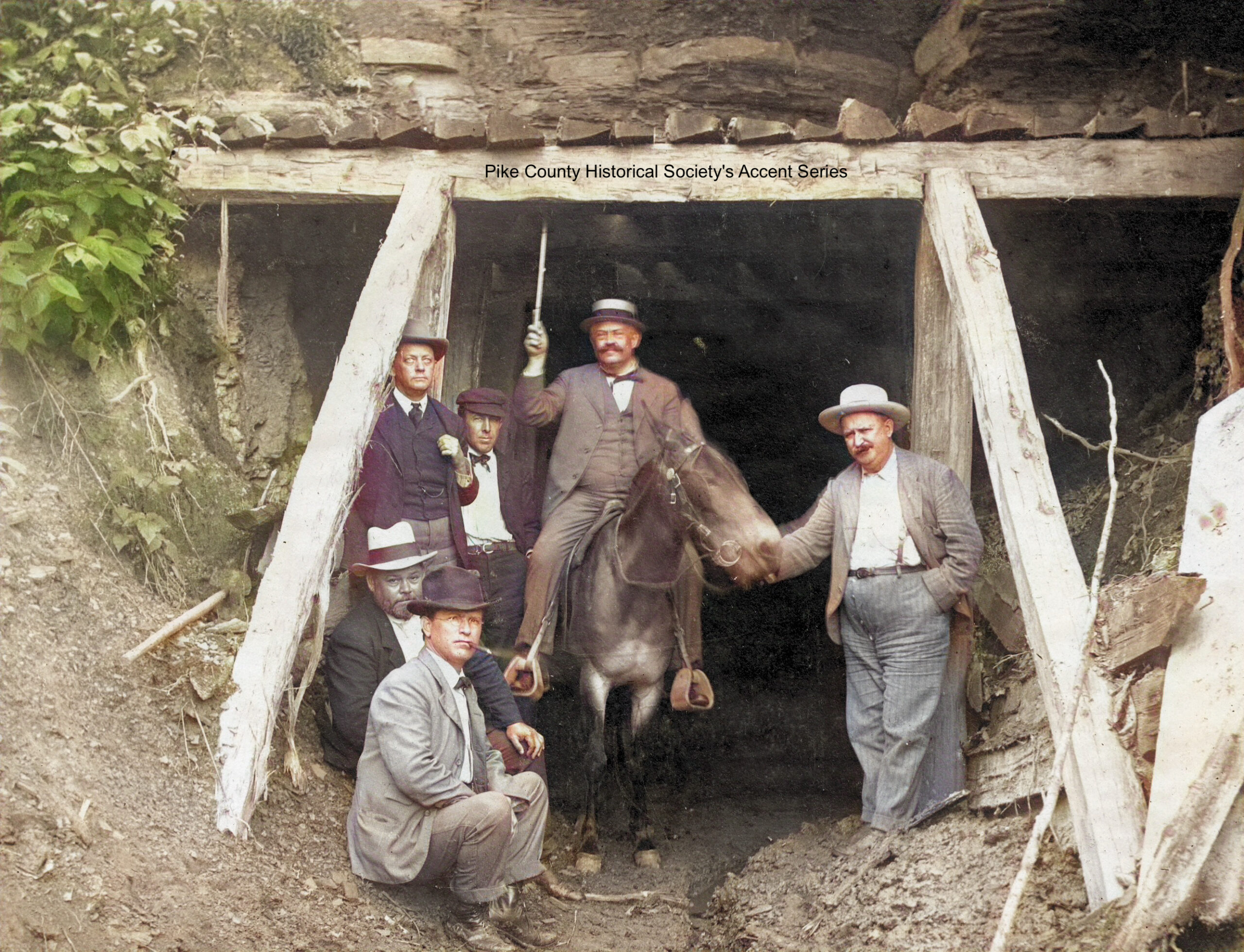
Robert Neil Dickman standing on the left knew more about the quality of Coke the Elkhorn Coal Field than any other person in the coal and steel industry. After Merritt’s lost the Mesabi Iron Range to John D Rockefeller. Dickman did investigate Elkhorn Coal Field by the request of Charles W. Wetmore a associate of John D Rockefeller in late 1893, early 1894 in a Young and Lane Report. Robert Neil Dickman did make a report on 200,000 acres in Eastern Kentucky territory about the same time Charles W Wetmore was being deposed in the Merritt lawsuit against John D Rockefeller at the same time, it was never brought to John D’s attention.
Robert Neil Dickman had work extensively for John CC Mayo and Northern Coal & Coke Co. proving to world what the Elkhorn Coal Field had offer. This Image was taken on Cane Branch on Elkhorn Creek in 1903.
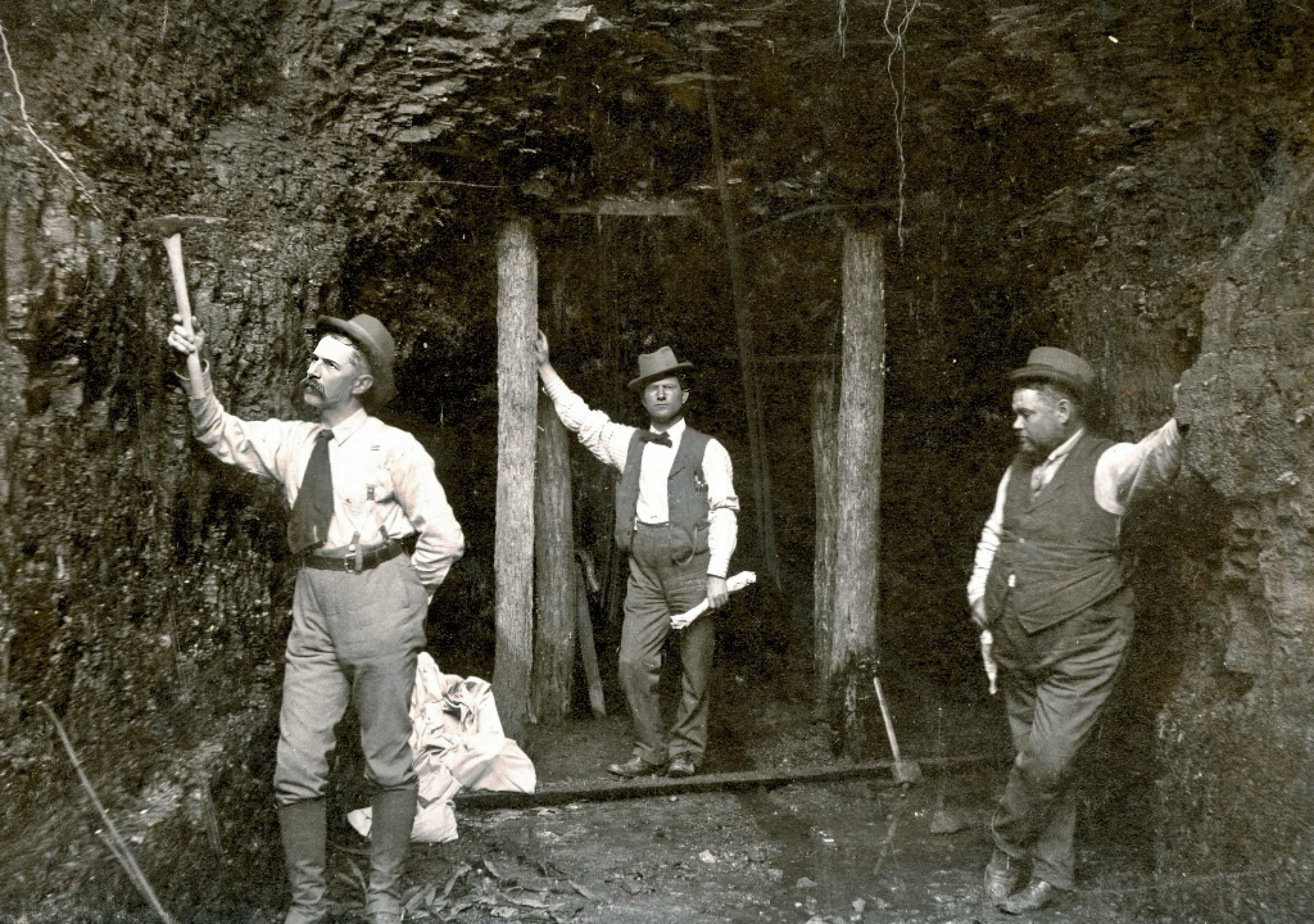
Near the Mouth of Little Elkhorn Creek, less than 40 feet above the creek. An open at Devil John W Wright’s coal bank, a coal sample was taken by J.J. Hillsman. Men shown in image listed from left to right: Horase Fox, James (Jim) Fox, John CC Mayo, J.J. Hillsman and young boy unknown.
–
“The Coke Oven”
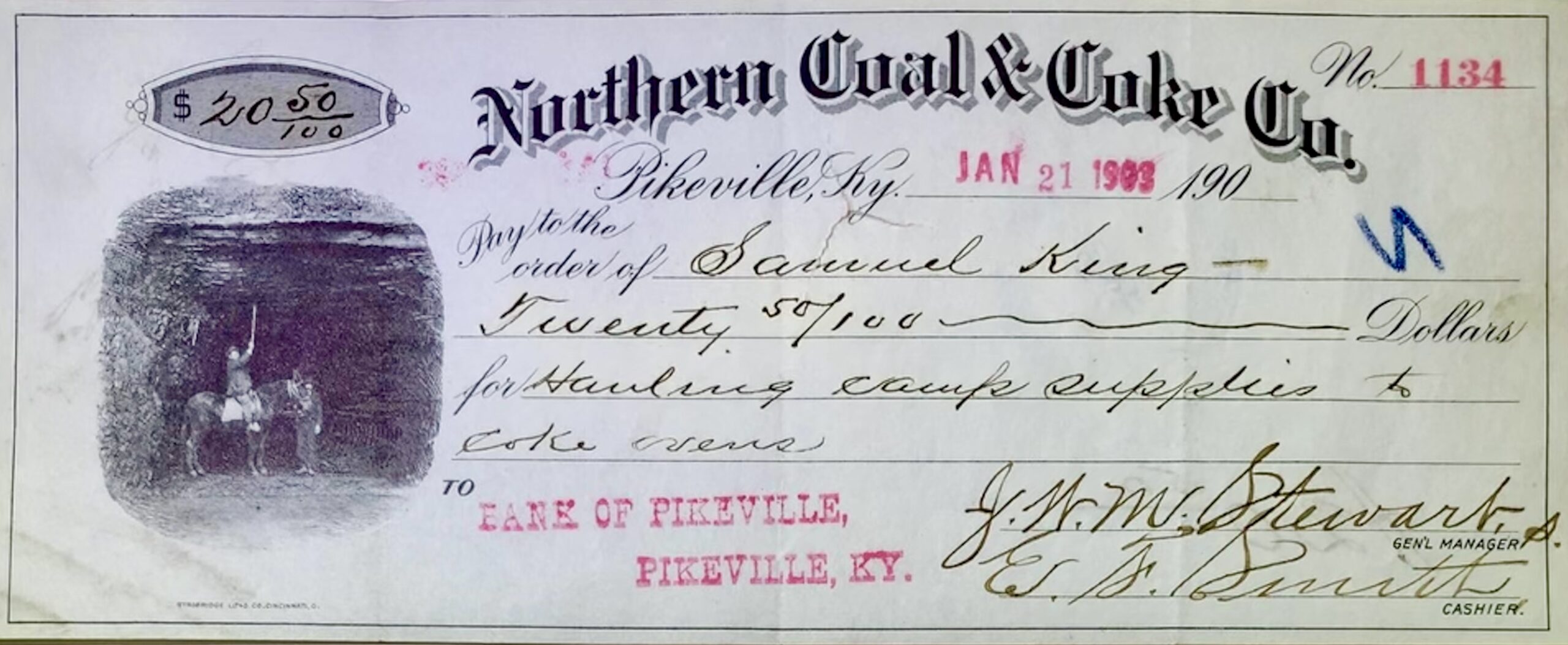
In an article that ran in a January 1903 Pikeville Independent Newspaper, the Northern Coal & Coke Company has recently completed construction on a Coke Oven on Upper Elkhorn Creek. The Coke Oven is located near Pound Gap on land purchase from “Devil” John W. Wright, and in close proximity to the finest seams of coking coal in the world. The Coke Ovens was constructed by W.W. Rickard and his brother, a master brick mason, both of men are from Blairsville, Pennsylvania, one of the largest oven builders in the Keystone State. John T. Jones of Iron Mountain, Michigan, one of the most prominent members of Northern Coal & Coke is now conducting experiments with the Coke Ovens. The construction of the Coke Ovens started prior July, 1902, A.S. McCreath is running samples at Coke Ovens taken by E.V. d’Invilles and Joseph Sillyman There is plenty of documented evidence that a Beehive Coke Oven was constructed in the head of Elkhorn Creek. Several coal samples coal sample were taken from the Elkhorn Coal Bed, from several coal banks in the neighborhood noted by the Manufactures Record Publication.
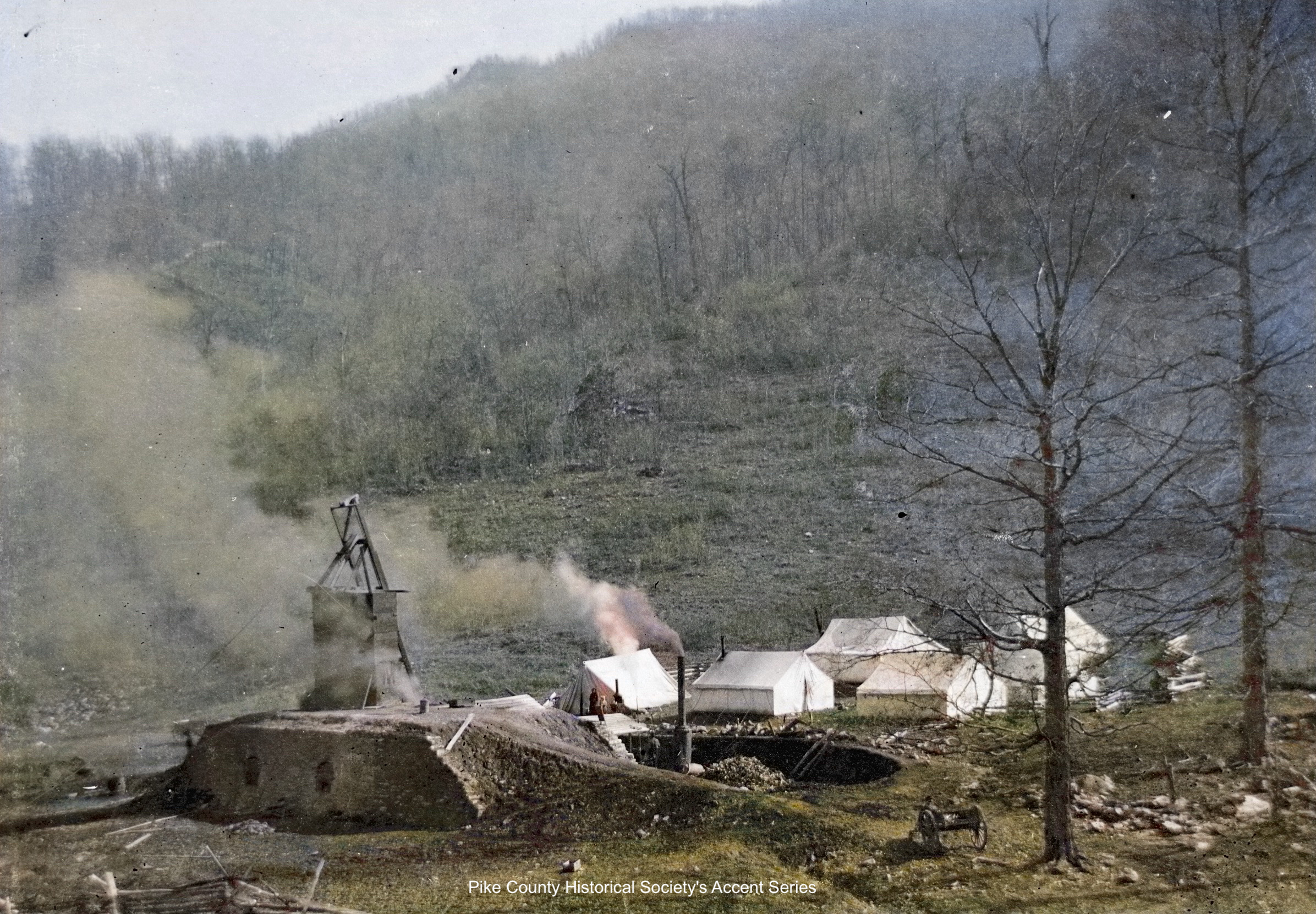
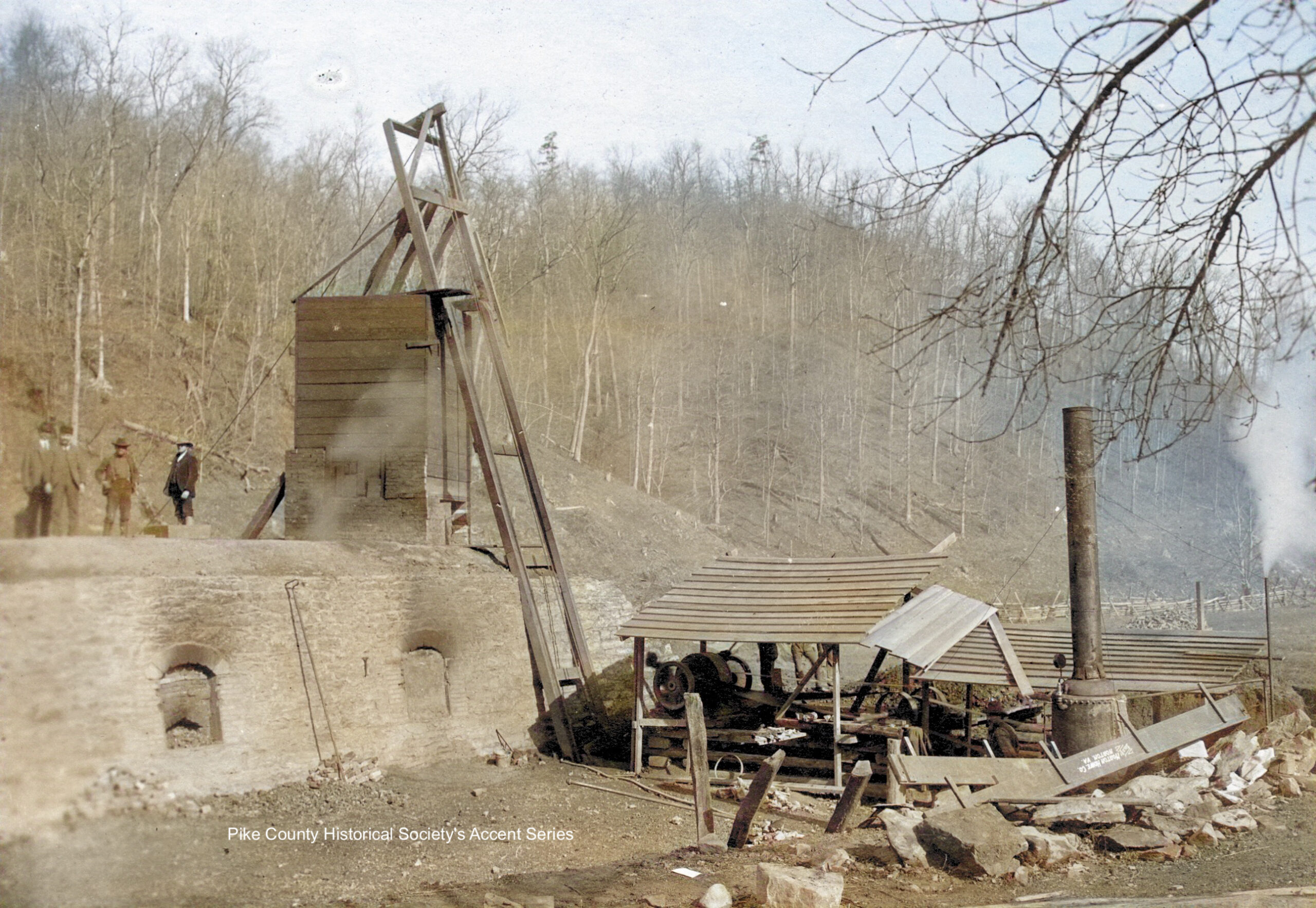
Samuel King’s wagon teams carried supplies to the coke oven on Elkhorn Creek as well as to other isolation camps during the prospecting and surveying of the Elkhorn Coal Field.
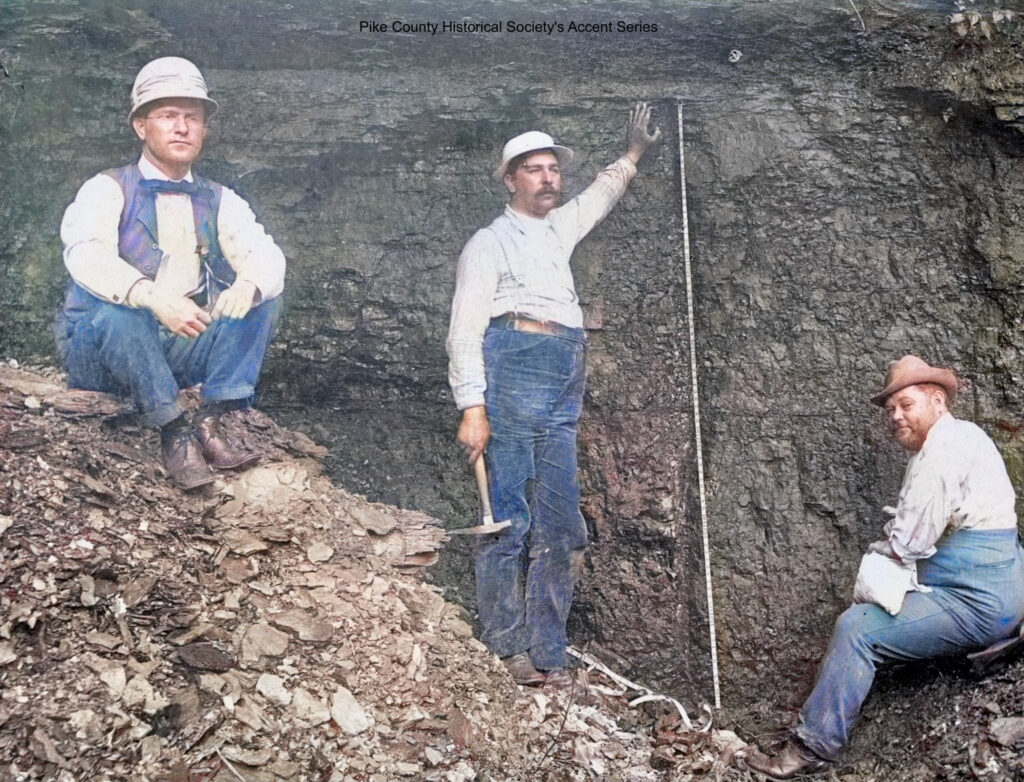
Sampling the No. 3 Elkhorn , Left to Right: John CC Mayo, Andrew S. McCreath a highly respected Analytical Chemist from Pennsylvania Steel Country . Sharon Steel Group highly sought his opinion. John T Jones. Sharon Steel Company’s all-in-one ground man before group sold to J.P Morgan, traveling all over United States representing the interest for Kimberly and Buhl, working in and around Elkhorn Field 1901 through 1903.
The Big Split
The Stockholders of Northern Coal and Coke and Beaver Creek Coal and Coke had already been decided several years ago, eventually this day would come to divide mineral assets into two mega Companies to get a return the stockholders investments. With the formation of Beaver Creek Consideration Coal Company, it brought more satellite mineral holding Companies into the picture. These Companies held mineral assets in Pike County, Letcher County, Floyd County, Knott County and Magoffin County. One company was Laclede Coal Company, stockholders were Isaac Mann, W.F. Hite, S. A. Taylor, C.L. Ritter, George Miller. Montrose Lands and Mining Company, its stockholders were John CC Mayo, W.F. Hite, A.M. Kelly and C.L. Ritter. C. L Ritter was a major timber man from Huntington, West Virginia. John W. Ensign brother-in- law to W.F. Hite W. F. Hite was a wealthy man with great ties to C & O Railway in Huntington, West Virginia, and a son-in-law to Ely Ensing, the owner American Car Foundry and a person friend to Collins P. Huntington. B.F. Johnson a commissioned land agent for Northern Coal and Coke, and first stockholder in Pikeville National Bank.
Gibson Coal Company, Montrose Lands & Mining Company, Leclede Coal & Coke, Cuyuga Coal & Coke Company, Collins and Mayo Collieries, Kentucky Coal Land Company, Long Fork Coal Company and Shelby Coal & Coke Company, a couple of these companies like Collins & Mayo were assigned mineral. All these stockholders of these Company meet the following day November 23, 1909, assigning mineral assets of these companies and some hard already been done months and days before the November stockholders and directors meeting. Taking stock option in Northern Coal & Coke Company and Beaver Creek Consolidation Coal. This organized event filled the majority of gaps in mineral bounds and property lines. Two major components was accomplished from creating a separation of Mineral assets. “Future Plans” to set in motion two extremely large mining companies, Consolidation Coal Company and Elk Horn Coal Corporation.
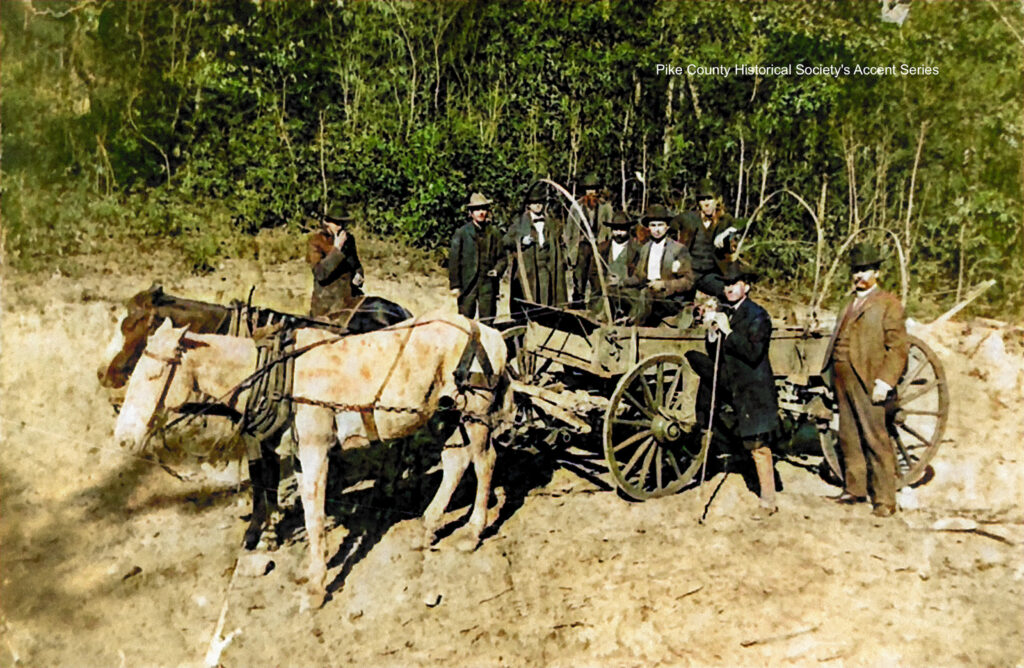
One of Mayo’s Caravan’s meandering up Shelby Creek to inspect future site of Consolidation City.
The Head of Elkhorn Creek, Mullins Coal Bank
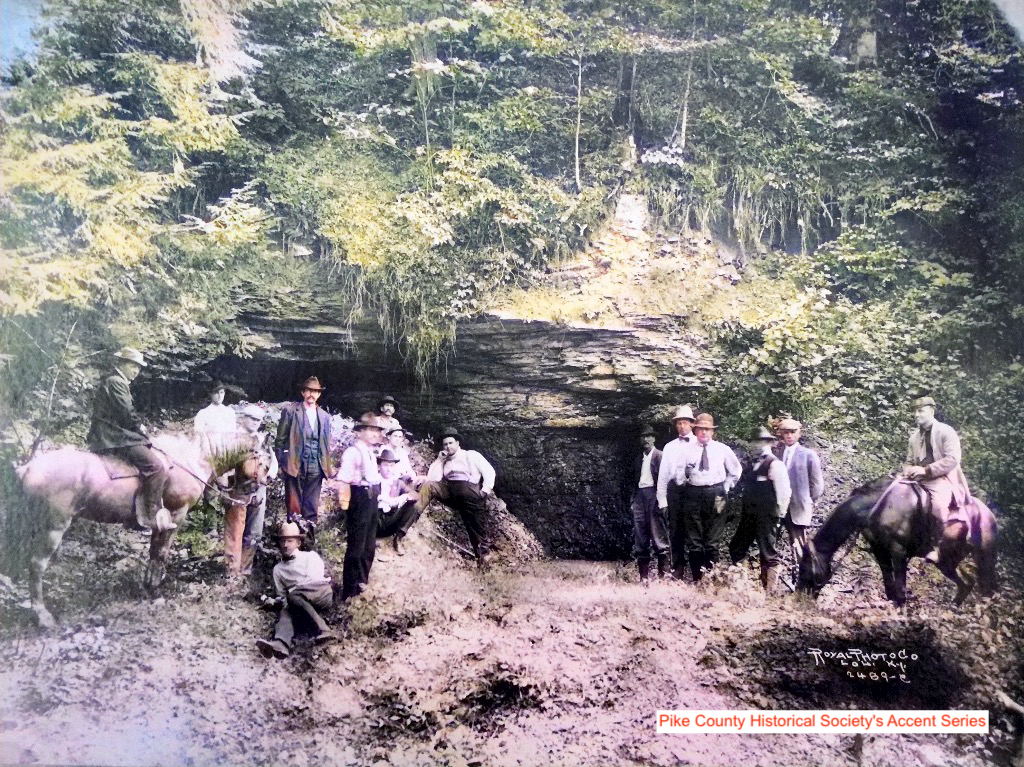
October 8, 1910
The Consolidation Coal Company Board of Directors, at a meeting held October 8, 1910, recommended, and the stockholders, at their meeting held December 12, 1910, approved the purchase of 100,000 acres of coal lands, at $45 per acre, in Letcher, Pike and Knott Counties, in the State of Kentucky, known as the “Elkhorn Field.” In payment of this tract it was arranged with the vendors to take at par $4,400,000 of the capital stock of your Company, participating in dividends declared after July 31, 1912.
This tract of land has been examined by the engineers of your Company, as well as by many prominent mining engineers and geologists, and the unanimous opinion of all is that it is the most valuable tract of undeveloped coal land in this country. One of the most prominent of the engineers has stated that the Elkhorn Field acquired by this Company will contain in the several seams germane (relevant) to it, at least 12,000 tons per acre; that the coal which this tract may be reasonably expected to yield becomes more significant when it is realized that all of it will come from practically self-draining mines and fully 600,000,000 tons of the highest grade of coal may be mined from one seam alone. For coking and by-products it is not excelled by any known coal at this date.
Since this Company took over this tract, additional prospecting, both by diamond drills and crop openings, has demonstrated at least one of the additional seams will produce coal of similar character and quality as the main seam, which will increase the quantity of mineable coal of this grade at least 50 per cent., or to a total of 900,000,000 or probably 1,000,000,000 tons of coal of this quality.
The Consolidation Coal Company has had several corps of engineers in its Elkhorn Field since last fall locating mining plants, and the actual work of opening its mines, with a capacity of 4,000,000 tons per annum when completed, will be commenced by May 1st, 1911, and the Company will be prepared to ship coal from these mines, by the time the two railroads that are now being built into this field, which will furnish ample transportation facilities for this large tonnage, are completed. The Louisville and Nashville Railroad Company is building an extension of their line from Jackson, Kentucky, a distance of about 100 miles into the Southwestern, or Kentucky River side, of this, our Elkhorn Field. The construction of this road was commenced in October, 1910, and is being rapidly pushed to completion.
The Sandy Valley and Elkhorn Railway Company have let a contract for the construction of a railroad approaching this field from the Big Sandy River and through the heart of the property, a distance of thirty miles. This road will connect with the Chesapeake and Ohio Railway at its northeastern terminus and with the extension of the Louisville and Nashville Railroad on the southwestern or Kentucky River side. The contract calls for the road to be completed within one year.
The Consolidation Coal Company Board, at a meeting held November 28, 1910, recommended, and the stockholders, at a meeting held December 12, 1910, adopted the recommendation to increase the capital stock of the Company from $20,000,000 to $25,000,000. Of the $20,000,000 heretofore authorized, there was remaining in the treasury undisposed of $974,000.Of the $5,000,000 additional stock $600,000, together with the Treasury stock referred to, amounting in all to $1,574,000, was offered to the stockholders of record December 15, 1910, at par, this stock to carry dividends declared after January 31, 1911. The remaining stock, $4,400,000, was deferred as to dividends declared until after July 31, 1912. Both offerings were taken.
The Consolidation Coal Company Board, at its meeting held on November 28, 1910, recommended to the stockholders that in order to provide for the payment, discharge, redemption, exchange or acquisition of the outstanding bonds secured by lien upon the properties owned by this Company, and its subsidiary Companies, and for the improvement and betterment of the properties of the Company and its subsidiary Companies, the acquisition by this Company of additional property, and for its other lawful corporate purposes, this Company do make and issue its bonds, to be known as The Consolidation Coal Company First and Refunding Mortgage Forty Year Sinking Fund Gold Bonds, to an amount which shall not in any event exceed in the aggregate the principal sum of $40,000,000 at any one time outstanding. Said bonds to bear date the first day of December, 1910, and be payable on the first day of December, 1950, and to bear interest at the rate of not exceeding five per cent. per annum, payable on the first days of June and December in each year. This recommendation was adopted by the stockholders at their meeting of December 12, 1910, and the execution of the mortgage and the issuance of the bonds authorized. Under the terms of the mortgage, $4,000,000 par value of the bonds have been issued to the Company since the close of the year 1910 in exchange for a like amount of bonds held in the treasury of the Company. $9,000,000 of the bonds have been disposed of since the close of the year 1910 to the National City Bank of New York and Kuhn, Loeb & Co., the proceeds of which under the terms of the mortgage will be used, so far as may be required, in the redemption of the outstanding bonds of the Somerset Coal Company, the Clarksburg Fuel Company and the Kentucky First Mortgage of your Company, and the remainder in the development of the Elkhorn Field. $6,000,000 -additional bonds are specially reserved for the development of this property. $10,876,000 are reserved for the redemption of the following outstanding bonds:
The Consolidation Coal Company First Mortgage 4½%———- $ 413,000
The Consolidation Coal Company Refunding Mortgage 4½ %—-$5,141,000
Fairmont Coal Company 5 %————————————$5,232,000
Briar Hill Coal and Coke Company 5% —————————–$90,000
The remainder of the issue, $10,124,000, are reserved for future uses of the Company.
All balances due the various Sinking Funds at the close of the year, as shown by the respective Sinking Fund Accounts, pages 6 to 9 inclusive, have been paid on the dates required by the terms of the various Mortgages.
The balance sheet and other statements of the Company will be found upon pages 16 to 21 of this report.
By order of the Board.
J. H. WHEELWRIGHT,
President.
Pay Record Price
Perhaps the limit in price in mountain lands was reached when the Consolidated Coal Co.’s representatives paid Sam L. Ison, $12.000 for less than thirteen acres of level land lying along Elkhorn creek near its headwaters, where the company expects to build a big mining town.
The company owns the mineral on the property. The company also gave John D. Bentley $5,000 for less than one acre of choice property near the residence of John W. Wright, which It proposes making the center of its operations. Fabulous prices are being offered for property all along Elkhorn and Boone’s Fork in the coal fields, though but few owners have so far accepted.
“Lonesome Pine” No Longer Lonesome.
Mountian Eagle, Whitesburg, Ky.-The scenes are rapidly changing on the “Trail of the Lonesome Pine,” for the Consolidation Coal Company’s model city on Elkhorn Creek. Is being built where the closing scenes of John Fox, Jr.’s, story, “The Trail of the Lonesome Pine,” is laid. The primitive log house in the “Shadows of the Cumberland,” in which is the heroine of the story was married to Hale, the engineer, has been torn down, and where it stood, new offices will built for the company. Here one will occasionally meet an ancient character, whom he will half suspect as being “Uncle Beams,” the Justice who performed the marriage ceremony on the porch of the old house that was once stood the home of John W. Wright, the famous detective, and which has stood the storms of almost a century. But if Hale, the engineer, did bury every bottle and tin can, and take away every sign of civilization from “Lonesome Cove,” as he promised his bride he would do, the spell cast over it has been broken and soon the whistle of the locomotive will proclaim civilization to the one-time haunt of “Bad Rufe Tolliver.”
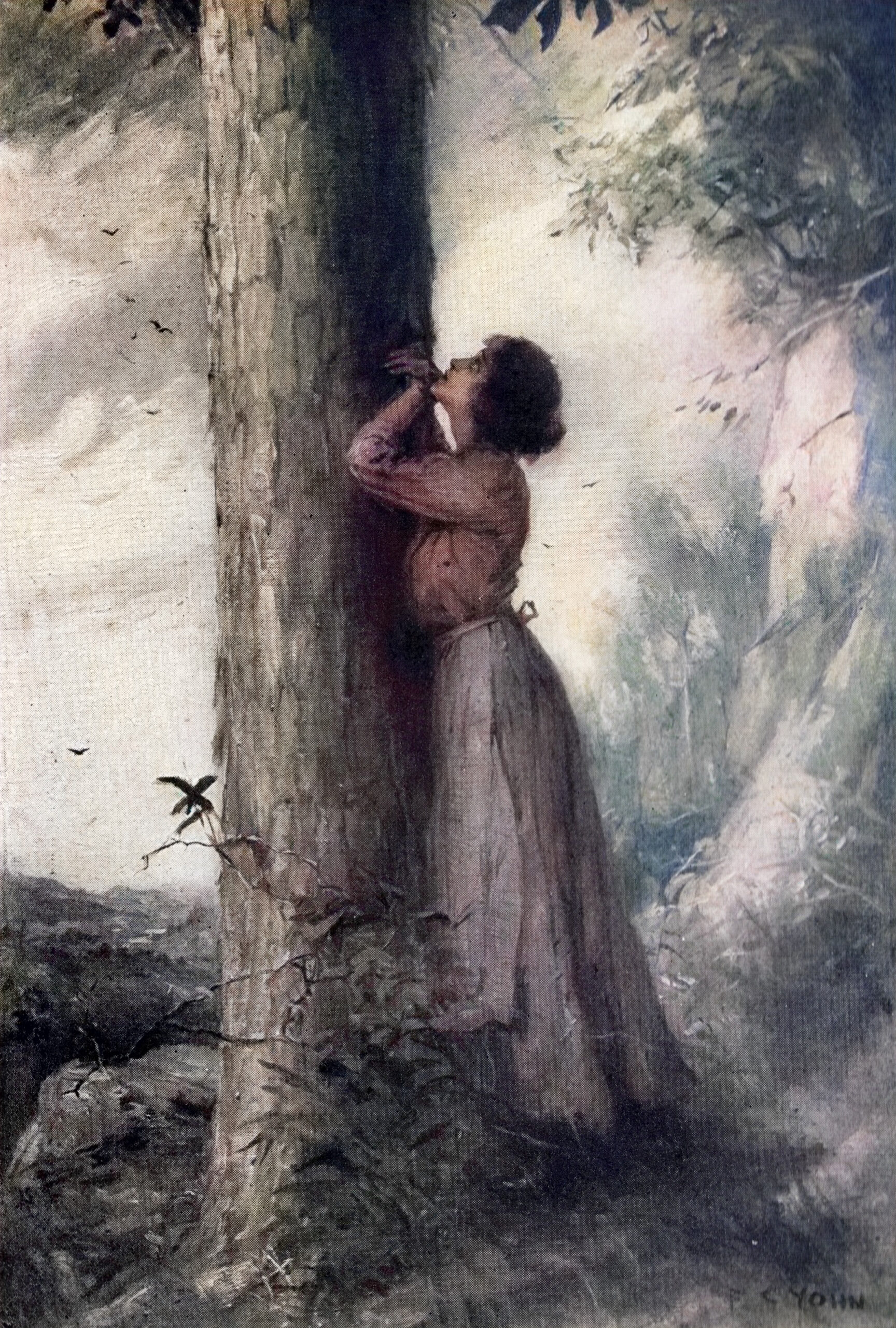
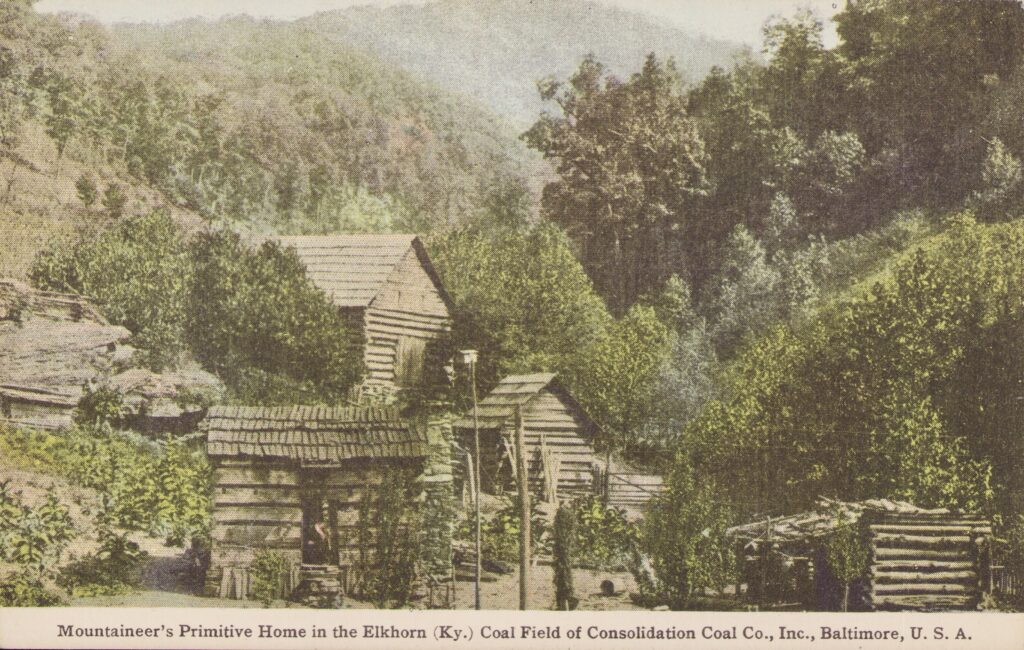
The new mining town on Elkhorn Creek, Kentucky, is situated on the spot where the closing scenes of John Fox Jr’s story, “The Trail of the Lonesome Pine,” is laid. The primitive log house in the shadows of the Cumberland Mountain in which the heroin of the story was married to Hale, the engineer, has been torn down, and where it stood a start of newly constructed office of Consolidated Coal , and a Bank Building and Temporary YMCA is currently being built as-well. One will occasionally meet an ancient character who he will half suspect of being “Uncle Billy Beams” the Justice of Peace who preformed marriage ceremony on the porch of the old house. But if Hale did bury every bottle and tin can, and take away every sign of civilization from “The Lonesome Cove'” as he promised his bride he would do, the spell thus cast over it had been broken and soon the whistle of the iron horse will proclaim civilization tooth one-time haunts of “Bad Rufe Tolliver.”
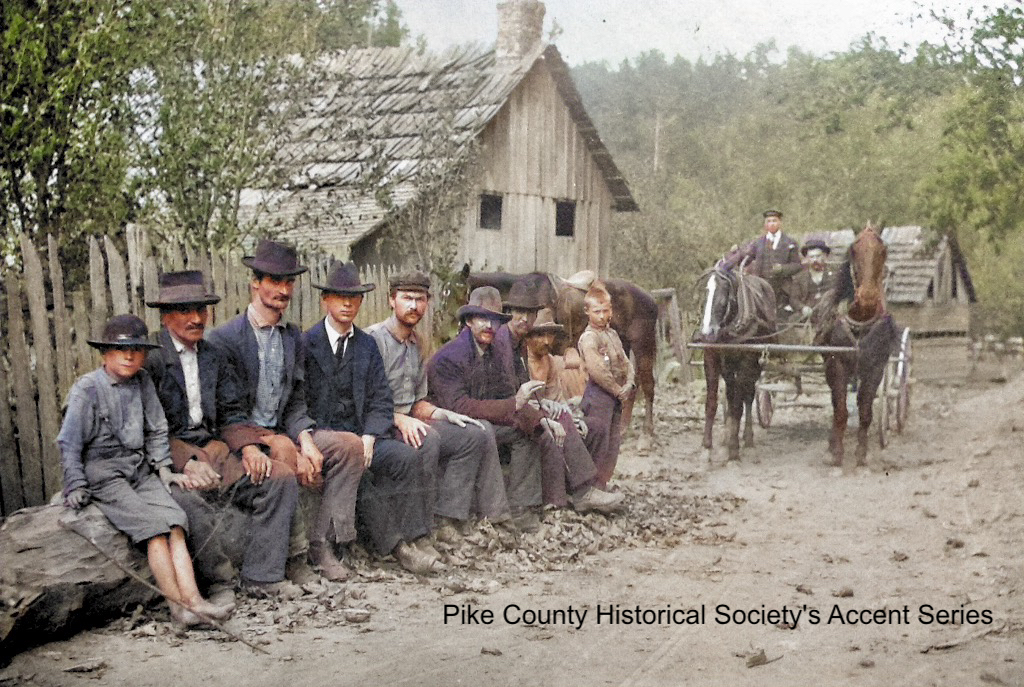
Most of the characters written into The Trail of the Lonesome Pine were setting on this log beside the old state road on Little Elkhorn Creek known as Lonesome Cove. The well dressed man on the Buckboard Wagon has a likeness resembling S.E. Baker, this could easily be Hon. Sam Budd listed in The Trail of the Lonesome Pine. The dark complexion man second from the left, could be Black Tolliver, Mary Bentley’s brother John D. Bentley, nearly all Bentleys have real dark complexion.
The Newspapers stated when Consolidation Coal Company tore down the Old Cabin of Devil John and Mattie Wright lived in, they moved down to his property next a Hotel on Elkhorn Creek, near John D. Bentley. Seen south of Hotel is a Splash Dam. This is one of two Splash Dams, Devil John and Kinky Haired Samuel Wright used to float timber past Shelby Gap.
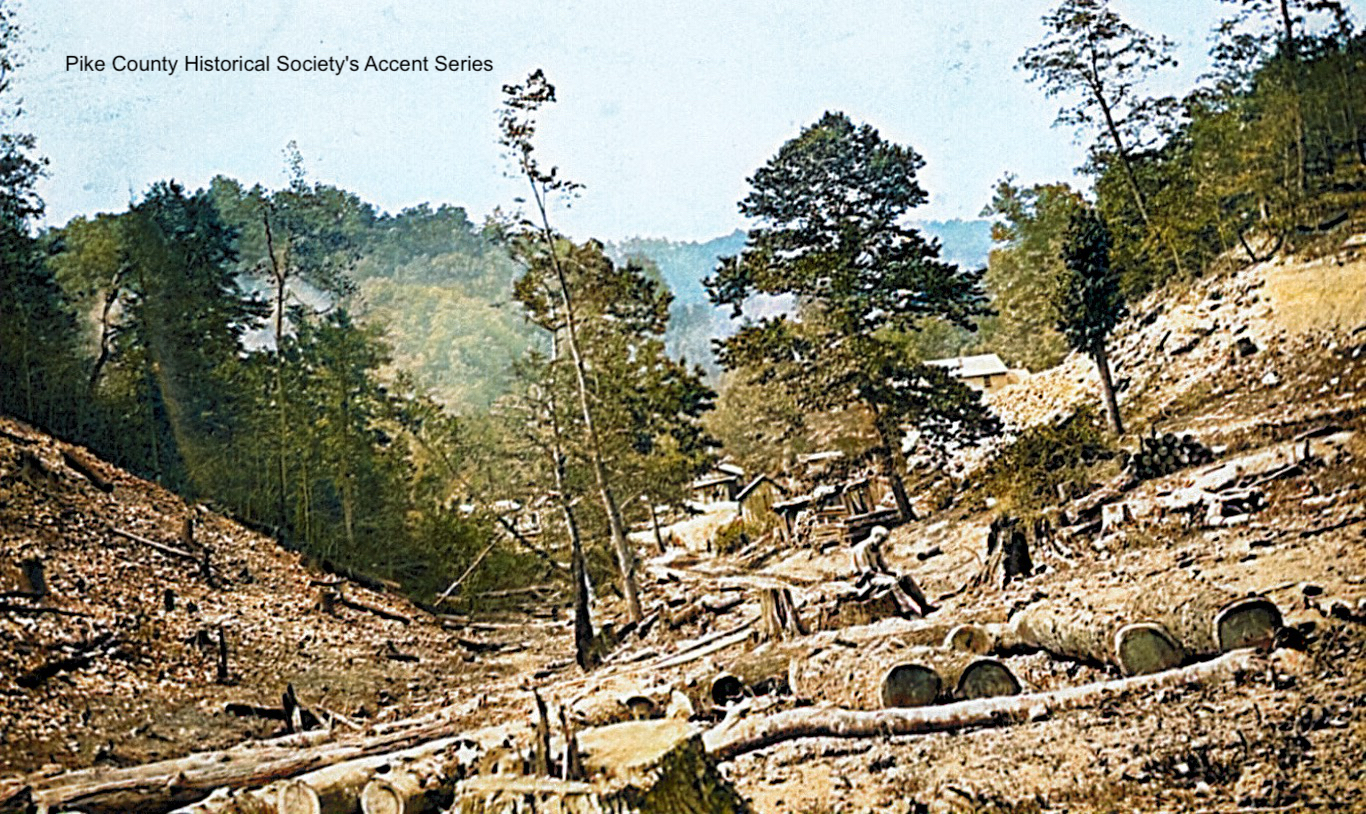
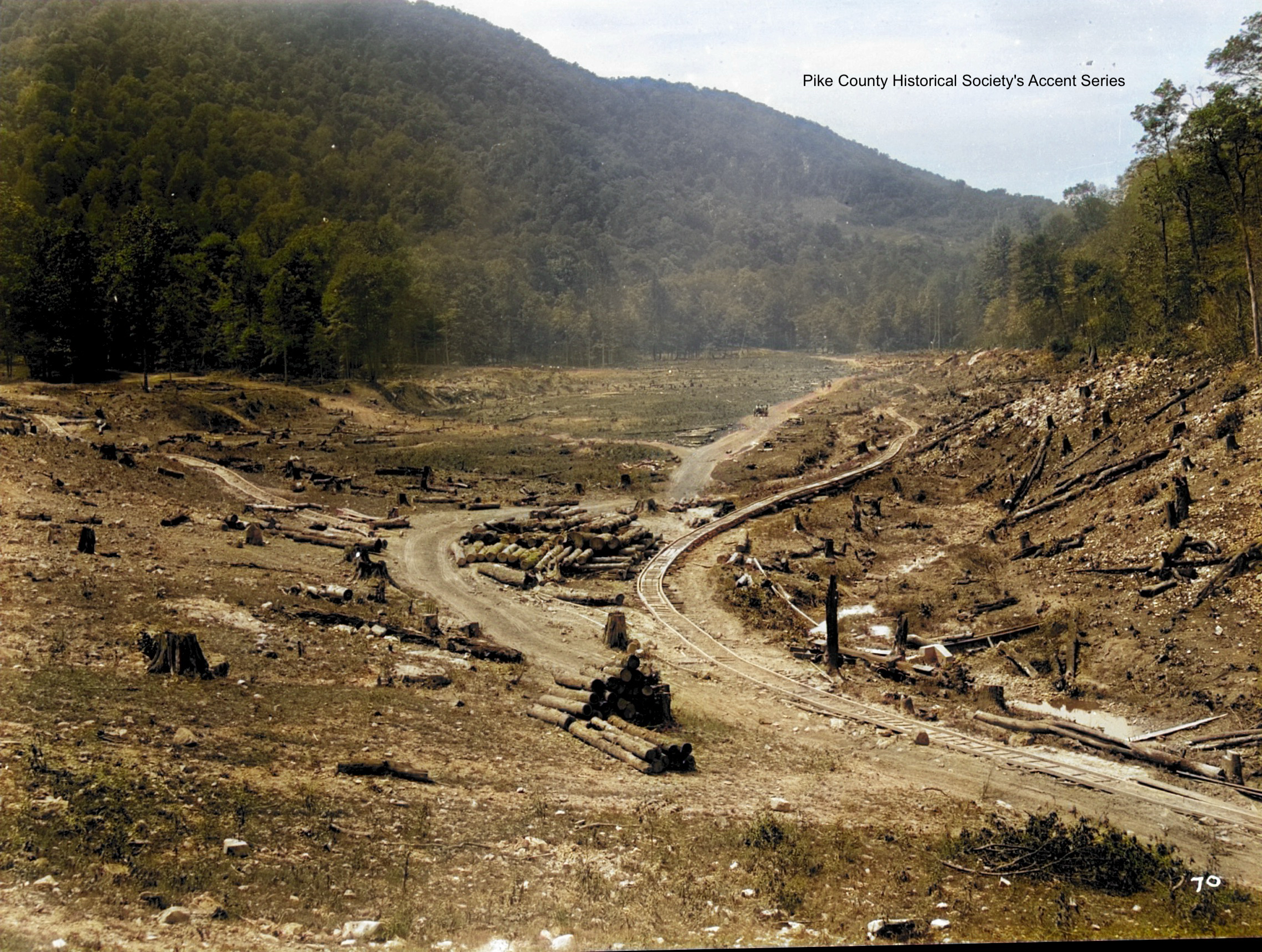
Little Elkhorn Creek basin looking towards the mouth. The future site for Elkhorn Lake is being cleared of trees and under brush. The Management at Pike County Historical Society apologize for the quality of image, but It does shown accurate timeline of construction.
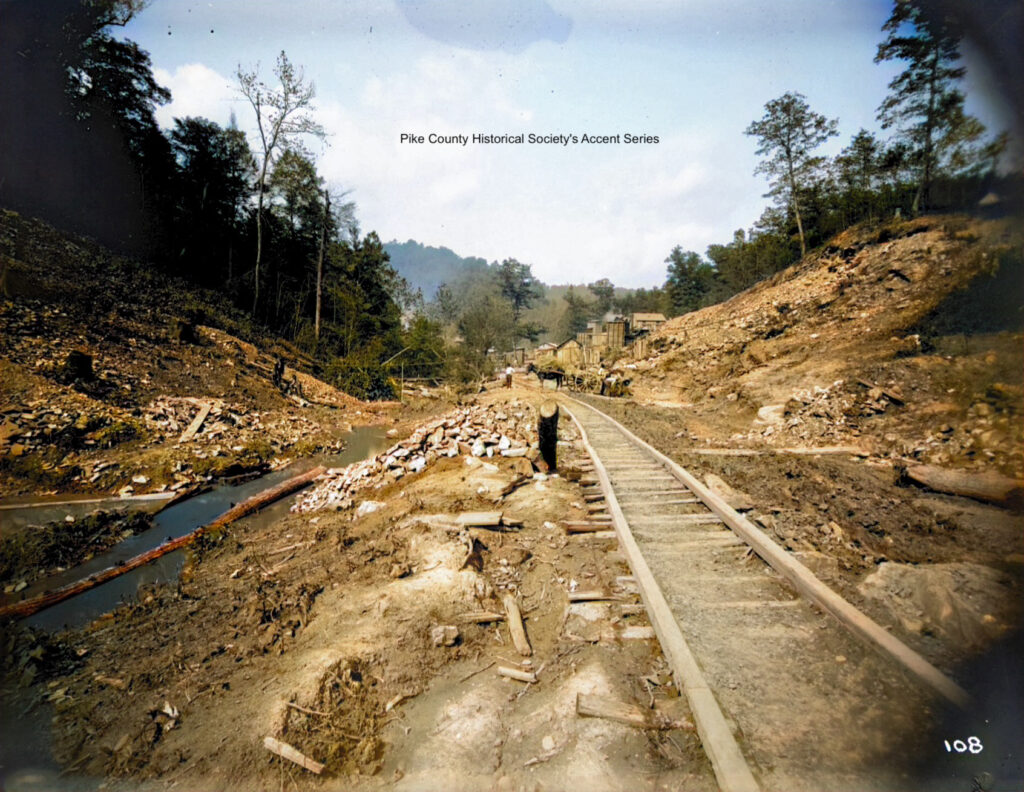
Looking up Little Elkhorn Creek, you will notice smoke in the center towards Coldwater Branch, the future site for Elkhorn Dam.
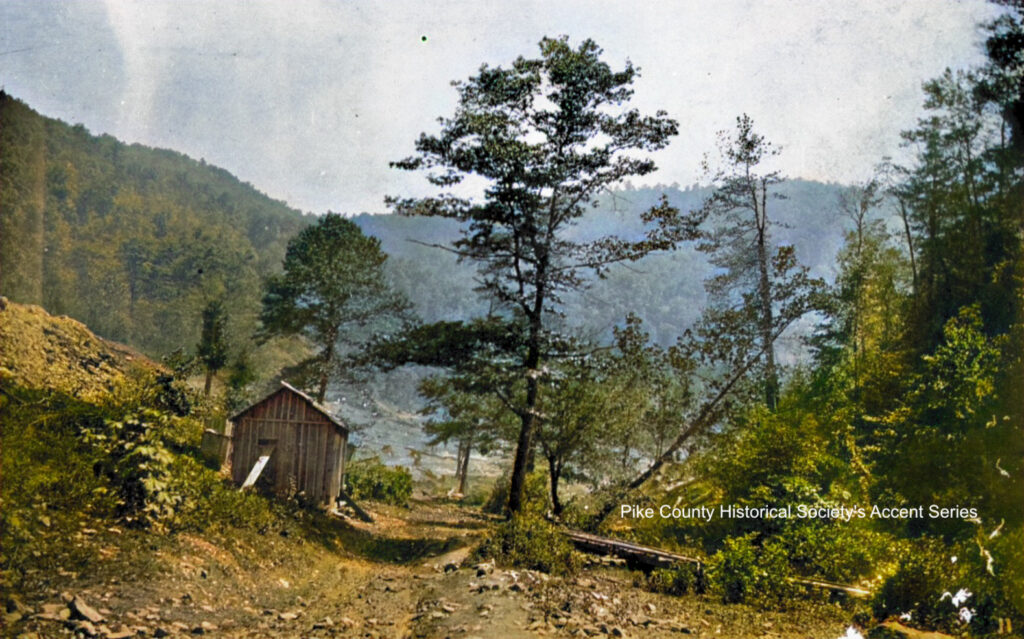
Getting ready to install temporary powerhouse near the Mouth of Little Elkhorn Creek
Future Reservoir site for Consolidation City, the Kentucky State Road shown meandering down Lonesome Cove as it was portrayed in “The Trail of the Lonesome Pine.”
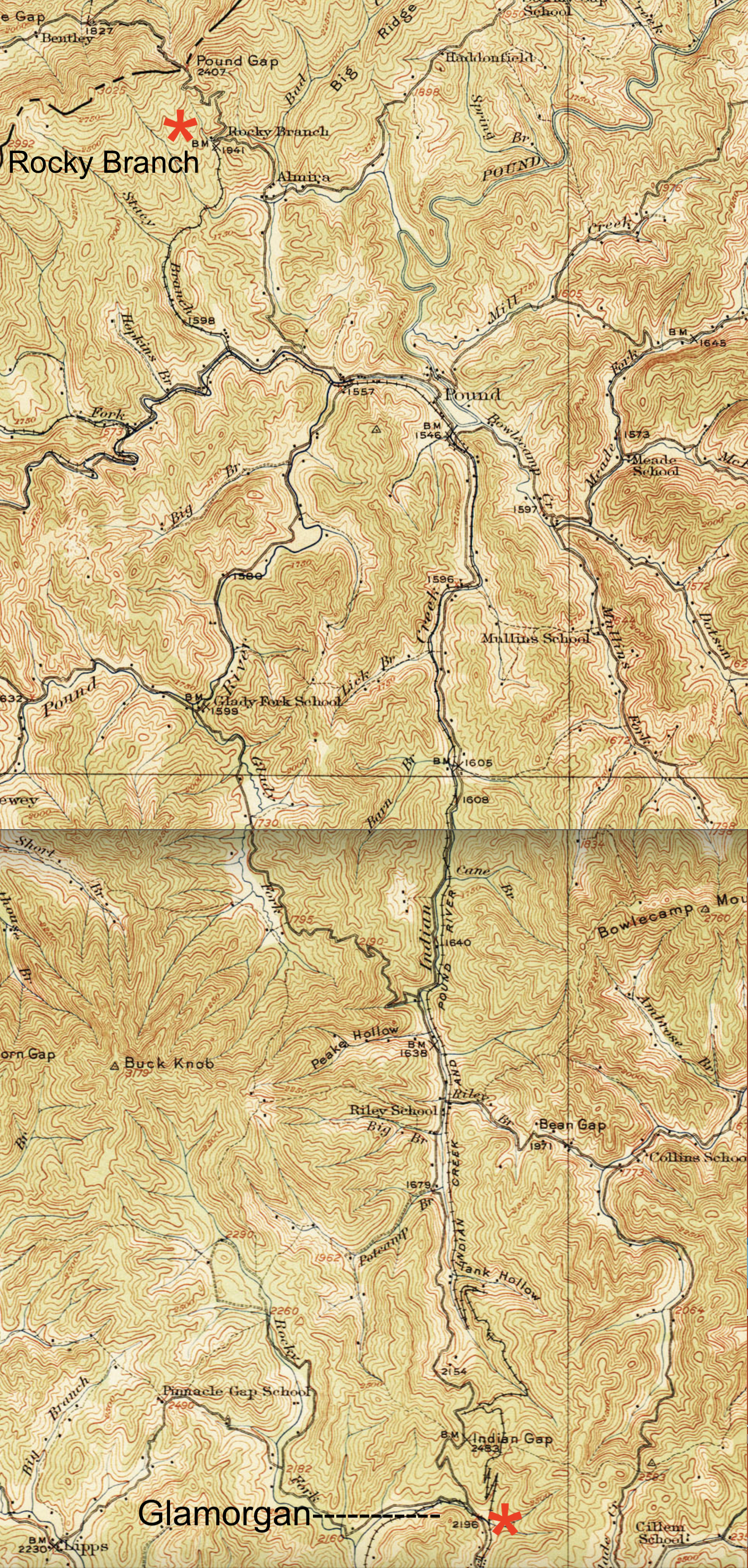
Big Stone Gap Post writes an article about Narrow Gauge Railroad finally being completed from Pound on the North Fork to Rocky Gap Holler on Pine Mountain just on the other side of Pound Gap. the Rocky Gap Depot was sage adjacent to the Old Fincastle Trail cross over Pine Mountain taking needed building supplies to Consolidation City in the head of Elkhorn Creek.
Looking up towards Pound Gap
–
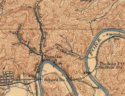
Indian Creek Narrow Gauge Railroad / USGS Topographical Map
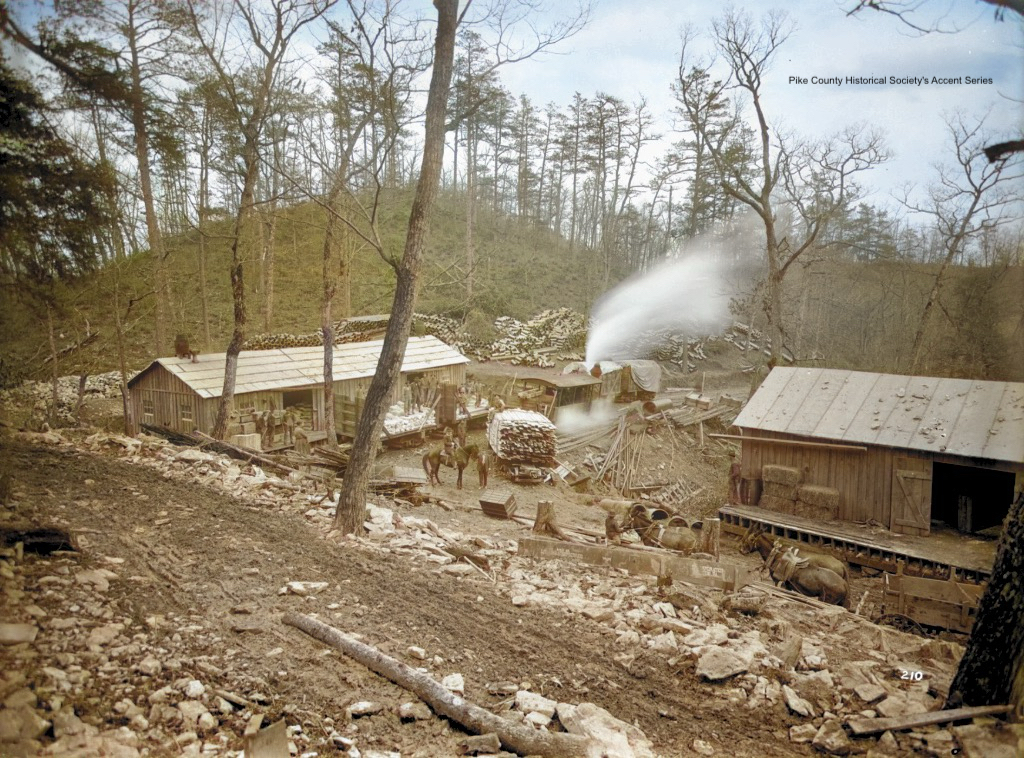
No. 1 Sawmill
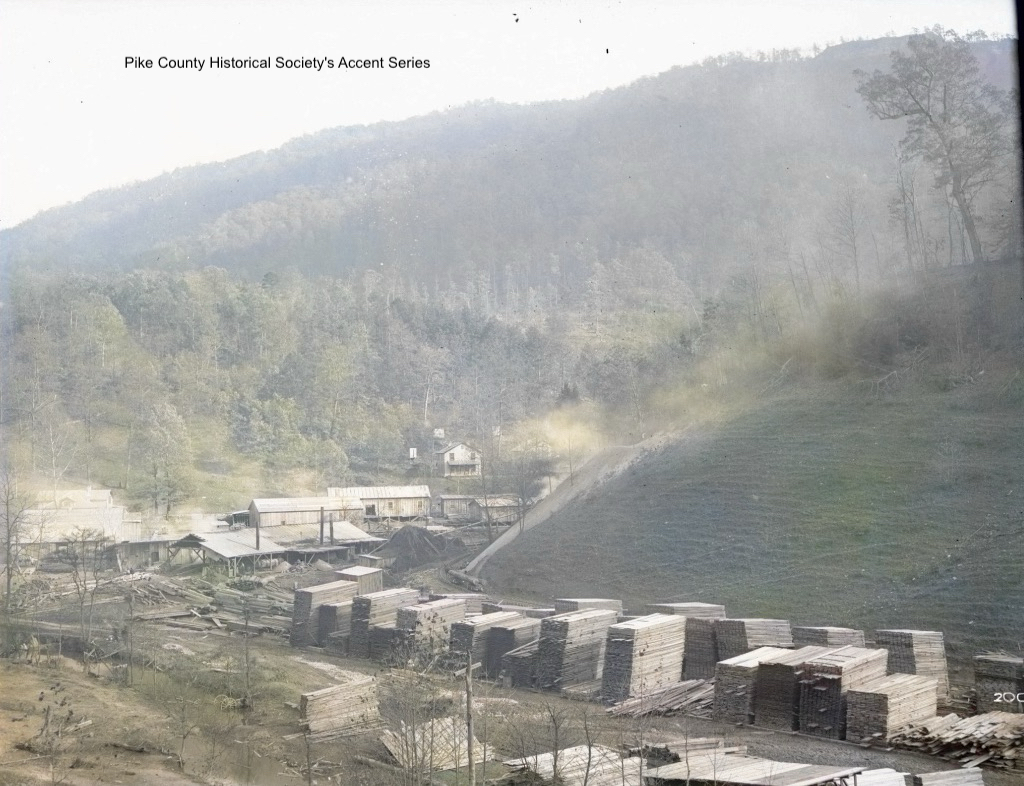
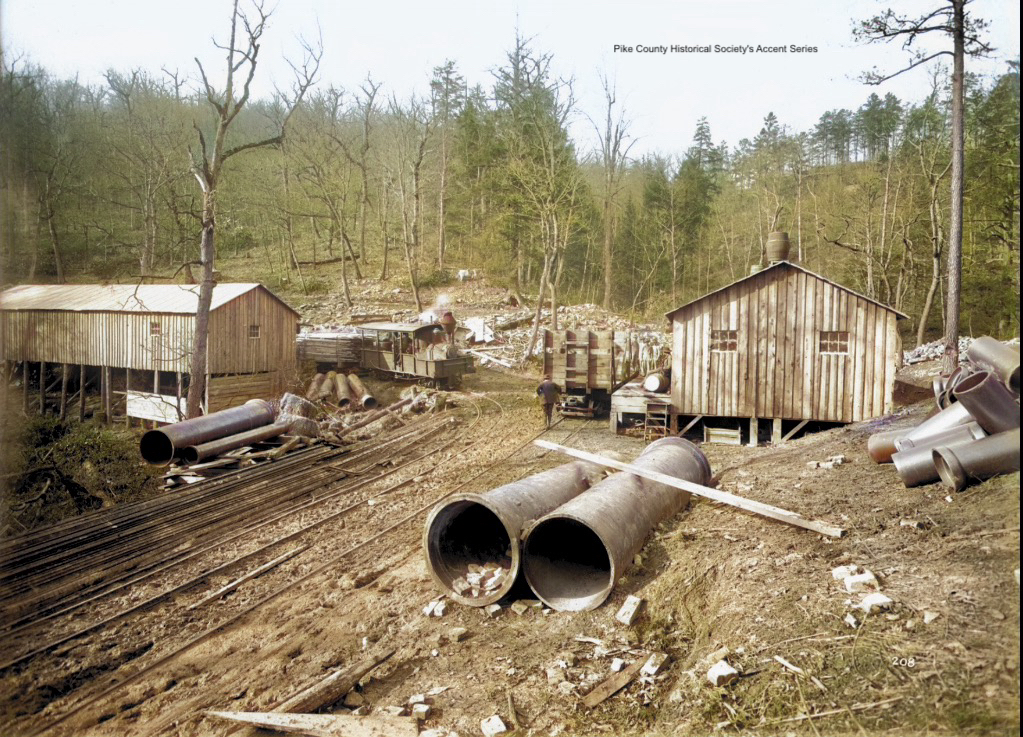
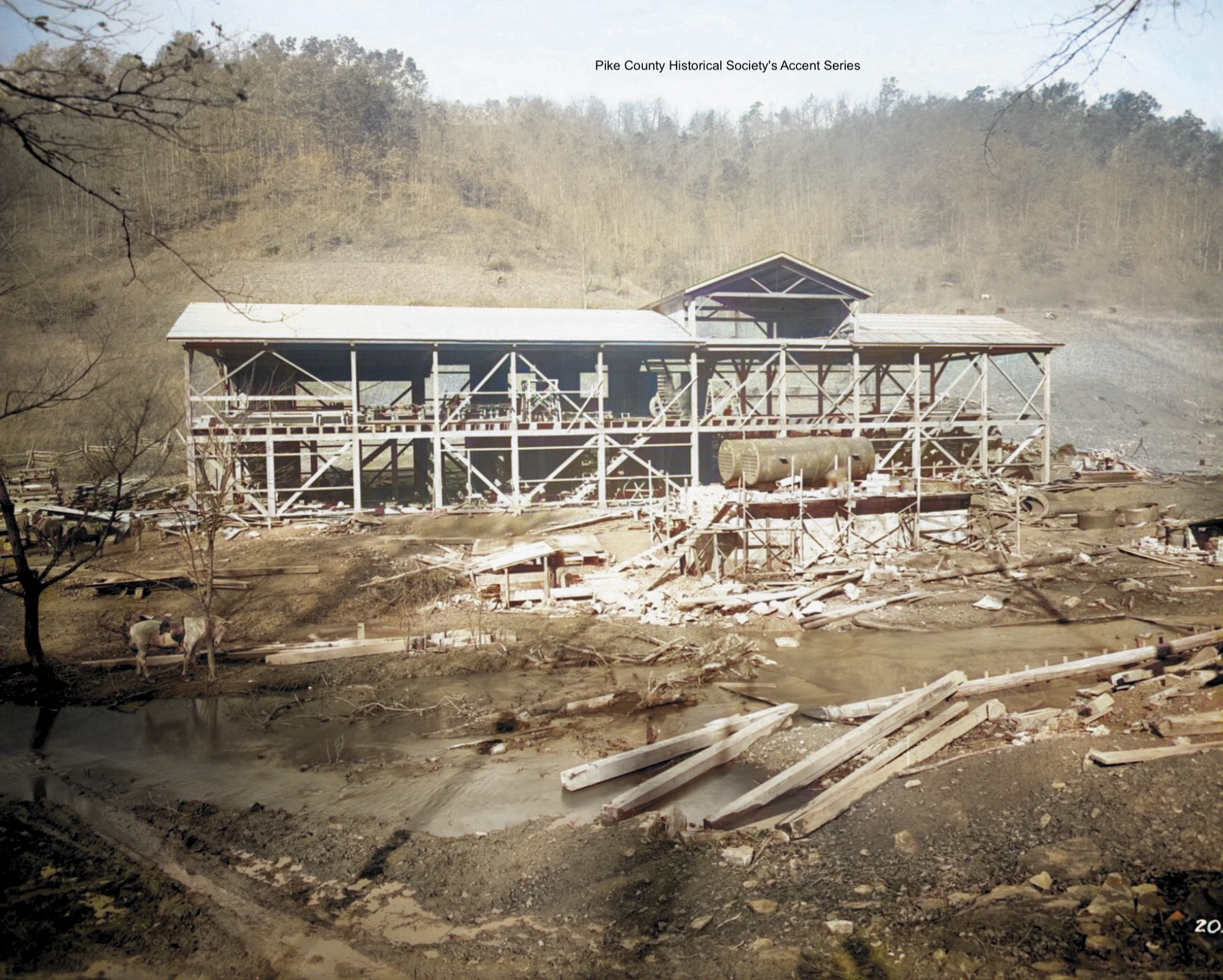
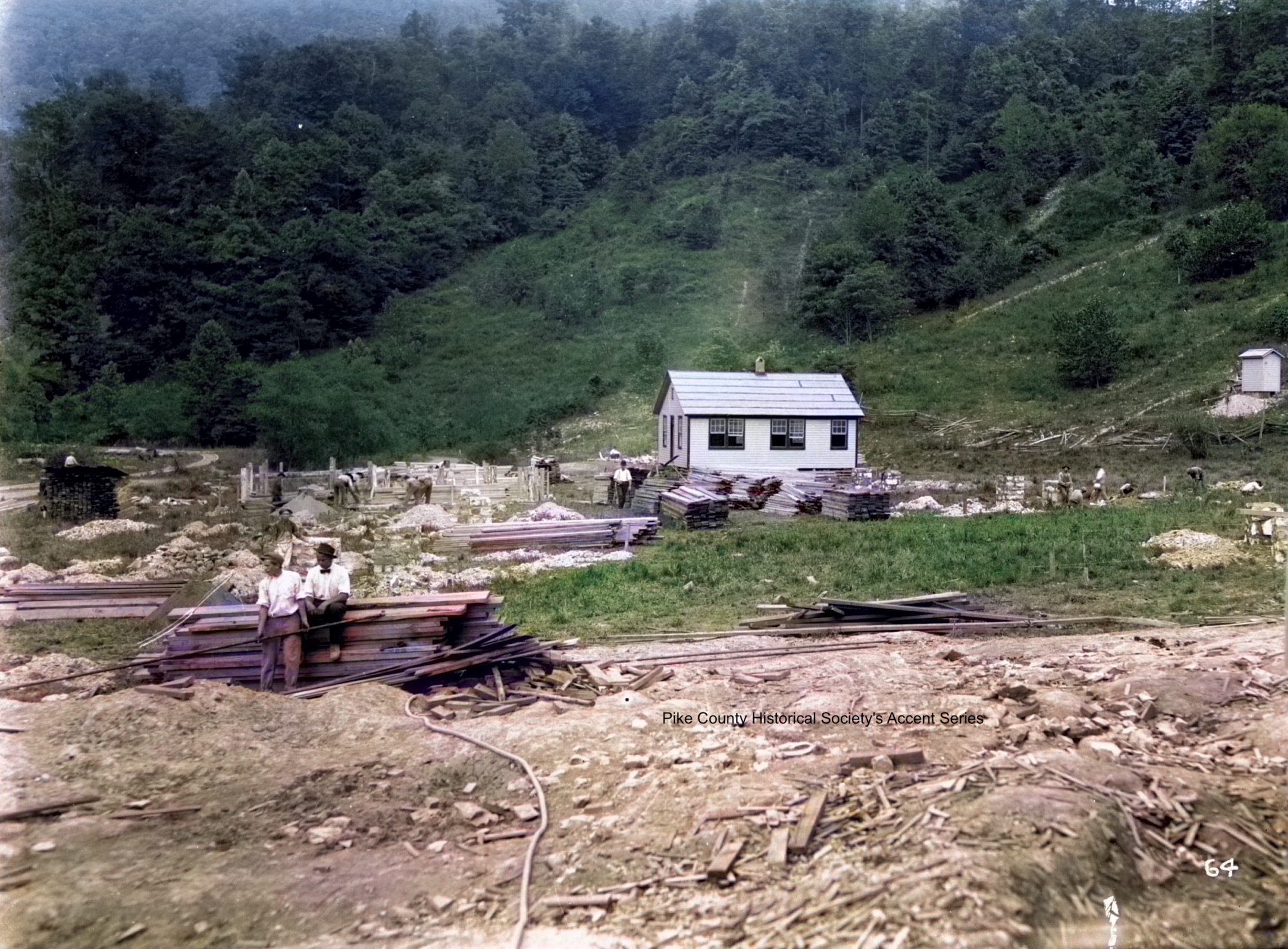
Consolidation Coal Company was estimating in the original construction plans to build nearly 2000 houses in the town and the Nicola building company of Pittsburgh Pennsylvania, which has been charged of the building operations, will be erecting more than 100 of them. A clubhouse for the officers and engineers of the newly been built coal company. Town is well underway, a clubhouse for the officers and engineers of Consolidation City will be built to accommodate several two-story building buildings of attractive appearances. Foundations have been completed for the central store, the business of which is now been conducted and temporary quarters, a bank and a post office building and office Buildings for Consolidation Coal Company employees. The building of company does everything in connection with the construction and dwellings and other structures in this new city. The company is cutting its own timber from adjacent forest around the Elkhorn Creek area, saws, and planed into lumber, and thus able to get most of the material on the ground, it been only necessary to purchase the meal work such as windows and doors, and also roofing nails and paint. There is also a brickyard that has been constructed at Consolidation City, and is equipped with a steam dryer, so the brakes can be manufactured in the winter. The yard is run by electricity from lighting plants, is already in operation. There are three sawmills total on Elkhorn Creek and a large band mill on sport. A sister city of Consolidation City itself all of them have planers and dry skins, and the lumbering is done under the direction of an experience Forrester, so that no waste is permitted. Even limbs of the trees are used for montages. The best poplar timber is been stored for sale after the railroads, and the newly being constructed Sandy, Valley, and Elkhorn Railroad will running from Consolidation City down to Shelby, Kentucky, On the Chesapeake and Ohio Railway. Even a town bank is being established and has been under construction for several weeks now taking shape and has a national charter.
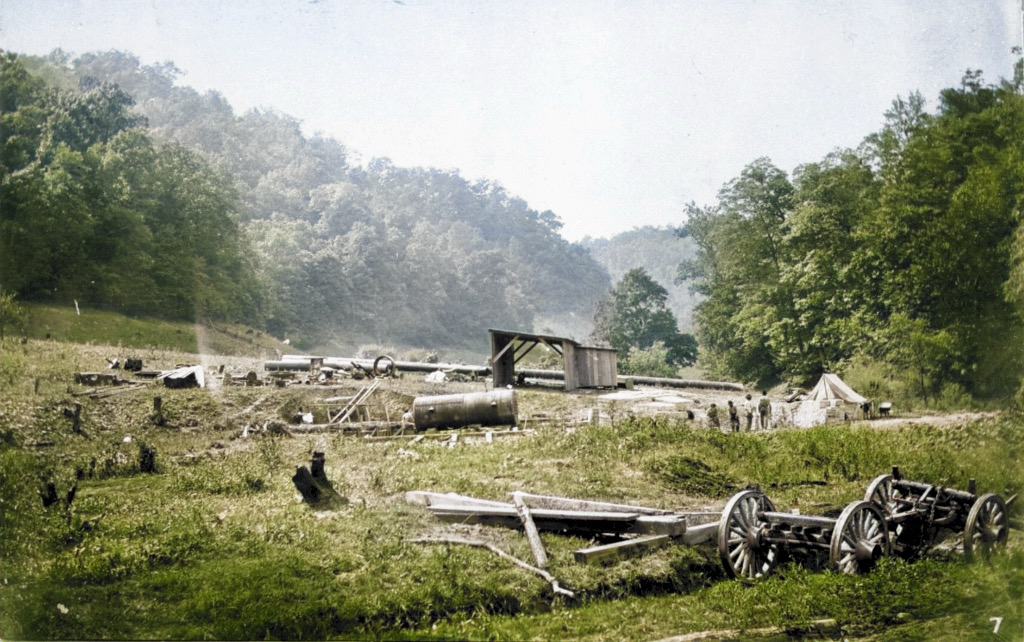
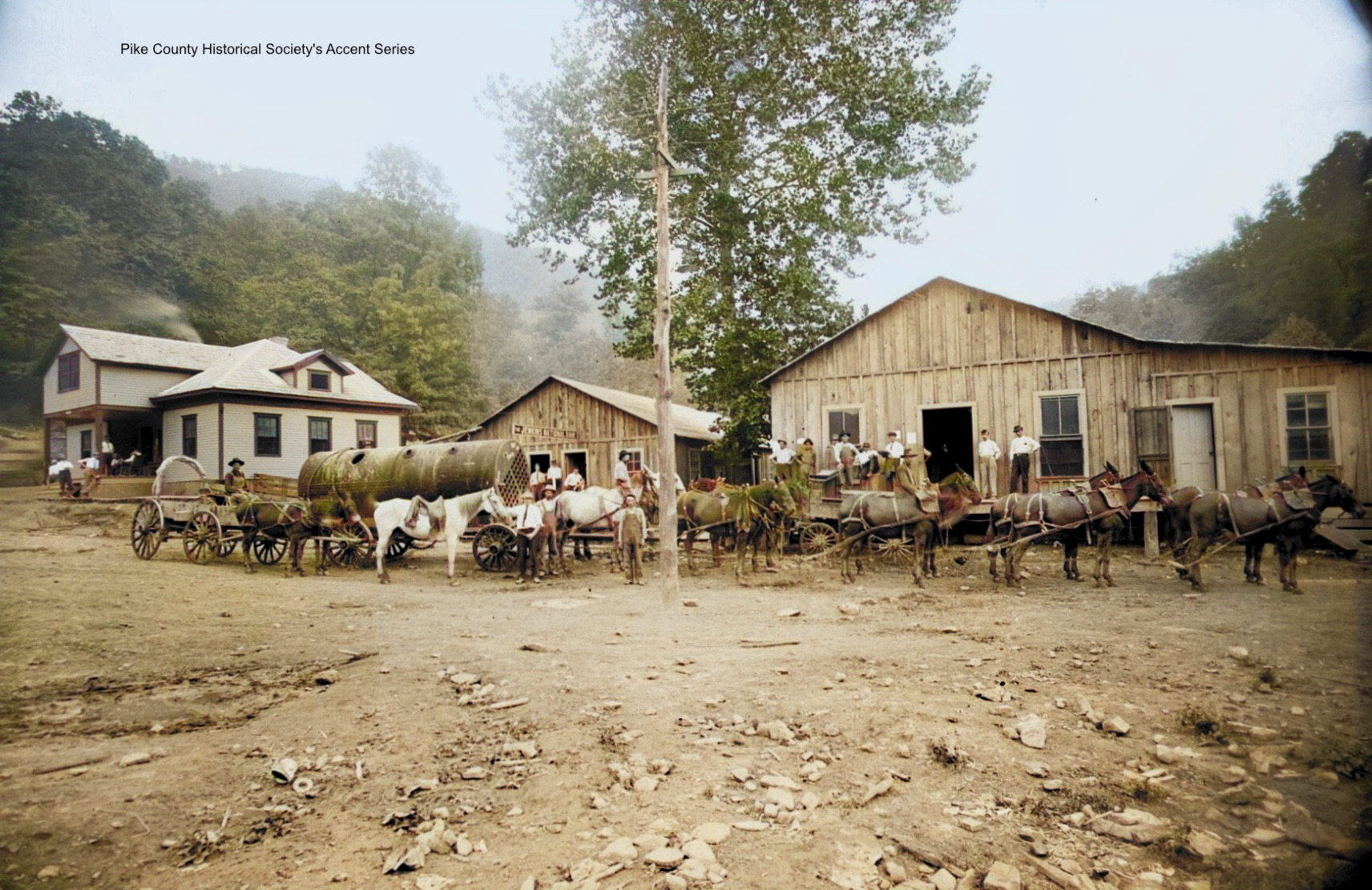
Mule Team pulling boiler from Ash Camp
No.2 Sawmill
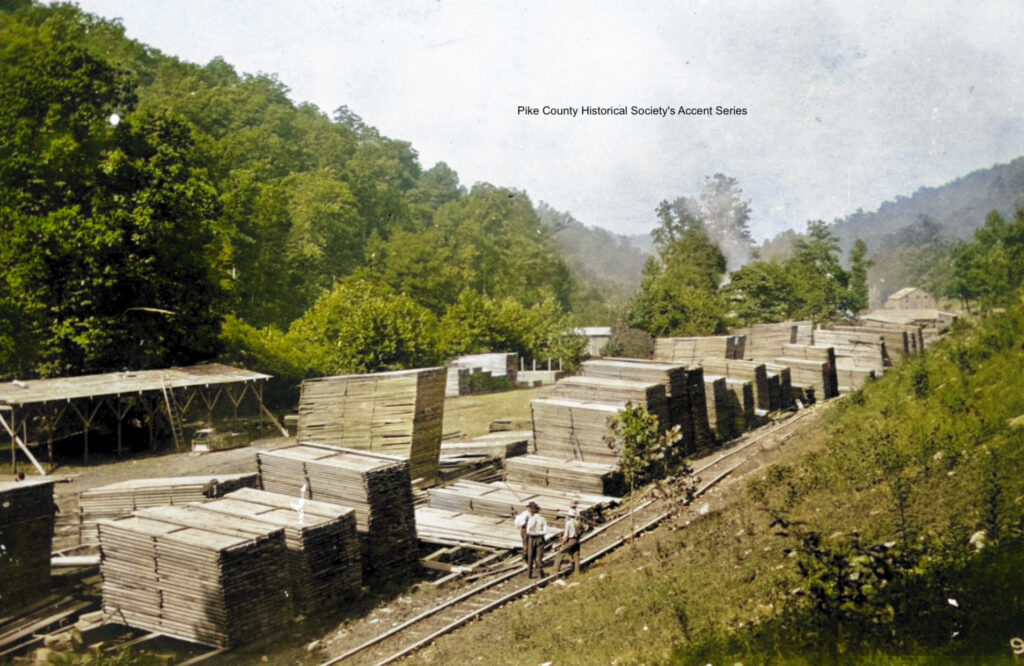
Consolidation City would require millions of board feet of lumber to build its great town.
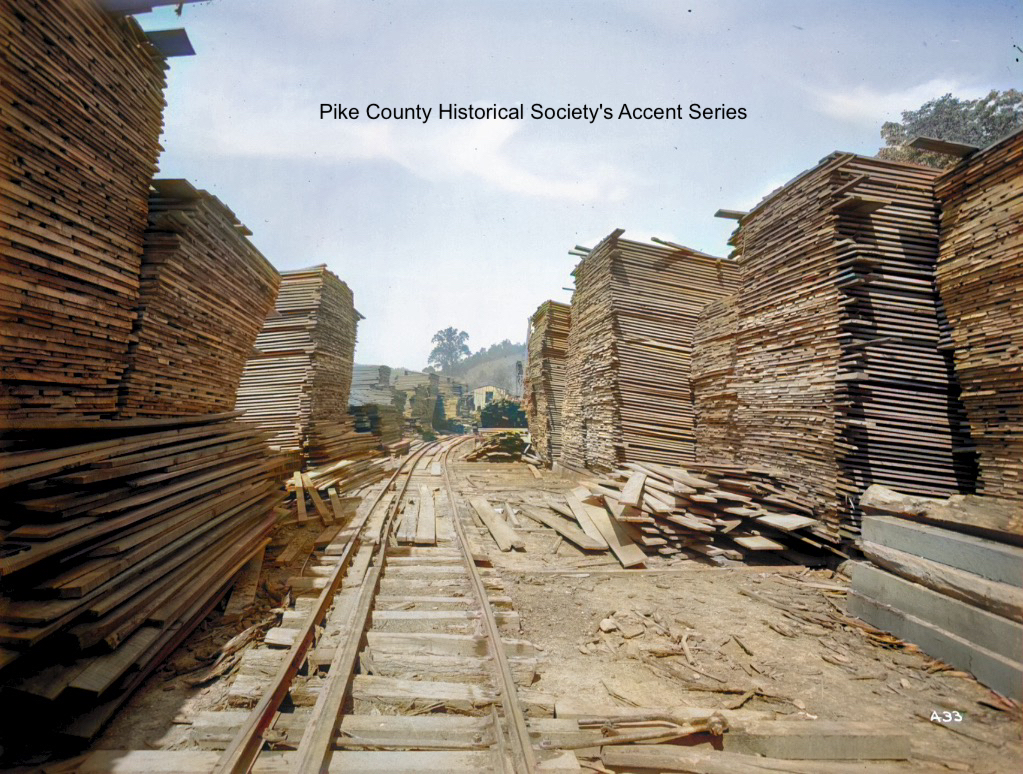
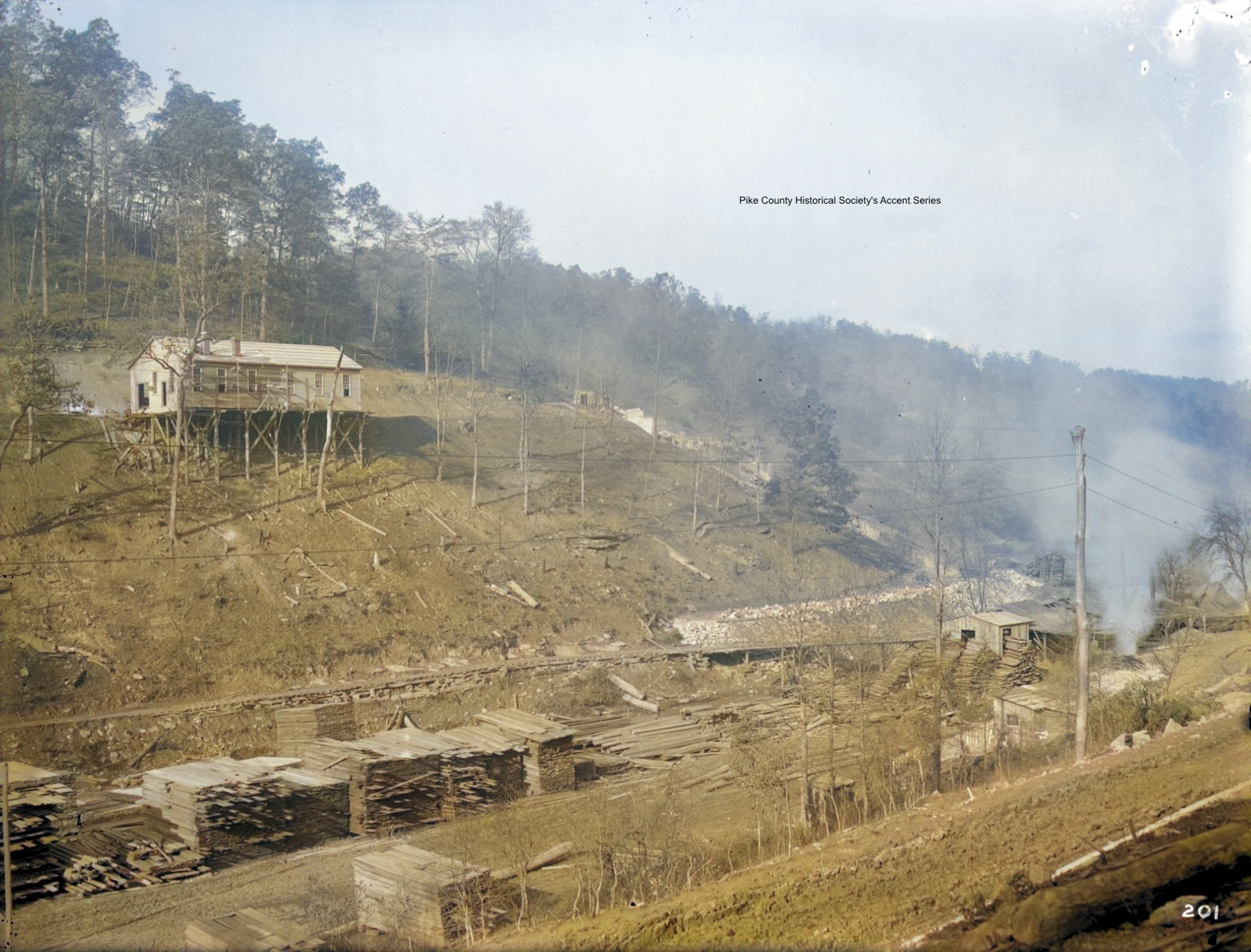
Wrights Fork Sawmill
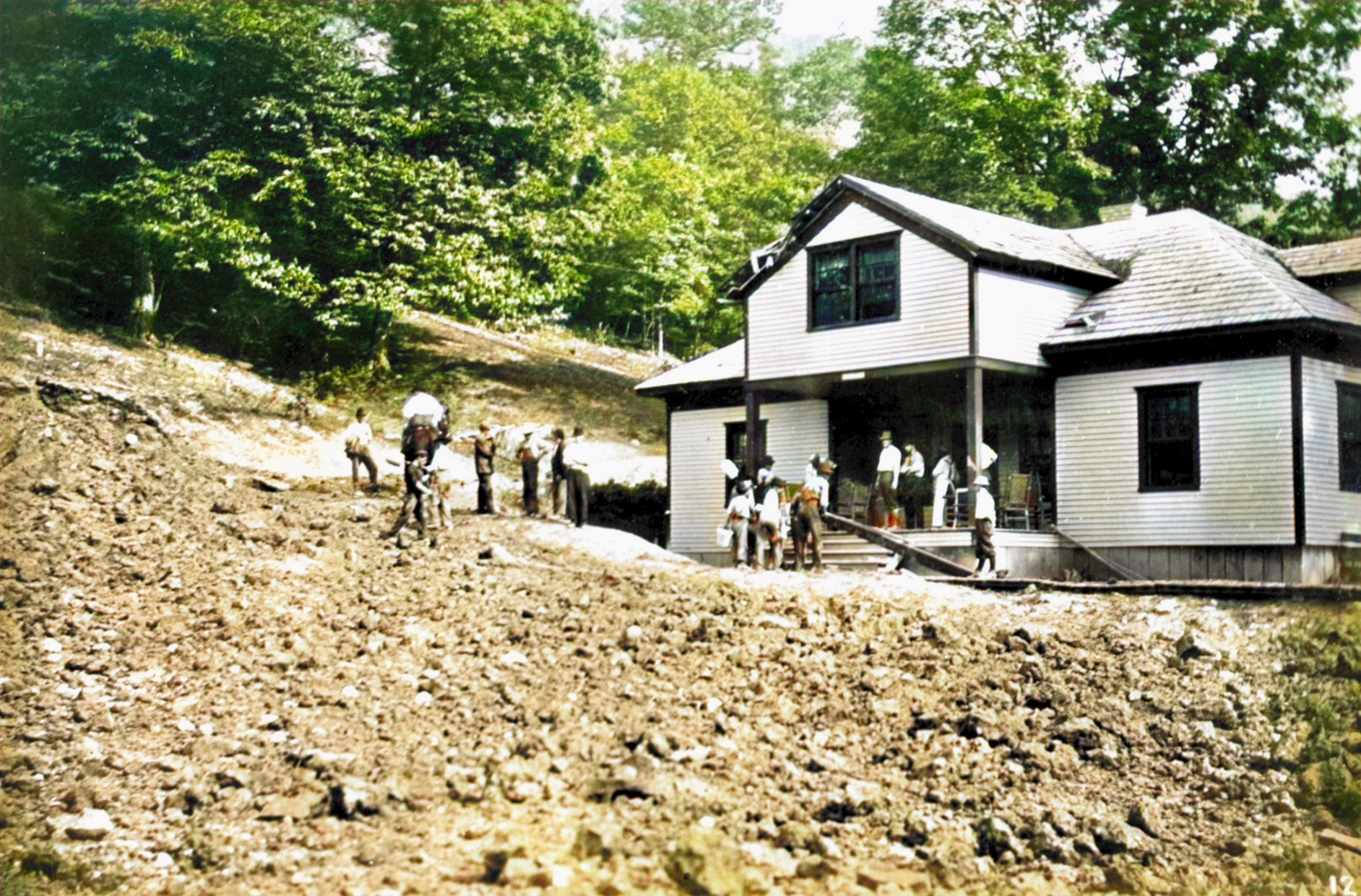
Newly constructed Bungalow, construction crew were building a road above house. while using dynamite to blast rock. accidentally shot part of the roof off when a piece of rock tore through roof of Bungalow. It was always said this house was built for Devil John W Wright’s
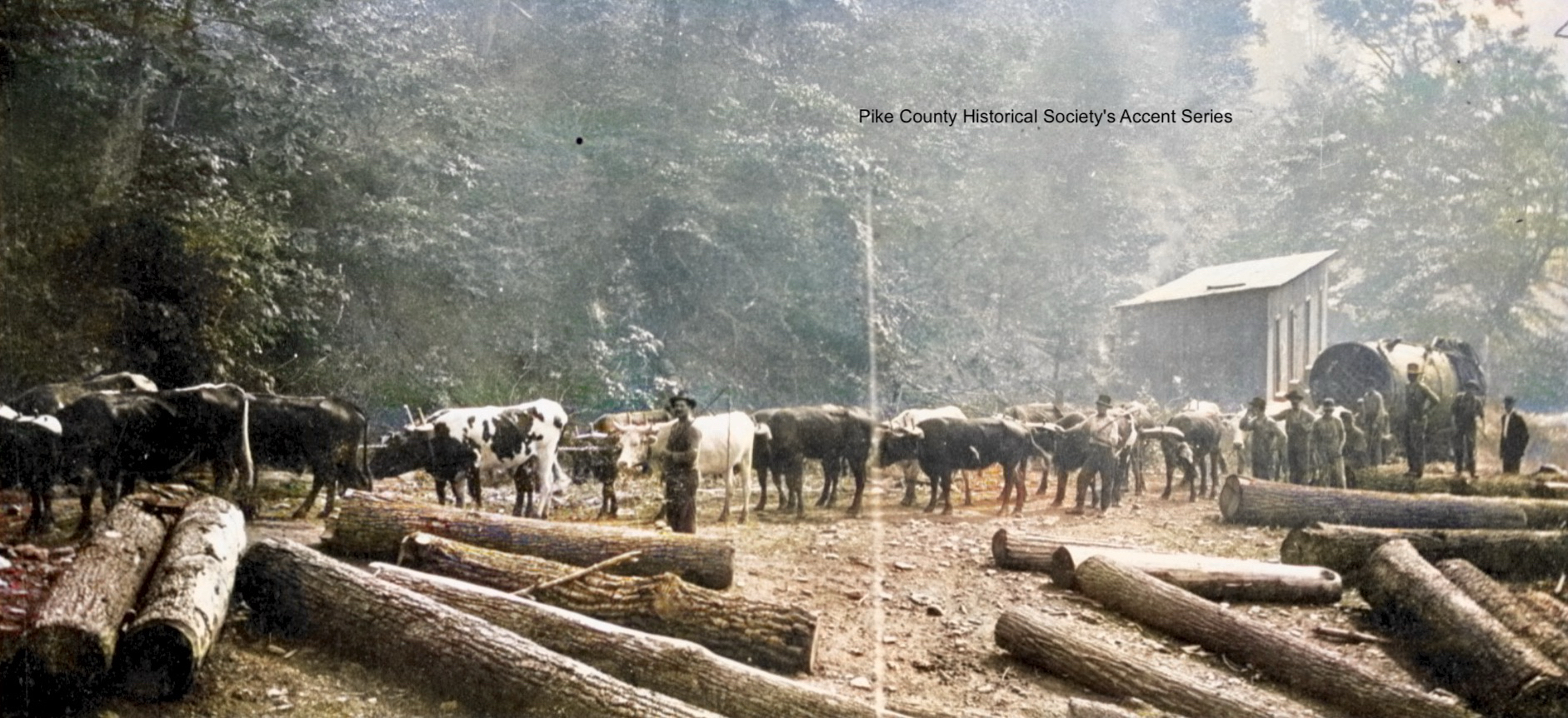
Oxen Team Hauling Power Plant Boiler To Projected Mine Site 206
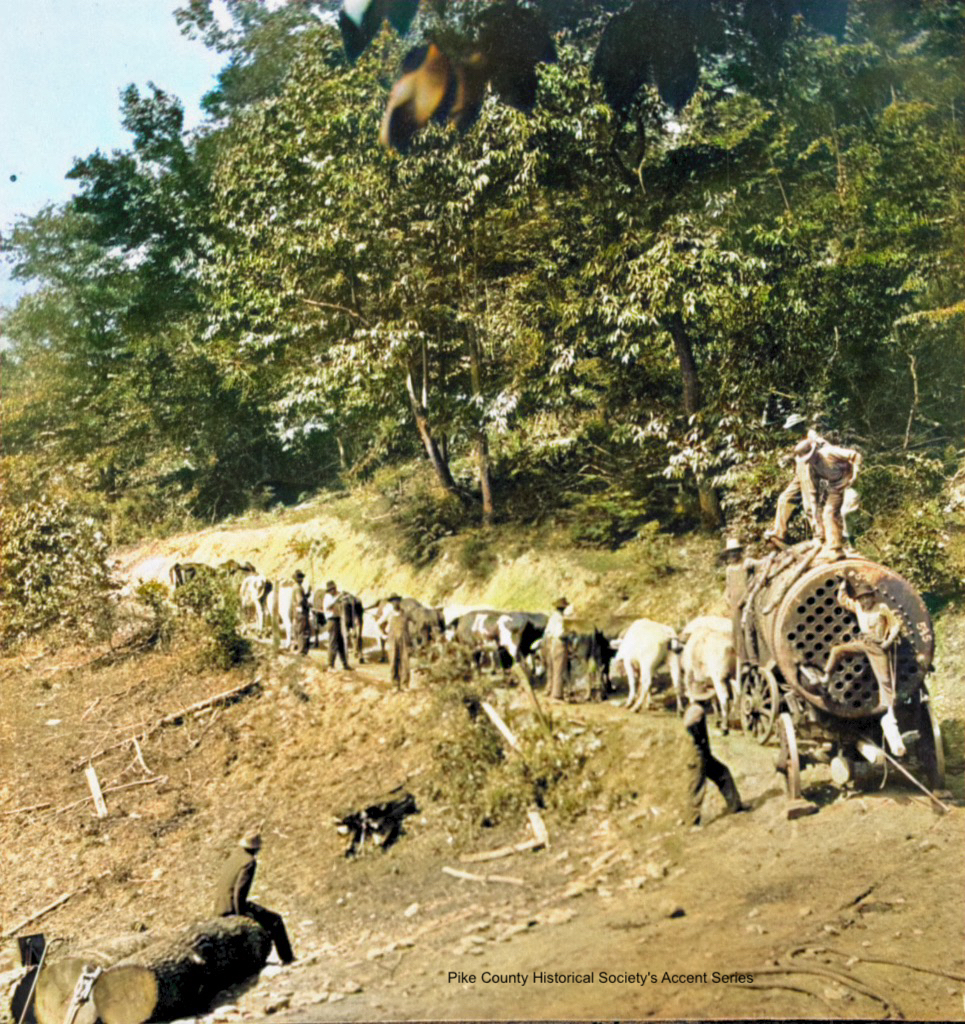
Oxen Team entering future site of Mine 206
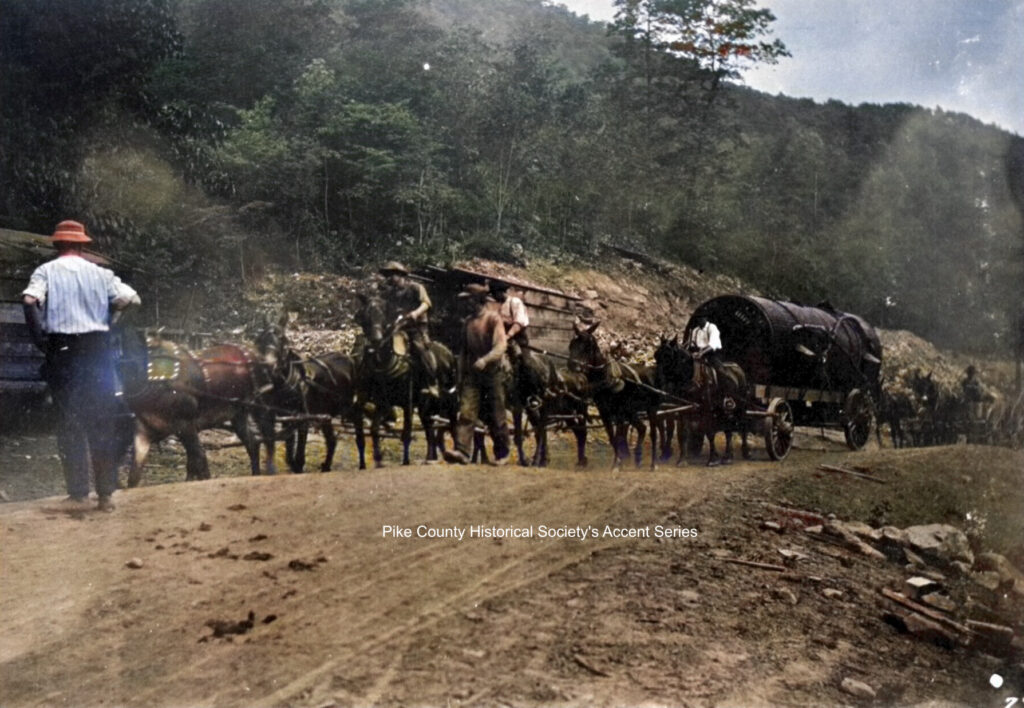
Mule Trains bringing supplies up from Ash Camp. Supplies were transported by rail up to Hellier Depot, the supplies were loaded onto wagons, transport through Gap on the Left Fork of Brushy Branch at Edgewater’s mine, then down to Ash Camp, then up Elkhorn Creek to the future home of Consolidation City.
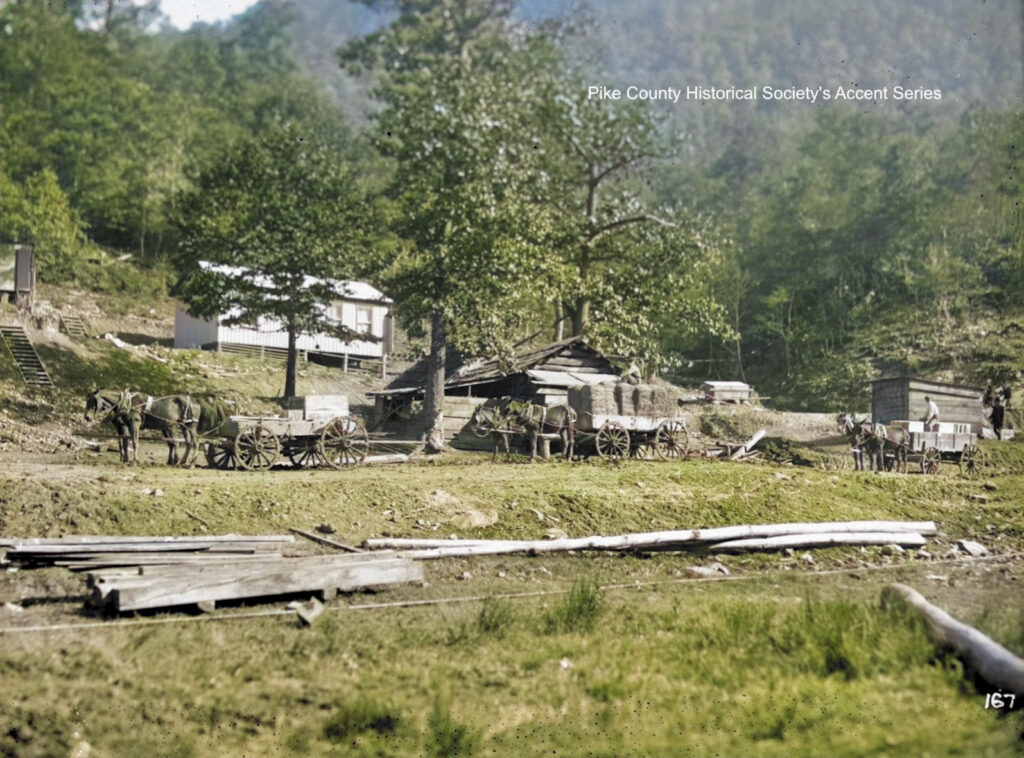
Elkhorn Creek near the mouth of Little Elkhorn
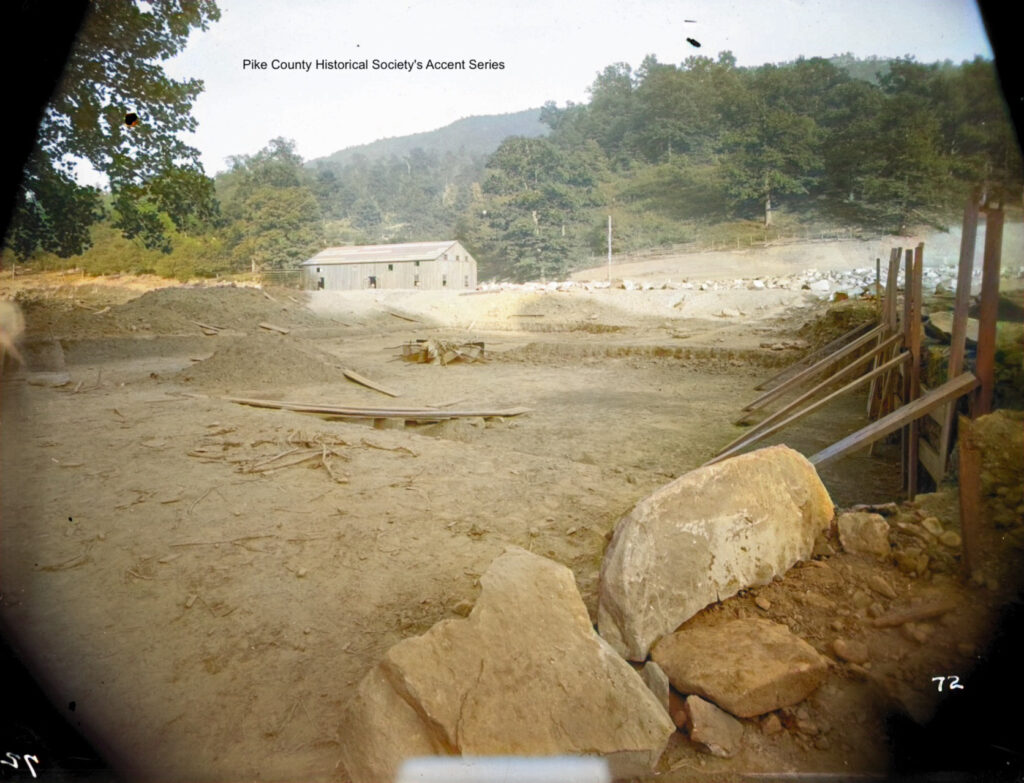
Future Main Street looking up Elkhorn Creek
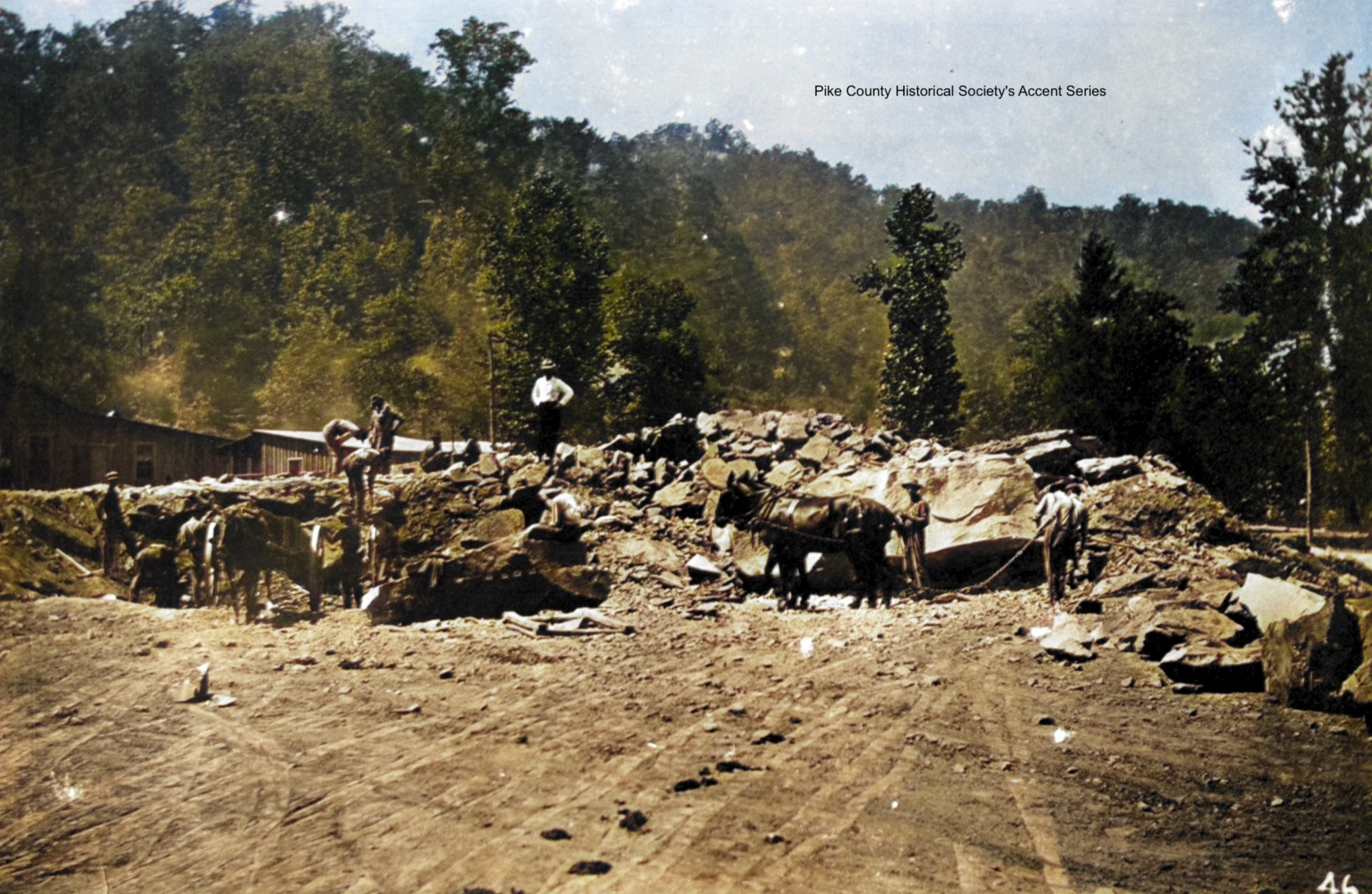
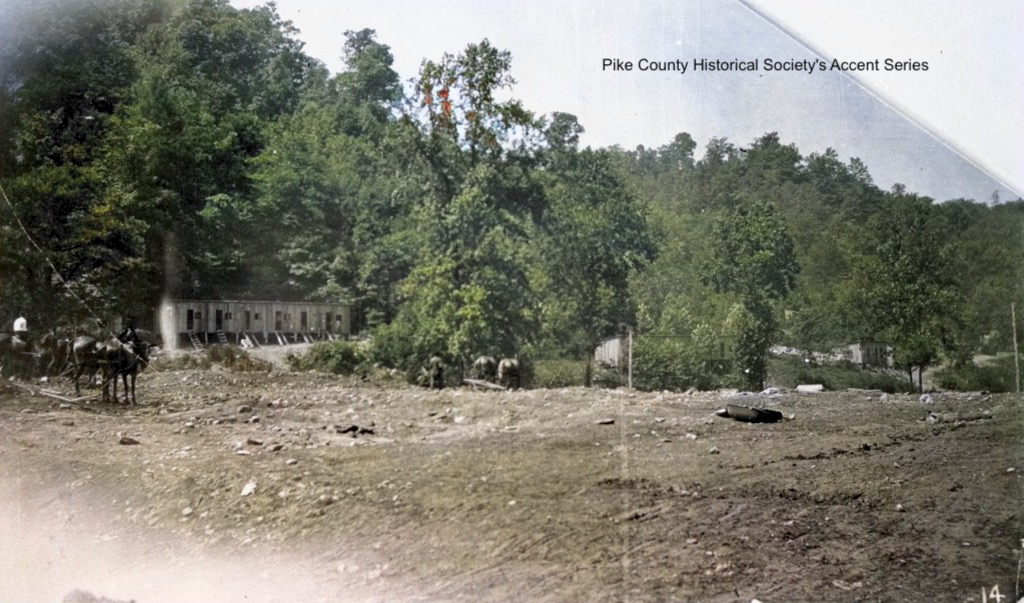
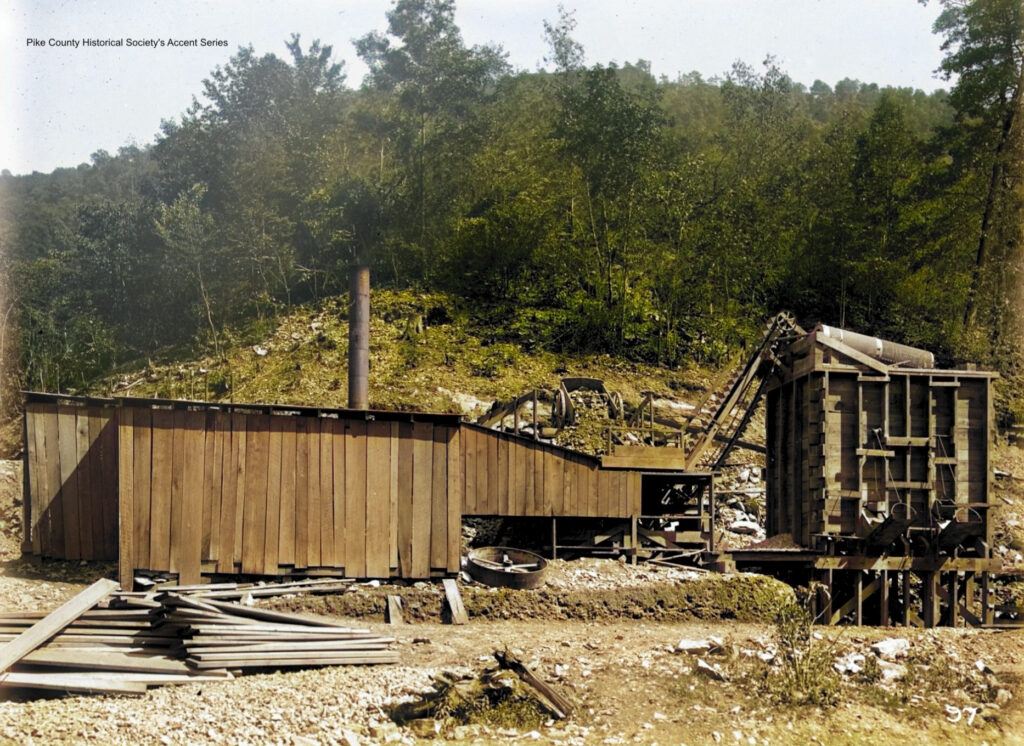
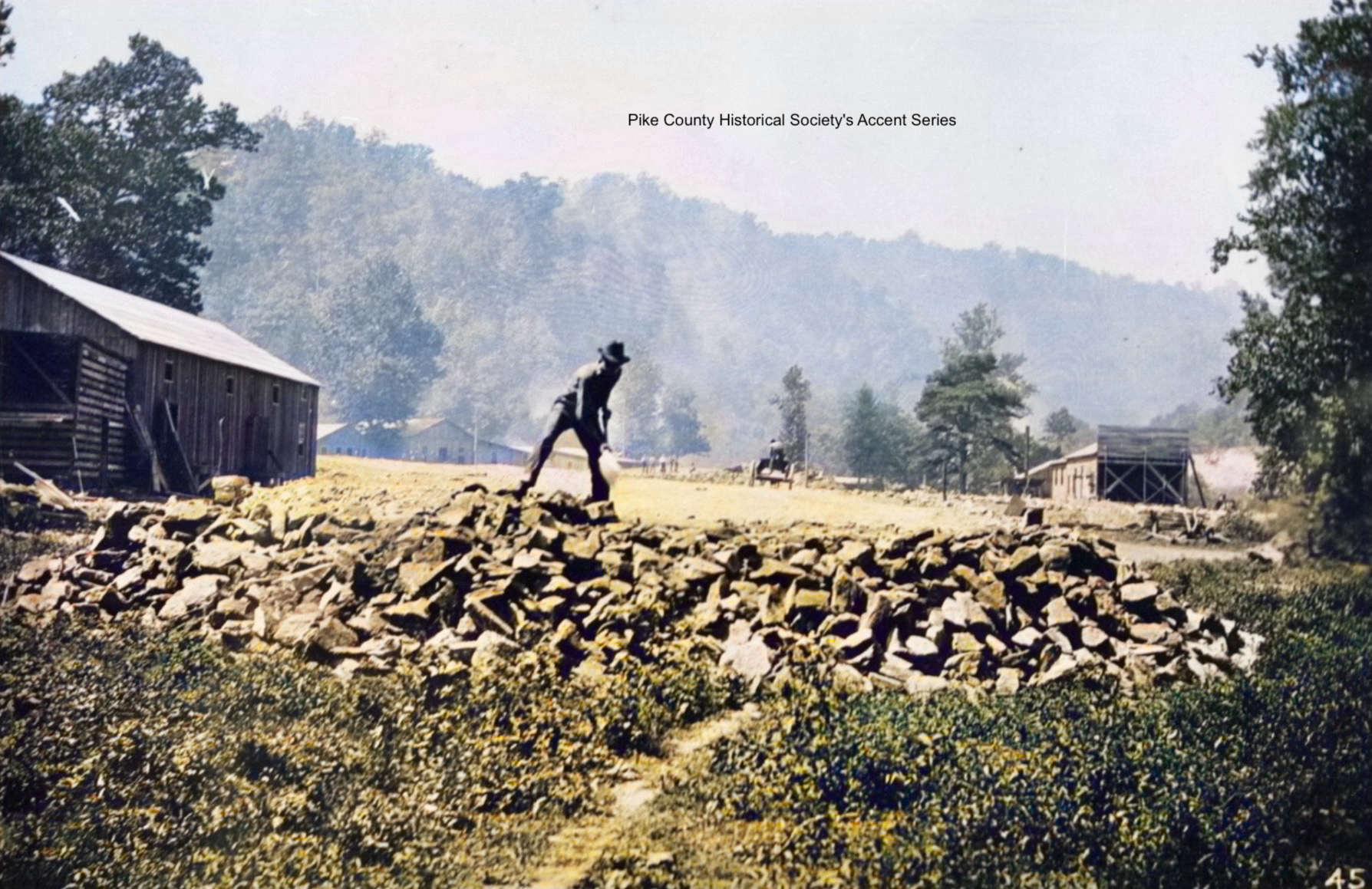
Having a good a road base and sturdy building foundations requires several thousands ton of rock. A rock crusher was shipped in small manageable pieces and reassembled on the point between Little Elkhorn and mean Elkhorn Creek.
Constructing Road Base and leveling up Grade on Main Street.
Construction of Boarding House near the site of the Old Coke Oven on Main Elkhorn Creek.
Construction on Club House
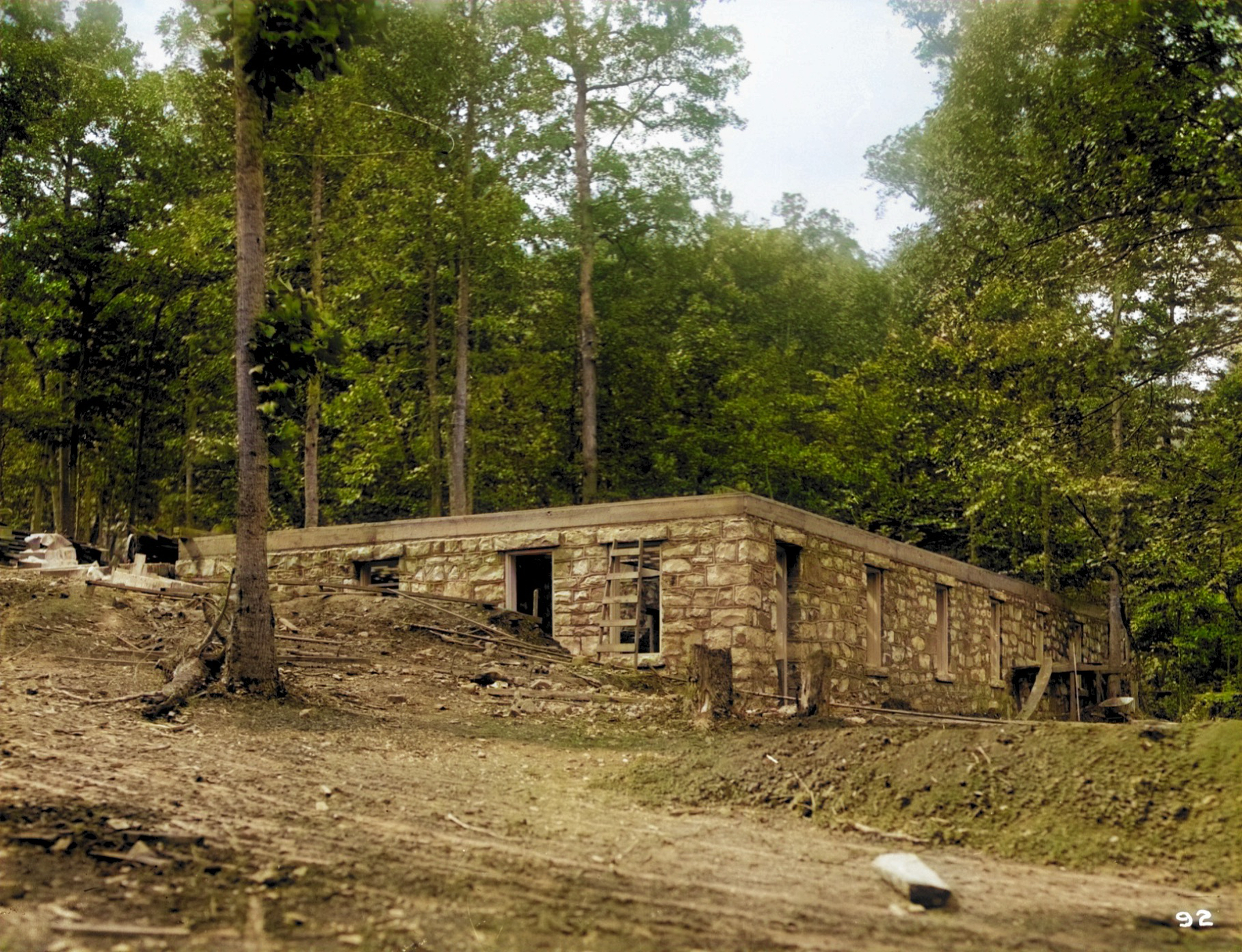
Club House is taking shape.
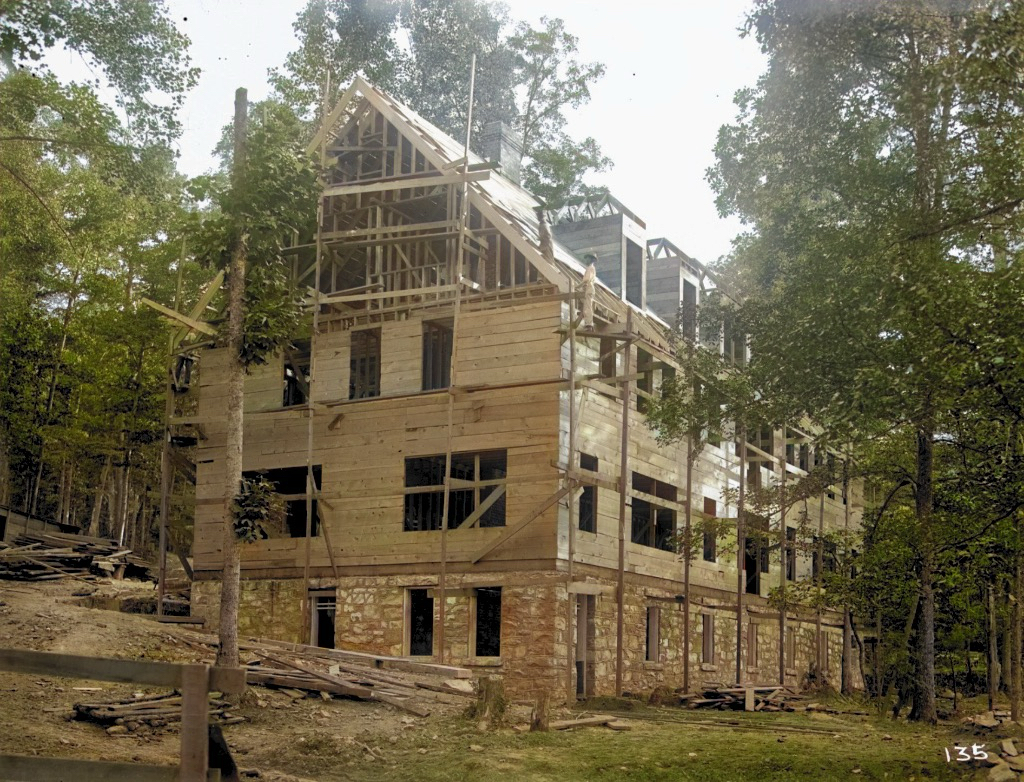
New home construction on Lonesome Cove Branch
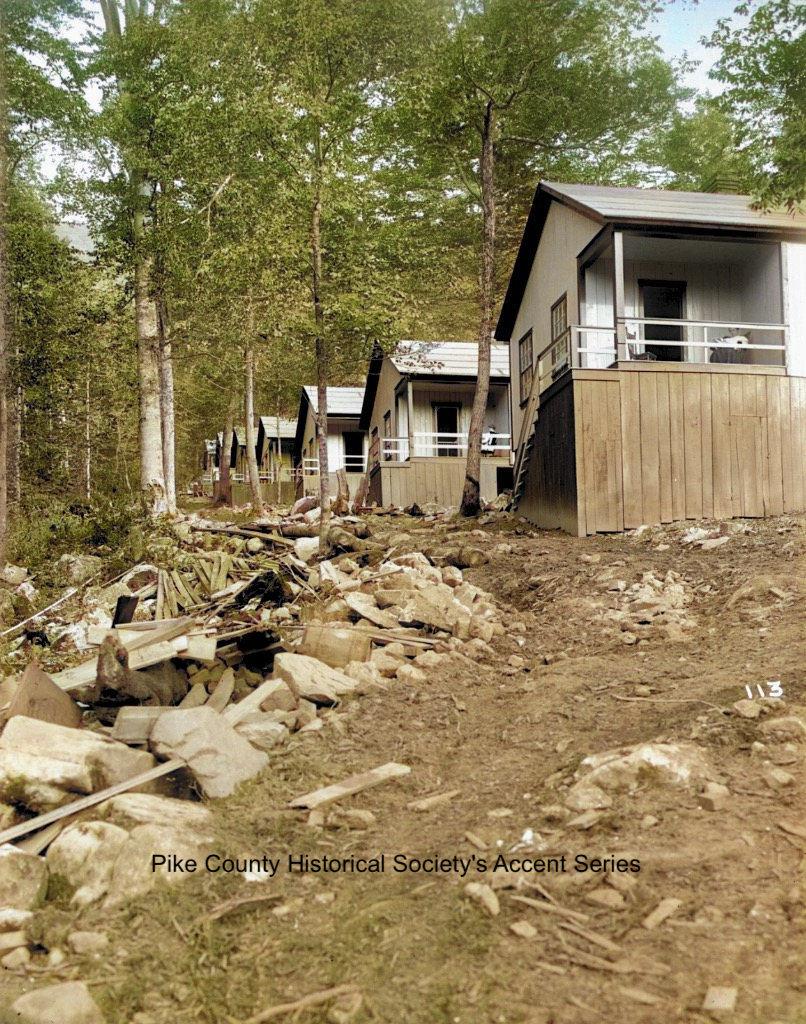
Langhorne & Langhorne Railroad Construction Crews Near Joe’s Branch, Making Grade
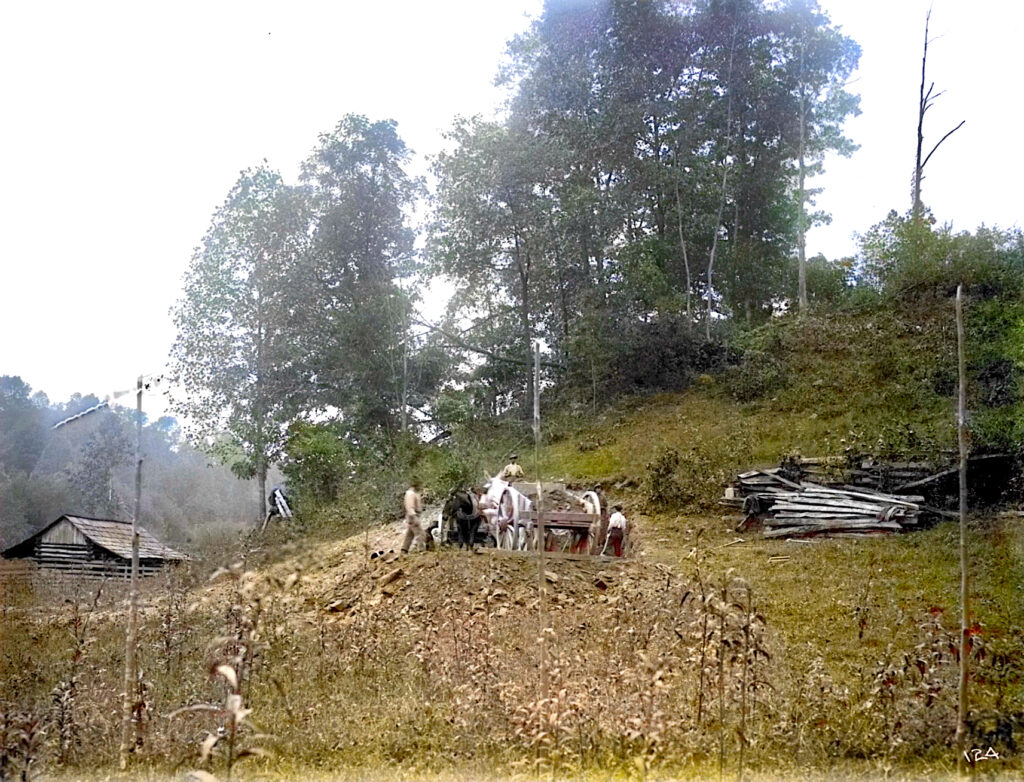
Early on Northern Coal & Coke Co had plans for the building of a large community in o the Head of Elkhorn Creek. A couple of newspapers would call this unknown town Consolidation City long before the final deal was signed transfer ownership of one hundred thousand acres from Northern Coal & Coke Company to Consolidation Coal Coke Company. In this particular sale the right hand had known what the left hand thinking because the majority of the stockholders in Northern Coal & Coke Co., was the persons that owned stock in Consolidation Coal, same goes with the transfer of mineral assets to Beaver Creek Consolidation Elkhorn, nearly a portion were stockholders in the above mentioned.