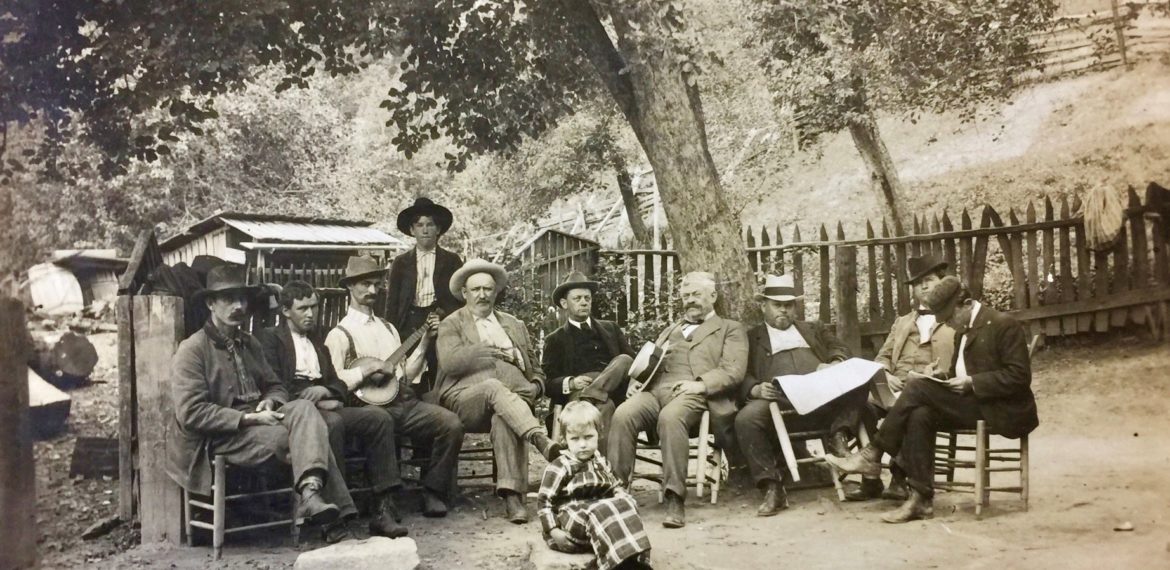
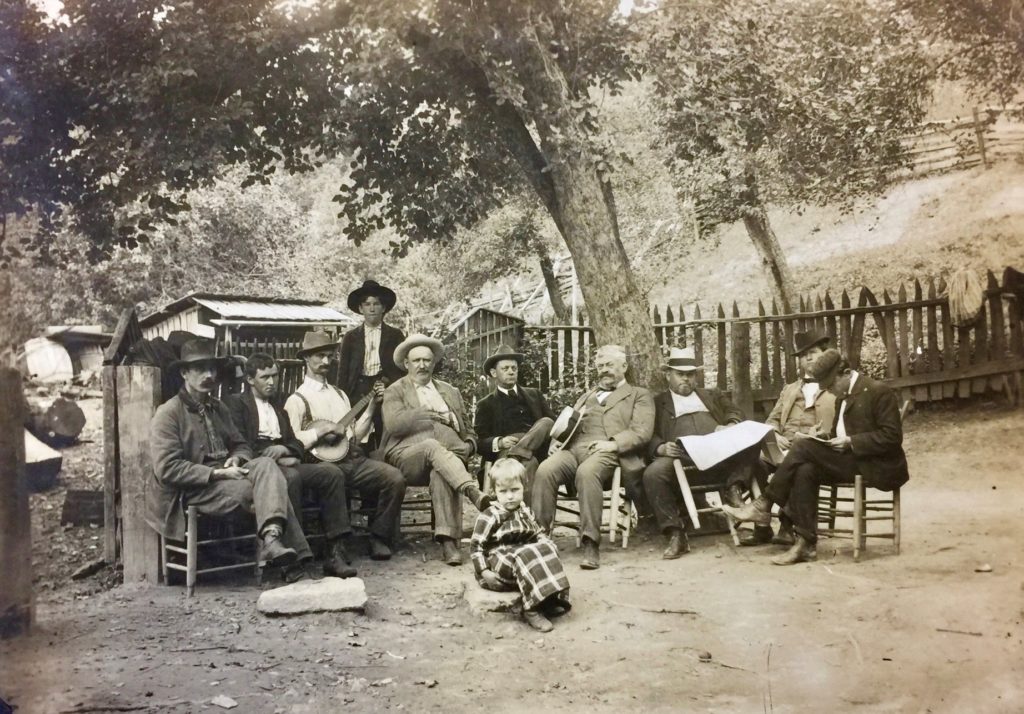
The people in the photograph were:
[Far Left] BENJAMIN FRANKLIN JOHNSON, better known as B.F., was a storekeeper who lived on Long Fork of Shelby Creek. He was chosen by the businessmen in the party for his detailed knowledge of the region’s topography and its people.
[Second from Left] Probably GEORGE F. JOHNSON, son of B.F., who came to be known as G.F. and enjoyed a reputation as a businessman.
[Third from Left with Banjo] HENRY CLAY JOHNSON was a noted local musician. He, like B.F. Johnson, was chosen for his knowledge of the mountain paths and the folks who lived along them. Note that this was more than likely a prompted, staged photo; Johnson’s picking hand is on the strings, but there is no blur of motion to indicate that he is playing.
[Fourth from Left] The young man standing appears in other photos with Peter Kimberly and was probably his personal assistant.
[Fifth from Left] PETER KIMBERLY was an industrialist, natural resource developer, and speculator. A year earlier, he had sold two iron ore mines in the Mesabi Range for $1,000,000.
[Sixth from Left] GEORGE S. COUCH was a partner in one of the highest-regarded law firms in Charleston, West Virginia as well as a founder and president of the Kanawha National Bank.
[Seventh from Left] JOHN T. JONES, like Pete Kimberly, was a prominent industrialist and speculator/investor in natural resources.
[Eighth from Left] FRANK H. BUHL was the grandson of a German immigrant. His father had been a fur trader and mayor of Detroit before starting the Sharon Iron Company. At the time this photograph was taken, Buhl was manager of the Sharon Iron Works in the Shenango Valley of western Pennsylvania as well as owner of several coal mines and smaller steel mills.
[Eighth from Left] JOHN C.C. MAYO was a native of Pike County. His family moved to Paintsville, Johnson County, when Mayo was an infant. After graduating from college and teaching for a time in the local public schools, Mayo began investing in coal. Mayo was solely a speculator who never developed the coal, but simply bought it in order to resell. Today his name is almost invariably associated with the broad form deed.
[Ninth from Left] JAMES ROBERT THOMAS, like George S. Couch, was a Charleston, West Virginia banker and source of investment money.
[Front Center, Seated] Young daughter, probably Lelia, of Henry Clay Johnson.
* * *
BUHL, JONES, and KIMBERLY were three industrialists who, along with JOHN C.C. MAYO, had made a July 1901 down payment on a 16,000-plus-acre spread of coal rights which had been put together over a 15-year span by a family from Boston and New York City. Mayo was well acquainted with the tract, but lacked the personal resources to make the purchase himself.
COUCH and THOMAS were only two of several sources of finance for the purchase. Once the earnest money had been delivered, these men set out on a tour of inspection to validate Mayo’s claims as to the quality and quantity of the coal.
Once the inspection tour proved satisfactory, final payment was made in November 1901. The investors created a corporation called Northern Coal and Coke to hold rights to what would soon become known as the ELKHORN COAL FIELD.
Economic panics in 1901 and 1903 prevented Northern Coal and Coke’s planned development of the Elkhorn field. Beginning in 1905, a series of stock transfers eventually led to Consolidation Coal Corporation owning the coal acreage.
Once Consolidation acquired full ownership, it began development immediately. The first major project was the building of the town of Jenkins, followed closely by the construction of mining facilities and smaller communities nearby, as well as completion of the SANDY VALLEY and ELKHORN RAILROAD from Shelbiana to Jenkins.
The rest of the story is that of Consolidation Coal’s role in the economic development of Pike and Letcher counties.