
By Robert Baker
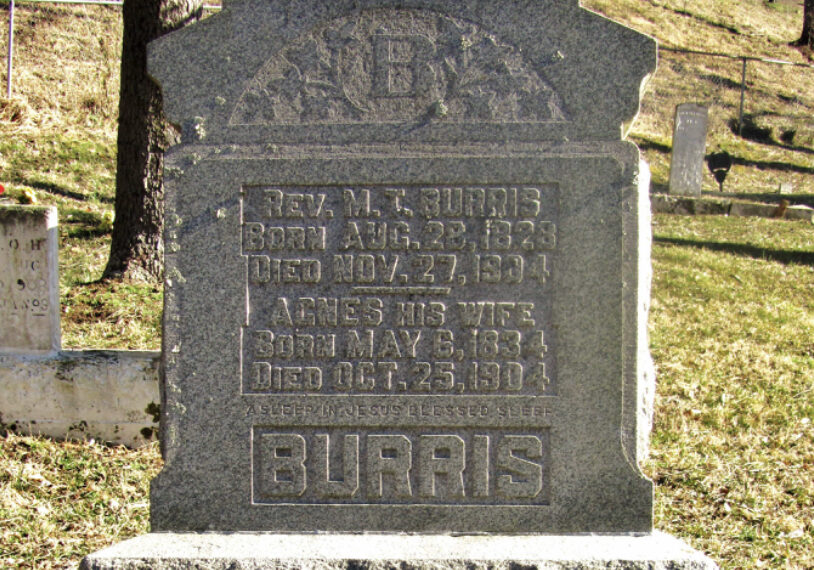
After extensive research, the Reverend M. T. Burris is still something of a mystery. What little that can be learned about him comes directly from his own writings reproduced here and from a few scattered public records. However, it is clear that he was an early school-teacher in the Big Sandy Valley, that he was raised in the vicinity of John’s Creek, and that he was a long-time resident of the area and familiar with many of the first settlers of the Valley. The Reverend Burris was briefly identified by William Ely in his book, The Big Sandy Valley (1887): “M. T. Burriss, now of Rockville, is one of the old-time teachers of the valley. He was raised on Johns Creek, in the Leslie settlement.” (p. 26) Historian William Elsey Connelley, also a Johnson County native, cited Rev. Burris as a source for his discussion of Jenny Wiley published in Judge Charles Kerr’s five-volume History of Kentucky. He may be the “M. G. Burriss” who was married to an unidentified lady in Lawrence County, Kentucky, on July 20, 1833. (Kozee, Pioneer Families . . ., p. 121) A clue in this account indicates that Rev. Burris may have married a “Miss Spears.” He was listed as a resident of Catlettsburg, Boyd County, Kentucky, in 1870. By his own account, he left East Kentucky for Golden, Missouri, in mid-1890. His letters to Connelley were posted and dated from Golden, Missouri, in 1902 and ‘03, so we can assume that he survived at least into 1903. Since the Reverend’s promised autobiography was not included with these papers, it is reasonable to assume that he may not have lived long enough to write and mail it to Connelley. If the 1833 Lawrence County marriage record is, indeed, the Rev. Burris, then it is possible that he lived to be about ninety years old.

The original typescript of this account ran to thirty-two double-spaced, legal-sized pages (the original was apparently longer, though nothing seems to be missing from this version, “Rev. M. T. Burris wrote for me a manuscript of almost one hundred pages on the history of the Valley; nine-tenths of it is genealogy.”): – a very significant amount of material, especially for the region and time period it covers. Even more significant, the Reverend was often citing his information from his personal knowledge and experience, and from his own acquaintance with many of the people mentioned in the account. Though he relates some of his knowledge from other sources, many times someone who was themself a witness to those events, a great deal is derived from his own participation in some of these early events and thus is considered fairly reliable. Still, on occasion, the Reverend’s memory slipped or he was confused, and this is most noticeable in the recounting of the names of the children of the pioneers or in naming who married whom. The reader is cautioned that Burris’ account is for the most part, fairly accurate, but it is not entirely free of an occasional error in fact.
While the Reverend was quite literate, the typescript contained some errors of grammar which were improved. Since the grammatical errors were of a different nature than those I have seen in Connelley’s own writings, I have assumed that the typescript was a fairly accurate transliteration of the original letter (the multiple misspellings of Connelley’s own name attest to this possibility). As well, and as Burris states himself in the notes at the beginning of the manuscript, words were occasionally left out and I have replaced them, [indicated in brackets], wherever I felt confident that I knew the correct word and that the addition would not affect the sense or meaning of the passage. In addition, Burris (and occasionally Connelley) often added explanatory notes in parentheses. These were preserved in the text and I call the reader’s attention to them. There were a variety of literary idiosyncrasies in the manuscript, including unusual abbreviations and the excessive use of semicolons. Most of these peculiarities were assumed to be those of Burris, but a few were possibly Connelley’s. I have chosen to improve the text in some passages to improve readability. However, I have tried to err on the side of “less is more.” To preserve as much of the flavor and style of the original as possible, I have done my best to avoid “over-editing” the text. In a few places, ellipses can be found where some words were omitted. In almost every case, these were repetitions or redundancies which did not contain any new information. In addition, I have standardized the spellings of many of the proper names given in the text, including that of Burris himself, usually deferring to the modern spelling of the name as it is now found in the mountains.

William Ely’s book, The Big Sandy Valley (1887), provides some of the most complete and detailed information available for the early pioneers in the eastern mountains of Kentucky. The Reverend’s account complements Ely’s book nicely, filling in many of the gaps and adding some detail not found in the earlier work. Ely’s work focused more on the people and events at the mouth of the Big Sandy River, though much space was devoted to the first families of Pike and Floyd Counties and the lower Valley. Although William Ely’s book covers the entire length of the Big Sandy Valley and its notable citizens, his focus is noticeably elsewhere, usually on Catlettsburg and Ashland or in the more established towns of Prestonsburg, Paintsville, and Pikeville. Reverend Burris’ account also discusses events and people from both ends of the Valley, and all points in between, but he devotes a great deal of space to the first settlers along John’s Creek, the Tug Valley, and many in Johnson County, in effect making up for the deficiencies in The Big Sandy Valley. Certainly, he must have possessed a copy of the book and wrote his own account of the settlement of the region with the intention of correcting the omissions and errors in the older work.
One family which benefits greatly from the Reverend’s attention, among the many, is the Leslie family. While Ely devoted some space in his 500-page work to a discussion of a few important members of this family, he only mentions their involvement in the early settlement of the Valley in passing and never explains it very clearly. Ely seemed to assume that his readers already knew the story and did not want to burden his already thick book with what he may have considered to be “common knowledge.” Generations later, Ely’s book is more notable for what it leaves out than what it provides. Burris more than makes up for the deficiency in this account, devoting almost seven full pages to the subject. He spends much more time on the Leslie family history than others, but he also discusses at length other families just touched upon in Dr. Ely’s extended work. Again, Burris’ mission of filling in the gaps left in Dr. Ely’s work is partly fulfilled in these unpublished notes.
Burris’ account provides repeated evidence of what might be called the “Appalachian diaspora”: the massive emigrations from the eastern mountains of the Bluegrass State and the settlement and population of many sections of the American West by those who settled first in the Sandy Valley. There are many references in this work to one branch of a particular family settling permanently in the eastern Kentucky mountains, while another chose to sell their Kentucky property and emigrate to Indiana, Illinois, Missouri, Arkansas, Minnesota or Wisconsin, sometime between 1825 and 1870. Oftentimes, this emigration followed close on the heels of a recently-completed war with the Indians, as was the case in Indiana and Illinois, and Minnesota. This rambling account provides strong testimony that many of the towns of the West were settled by the brothers and sisters of those who first settled the Big Sandy Valley in the early decades of the Nineteenth Century. In effect, the West was settled in large part by Kentuckians who kept moving until they found the most desirable tracts of land in the newly-opened territories. Disenfranchised in the Old Dominion and the former Colonies, they established themselves in virgin territory and became the landed aristocracy of the new territories.
The Reverend discusses events which occurred at many different points in the Big Sandy Valley, but it seems that the people he knew and the places he visited were located mostly along John’s Creek, south of the Leslie settlement and focused mostly around Raccoon Creek. His comments reveal that the John’s Creek region was never really “uninhabited,” as it apparently served as a burial ground to the Native-Americans and was the site of some of the first permanent settlements in the region. He also displays a great deal of familiarity with the Tug Valley inhabitants and provides some of the most detailed and extensive information for this somewhat remote and forgotten section of the mountains, later home to the infamous Hatfield-McCoy feud. While members of the Hatfield family dwelt on the Kentucky side of the Tug River, they were not part of the “set” involved in the shooting. The Kentucky bank of the Tug was the home of the McCoys and the scene of the majority of the violent episodes in the feud. Thus, Burris gives us a picture of what that little-studied region resembled twenty or more years before the first bloodshed in that storied conflict, and provides some significant details about the family. Regrettably, though, as he states near the end, since the “war” was already well-covered in the newspapers, the Reverend elected to forgo an explanation based upon his understanding of the conflict.
The time frame for most of the events mentioned appears to be the three decades after the founding of the first towns in the region (early- and mid-1820’s), but Burris also recounts events told to him from before his time and even after his emigration from the eastern Kentucky mountains to Missouri in 1890. The account covers sixty or more years’ worth of history for the Big Sandy Valley and much of it about families overlooked and neighborhoods not discussed in any other sources about the region. Burris also provides many second-hand accounts of the first three or four decades after the first attempts at settlement in 1790, in all, discussing more than one hundred years’ worth of reminiscences for a region for which there exist few similar histories.
A portion of this material was previously excerpted and presented in William Elsey Connelley’s East Kentucky Papers: The Founding of Harman’s Station, published in 1910. The majority of this material has not been seen for at least seventy years. The source for this account was the William Elsey Connelley Collection in the Western History Collections at the University of Oklahoma Library, Box 2, Folder 29. Special thanks are here offered for the assistance of Curator Kristina Southwell and graduate assistant Josh Clough, who made the extensive set of photocopies of this material.
“A Sketch of the Big Sandy, Ky.,” by Rev. M. T. Burris
November 6, 1902.
My Dear friend Connolly–I hope you are well. I have not reviewed M. S. You may find words left out.
M. T. Burris.
Golden, Mo.
Nov. 6, 1902.
Mr. William E. Conley:
Dear Sir:–I will now undertake the important task of writing a sketch of the Big Sandy, Ky. It sounds or reads like a romance, no doubt, to many who may read it. Yet, those who know the facts will be interested in a rehearsal of the facts in regard to its settlement and their ancestors who have long since passed away.
About 1789, perhaps a little before that, many hunters and explorers who were fond of adventure penetrated the Valley, among high mountains, and heavy forests, where deer, bear, elk, wolves, panthers, [and] buffalo were in abundance, as well [as] turkeys, pheasants, coons and wild cats. Indians made frequent raids up Big Sandy, and Guyan rivers into Tazewell and [the] adjoining counties [in] Virginia. The citizens forted there, but many lost their lives while out hunting and other business. Many of those pioneers at length settled on Big Sandy; among them were the Harmons, Strattons, Auxiers, Mays, Pattons, Ratliffs, and Leslies and others, which I will name hereafter.
Big Sandy was first settled at [the] head of Tug and Levisa Forks; but when the Indians were driven back, the settlers kept on filling up the Valley from head to mouth. The Auxiers and Hagers came from [what] now is Scott Co., Va., so I heard John B. Auxier say. [In] 1790, they, with the Harmons, Henry Skaggs and others built the Block House, half a mile below the mouth of John’s Creek, Ky.; now Johnson Co. The Auxiers and Hagers came from the River Rhine [in] Germany. Old man Hager built a house and settled about above the mouth of John’s Creek on the west side of Sandy. Mr. Auxier settled on the Block House bottom on the east side of the river. I heard Daniel Hager once say in a speech that his father landed on the Coast of North Carolina, [went] afterwards to [Virginia] (the southwest [section]). Mr. Hager had their Bible from which I read. His children that I knew were Katy, John, Daniel, and George Hager. Katy married James Shannon Layne, and settled in a large bottom where Laynesville is. Their children were Jenny, William, Tandy, John, Lindsay, and Samuel George. Sam G. was single. The four first sons were all married and died of fever in 1841, and left, each one, several children.
There was a colony [that] came when that neighborhood was settled. Henry [Stratton], commonly called “Uncle Harry,” Cornelius McGuire, [the] Browns, and Whitleys settled there 10 miles above Prestonsburg and forted, and “Uncle Harry” is said to have lived in the fort 15 years. He married a Shannon. I used to meet him at church and he was a good man, tall and spare made. I staid all night with him once; he was elected to Legislature three terms, but would not consent to have the office a fourth term, as he was tired of it. He raised several children, but they all died before their father, but left families. “Uncle Harry” died near Preston’s-burg, Ky., some time about 1856; age near 90.
Rev. Cornelius McGuire, his brother-in-law, came with [him] to Ky., [in] 1795[?], and settled near Mr. Stratton. It was said he preached the first sermon as a Methodist preacher that was ever preached in the thirteen mountain counties of Ky. He was rather on the tall order, full of zeal and did much good, [and his] hair somewhat brown. Mr. Stratton had great confidence in him as a Christian, and slipped [up] close to his house to hear him pray, and this was so full [of] earnest pathos that Mr. Stratton was so alarmed as to his condition, as a sinner, [that he] rushed into McGuire’s house and cried for mercy until he was happily converted, and died in the faith. Rev. McGuire was sent with a petition to the Bishop of the Ohio Conference to send them a preacher, and Benjamin Edge was sent in the fall of 1809. Rev. McGuire died at his home about 1810. Him and Easter, his wife, were two [good] Christians.
James S. Layne came and settled at the place now called Laynesville. Near 1803 he married Katy Hager, sister of Gen. Daniel Hager of Paintsville. Layne lived over 90 years. He had grown wealthy.
Tandy Stratton, Richard and Solomon Stratton came to Ky. near the same time and settled near Mr. Layne. Richard Stratton raised three or four sons, Henry, Hiram, and Harvey. They died a few years ago, Henry over 90, Hiram about 90 years or more. Tandy Stratton married Polly Preece, a daughter of Richard Preece who came from Tazewell Co., Va., before the War of 1812, and was murdered by Thomas Duty in the Reedy Bottom, below the mouth of Cow Pen in the lower edge of Pike county. Duty was said to be [of] a low character, and when he shot Preece, Preece soon became sick, and ordered Richard Ratliff and Silas Ratliff to arrest him. Duty ran off fifteen or twenty steps and began to load his gun; Silas Ratliff threw a stone at Duty and broke the gun off at the breech. Duty held [on] to the barrel and ran off with it, and, it was said he was never heard of but once, and that was on Pidgeon creek, W. Va., as he fled. An old lady who knew of Duty’s conduct at Lebanon, Russell Co., Va., told me that Duty and wife were accused of murdering a child and left Va. between two days to escape the penalty of the law, and came to Big Sandy and lived in a rock house some 3 or 4 years, at the foot of what is now called “Duty’s Knob.” It is the greatest curiosity on Big Sandy, a high peak, a mile north of Pikeville. Duty came there about 1808.
John Hatcher came from Va., married a Branham, and settled opposite or a little above the mouth of Mud Creek. [He] was a business man, raised 4 sons: James, John, Farley, and Anthony W. Hatcher, and one girl that I know of. She married Harrison Ratliff of Pikeville. They, as well as their descendants, as a rule, have good business qualities, and [are] honorable.
The Weddingtons and Damrons came from Va. about 1806 and settled and forted at the mouth of Hurricane, above the mouth of Mud. Also [came] the Meads: Rhoads Mead, Eli Mead, [and] Moses Mead. I think they came from Penn. Moses Mead was a hatter. Rhoads Mead was a stock trader, but moved to Indiana early in the last century, not a great ways from Louisville. He has a host of descendants in Ky., Mo., Ind., Ottowa Co., Kansas, at Culver, and one granddaughter, Eliz. Olive Lycan, in Boulder, Colorado. I will refer to her again further on.
Col. Thomas Price, a brother of Crabtree Price, who moved to Dade Co., Mo., at an early day, William C. Price that you know of in Springfield, Mo., was one of his sons. Crabtree Price was a secretary in [the ?] Department in Washington during President Madison’s term, and came in possession of [a] large tract of land in Pike County, Ky., on Sandy river. When he moved to Mo., he got Thomas Price to see after it, and somehow, it fell into his hands: the Reedy Bottom, Mossy Bottom, and much more. I suppose it was sold for taxes. Thomas Price was a large, tall man. I would judge 6 ft., 3 or 4 in. He was well-educated and brainy. He raised four sons: William, Thomas R., James, and Wesley. Thomas R. was a tall man, straight, with black hair; a lawyer who came to Lawrence County, Mo., and married a Miss Anderson. He died in Ark., just after the war between the states ended. William died in the 39th Ky. Wesley was captured, taken to Richmond, Va., and died in prison. I don’t know where James died. The girls lived on the old homestead a few years ago. Thomas Price, Sr., married Nancy Ratliff, who was born 1796. She was the daughter of James Ratliff who settled on the bottom where Pikeville is (built his house as a fort, flooring [it] so the Indians could not scale it, with portholes), where he died and was buried just across the river on the east side. I learned this from Nancy Ratliff Price, when [she] was 89 years of age. She told me that she was the first white child born there. Her brother used to be Sheriff of the county.
The Mays of Pike County came from east Va. [in] 1796. The old man’s name I never learned, but his wife was a Graham who settled on the Great Bottom in the bend of the river 7 or 8 miles above Prestonsburg. [?] built the finest house in the county. The old man May and his wife raised several sons and daughters: Samuel, Thomas, John, Reuben, and Pollard; one girl married Samuel Stevens and another a Mr. _______ Hamilton; Thomas married Dorcas Patton; Samuel [married] Miss Katy Evans. The rest I never learned who they married. Thomas May settled on Robinson Creek, Pike County, [and] raised a large family: Reuben, Rev. Thomas P. May, Wm. J. May, Rev. Samuel, John, Harvey G., Henry, and David. The girls were Sally, Cynthia, Dorcas, and Mary. Ruben married Elizabeth M. Leslie, Mar. 4th, 1841. W. J. married a Miss Harmon; Samuel a Miss Osborne; Henry [married] Miss Harmon; John a Miss Osborne; Henry G., now of Pleasant Hill, Cass County, Mo., [married] Louisa Adkins. David, a Miss Bickley; Sally, William Adkins; Dorcas, Robert Owens, now of Pleasant Hill, Mo.; Cynthia, John Marrs; Mary, Elias Harmon, now in Nebraska. The Mays married in the leading families of Va. and Ky. Reuben May, when the war of secession and coercion broke out between the states, was a colonel of a regiment under General T. T. Garrard in the Federal army and was wounded by a piece of a shell, I think, at Chickamauga. After that he resigned and moved to Wisconsin. The Mays were farmers, stock raisers, and traders. They were honest and industrious. Their word was their bond.
The Pattons came from Va. and settled on Beaver Creek in Floyd County. Henry Patton was an early explorer of [the] Big Sandy, and [a] hunter. On the 17th of June, 1789, he killed a large elk on Turkey Creek on Beaver, and carved the date on a beech tree. [He] settled about 2 miles up Beaver where he died at an advanced age. He was a man of great muscular power, [and] so are his descendants.
Alexander Lackey was a Virginian. He married Polly Morgan and settled at the forks of Beaver. [He] grew rich, served 2 or 3 terms in the legislature, and died at his home on Beaver. He raised 2 sons, Morgan and Greenville, and two daughters. One married Hon. John P. Martin of Prestonsburg; the other Samuel Davidson and settled just below the mouth of Ivy Creek, on the old David Morgan farm. John Osborne killed David and Wm. Morgan with a butcher knife in an early day there, near the battleground, where Gen. Wm. Nelson and Col. Jack May fought the first battle of the war on Sandy, 1861.
The Mayos came from Henry County, Va., and settled near and in Prestonsburg, Ky. Jacob Mayo was clerk of the court [for] several years, and died 3 miles above town. Miles Mayo was a large, heavy man. Harry B. Mayo married a Miss Maguire, and moved to Platte Co., Mo. John Mayo moved to Edgar County, Ill. Louis Mayo, was a man of learning, taught in academy in Prestonsburg about 1836-8, [and] bought a river farm at [the] head of Hill’s Shoal [in?] 1863 or 1864. They were honorable men. (My father once lived on this farm. W. E. C.)
Lawyers who began to practice or lived in Prestonsburg in an early [day] were Robert Walker; John M. McConnell taught school in 1812 there, but in 1801 with John Rodgers surveyed lands on John’s Creek. On the Leslie homestead I saw their names carved on beech trees: “John M. McConnell, Oct. 31, 1801,” on line trees. McConnell was a noted lawyer [and] settled in Greenup County on [the] Ohio River some 4 miles above the county seat. Charles McConnell of Catlettsburg was his son, who was keeping a bookstore there when I came away in May, 1890. James M. Rice of Catlettsburg was instructed in the law under John M. McConnell. Rice once lived in Prestonsburg. [Other lawyers practicing early in Prestonsburg were] John M. Elliott, John M. Burns, James and Lyttleton Harris, and several others.
Doctors: Gabriel Vinson, Daniel Steele in the forties. [And] I should have said Peter Akers, but he quit the law, and became a preacher in the M. E. Church, went to Illinois, and was said to be the peer of Peter Cartwright. He had a great memory, [was] a man of fine address, and possessed of great oratory powers. He began his practice in Prestonsburg. Judge Graham and Gen. Preston were early surveyors there in an early day. Not far from 1800; also, a Mr. _______ Plummer.
I will now try to answer your questions: — Mrs. Jenny Wiley was [a] Sellards born [in] Va. [She was] captured by a squad of roving Indians, after Thomas Wiley and her were married (several years after). They brought her down Tug River, to the mouth, came down the Va. side of the Big Sandy, some say, opposite the Falls of Blaine and by some means crossed the river, and made their way to the mouth of Little Sandy, crossed [the] Ohio River to Chillicothe, where Jenny was purchased and adopted, as you state, and brought back to Ky., as you state, on Big Paint Creek, where they went in[to] camp in the rock house, at the mouth or near the mouth of Mud Lick, from which place Jenny escaped, and was ferried over by Henry Skaggs, as you have it, and cared for at the Blockhouse, a few days, when the Harmons and perhaps some others put [her] on a horse, and took her home to Va. after an absence of eleven months.
Statement of Thomas Lewis, Jr., to me.
Lewis was raised in Floyd Co., Ky., near Laynesville. He was well acquainted with Mrs. Wiley. He said that she had dark hair, rather heavy eye bones, and dark eyebrows. I knew Thomas Sellards and Jack Sellards that lived on the Buffalo Fork of John’s Creek, [and] they had dark hair. Thomas Sellards moved to Tom’s Creek when I was a small boy, but Jack lived and died on Buffalo. I saw him in 1885. I passed his house, he was very old, [and] he must have been near 90 yrs. of age. I will speak of Thomas Lewis’ son further on. He died [in] 1862 near 100 years of age, so his son Thomas told me. Rev. Joseph Kelly told me about the same thing as Mr. Lewis, about Jenny Wiley. Thomas Lewis once lived at or near the mouth of Jenny’s Creek, and taught school there. Jos. Kelly was a half brother to Nat, Sam, and Daniel Auxier. He was a son of Jesse Kelly, who went off in the war of 1812, and was lost, was never heard [from] again. Joseph Kelly was born [in] 1804, and died at or near the Falls of Blaine, Lawrence County, Ky., aged 90. He lived at Aurora, Mo., [in] 1858. I was there at his house [on] May 25, 1858. He left Aurora during the war, went to Ohio, [and] after the war closed he came to Boyd Co., Ky., then to Blaine where he died. (I have been anxiously waiting for a letter from Adam Harmon, Jr., a grandson of Adam Harmon, who was born [in] 1799 [?], in Floyd Co., Ky. Mr. Harmon was well acquainted with Tom and Jenny Wiley. Young Adam Harmon, was raised by his grandfather, and [I heard] him tell about the capture of Mrs. Wiley scores of times. Mr. Adam Harmon was taken down of fever in the fall, and has not written to me since.)
I suppose you think I am slow in writing. I have not been very well, and very busy, and it seemed that I could not get to write, but will keep at it as fast as I can. I will begin at the Blockhouse and go up John’s Creek and Tug River, then over and above Pikeville, Ky., in my next [letter], so be patient and [I] will try and not be so slow hereafter. I want to get the sketch as near [to] correct as possible. Do justice to all. More anon.
Yours truly,
M. T. Burris
______________________________________________________________
(The next two paragraphs appear to have been a postscript to the letter above.)
I will give a list of the early school teachers in [the] Big Sandy Valley, as far as I know and have heard, by the early settlers:
Mathew Davis taught at the mouth of Grape-vine between 1800 and 1810, said to be the first school ever taught on Sandy. [Other teachers were] Job Dean; Jonathan Salmons; Thomas Lewis, Sr., who was born on St. Michael’s Isle near the coast of Portugal, educated [as] a priest, but left home and came to America, landed on the coast of N. C., came to Wythe Co., Va., married a Miss Galloway, moved to Ky. in 1811, [and] taught school in the Layne[sville] vicinity.
_______________________________________________
Second Package after so long a time.
I will say what I heard Daniel Auxier and Samuel Auxier say about the Blockhouse, also John B. Auxier that stood at the mouth of the little branch that runs from the hills past the house of Samuel Auxier, near the river’s bank opposite Spruce Pine Cliff. I do not remember that they said it was “burnt” and never rebuilt — though it might have been burnt. From there Daniel and Nathan Boone (I think [in] 1795 or 6) left in a large pirogue or canoe, floating down Big Sandy. Nat Auxier, Sr., and the Boones hunted together on Greasy Creek, Rockcastle, and Daniel’s Creek, [and they] had their camp at or near the forks of Greasy. A post office just below was named “Boone’s Camp.” I heard George Wells [and] John B. Auxier say that there is a double lick on the head of Daniel’s Creek where Boone used to visit and watch for deer, one of them said Boone’s name was cut on [a] beech tree or rock, I forget which they said. Boone’s home at that period was said to be in Greenup Co., Ky.
There is no doubt in my mind but Boone and his comrades were up in the Leslie settlement, as I used to see carved on a beech tree just above Pharmer Leslie’s home, and below Allen Leslie’s home, I saw it scores of times, on the old trace or road, in the bottom near a branch called “Horse Pen Branch.” [It said] “D. Boone, 1795.” I think [it may have said] October; also, on Caney Creek (which empties into John’s Creek about two miles above), at the forks of the creek, “D. B. 1792.” It was old letters, well executed. At the Horse Pen Branch I used to see the names of some and initials of others on large beech [trees], “Aaron Ross,-A. P.,” said to be, by Allen Leslie, the initials of Aaron Pinson. The tree was cut down and the land cleared near 50 years ago. A gun, tomahawk, and shot pouch were pictured on [the] tree.
I should have said above that Daniel Auxier, Sr., . . . kept [a] camp for Boone and Nathan Boone and Nathaniel Auxier while they hunted, that Boone showed him how to run the “gamut.” Daniel Auxier and family, except Emily Burchett, wife of William Burchett, moved to Mason County, Illinois, about 1856. I saw them start from the mouth of John’s Creek, in flat boats, as they floated away from shore. He said, “Farewell to you all,” in a clear voice. The Auxiers were originally from the river Rhine, Germany. They came from the mouth of Big Copper Creek, Clinch River, Scott Co., Va., to the Blockhouse bottom, Ky., [in] 1790, so John B. Auxier told me. From all they could learn about the German name, they were called Auxtier — from auctioneers. The Hagers were also from Germany. I heard Daniel Hager say, in a speech, at Moses Wells’, when him and Thomas S. Brown ran for county judge, that his father landed on [the] coast of N. C. and came to Wythe County, Va., and after a while to Ky., where [he] settled and died, [and] where Elijah Auxier now lives. He built his house on a large circular mound, thrown up by the Mound Builders, 10 or 12 feet high or more. It covers an area of about an acre, I would think, as I would measure by my eye. It seems the Mound Builders lived and died in the Big Sandy Valley by tens-of-thousands from the graves found all over the Valley from head to mouth; of which I will speak further on, more particularly.
Rev. Joseph Kelley, half brother of Samuel and Daniel, Nat and Enoch Auxier, told me several times that there was a great earthen circle in the bottom between Samuel Auxier’s house and the mouth of Johns Creek, where many curious relics were found: arrow heads, quirts, stone hatchets, and so on. Rev. Joseph Kelley was the son of Jesse Kelly, born 1804. His father, so he told me, went off in the time of the war of 1812-15, and was never heard of any more.
Kelly died about 8 years ago near the Falls of Blaine, now called Fallsburg. He came west and lived in Johnson Co., Mo., once, but the wind was so hard and cold he moved back to Greenup Co., Ky., [where he] bought 600 acres of land on [the] Ohio River . . . [then] took typhoid fever, but recovered and sold out and moved up on Blaine, Lawrence Co., Ky. [He] bought a farm and sold goods awhile in the Guietnam settlement, but sold out there and bought the old Hager farm that I spoke of above, lived there four years, and sold out to G. W. Auxier and moved to Dade Co., Mo. His first wife was Isaac Preston’s daughter. Kelly and her disagreed and divorced there. He came back to Ky. and married Easter Neal. I officiated [and] that was in 1856. He came back and entered land where Aurora now is, but the war drove him from there. [He] sold his land for $5 per acre, and went to Ohio and lived there till the war was over, then came to Boyd Co., Ky., and bought a farm on White’s Creek, but sold out again and moved to Arkansas, below Van Buren, to the Arkansas hills and [then] moved back to Blaine, where he died — age 90 years.
He once went to school to Thomas Lewis, Sr., that [I] spoke of above, at the mouth of Jennie’s Creek, when Lewis lived at Paintsville. Mr. Lewis, Sr., mind you, came from Portugal — was a fine scholar of his day, understood seven languages. He once taught at Louisa, Ky., but James S. Layne and Henry Stratton went after Lewis and [he] moved back to Floyd Co. to teach, as he had taught there when he first came to Big Sandy. The Mays of Pike Co., Ky., Strattons and everybody, almost, went to school to him. He first married a Galloway, in Wythe Co., Va., raised several children, [then] after his first wife’s death, he married a Miss Blankenship. I learned this from his son, Thomas Lewis, and his daughter.
I will now speak further of the Auxiers. Nat Auxier, Sr., settled on Little Paint; who he married I don’t know. Her first name was “Taffy.” Her son J. J. Auxier could tell, of East Point, Ky. Jeff Conley married his daughter — Loraine, Henry Robinson, another, — William Robinson, – (Eueline.) but after the Civil War moved to Meeker Co., Minnesota, with his family. His son John H. married Miss Susan Spears, my wife’s oldest sister. Nat Auxier was thrown from a horse in Paintsville, and killed, in the’ 40’s. Samuel, a son of his, was killed on [a] steamboat, crushed to death by the wheel a while before that. Daniel Auxier married a Miss Virgin. His daughter, Gemima, married Hezekiah Borders. After his death she moved to Kansas, and died a few months ago. Melissa married Rev. J. W. Regill. Emily married William Burchett, son of Thomas Burchett, and was alive a few months ago. Daniel married Lucinda Lyntacum [spelled Linthicum in Johnson Co. marriage records], and moved with his father to Mason County, Illinois, 1856, and died. [He] left several children. Kinsey, Eliza, Fletcher and Samuel were not married when they left Ky. Fletcher made a noted Methodist minister in Illinois. There was two sons already in Ill. John and __________. One was killed up Johns Creek, about 3 miles, by a sawlog rolling over him. I looked [upon] the place once with sad feelings. His name was George.
Samuel Auxier, Sr., was born [in] 1791, and lived in the Blockhouse Bottom where he died, about 93 years of age. His first wife was a Miss [Rebecca] Phillips; to them was born 12 children: Nat [1], John B. [2], G. W. [4], Samuel [3], Joseph [5], Thomas Jefferson [6], — daughters were (1) Gemima, (2) Sarah B., (3) Rebecca, (4) Arminty, and (5) Martha, an infant, died. Mr. Samuel Auxier’s second wife was Agnes Wells, my wife’s aunt, for whom my wife was named. To that union was born, Elijah, William Lewis, Polk, Margaret, and Anna. Nat (1) married Hester Mayo. John B. (2) married Angelina Mayo. Samuel (3) married Rebecca Mayo. George W. (4) married Nancy Prater, moved to Mo., and died. Joseph (5) [married] Jane Walker. Jeff (6) [married] Harriet Muric. (I solemnized them.) Sarah B. (1) first married G. W. Mayo. There was two sons born to them, Thomas J. and John Wesley. G. W. Mayo died, then she married Martin Leslie. Gemima (1) married William Prater. Rebecca (3) married John Prater. Arminty (4) married James Neibert. Martha (5) married Henry Walker, now of Salem, Nebraska.
Second family: — Elijah [B. Auxier married] Margaret Richmond; William Lewis [married] a Miss [Louisa] Ford; Margaret married [Lorenzo] Dow Chambers, [in] W. Va.; [James K.] Polk [Auxier] married a Miss Spradling. Ann [Auxier] married John Richmond, [a] son and [Margaret Richmond, who married Elijah B. Auxier, was a] daughter of James Richmond of Scotland. The 2 [Richmond] children were born in Scotland. Mr. James Richmond died in the fall of 1861, of a carbuncle on his head. Richmond came to America and stayed twenty years. In 1858 he went back to Edinburgh, Scotland, to bring his family. We came to Cincinnati together, he went on to Scotland, I to Kansas City, Mo. We started the 12th day of April. I came through Jackson, Cass, Johnson, Henry, Cedar, Benton, and Polk, crossed the corner of Greene to Lawrence County to where Aurora now is, but it was in the commons, and arrived in Springfield, Mo., June 1st, 1858, and passed on to Marshfield, Lynn, to Jefferson City, took the cars there for Cincinnati, boarded the old Boston for Catlettsburg, Ky., having been gone nine weeks, and came again, leaving Catlettsburg, May the 6th, and arrived in St. Louis, May the 8th, 1890, to the General Conference. After remaining there a few days, I came on to Springfield, Mo., where I met William C. Price, whom I saw 32 years before, and my worthy friend W. E. Conley. I suppose it was Providential. Springfield in 1858 was a small town, but what changes! How it has grown! Who could have thought it?
Nathaniel Auxier, Jr., raised several children. Samuel Lewis was killed with a gun, accidentally or purposely, “not known which.” David was [a] Captain in the Federal army and was killed in battle at King’s Saltworks, Va. Andrew J. Auxier studied law under his uncle James E. Stewart, served as common-wealth’s attorney six years, and served 12 years [as] circuit judge, lives in Pikeville, Ky. [Andrew] married Miss Scott, a relative of mine. George served in the Federal army. One of the girls married John Layne, another Robert Kirtley Friend of Prestonsburg, Ky. — a lawyer, and one married William Theodore Hager, son of Harmon Hager, [who] was raised on Little Point. He lives at Rich Hill, Mo., or did the last I heard of him. John B. Auxier and wife raised several children; so did Samuel. Joseph and Jefferson had no children.
I will speak more about the citizens of Prestonsburg in Floyd County: — Dr. Garland Hurt practiced medicine in Prestonsburg and the surrounding country for years, also in Paintsville. While at Prestonsburg, under President Pierce’s administration, he was appointed Indian agent to Utah. His term [was] extended [into] James Buchanan’s administration. While in Utah the Mormons would have killed him, but the Indians found out [about] the plot, came and warned him of his danger. The chief, who was a great friend of Mr. Hurt, and a squad of Indians came with mules saddled and hurried the Dr., told him they were coming in sight. So he with the Indians left in a hurry, and traveled over the mountains several days and nights and escaped and finally, after a time, arrived at Fort Leavenworth, Kansas. Buchanan in the meantime issued his proclamation, and said, “The Mormons are the most the deluded people on the face of the earth,” and sent troops under Gen. Albert S. Johnston against them in 1858, against Brigham Young and his deluded followers, and made them behave themselves. Dr. Hurt came home safe to Prestonsburg, went on to Washington, D.C., [and] settled with the government, and in the fall of 1860 or spring of ’61, came to St. Louis, Mo., engaged in the mercantile business with a company, and was broke by the company, as they got hold of his money, and left him to foot the “bills.” The Dr. then went [into] the practice of medicine again on Olive Street, and was still at it when I was there in May, 1890. I met him in Centenary Church, in the general conference room. He was glad to see me and treated [me] as a brother, equal and true friend. He had not forgotten the time when his brother, R. Hurt, had small-pox, and how I went and stayed with him till he got well. Dr. Garland Hurt was elected to the legislature from Prestonsburg. He ran against Washington Mayo. Hurt got a charter for a R. R. up Sandy. The first race he ran was against Bernard Garrett. Hurt said he would try to get a charter for a R. R. up Sandy, but a few ignoramuses laughed at him, and he was beaten in the first race. Hurt was a graduate of Emory and Henry College, Va., and understood science and saw what could be done with brains, money and labor, and [he wanted to] opened up the great coal, oil, gas, timber and iron fields of that classic stream — the Big Sandy. Now the people can see, those that are alive, that Dr. G. Hurt was a man of wisdom and great foresight, while those that were not educated could not nor did not see, hence the necessity of an education. Dr. Robert Hurt practiced medicine with his brother, Garland, at Prestonsburg and Bert taught school there [in] 1852. After that he taught at Snively on John’s Creek 2 or 3 terms.
John M. Elliott practiced law there and was elected to Congress three terms. After the war [he] served as Judge of the circuit court, at Owensboro, Ky. After that [he] moved to Catlettsburg, Ky., was elected associate Judge of the court of appeals, and was assassinated by Tom Buford at Frankfort for giving a judgment, a correct one too.
John M. Burns practiced law in Prestonsburg, Pikeville, [and] Whitesburg and in the time of the war moved to Catlettsburg . . . after the war (I think in 1888), was elected circuit judge–a term of 6 years. Hugh Harkins and his son John practiced there before the war. Robert H. Weddington practiced law there. In 1890, [he] came to Mo. and bought a farm here at Golden. He went back to Prestonsburg, to settle his business, to settle with the county as he was county treasurer. On his way back, at Washington, Indiana, on a bridge in the night, [he] stepped out and fell 40 or 50 feet and [was] crushed to death. He was brought home and buried at Golden. He left a wife and several children, most of them grown. He was the son of William Weddington of Pike Co., Ky. His mother was Polly Meade-Weddington. Mr. William Weddington served the county as judge for one term. R. H. Weddington was a lawyer of ability. Washington Cloud of Pierce City, Mo., married R. H. Weddington’s youngest sister. The Weddingtons as a rule were men of business. Henry and Jacob (brothers) came from Va. early in the century. Their numerous descendants, many of them, are still there yet.
The Hatchers of Floyd and Pike County are the descendants of John Hatcher, who came from Va. in an early day and settled just above the mouth of Mud, on the east side of Big Sandy. His wife was a Branham [and] he was assessor of the county for several years. He raised 4 sons: James, Farley, John and Anthony W., and one daughter who married Harrison Ratliff, the father of W. O. B. Ratliff, an able lawyer of Pikeville, Ky. W. O. B. Ratliff married Elizabeth Coats, granddaughter of Moses Wells of Johnson Co., Ky. The Hatchers were and are men of merchants and traders. James Hatcher died of cholera at the mouth of Mud [in] 1851. John died of fever. Farley moved to Louisa, Ky., [where he] was a clerk for many years. A. W. Hatcher was also a merchant on the old homestead, but in the time of war, broke [it] up, moved here and kept the Oak Hill, Arkansas, post office until his death 2 years ago. He married Jane Layne, [and they] raised a large family. James Hatcher married Miss Peary in Va., [daughter of] a noted family.
The Pinsons came from North Carolina. Aaron and Thomas were the ancestors of the Pinsons of Pike County. Aaron was an early explorer and hunter in the upper part of [the] Big Sandy, about 1795, as his name was carved on beech trees, on John’s Creek, above the Leslie settlement, on the farm where I was raised, principally. Thomas Pinson’s sons were Allen, Jarrett, John, William, Henry and Thomas, who settled on John’s Creek, above the Leslie settlement . . . John moved to Wayne Co., W. Va., on 12 Pole. Allen married a Miss Belcher, I think. He was born [in] 1781 and died at the mouth of Bent Branch, and is buried [on] a low ridge on the west side of John’s Creek. He was a large fleshy man, quite a talker, [and he] was a good citizen. (More about him further on.) Jarrett Pinson married a Miss Walters and settled about 2 miles below the mouth of Raccoon Creek. William settled a mile below him. Henry settled 5 miles below him, at the mouth of Joe’s Creek. He first married a widow Whitt, who died, and he married a Miss Lewis, and raised several children. Wm. Pinson raised 2 sons, Henry and John. John married Miss Meade, a daughter of Moses Meade at the mouth of Mud, and lived and died on the old homestead. Henry was not married, [and he] died – him and his sister Polly and their mother in the fall of 1838, of fever. A daughter married Andrew Scott. Thomas Pinson married Rachel Leslie, settled below at the mouth of Miller’s Creek, or Millard Creek, but sold out there and moved to Edgar County, Ills., seven miles [outside] of Paris, about 1829 or ‘30, but sold out there in 1857, moved to Henry County, Mo., [and] bought a large tract of land at Brimmetts Point. The armies in the war, I learn, tore up his farm, robbed him of much property, so at the end or shortly after the war he sold out and moved to Brownsville, Texas, or near there, and part of his family and descendants are there still, so I learn. His son, Allen, was a shrewd, energetic man [who] was a captain in the Confederate army, it was said, under Gen. Sterling Price, but I do not know whether he was or not . . .
I, with my cousin Milton S. Mayo of Paintsville, Ky., and Miss Cora E. Lycan of Boulder, Colorado, are trying to hunt up all the Leslie generation. Miss Cora E. Lycan is [a] fine scholar, [and] took the degree of A. M.[?], 1893, at the University there — Boulder. She is a grand daughter of Amos Leslie. (More further on.)
William Scott, who married Elizabeth McCoy, came from Kanawha, came from W. Va. to John’s Creek several years before the war of 1812-15, and settled 3 miles above the Leslie settlement, just below Henry Pinson. From this union sprung a large family: Andrew, John, Barnabus, Evan, Thomas, Daniel, Axton and Polly, and I think 2 other daughters. One married Thomas McColley, the other Elijah Porter. The descendants are many.
The Burchett family came, I think, from Washington County, Va., in an early day. Thomas, Benjamin, Drury, John and Armstead, settled in Floyd Co., Ky. They were bell makers and farmers. They made the best bells that I ever heard knock or ring. They told me that there was five brothers of them came from Ireland; and from them sprung the numerous Burchett family. They were brave and patriotic. Thomas Burchett married Millie Maynard, grew rich at farming and stock raising, was robbed by a set of outlaws in the time of the war and treated shamefully, him and [his] wife, and by those whom he had fed many a time when they were hungry, it was said. They did their dirty work in the night, hung him 2 or 3 times to make him give up his money — but would not. They threw the rope over the neck of his wife — scared her so badly she gave up $600 to $800! Thomas Burchett was a strict Methodist.
The Harman family came from Tazewell County, Va. That was Daniel Harman, and [he] settled near the mouth of a creek called ever since “Daniel’s.” He died and is buried there. He left several children: Adam, Aquilla, William, L. Dow, and one daughter, Rachel, [and] she never married. Adam Harman was born 1799. After his father’s death he went to live with his uncle, Henry Harman, in Tazewell County, Va. When old he moved to Lawrence Co. and bought a farm in the bend below the Falls of Blaine, and died there, and [was] buried, age about 85 years. He married Rhoda Jarrell, who survived him several years, and died about the age of 90 years. Their family nearly all died before them and [were] buried in the family graveyard.
Daniel Harman was a brother of Henry, George and Matthias Harman, the great Indian fighters and early explorers of Tug Fork and Levisa Fork of Big Sandy. They had a terrible battle with Indians on Tug River, up near the Va. line. They came upon the Indians a little unexpectedly. George Branham commanded his squad, and the battle opened in earnest. It seemed at first that the Indians would be too much for them. Harman’s boys said to him, “Had we better not retreat and try to save ourselves?” (A man by the name of Draper ran the first fire.) Harman replied in a determined voice, “No! Give them h–l! When you see me fall it will be time to retreat.” At that word, the boys took fresh courage and loaded and kept blazing away.
[George] Harman was a brave man. The chief ran up close to him, made motions to Harman to throw down his gun so he could take him prisoner, but he would not. They closed in a scuffle. They were so equally yoked in strength, the Indian could not hold him down. In [the] scuffle Harman got hold of the Indian’s butcher knife that was in his belt and began to use it in earnest, having the Indian by the legs. [The] Indian’s head [was] down, [and he was] biting Harman’s legs. Harman stabbed him 24 times before he dispatched him. The others took to their heels as the Harman company was proving too much for them.
The Harmans had a rockhouse or cave up in that region where they camped when on Tug, hunting and exploring. (These facts I learned from Adam Harman.) At another time when down near Cassville, W. Va., just across the river from Louisa, Ky., they came upon a squad of Indians who had captured a Mr. Rice. They had Rice tied down and [were] slowly torturing him, by burning his feet, having shot him with an arrow with [a] flint head, which was sticking in him. The Harmans drove them away and rescued Rice. The Rices kept that arrowhead for years, having cut it out of Rice. Rev. R. F. Rice of Fallsburg . . . told me this. He is the grandson of the Rice rescued by the Harmans. He honored Matthias Harmon by naming a son after him.
The Crider Family: — John Crider, the ancestor, came from east Va., I think from Pittsylvania County and settled on Johns Creek, bought a farm [from] George Martin. Martin married a McGuire [and] raised 2 sons: Doc and Henry W. H. W. Martin went to Edgar County, Ill., and married Miss Reynolds. From there, in after years, [he] was appointed agent, served one or two terms in the legislature, and introduced Odd Fellowship-ship into Kansas. [He] was there when John Brown was terrorizing and murdering citizens, was connected with Brown part of the time, but Martin did not favor murdering and burning citizens’ houses. [He] came to Eureka Springs several years ago, engaged in merchandising, but broke up and went to Mount Vernon, Ill., to live on a farm, or in a house close to his daughters (Martin told me this himself), but [he] died 2 or 3 years ago. In the late war he was [a] Major. Crider raised 3 or 4 sons and 2 daughters. The sons are still there. Crider was an honest, good citizen. He died several years ago.
The McGuire family came from Tazewell County, Va., in an early day. William and Henry McGuire were sons of the Rev. Cornelius McGuire, who came to Ky. [in] 1795. William married first Polly Stratton. She died sometime in the ‘50’s. After some years he married Amy McGuire, a second cousin. She was the daughter of the Rev. William McGuire of Cedar Bluff, Tazewell County, Va. After McGuire died, she came here and lived with her nephew, T. D. Hurt of Golden, Mo., until her death. Her three children died in Ky. William McGuire raised several sons and daughters. Those that are alive live in Ky., some on the old farm. Several of the McGuire family from Va. moved to Edgar County, Ill., also [some of] the Strattons in an early day. And also, John Mayo, a brother of Lewis Mayo, and David Morgan, whose father was killed by John Osborne.
The Spears family and Webb family came from east Va. early in the century. Thomas Spears, the ancestor of the Spears family on Big Sandy, him and Wm. Webb were brothers-in-law. Webb married Nancy Spears, [while] Thomas Spears married Ruth Layne, and settled up John’s Creek about 4 miles up . . . Thomas Spears was brutally assassinated by Abe Franklin, but [the latter] was acquitted by, I suppose, a bribed jury. Abe Franklin died in the poor house. Two of Ruth Spear’s sisters married two Mr. Penningtons. They moved to Illinois in the early settlements. In after years, one of them moved to Lawrence County, Mo., died there and left a large number of descendants, who are still there — many of them. The other brother remained in Illinois. Wm. died at the age of 70 years. Ruth Spears was the mother of Spencer, Wiley, William, Enoch, Nancy, who married William Auxier, who with his father, John Auxier, and family [moved] to Lawrence County, Mo., in the ‘40’s. William was bushwhacked in Washington, Arkansas, in the time of the war. His widow married another man (I cannot learn who), and moved to or near Fort Scott, Kansas. That is the last we know of her or her family. Spencer Spears married Miss Rosa Wells, a sister of Agnes Wells-Auxier. Spencer Spears and wife raised 10 children. He died about 1844, [and] his wife died [in] 1872.
The Wells family: — Richard Wells, son of George Wells, was born on Chestnut Street, Philadelphia, and with his father moved to Augusta, Georgia, and engaged in the iron business and merchandising. I am informed [he] built two iron furnaces, was rich, but had a difficulty with a man by the name of — Jackson. They fought a duel — Jackson mortally wounded Wells — firing before the signal was given — Wells fired and shot Jackson through the thigh. Wells died in a few days. Wells willed all his estate to his son Richard Wells, who was a mere boy then. After [a] time, R. Wells enlisted as a soldier and came to what is now Scott County, Va., and helped drive the Indians from there. Richard Wells married Susannah Hutchison, daughter of Peter Hutchison who was then with Gen. Nathaniel Green at the battle of Guilford C. H., North Carolina . . . During the Revolutionary War, Peter Hutchison with his family and a colony of others, gathered together what they could carry on horses, and they left in the night, crossed the mountains (Smoky Mountains), to Castlewoods, Scott County, Va., and forted. The Indians and Tories were so bad they could not scarcely keep anything, so they left. The Indians were troublesome in Va. and some of the party, from the time, were killed, near the fort. The place was pointed out to me many years ago. The Hutchison family were in [the] fort, during the battle that raged between Greene and Cornwallis. The cannonading was so heavy that it jarred the dishes in the fort like an earthquake. I learned this from Susannah Hutchison-Wells and her sister Patty Hutchison-Porter, who lived and died below Prestonsburg, Ky. Patty married John Porter [in] Va., but came to Ky. about 1828. The Hutchisons lived in Rockingham County, N.C., when the Revolutionary War broke out. [They were of] French descent. Richard Wells and wife raised 10 children:
George Wells, a powerful man of his day, married Betsy Delong — whose mother Polly was an Auxier.
Fanny Auxier married Sam Hanna.
Hanna Wells-Robinson.[?]
Andrew Wells died in Abingdon, Va., had 2 sons — William and Morgan. Wells’ widow, whose maiden name was Mobley, married a Mr. Hite and moved to Oscaloosa, Iowa.
Moses Wells — Peggy Hillman.
John Wells — N. A. Webb.
Peter Wells — Polly Porter.
William Greene Wells — Polly Butcher.
Agnes Wells — Samuel Auxier.
Polly Wells — William Butcher.
Betsy Wells — John Hillman, [in] Va.
All raised large families or most of them. (I suppose you knew the most of them.)
Richard Wells’ wife, after he became of age, he wanted to go to Augusta, Georgia, to take possession of his property, but she would not go. So it is lost — millions in it, if it could be recovered. Most of the city stands on the Wells tract of land. Moses and William Wells went to look after it, after Richard Wells’ death, which occurred on Daniel’s Creek, Johnson County, Ky., about 1850. The Wells got scared and left, as their presence raised much excitement. They were afraid of being mobbed and robbed. The will was there on record.
The Leslie family — or as part of them spelled their name [“Lesley”], — are of the Celtic race, of Scotland and Ireland. They belonged to that old stock. William Robert Leslie and his brother John came to America about 1756 or 7, [and] landed in New York. W. R. Leslie had a difficulty with some man and I suppose a fight, and afterwards went into a barber shop to get shaved, and the barber cut Leslie’s throat, so it injured the swallow, but he recovered. While he was confined with his wound, John was separated from him and was never heard of any more. Post offices and newspapers were then scarce.
W. R. Leslie, after [he] recovered, came [to] Pennsylvania, married Elizabeth Buchanan, [and] after some time he moved to Augusta County, Va., and some of the Buchanans, [that’s] where I suppose their four children were born, namely: John Leslie was born October 23, 1763. Robert Leslie was born October 25th, 1763. Elisabeth and Nancy, I don’t know the date of their birth. John married Martha Cloyed. I ought to have said after they came to Tazewell County, Va., and settled on Blue Stone, they came with Col. John Wynn’s colony. John owned a fine farm, grist mill, carding machine, and several negroes. He went a man’s security, for a considerable amount, had it to pay, [and] that broke him up. Him and [his] wife moved once to Duck River, but finally moved to John’s Creek, Ky. They came to John’s Creek [in] 1828, [and] his wife died there in the Leslie settlement, about 1830. They raised several children: (1) William, (2) John Preston Leslie, (3) Jennie, (4) Matilda, (5) Orpha, (6) (and one I forget her name) Martha and (7) Polly, John P. and William to (now) Boyd County with their father. John and William died there on Bolts Fork of the East Fork of Little Sandy. Their father by and by moved to 12 Pole, Wayne County, W. Va., where he died at his daughter’s, Mrs. Martha Stratton, [in] 1842. 3 of his daughters are buried there. Martha Stratton after the war [of] 1861-65, moved to Wisconsin and died there. She had four sons: Hiram, Buren, Harrison, and Wicliffe.
John Leslie, Sr., brother of Robert Leslie, was a tall raw-boned, straight, red faced man, [a] very quiet unswerving Christian gentleman. His children were like him. He was a great reader of good books, [but] he loved his Bible best. I used to see him in 1835-6. Trashy books he would not read.
Robert Leslie, with his father W. R. L., started from Blue Stone, October the 10th, 1802. Robert came in the fall of 1801, and in the spring of 1802, bought land, cleared land, made a crop, got his friend and neighbor, Edward Guilky, in Va., who came in 1800 or before, to see after his crop until he went and moved his family, driving hogs, cattle, sheep, geese, and moved on horses. There was no road, only bridle paths, [and] deer, bear, wolves, [and] panthers were plenty.
Robert Leslie married Elizabeth Compton, who was born near Leesburg, Va. From that union fifteen children were born:
1. Hannah, born May 2, 1789.
2. Elizabeth, born 1791 or 2.
3. Allen, born July 9, 1793.
4. Rachel — I don’t know.
5. Addah ————
6. Milton, born Nov. 10, 1800.
7. Harvey, born 1799.
8. Cynthia ————–, died a young woman.
9. Gemima —————-
10. Naoma —————
11. Easther ————— Died 1857.
12. Amos, born May 25, 1805; died 1849.
13. Pharmer, born May 22, 1803; died Oct. 23, 1883. Said to be the first white male child born on John’s Creek.
14. Luna, born Nov. 30, 1809; died age 80.
15. Martin, born 1807; died March 5th, 1859.
Hannah Leslie married Rev. Hiram Stratton. Elizabeth Leslie married Isaac Jackson [in] 1838. Allen Leslie married Elizabeth Bennett in Scioto County, Ohio, Dec. 18, 1820, [and] settled on John’s Creek. Allen Leslie died June 15, 1880. His wife died April 4th, 1887, age 93 yrs, 3 mths, 3 days. She was born in Monongehala Co., Va., near [the] Penn. line, and with her father Thomas Bennett, Caleb Bennett, and Robert Bennett, moved to Scioto Co., Ohio, [in] 1805. Her mother was a Miss Jenkins, her grandmother a Pope. Allen L. and wife raised 2 children: James H. and Eliz. Margery. J. H. married Mary Jane Stratton [in] 1843. Eliz. M. married Rev. Thomas Patton May of [John’s Creek], Ky., March the 4th, 1841 [in Pike County]. — Thursday and Friday were clear and warm, not a cloud was to be seen. 3 sons and 4 girls were born to them and live in Pike Co., Ky., except Allen Jenkins May, who lives near Salem, Oregon. Thos. P. May and wife still live on John’s Creek. May was born August 3rd, 1816. His wife June 8, 1824. Two of their daughters are dead. James H. Leslie was born Oct., 1821, [and] died Oct. 18, 1899. Him and [his] wife raised several sons and three daughters. Addah married Edward Milam, settled in Scioto Co., Ohio, on Little Scioto, [and] several children were born to them. Three or 4, I remember. Allen Milam was a giant, but died young. Russell and Easther, I saw [them] about 1847 to ‘50; one died at the old Leslie homestead — two or 3 girls. I don’t remember their names. Easther and Gemima never married. Naomi married James M. Jackson, had two sons, and died: Martin Greenville and Wayne Isaac Jackson. [Wayne] and wife had one son, Dr. Robert Leslie Jackson, a fine physician, of Pike County, Ky. He married Lorain Shelton of Falls Mills, W. Va. 2 sons and one girl were born to them: Robert, James M., and Elizabeth. Milton Leslie, born Nov. 10, 1800, married Miss Rhoda Walker and moved to Illinois, about 1829 or ‘30, [where he] helped lay out the town of Danville, county seat of Vermillion County, and built some of the first houses. Several children were born to them, 10 I think. James Harvey Buchanan, when an infant, fell off a high porch and [was] injured, so he died on John’s Creek. Elizabeth Jane, [the] eldest daughter, [was] born in Ky. but [was] raised in Danville, Ill. [She] first married Rev. —— Huckstep, [and] traveled ten years [as] a Methodist preacher. When the War of ‘61 broke [out], he was elected Chaplain of a regiment, went south, [and] was wounded at Lookout Mountain. [His] wife went after him [and] brought him home to Danville, Ill. He died in six weeks. After some years, E. Jane married a Mr. Moody of Jacksonville, Ill. Their health became poor, they sold out, and moved to Lewis, Edwards Co., Kansas. After some time, Mr. Moody was thrown from his buggy, from the effects of which he died. Moody was [a] cousin to President Hayes, and a brother of ex-governor Moody of Salem, Oregon. In 1899, she married Mr. Byrum Craft. Mr. Craft was a nice man, but died a year ago. His widow still lives in Lewis, Kansas, [and is now] 75 yrs. and 8 months old. She never had any children, but raised sixteen or partly raised them, all married now and doing well. Her brother, Henry Clay Leslie, with his family, live there. They left Ill. about 22 years ago. Several of the children died in Danville, Moses and John M. Leslie. John M. Leslie, studied law under David Davis, a senator, and practiced with D. Davis until he died in 1862. He married a Miss Davis of Attica, Ill. They had one son, John C., now of Danville, Ill., in business there. John M. used to edit the Vermillion Press. He was an able writer and poet [and] and fine scholar. His sister Cynthia Ann Leslie married Elijah Vermelya, of New York, [and] moved to Lawrence, Kansas, [in] 1856. [She] bought and settled on a farm [with]in 3 miles of Lawrence and is there yet, a widow for the last fifteen years. She has three children.
Pharmer Leslie married Polly Bevins [and] they raised a large family: (1) Robert Wesley, (2) John Emory, (3) Easther, (4) Betty, who married T. J. Mayo of Paintsville, Ky., (5) James Kenerly, (6) Addison Noblett, (7) Amos, (8) Arminty, (9) Victoria, (10) Sparrell B. Leslie, [and] (11) one infant died. What is alive live in Pike County, Ky.
Amos Leslie married Lucinda Meade, moved to within 7 miles of Paris, Ill., and died there [in] 1849, leaving several children, Clinton, Louisa, Quincy, Huston, and another daughter. They left there 22 or 23 years ago, settled in Ottowa Co., Kansas (Culver P.O.), and engaged in the mercantile business, farming and stock raising. All of Amos’ children are dead, except Elizabeth Olive Lycan of Boulder, Colorado, unless Clinton Leslie is alive. [He] went to Oregon when 21 years of age, married there, at or near Oregon City, but we cannot hear of him and [his] family for several years, but the kin are going to see what has become of them. E. Olive Lycan has a son and daughter, Walter, now in Oregon, [and] Miss Cora E. [who] lives with her mother in Boulder, Colorado, 1633 Pine Street. [She] is a fine scholar: — degree A. M.[?] We are in regular correspondence tracing the kin everywhere. She is an able writer.
Amos Leslie was one of the best men that I ever knew, strictly moral and deeply pious — a worker in the M. E. Church. He was loved, as far as I ever heard, by everybody. He was almost idolized by his brothers and sisters and kin. He was a fine looking man, tall, straight, walking erect, rather yellow hair, red faced, and blue eyes, glowing with intelligence, full of wit and humor. [He had] a logical mind [and] had great wisdom. He was a kind husband and father, industrious and economizing. His death was mourned by all that knew him, and the sad news of his death came like a thunder clap to us all. He was back on a visit to John’s Creek [in] 1844; that was the last time I ever saw that noble, lordly looking man.
Martin Leslie married Sarah B. Auxier-Mayo, the mother of T. J. Mayo of Paintsville. From that union five children were born. Amos S. S., who married Polly Conley. Robert Allen English . . . graduated at Lexington University with highest honors in the law. His brother, Samuel Martin, also at the same time, in the medical department, but finished in Cincinnati Medical College, [then] commenced the practice of medicine in Lexington. [He] married a Miss Ford, I think, but settled in Greenup, Ky., [and] is still there. [Robert Allen English Leslie] married a Miss Womack, [of] Old Town, Ky. He is now teaching in the Sandy Valley. He was once the editor of “The Big Sandy Banner.” Amos S. S. is or was a farmer on the Conley homestead the last that I knew of him. Rebecca Elizabeth Leslie married A. J. Conley, the father of Martin Leslie Conley of Louisa, Ky., M. F. Conley, and Miss Stella Conley. Milton F. Conley is editor and proprietor of “The Big Sandy News,” a spicy and newsy paper.
Luna Leslie married Hiram Bevins. Martin Clinton, Jefferson, Apperson, Montraville, Polk, Mary and Easter were born to them. The first three are dead. The rest are in Ky. Mont[raville] B. married a Miss Burnett, whose mother was a May. Polk married a Miss Banner. Easter married a Mr. Taylor. Mary married a Mr. Miller of Morgan County, Ky. Hiram was sheriff several years. He died of measles in the time of the war. His wife Luna died at about the age of 80 years — a noble Christian — full of faith in Christ. Montraville is a Social preacher and teacher of ability, and lives on John’s Creek, on the old homestead.
The Leslies are akin to ex-governor Taylor of Tennessee, I was told by the old set of Leslies. Their father, Col. Nathaniel Taylor, lived on Holston River. He was with Gen. Andrew Jackson [at] the battle of New Orleans. After that was over, and he returned home, Mr. Taylor was promoted to Gen. over the militia, so the Taylors write me.
I should have said in the proper place that John Leslie, Sr., was a soldier in the Black Hawk War, [in] 1832, ‘til it ended. His brother was a captain of a company in Tazewell County, Va., when, or after, Col. John Wynne came there with his colony. Robert, the father of the Leslies in Ky., was a tall raw boned man, weighing about 200 lbs., and a man of great courage. At one time him and his company was out, hunting and watching out for Indians. They camped in a little cabin that someone had built and left. It was 12 miles from the “Fort” on Blue Stone. Each man set his gun where he thought he could lay his hand on it, in case of an attack or an alarm. The moon was about full; in the Indians came — pushed open the door shutter. The chief, as they supposed, poked his gun in, rested it against the facing of the door, but was sly and easy about it. Leslie heard it, reached for his gun, but got hold of another man’s gun, set the trigger as he supposed, pulled the trigger, the hammer did not fall. Leslie, being a very stout man, pulled with all his might, bent the trigger back, but the gun did not fire, or he would have blew the whole load into the Indian, as [he] could almost have touched the Indian with the muzzle of his gun. The click of the hammer waked the other men, who made such a racket that the Indians ran away.
But they came over on the Tug River, where a few families had ventured to settle. The Indians killed and scalped four or five families, but some one or more escaped [and] gave the news. Leslie had hastened home on the same night of the scare by himself to protect his wife and 2 children. When the sad news of the killing of the families [arrived], Leslie gathered his company and started in haste to the scene of blood, but found no Indians. They had left, but there lay the dead, terribly mangled. The Indians had stolen some sheep shears, broke them at the bow, had whetted them sharp and keen at the point. I suppose they expected to be pursued . . . and at Little Muddy Branch, some distance on the route, they stuck the shears in the mud point up. Leslie was in the lead. Seeing the Indian tracks in the mud, Leslie jumped across the Little Branch, among the Indians’ tracks, and stuck [the] shear through his foot. He lay down and a man by the name of Stafford gave it [a] quick pull and pulled it out, tore off part of his (Stafford’s) shirt, [and] tied it up. Leslie tried to get some of the company to take command, but they would not, so all went back. That was sometime early in 1790 or a little later.
In 1798, Leslie, with his nephew, Wm. McGuire, came down the Tug River, made an improvement at the mouth of Pond Creek, then came on down, on the Ky. side of the Burning Springs on Tug. [They] camped, sent the boy to the river for a bucket of water to cook supper. When the boy, William McGuire, came to or near the water’s edge, he saw a large elk put into the river to come to the Ky. side. The boy dropped his bucket, called to his uncle to run there quickly, an elk! An elk! Leslie ran quickly. The noise of the boy turned the elk back to the Virginia side. [As] it was walking up the bank, Leslie took aim, fired, [and] down fell the elk. Some hunters were camped above on the Va. side to see what the report of Leslie’s gun meant, or who it was. The men set the springs on fire [and] they burned all night. McGuire told it looked frightful. Elk tracks were thick where they camped. Leslie next morning cut and rolled in some logs, tied them together with vines and withes [sic], got [a] good pole, [and] pushed out into the river. [The] Tug being very high, he floated down about the distance of a mile before he could land. [He] came up, [and] skinned the elk. (The river thence to the Va. side.) He came to his raft, carrying the elk hide, got on his raft, with the pole gave a push with all his might, crossed the current, and soon landed. He, after that, killed deer and bear, loaded 2 or 3 horses and went home to Va. In after years he gave his improvement to Mr. Stafford (or sold it for a trifle), for Stafford’s kindness when he jerked out the sheep shear. An account of this was written and published in Bickley’s history of Tazewell Co., Va. I heard Rev. William Shannon, the ancestor of the Shannons above Louisa, Ky., tell of it, as well as the Leslies. Shannon was a comrade of Robert Leslie in his pursuits and scouts after the Indians, [as] were the Harmons. Mr. Shannon was born Oct. 13, 1772, in Amherst County, Va. I knew him long and well. He traveled and preached 2 years in the head of Sandy and Tug, where there was no roads, only paths, [and he] brought a tomahawk to blaze the trees and cut away the ivy, laurel, and spruce pine brush, so he could ride and not get lost. I heard him tell it often. He married Nancy Peary in Tazewell County, Va. He was elected 2 or 3 terms to the Va. Legislature. He died [in] 1862 at one of his granddaughters’ in Lawrence, Ky. I saw and talked to him in the fall of 1861, the last time.
The Wiremans: Abraham Wireman told me he came from Pennsylvania, then to east Tennessee, and came back to Floyd Co., married a Miss Dean, [and] settled on the east side of Sandy, above John’s Creek. [He] raised several children, but he sold out there [and] moved to Greasy Creek, Johnson County. He told me that he was 93 years old, the spring of 1887.
The Deans, of Pike Co., Ky.: John Dean came from North Carolina. He was a Revolutionary soldier [who] came to Ky. about 1803. [He] settled on the Brushy Fork of John’s Creek, bought a large tract of land, built a mill, [and] threw up an embankment to prevent the water from cutting around. The embankment was [still] there [in] 1887. Brushy is about 25 miles long, supports 7 free schools, but has no post office – only [one] at the mouth, [called] “Thomas.” John Dean had but one son, Job. Job was a good scholar, a great reader, [and] he wrote [with] a fine hand. He used to teach school about 1810. He married Peggy Gannon, raised several sons and daughters. James R., his son, sold out there, two or three miles above [the] mouth of Brushy, [and] moved to Blaine, Lawrence County, Ky, [where he] married a Miss Swetnam. He served several years as school commissioner, county judge, and after that was surveyor. One brother was a doctor. John Dean’s daughter, Penina [Perlina?] married Samuel James, and A. Wireman. John Dean, after remaining on Brushy many years, sold out and moved to 12 Pole, W.Va., and died there, quite an old man.
The Lycan family: The ancestor (I never learned his name), came from Ash Co., North Carolina, [in] 1797, in November . . . He settled four miles below Pikeville on what is called the Owens Bottom. He buried two children there, but after a time, as there was some dispute about the land, he left there and moved to what is now Wayne Co., W. Va., and settled on Big Hurricane, cut the first logs to build a house on that creek, [and] died there, I suppose. His family moved to Illinois, and settled within [a] few miles of Paris. Five brothers died there and are buried side by side — the descendants are there yet. A brother remained in Wayne County — or came back there. [That] was the Rev. Goodin Lycan, of the Baptist Church. He was [one] of the leading ministers of that church. He was a mighty man of his day. I would suppose that he was about 5 feet 10 inches tall, with [a] powerful chest and limbs, [and] a head [as] clear as a bell. I heard him preach when I was a small boy and in 1844 or 1846, or thereabout, I heard him preach the funeral of his aunt — Rachel Lycan-Clark (she married Reuben Clark [of] Pike county, the father of the Clarks on John’s Creek, Pike County: Edmund and Hiram Clark and three daughters). Reuben Clark died, 1836, age 65 years. Rev. Phillips Strother preached his funeral. Edmund Clark died [in] 1885, June the 30th, age about 85 years. I officiated at his funeral. Mr. E. Clark was a man of powerful strength, 48 in. around the chest, about 5 feet 6 inches tall, sandy hair . . . blues eyes, [and] red face. Hiram C. was sent off to a northern prison in [the] time of the war, an old man, and died, it was said, in Camp Douglas, leaving a large family of sons and daughters. E. Clark married Millie Ramsey [and] raised a large family. Hiram married Nellie Lewis. Families are born; death cuts them down. John Lycan, a cousin of the Rev. Goodin Lycan, was born September, 1793, I heard him say. [He was] a man of great strength, rather dark hair, gray eyes, a great hand with a whipsaw. Him and “Beardy ” John King used to see nearly all the planks in the surrounding country. He was a great hunter from a boy to middle life or near 60, that too when deer, bear, panthers, wolves, turkeys, wildcats, and raccoons were plenty. He came near losing his life several times with bear. He once killed a large panther at the Pine Knob, on a spur between Bent Branch and John’s Creek. It was chasing deer — an old “he” 9 feet in length. I heard him tell often of his many hunting scrapes. He married Betsy [Zeck], now generally spelt “Syck.” John Lycan left John’s Creek in the ‘40’s, moved to Brushy Fork of John’s Creek, but sold out there and moved to 12 Pole, Wayne County, W. Va., as his boys, several of them, were there, [at] Ferguson P.O., and joined the Baptist Church and was immersed by the Rev. Goodin Lycan when he was about 85 years old, the oldest man [that] he, Rev. G. Lycan, said that he ever immersed. I learned most of [the] above facts from Rev. G. Lycan, whom I visited about two months before his death. The rest from John Lycan himself. Goodin Lycan, at the age of 90 years, was in his mind clear at that age.
The Clark family of lower John’s Creek and the Clarks of upper John’s Creek came from N. C. in the early settlements of John’s Creek. Samuel Clark was the father of Morgan and Dow Clark.
The Williamson family of upper John’s Creek came from Va. about 1800, and settled on [the] Tug River, on [the] Ky. side [of] Pond Creek. Alden Williamson was the ancestor.
The Ferrells came about the same time and settled below the mouth of Pond Creek and the Hensleys also settled there. I heard Daniel Hensley say, when he was an old man and I a small boy, that he was the first white child born on Tug River.
The McCoy family: William McCoy, the ancestor of that large race, came from east Va. and settled on upper John’s Creek in an early day, on what is now known as the Thomas Bevins farm. He raised thirteen children: (1) Walter, (2) Ezekiel, (3) William, (4) Samuel, (5) John, (6) Daniel, (7) Richard, (8) Joseph and (9) Benjamin (were twins), (10) Randolph, (11) Nancy, (12) Mary, [and] (13) Elizabeth. [Some] of them moved west, I think to Mo.
(More anon.) Excuse [the] delay; my eyes have been so that I could not write at night. If I could take the time, I might correct many mistakes in language. I have written as I had time, but will send more soon.
M. T. Burris.
From William and wife the families of McCoys [are] descended. They were farmers and stock raisers; they kept fine horses and the best cattle the country could afford. They were Baptists of the old school. Sam McCoy was a Baptist preacher. He lived and died on Tug River about two miles above the mouth of Pond Creek, [on the] Ky. side. Daniel McCoy, it was said, was over [?] years old when he died. John McCoy and his wife died the same day, and [were] buried in the same grave. His wife was a Jackson of Tennessee.
The Maynard family of Brushy Fork of John’s Creek: James and Kit came from N.C. about 1800, or a little before that, and they settled Brushy Fork of John’s Creek, and lived in a rockhouse until he could build a house. Kit’s oldest son, Christopher, was born in the rockhouse. The two old men were about half Cherokee Indian. They were hunters and very honest was their reputation. I saw them often, and their families.
The Runyons of the same creek came from Va. Henry Runyon married Hannah Collinsworth [and] they raised a large family. Thomas Mathias, who came from N.C., married Cena Collinsworth. The Collinsworths came from Botetourt County, Va., [in] 1811. Moses Collinsworth, a highly respected citizen, was born [in] 1809, in Botetourt County, Va., and died after the war, age 75 years. All those named above are buried at the mouth of Big Branch, on Brushy Fork. I visited the place [in] 1887.
The Cecil family: To Kinzee B. Cecil and his first and last wife were born 12 sons and no daughters. Those that [I] knew [were]: Thomas C., Colbert, William, Fleming, and Samuel. Thomas C. was once elected to the Legislature. When the term ended, he came home and died. William was a rich farmer, surveyor, and county judge for one term. He was murdered [in] 1861 by Jeff Sowards, while a prisoner, captured by the Federals. He had not raised arms, but Sowards had an old grudge [against] him. He lived 1 1/2 mi. below Pikeville. Colbert was a rich merchant and land holder, [and he] died in Catlettsburg, Ky., a few years ago. Fleming was fitified [and] died in 1850. Samuel raised a large family and died at William Cecil’s homestead a few years ago . . . He was a clever man. I was at his house in 1885 and drew a cut of Duty’s Knob, the grandest curiosity on Sandy. I looked east while sitting on Mr. Cecil’s porch and drew it with a pencil. I send you the model on 81 page [?], just as it is. Anyone that ever saw it (the Knob) will know it. It is north of Pikeville, on [the] east side of the river. I hope you will put it in the “Book.”
Barnabas Johnson came from Va. and settled at the mouth of Raccoon Creek, on John’s Creek, eight miles above the Leslie settlement in 1811. He had no children, but had a number of slaves, 15 or 20. They were hard nuts — some of them. He lived to be old. In his farm, in a large mound, Allen Pinson, while plowing over it, plowed up human bones and a gold wedge, or what was so called, about 7 inches long and beveled off to an edge. By and by, one Charles procured it from Mr. Johnson, to braze bells as Charles was a bell-maker. Charles said it was the best metal he ever used for brazing. After he used a part of it (thinking [it] copper), Sol Mullins came along and looked at it and asked, “Charles, what are you brazing your bells with gold for?” Charles replied, “It is copper.” “Well,” said Mullins, “I will give you this still cap for it, which he did and carried [the remaining part of the golden wedge] away. Mullins bore the name of an expert counterfeiter and no doubt molded many a dollar out of the “wedge.”
The Bevins family came from Powell’s Valley, but after the War of 1812, and settled above the mouth of Raccoon Creek, one mile above Barnabus Johnson. [They] raised a large family: (1) James, (2) Hiram, (3) John, (4) Jefferson, (5) Betty, (6) Vicy, (7) Patty and (8) Rebecca (twins), (9) Gemima, (10) Polly and (11) George. Their father, John Bevins, married Miss Betty Stacy. His brother, Thomas B., married a Miss — Porter, [and] also raised a number of children. The Bevins were businessmen, holding the offices of magistrate and sheriff, [and] were industrious farmers. Their children were virtuous, sociable.
The Robinson family came from Washington County, Va. Rev. Dr. David used to teach school. He was a carpenter, also, a great singer, large, active, and stout. Isaac and Richard Robinson were his brothers. They were akin to Thomas Price, [and] all were large men. They lived above the mouth of Shelby Creek or near there.
The Powell family came from N.C. in an early day and settled above Pikeville. The ancestor’s name I don’t know, but I once saw two of his sons, George, the father of David A. Powell who lives near Oak Hill, Ark., and Rev. Orpha, who moved to Oregon, about 1840, with Allen Powell’s family. Allen Powell was burned to death in a rough on Cumberland Mountain. [It] was said, he dreamed that a panther jumped on him, three successive nights. Powell went with gun and dogs to see if he could start it — set the woods afire . . . [Somehow] he got above the fire and was dead when found, somewhere near 1830. So, when Rev. Orpha Powell moved to Oregon, the family went with him, and David Powell [who] died on top of the Rocky Mountains and [was] buried there. The Powells during the gold excitement in California raised potatoes and sold [them] to the miners and grew rich. George Powell married Miss Pauley, sister to David Pauley. Mr. Powell was a good citizen, well respected, and a member of the Methodist Church. He was a good member, [and] had preaching in his house [for] many years. He had a good mill and farm. Mr. David Pauley was a farmer [who owned] a number of slaves. He was well spoken of. George Powell’s mother was a Miss Foote. She lived to see and nurse her great-great-grand children.
Thomas Hackney came from Blue Stone, Tazewell County, Va., and settled near the state line (Va.). He lived to be about 100 years old. Some man built a steam boat [and] called it “Tom Hackney.” Allen Leslie and him were little school boys together before 1800, or about that time, before Robert Leslie moved to Ky. The friends of Mr. Hackney brought him to Catlettsburg, Ky., when he was said to be 100. He was so old and feeble that they had to lead him.
The Kings of John’s Creek came from Washington County, Va., and settled on upper John’s Creek. [The sons] of Samuel King [were] John, Frank, Lewis, and Samuel, and one or two daughters were the family. The Kings were dissipated, and great fighters. Frank died in prison in Richmond at the time of the war. Sam was killed in raising a corn crib. Lewis moved to Minnesota in [the] time of the war. John married Miss Charles [and] when old moved to Elk River, W. Va. [He] lived to be nearly 100 years old. He was alive after the Civil War. He raised several children. David and George were his sons, and [he also had] some daughters. One married Lewis Burchett and lived on the waters of John’s Creek.
Well, Friend Conley, I have given a running sketch of the old citizens of Big Sandy and John’s Creek, [and] a few on Tug River. I have been pushed for time, as well as my left eye has grown dim. I had to delay some time on that account.
I have not reviewed my [manuscript] as my eyes have been in a bad fix, but have done the best I could under the circumstances. I have written from memory, as I knew about all the families and descendants that I have named, or had accounts from their descendants. I could give [hundreds] of spicy anecdotes, but forbear to do so now. I have talked with most of those I have named. Yet, this is a meager sketch, I hope it may interest the readers of the “Book.” As there has been so much written in the newspapers and magazines about the Hatfield-McCoy war, I shall not attempt to add more.
I ought to have said more about the early teachers and preachers of the Big Sandy Valley and Tug River, but will in the future, also, the many curious marks [and] relics of the Mound Builders and Indians, all over the Valley, [up the] creeks and [on the] hills where they lived, fought, and died and are buried. Eternity alone can or will tell who they were, from whence they came, and what became of them. Let me hear from you soon.
Yours very respectfully,
M. T. Burris.
January 16, 1903.
P.S.: I will give you a sketch of my personal history [as] soon as I can write it.




rev. m.. burris married athega spears in johnson co. ky the 06 of july 1854 she was the da. of john spencer spears and rosannah wells spears