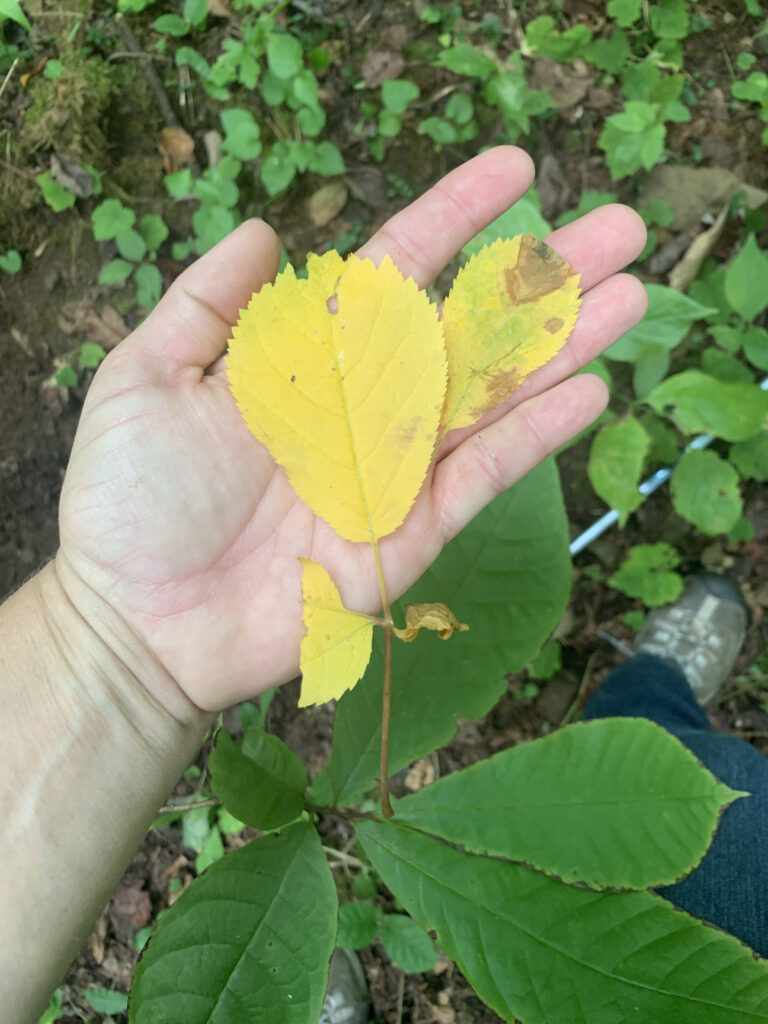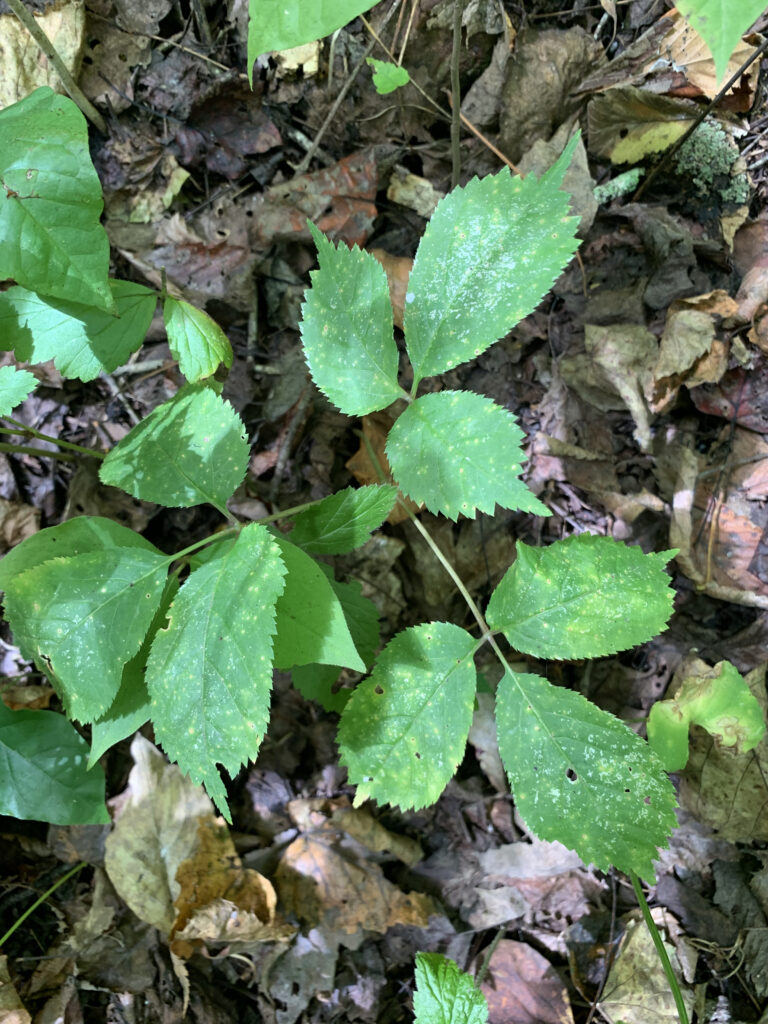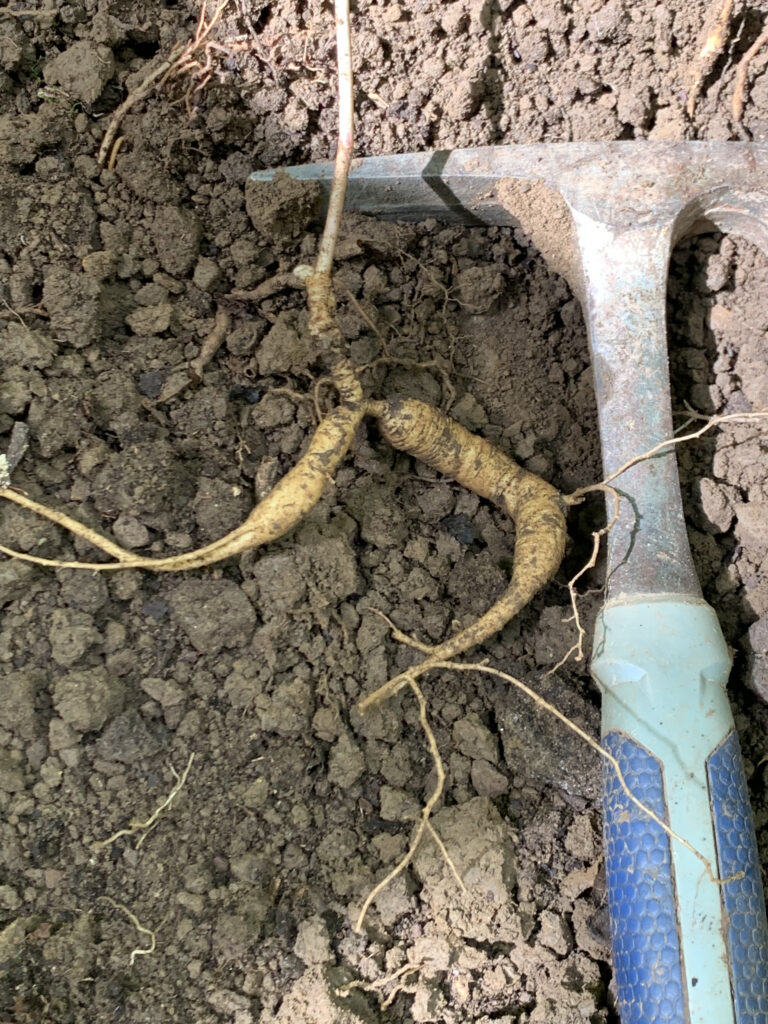
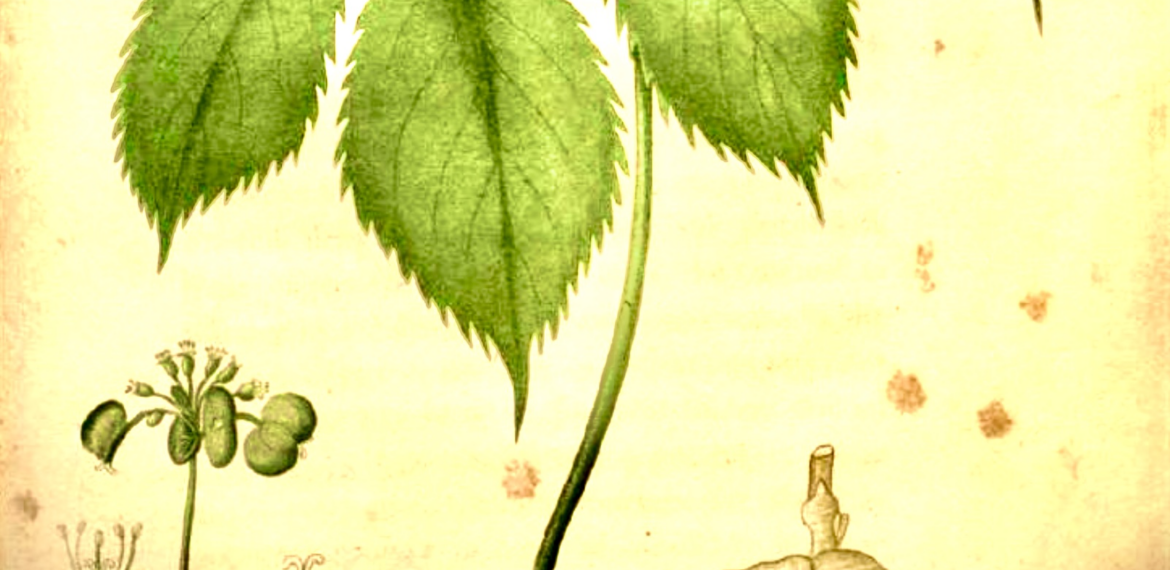
Many years ago, as a young child I remember my father going squirrel hunting. Hunting season normally started after the middle of August, but he would always wait a little later in the season to avoid harvesting a squirrel to avoid finding parasites in their necks. Most hunters call them Wolves, though Warbles is the scientific name, a condition caused by Bot Flies, which were common in Eastern Kentucky. My father normally went hunting with great success. He would always bring home four to five squirrels, which made a fine pot of squirrel and gravy. He skinned the squirrels carefully and with great skill, never leaving a hair or buck shot for Mom to complain about, but before he would get started cleaning the squirrels, I always noticed a big bulge in his left pants pocket, for he was left-handed. He would pull this big, tangled mess of fat roots from his pants pockets. As a young child, they seemed to me quite large. A 2- to- 5- inch root resembled a yellowish figurine with arms and legs. Usually after a few hunting trips my father would have enough to make a pound of dried Sang, for that’s what he called the yellowish roots. He would dig Ginseng roots throughout the end of August or September before a hard freeze killed the Ginseng tops. The money he collected selling Sang would always cover a fishing trip to Tennessee or Smoky Mountains, or both. Finding and digging Sang was an art, one my father learned from his father and older brothers.
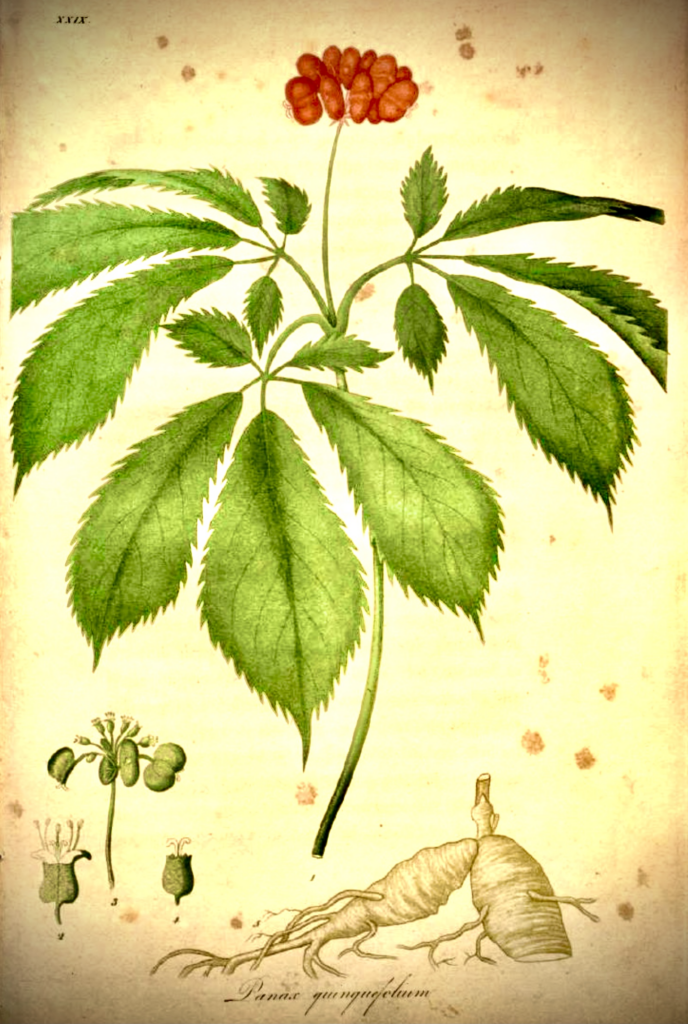
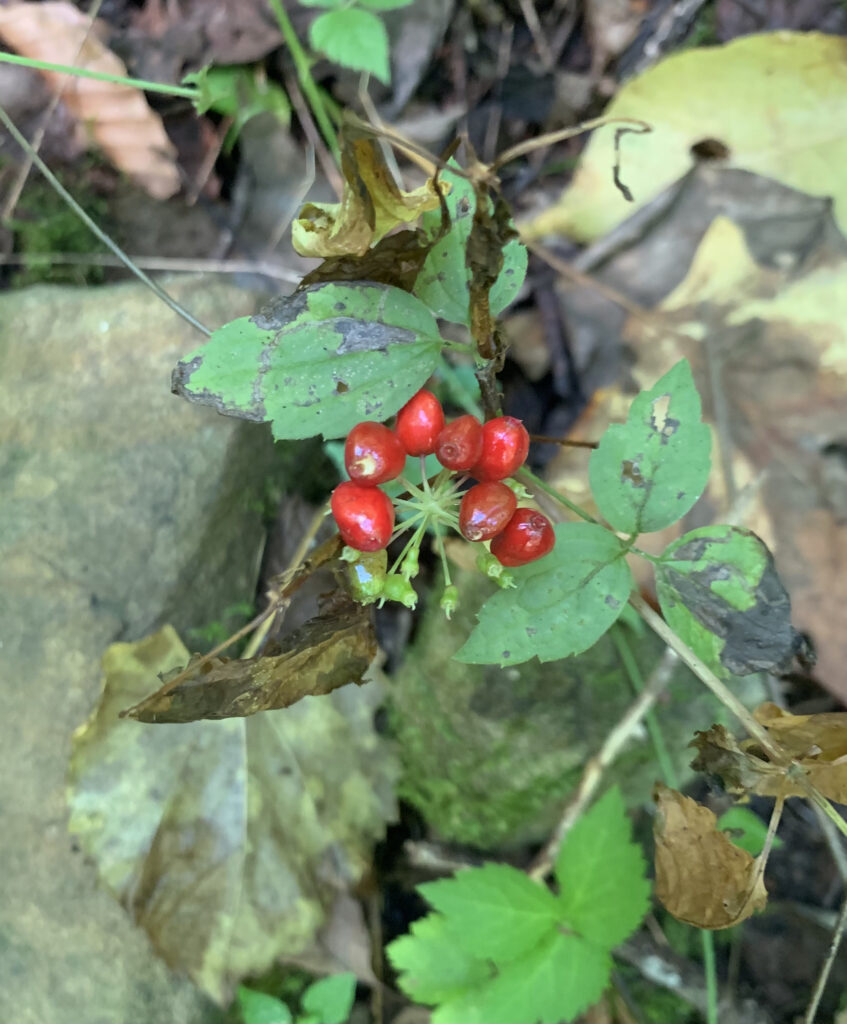
Hunting Sang takes a good steady eye and plenty of patience. It also takes a couple of good seasons under your belt hiking long distances to find good fertile grounds. Many less experienced hunters can spot Ginseng by its bright red berries, once they’ve dropped. Only the most experienced diggers are successful in finding the precious organic gold. Even in late Fall, after the green stems and leaflets have lost their shiny green silks, a trained eye can locate the light golden stems that give away the precious yellow gold Sang lying beneath.
Long before marketer’s starting shipping American Ginseng to the Far East, Director J.W. Powell of the US. Bureau of Ethnology had written an annual report to the Secretary of the Smithsonian Institution, with a chapter outlining Sacred Formulas of the Cherokees. Ginseng Number 14 was one of the herbs discussed in Powell’s report. “A Tali Kula” was the Cherokees’ given name for Ginseng, or “Sang”, meaning “it climbs the mountain”. Decoction of a root was taken for headache, cramps and female trouble. Juice from the Genseng root could be swallowed for pain in the side.
Several Indian Tribes used Ginseng for herbal healing, but it was not listed for use by the Miami Regional Tribes.
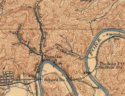
Around 1715 Jesuit priest Joseph-Francois Lafitau was the first to discover that American Ginseng could be a substitute for its valuable cousin, the Korean or Chinese Ginseng. Writers give credit to the French Canadians as being the first to set up trade selling Ginseng to the Chinese. Word quickly traveled south to New England about Ginseng trade between the French and Chinese. Another question would arise from the French Jesuits early involvement in Ginseng trade. There were several log structures allegedly built by the French at the mouth of Big Paint Creek on the Big Sandy River, their use originally thought to provide housing for the French traders and fur trappers. There are additional references to “Sacred Formulas” of the Cherokees sold in large quantities to traders for fifty cents a pound. Cherokees would sometimes venture as far as the Kanawha Valley or Northeast above the Miami Valley territory, resulting in an occasional skirmish with the Shawnee. This would probably paint a bullseye on Cherokees digging and collecting Ginseng in Kentucky, and as far North as present-day West Virginia. The French log cabins on the Big Sandy would become a market point for the Cherokees to sell their harvested ginseng to the French traders.
On August 20, 1737, letters were exchanged between Hans Slone of the Royal Society and William Byrd II about vegetable substances, like Ginseng, and their value to the Europeans. In this particular letter William Byrd talks about his personal experience with Ginseng.
“I fancy you have been nibbling of Ginseng ever since you have received that Box from my good Lord Pembroke, by the Venture which you have mended all the Flaws which Jamaica had made in your constitution. I believe ever since the Tree of Life had been strongly guarded the Earth has never produced any vegetable so friendly to man as Ginseng. Nor do I say this as Random, or by the Strength of my Faith, but by my own Experience. I have found it very cordial and reviving after a great Fatigue”.
Countless numbers of researchers and scholars have done extensive work trying to discover the inhabitants of North America who first set sight on the American Ginseng plant for the commercial market in the new world. The next few pages, and exhibits that follow, offer a first-hand glimpse of how Ginseng and its medical and commercial importance evolved in North America over the last 275 plus years of harvesting the golden herb. A ready-made market had existed in China for over “5000 Years”. China’s demand for the Ginseng root had its benefits, establishing its medical and spiritual values to its peoples. The consumption of a Ginseng tonic was thought to restore the body’s balance.
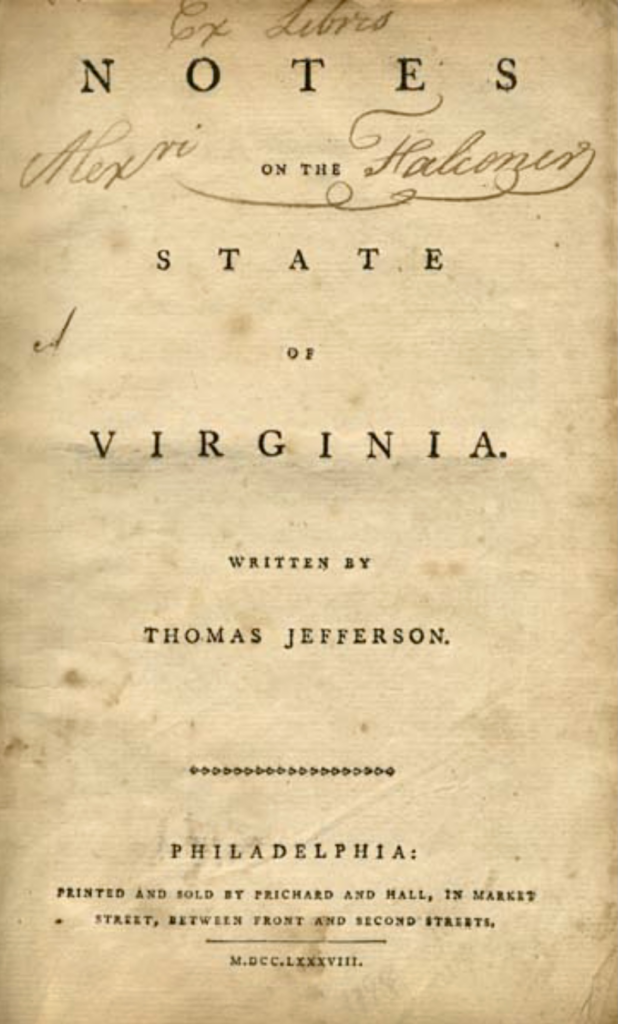
Thomas Jefferson’s Notes on the State of Virginia listed 21 medical plants native to the state and its Western Territory, which would include present-day Kentucky. Of the eight plant-based drugs being shipped from the colony Jefferson wrote about, Ginseng was one of the most highly prized exported in large quantities to China. In a letter written to John Adams November 27, 1785, Jefferson wrote: “We can furnish them enough Ginseng to supply their whole demand for the East Indies.”
George Washington’s Journal
[Diary entry: 12 September 1784]
12th. Left Daughertys about 6 Oclock, stopped a while at the Great Meadows, and viewed a tenament I have there, which appears to have been but little improved, tho capable of being turned to great advantage, as the whole of the ground called the Meadows may be reclaimed at an easy comparitive expence & is a very good stand for a Tavern. Much Hay may be cut here when the ground is laid down in Grass & the upland, East of the Meadow, is good for grain.1
Dined at Mr. Thomas Gists at the Foot of Laurel [Hill], distant from the Meadows 12 Miles, and arrived at Gilbert Simpsons about 5 oclock 12 Miles further. Crossing the Mountains, I found tedeous and fatieguing. From Fort Cumberland to Gwins took me one hour and ten Minutes riding—between Gwins & Tumbersons I was near 6 hours and used all the dispatch I could—between Tumbersons and Mounts’s I was full 4 hours—between Mounts’s and the [Great] crossing upwards of 3 hours—between the crossing and Daughertys 4 hours—between Daughertys and Gists 4¼ and between Gists and Simpsons upwards of 3 hours and in all parts of the Road that would admit it I endeavoured to ride my usual travelling gate of 5 Miles an hour.
In passing over the Mountains, I met numbers of Persons & Pack horses going in with Ginsang; 2 & for salt & other articles at the Markets below; from most of whom I made enquiries of the Nature of the Country between the little Kanhawa and ten Miles Creek (which had been represented as a short and easy portage) and to my surprize found the Accounts which had been given were so far from the truth that numbers with whom I conversed assured me that the distance between was very considerable—that ten Miles Ck. was not navigable even for Canoes more than a Mile from its mouth and few of them, altho I saw many who lived on different parts of this Creek would pretend to guess at the distance [to the Little Kanawha].
I also endeavored to get the best acct. I could of the Navigation of Cheat River, & find that the line which divides the States of Virginia & Pennsylvania crosses the Monongahela above the Mouth of it; wch. gives the Command thereof to Pennsylvania—that where this River (Cheat) goes through the Laurel hill, the Navigation is difficult; not from shallow, or rapid water, but from an immense quantity of large Stones, which stand so thick as to render the passage even of a short Canoe impracticable—but I could meet with no person who seemed to have any accurate knowledge of the Country between the navigable, or such part as could be made so, of this River & the No. Branch of Potomack. All seem to agree however that it is rought & a good way not to be found.
The Accts. given by those Whom I met of the late Murders, & general dissatisfaction of the Indians, occasioned by the attempt of our people to settle on the No. West side of the Ohio, which they claim as their territory; and our delay to hold a treaty with them, which they say is indicative of a hostile temper on our part, makes it rather improper for me to proceed to the Kanhawa agreeably to my original intention, especially as I learnt from some of them (one in particular) who lately left the Settlement of Kentucke that the Indians were generally in arms, & gone, or going, to attack some of our Settlements below and that a Party Who had drove Cattle to Detroit had one of their Company & several of their Cattle killed by the Indians—but as these Accts. will either be contradicted or confirmed by some whom I may meet at my Sale the 15th. Instt. my final determination shall be postponed ’till then.
1. GW’s 234½ acres at Great Meadows were offered for lease on a ten-year term to the highest bidder at Washington’s Bottom 15 Sept. (GW’s advertisement, in Va. Journal, 15 July 1784). The right to patent this tract, which straddled Braddock’s Road and embraced virtually all of the meadows, had been bought by GW 4 Dec. 1770 for 30 pistoles, or £35 5s. Virginia currency, a price GW considered high. Due to a variety of circumstances, the patent was not issued until 28 Feb. 1782 (bill of sale from Lawrence Harrison to GW, 4 Dec. 1770, DLC:GW; General Ledger A, folio 344; GW to Charles Simms, 22 Sept. 1786, DLC:GW; HULBERT [2], 137; UMBLE, 36). Writing to Thomas Freeman about the Great Meadows tract on 23 Sept. 1784, GW noted that “there is a house on the premises, arable land in culture, and meadow inclosed” (DLC:GW), but as his observations here indicate, those improvements must have been small and in poor condition. In a letter to Freeman written 22 Sept. 1785, GW urged the necessity not only “of reclaiming the Meadow” but of “putting the whole under a good fence” and building a dwelling house, kitchen, and stable (DLC:GW).
2. North American ginseng, Panax quinquefolius, was a staple of the China trade, being a common substitute for the oriental variety, P. schinseng, roots of which the Chinese used extensively in medicines. While crossing Laurel Hill in 1783, Johann David Schoepf met “a man . . . who was taking to Philadelphia some 500 pounds of ginseng-roots . . . on two horses. He hoped to make a great profit because throughout the war little of this article was gathered, and it was now demanded in quantity by certain Frenchmen [for the China trade]” (SCHOEPF, 1:236–37).
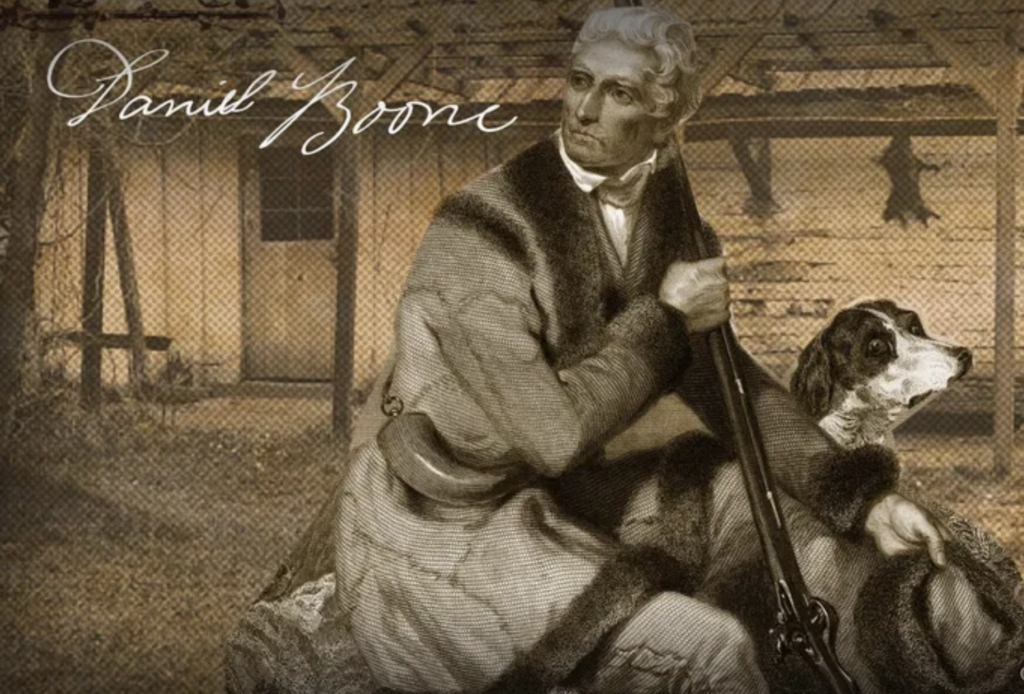
There are numerous stories about the Ginseng herb being heavily grubbed throughout the Appalachian Mountains in the late 1700’s, after the Revolutionary War. One writer’s story of how Daniel Boone lost “12 tons” of dried Ginseng roots when a river barge overturned on the Ohio River is more realistically told when “tons” is translated as “tuns,” meaning “barrels.” The writer quotes that, even as popular as Daniel Boone was, “It’s a tall story that a single shipment of 24,000 pounds existed at one river haul.” Twelve barrels of Ginseng is probably more realistic. Ginseng trade was well underway when Daniel Boone spent the winter at the Middle Fork Salt Lick at present-day David, Kentucky. One writer, after researching the commercial history of American Ginseng, found that once the old growth Ginseng plants had reached the age of 100 to 200 years, the old roots would resemble the body of a man, complete with head and limbs. These old Ginseng roots would fetch enormous prices, five times the price of gold in that time period.
There were many Pike County residents who, after fighting and serving in the Revolutionary War, chose to drive their homestead stakes into the Upper Waters territory of the Big Sandy River. Joseph Boney was one of those Freedom Fighters. Even before Pike County was eventually separated from Floyd County, Joseph Boney was widely known, appearing in early court order books. One was most likely to see Joseph Boney’s name in a trespass case, failure to maintain a county survey order or a citizen’s inability to pay his debt to local merchants. Joseph Boney was a noted backwoodsman, living off the land, harvesting anything the waters of the Levisa River could provide.
From 1810 to 1820, the standard monetary fund was still based on the pence and pound, but in the mountains and valleys there were only a few trusted forms of currency. Gold and silver were the most trusted, but few mountain families had the luxury of possessing these currencies.
It was in the early 1800’s when most Pike Countians harvested their monetary funds. Precious heirloom seeds that had been passed through generations produced a bountiful harvest. The surplus was saved for the table and the planting of next year’s crop. The real currency for barter or trade came from Sang and deer skins. Deer was still plentiful, putting meat on the table when few could afford cattle. Nothing went to waste when harvesting deer. The antlers were used for knife handles or a custom-made coat hanger. The hides were scraped and hung to dry. Good clean deer hides became currency for merchant goods used every day by Pike County settlers.
Ginseng was the number one currency used in Eastern Kentucky. In spite of being harvested for nearly 70 years, it was still plentiful. Priced per pound, Ginseng was most prized root in the mountains. Because of its wide use in China, Ginseng became the most stable currency in the young United States of America.
The market price on Ginseng was always stable, and for good reason. Local buyers in Pikeville were usually local merchants such as Spencer Adkins, James Honaker, Thomas Owens Merchants, Mims & Allison Wholesale, and retail merchants in Pikeville, Prestonsburg and Louisa.
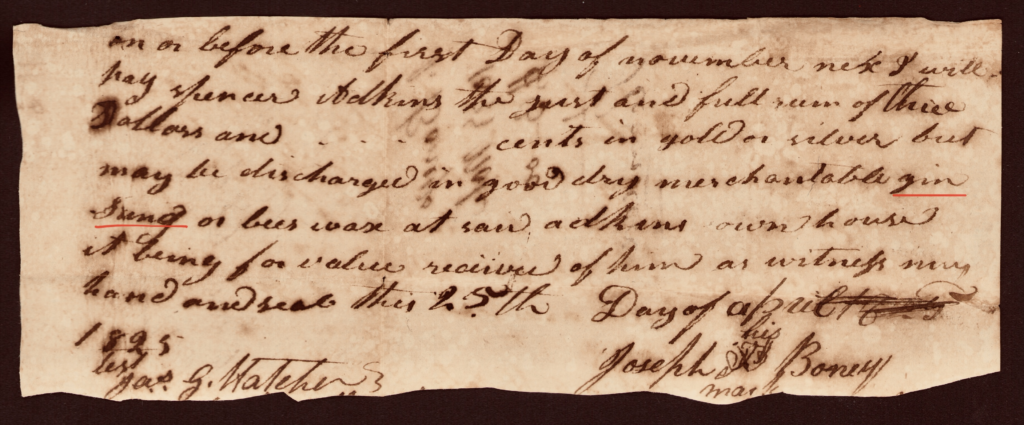
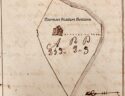
The 1825 document above shows Spencer Adkins, a Pike County merchant, excepting on Joseph Boney. The note is for 3 dollars, to be paid on November 1, 1825. It is to be paid in gold, silver, good dry merchantable Ginseng, or bees’ wax.
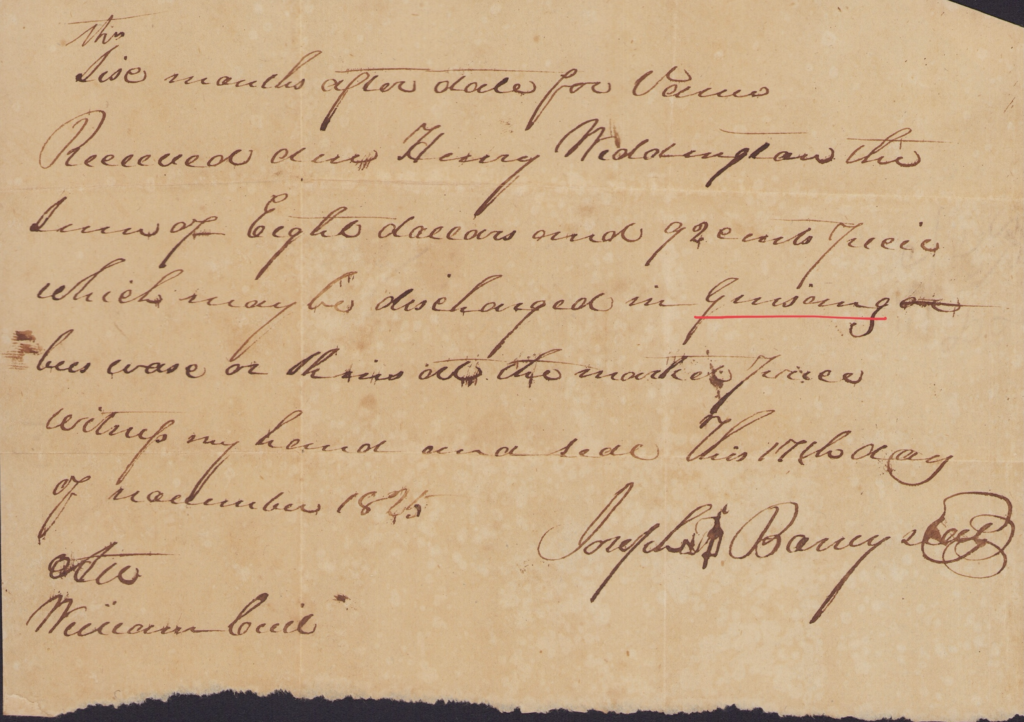
On November 17, 1825, Henry Weddington took a note signed by Joseph Boney for 8 dollars and 92 cents. The Note was to be discharged with Ginseng or bees’ wax.

Joseph Boney traded with numerous Pike County residents and merchants. This particular note shows Joseph Boney signing a note with Martin Thornbury September 25, 1826. The debt may be discharged with good marketable Ginseng.
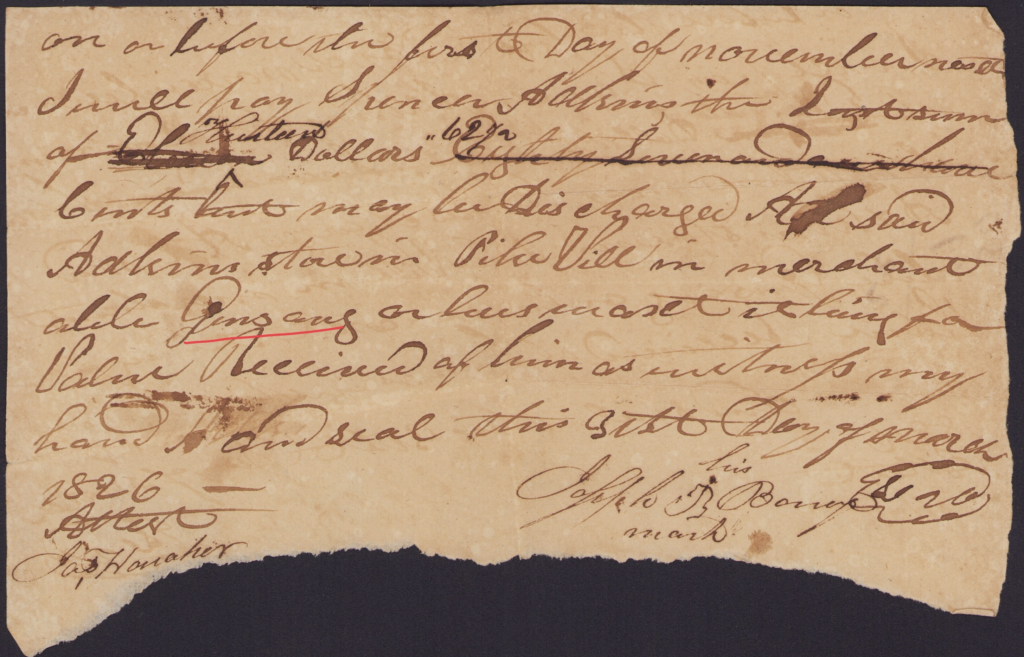
Another Joseph Boney note, shown below, was signed by Spencer Adkins March 31, 1826. The amount of $13.62 was due the following November, and payable with good merchantable Ginseng or bees’ wax to Spencer Adkins at his Pikeville Store.
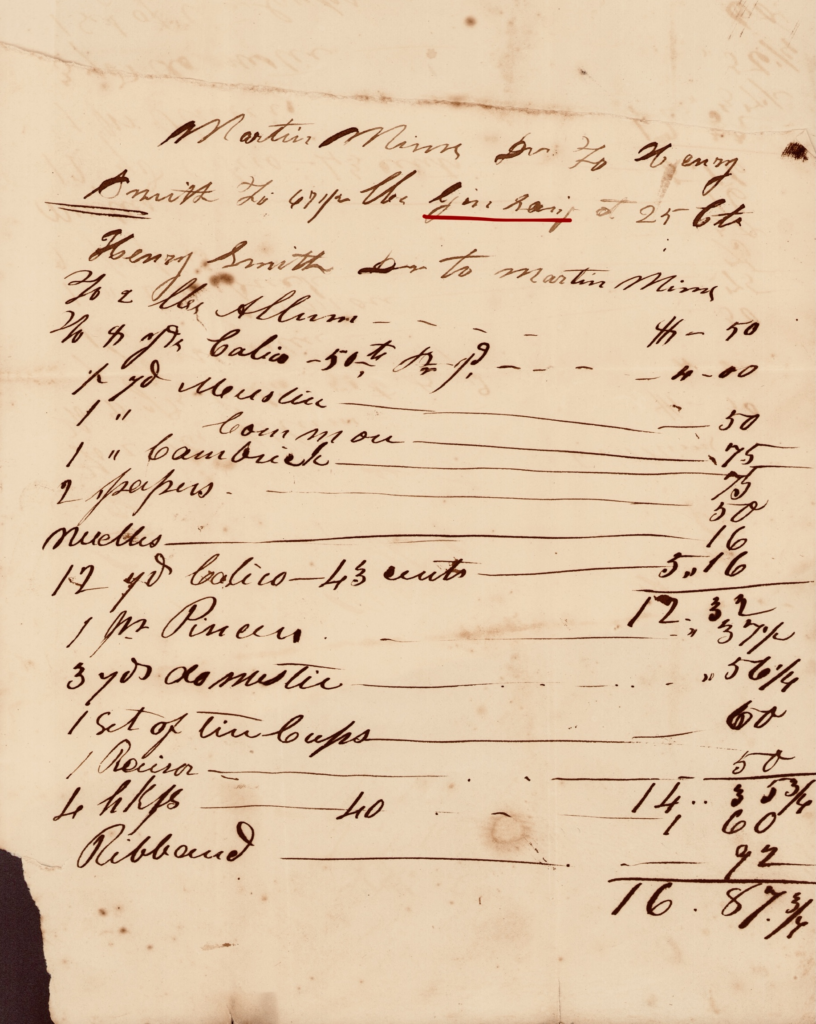
The date of this ledger entry is unknown but is most likely between 1829 and 1830. Martin Mims, the largest wholesale, retail merchant in Pikeville, traded with Henry Smith on dry and essential goods. Henry Smith had grubbed and dried 67 1/2 pounds of Ginseng. Martin Mims allowed 25 cents per pound for Henry’s merchantable Ginseng. The store ledger page covered every single penny allowed for Henry Smith’s Ginseng, leaving no balance.
A letter written May 13, 1831, by Robert Toland informs Mims and Allison Merchants that A. Biern & Company is buying Ginseng at 40 cents a pound.
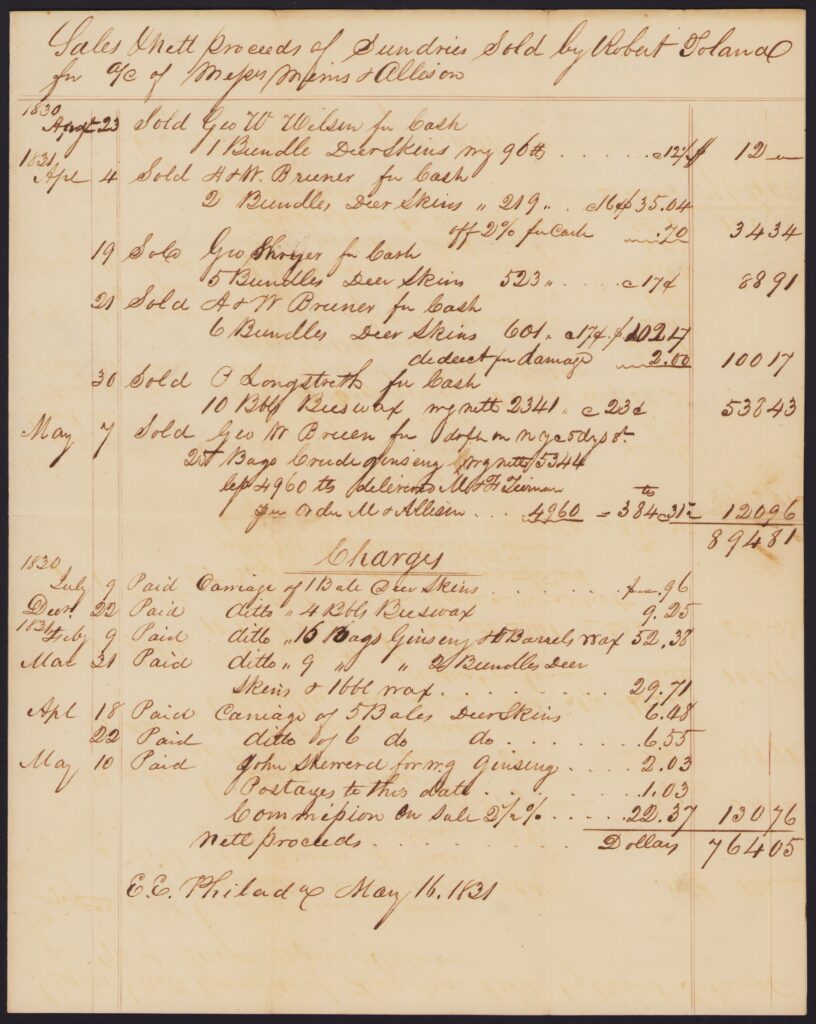
May 16, 1831, sales and proceeds of sundries sold by Robert Toland, represents the account of Mims & Allison Merchants as seen above. The list of sundry items represents deer skins, bees’ wax and Ginseng.
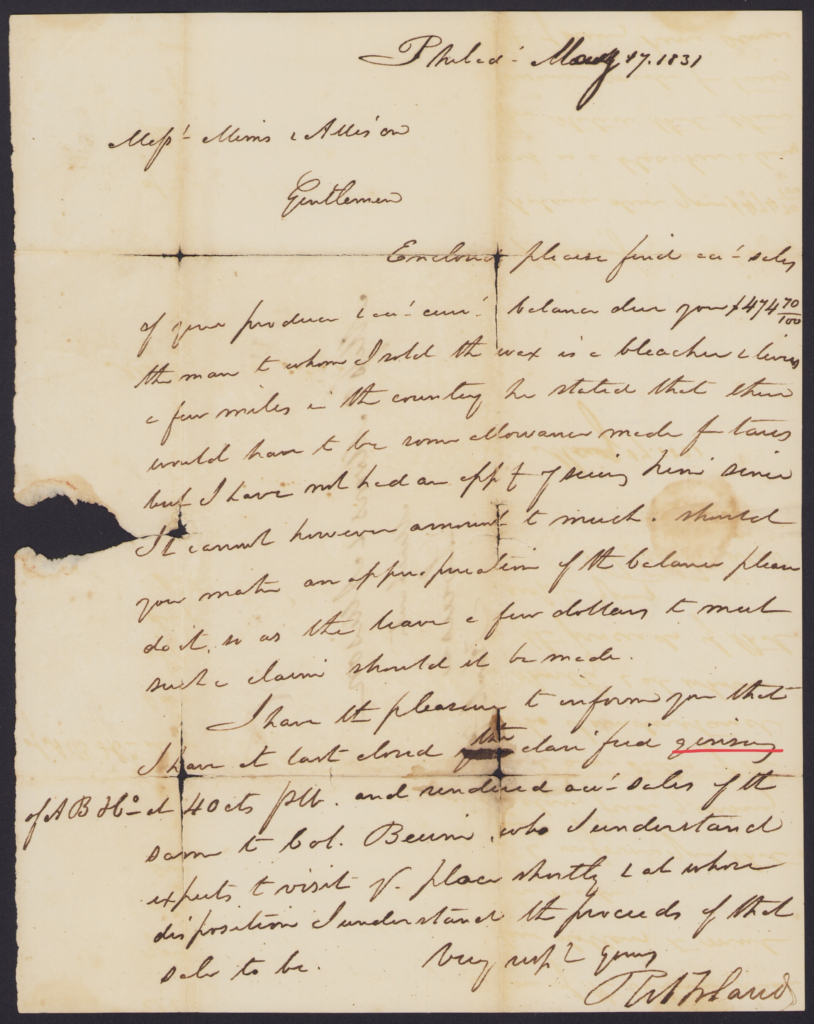
Page 1 of 3…… October 6, 1831 (above)
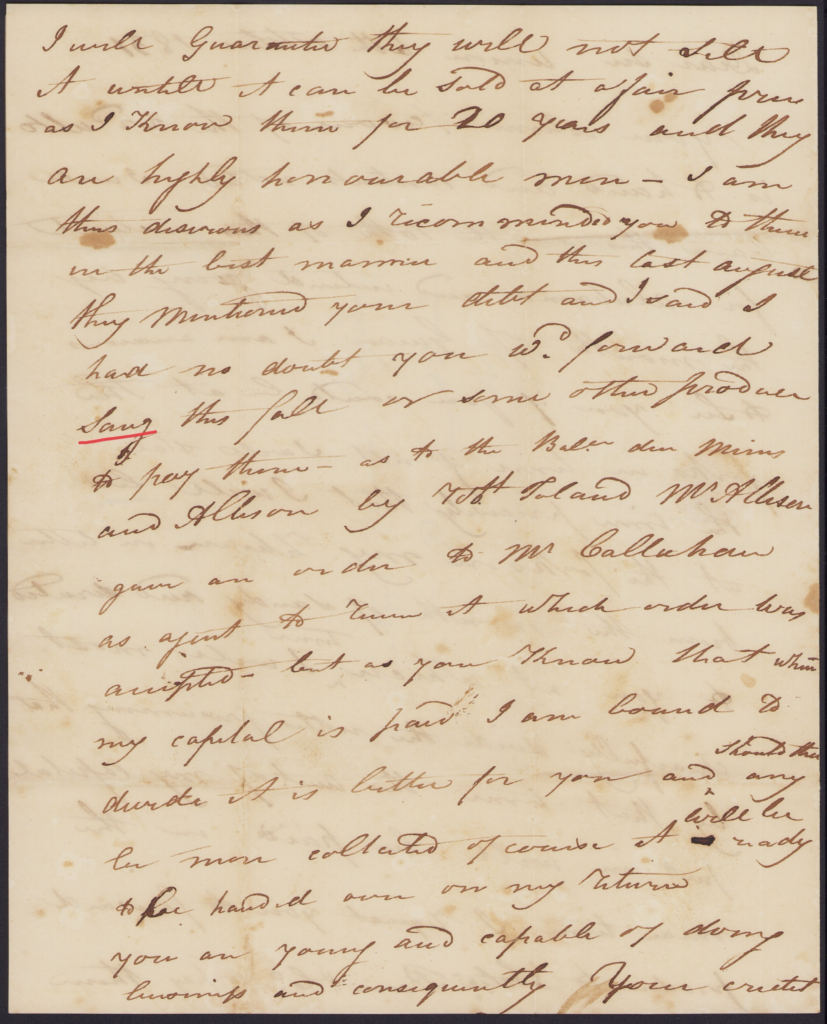
The Rev. R. D. Callihan, the future brother-in- law of John Dils, was an agent of A. Beirne and Company and a merchant himself up and down the Big Sandy. R.D. Callihan was a partner with James Honaker in his river front business in Pikeville.
Page 2 of 3 (above)
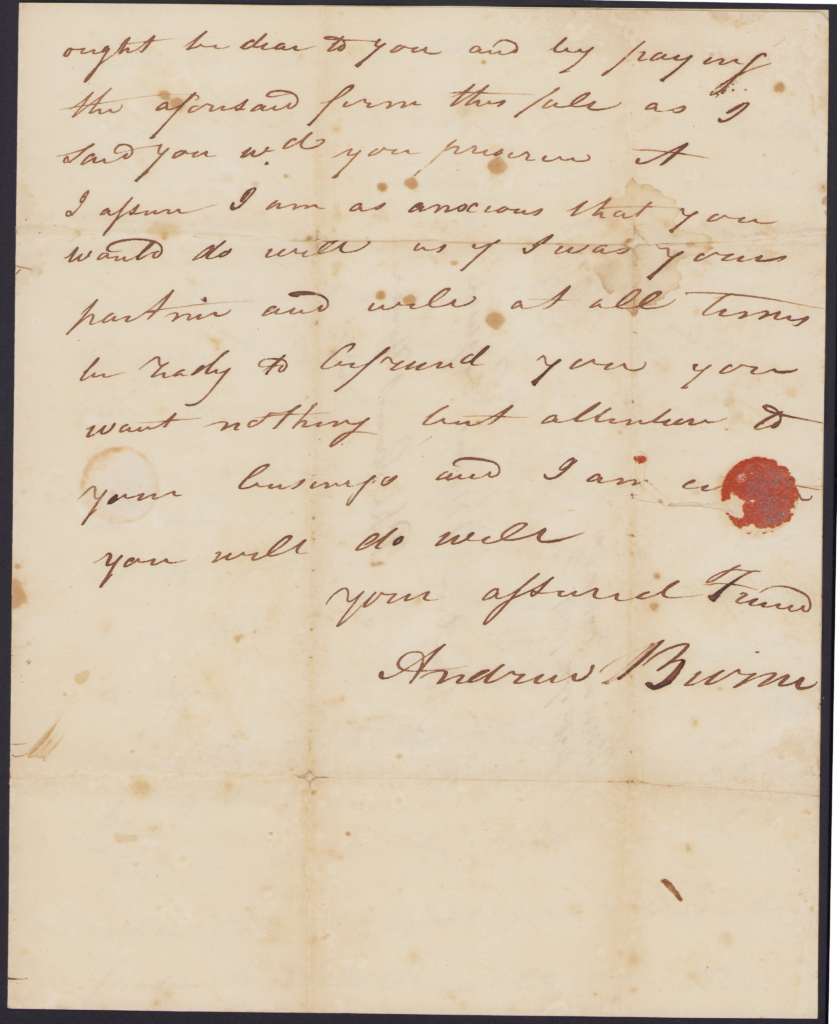
Page 3 of 3 (above)
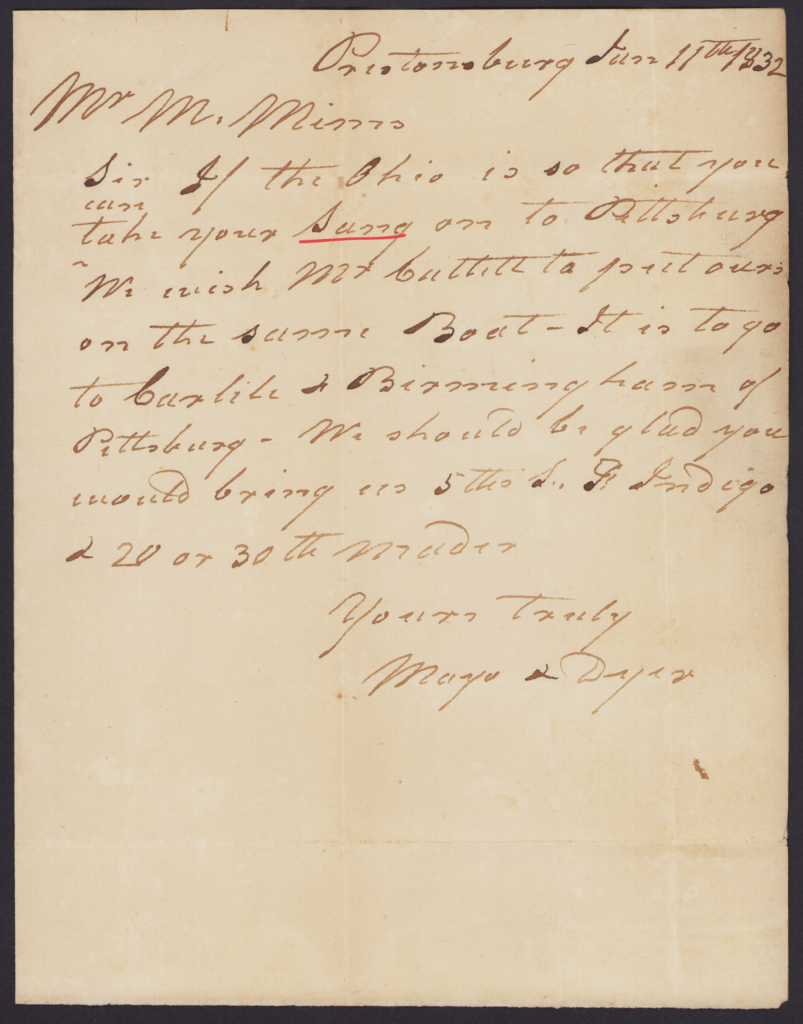
In this exhibit Mr. Martin Mims is recommended by Mayo & Dyer to “sell your Sang at Pittsburg,” and recommends Mr. Cattlet to “put ours on the same boat.”
Another newcomer would soon be entering the picture around Pike County. His name was John Dils Jr. The year was 1836. In Parkersburg, Virginia, a man named R.D. Callihan was courting the sister of the future John Dils Jr. and soon thereafter R.D. Callihan would take his bride. Over the years Mr. Callihan had built a large trade business on the upper Big Sandy River Territory. After Callihan’s return trip from Pikeville, it caught John Dils Jr’s attention. Soon John Dils would return with R.D. Callihan and Pikeville would be John Dils Jr’s permanent home. In due time, in partnership with R.D. Callihan and Henry B. Mayo, John Dils Jr. would have the guidance of one of the largest merchant groups on the Big Sandy. It didn’t take John Dils Jr. very long to figure out that if a man had a gun, he could live off the fat of the land. His belief in that principle would eventually lead to his becoming one of the largest merchants in Pikeville near the Civil War period.
John Dils Jr. came to Pikeville in the prime of the period when bear skins and deer carcasses were taken for profit. The two commodities were used as legal tender to trade for goods like gun powder, flour, sugar, plows, seeds and even clothing. Another commodity John noticed being laid on the counter was Ginseng. In William Ely’s book The Big Sandy Valley it is noted that little boys and girls could make 2 to 3 dollars a day digging for Sang. The Sang would accompany the bear and deer hides going down the Big Sandy on steamers or keel boats. Around 1843 John Dils Jr. married Gen. William Ratliff’s daughter. He later formed a partnership with R.D. Callihan and John N. Richardson, known as John Dils Jr. & Company, which eventually became Richardson and Dils. One could hardly imagine how many thousands of pounds of Ginseng John Dils Jr. had shipped down the Big Sandy.
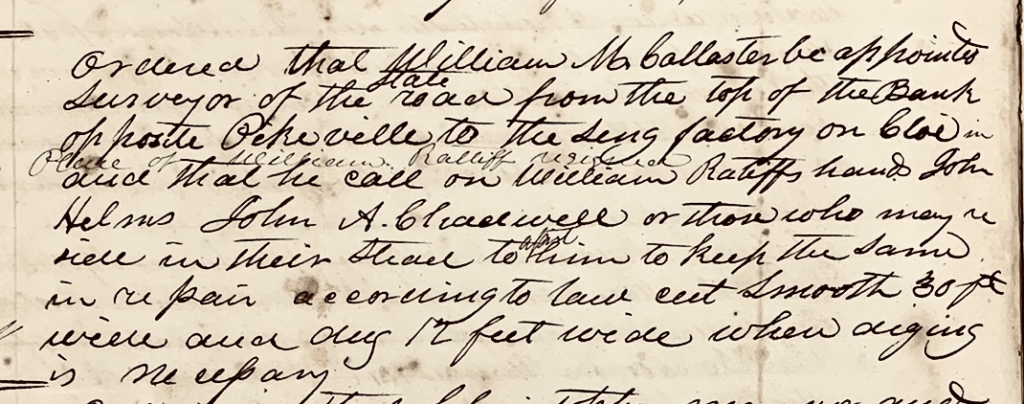
A Ginseng factory was located near the head of Lower Chloe Creek in April of 1842. John Dils Jr.’s future father-in-law Gen. William Ratliff would resign his position of surveyor, leaving no records. Gen. Ratliff probably owned this Ginseng factory.
Pike County Court Order Book B, page 482
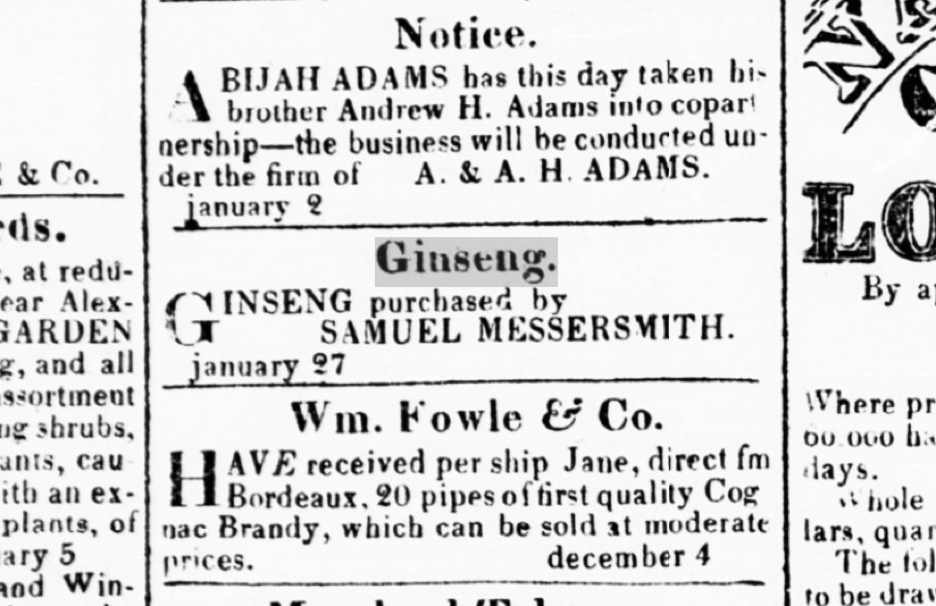
From the Alexander Gazette newspaper, February 23, 1821: Samuel Messer Smith & Co. was one of the largest buyers of Ginseng for decades. Samuel Messer Smith advertised in several newspapers throughout Ohio, Virginia and Pennsylvania, looking to purchase Ginseng.
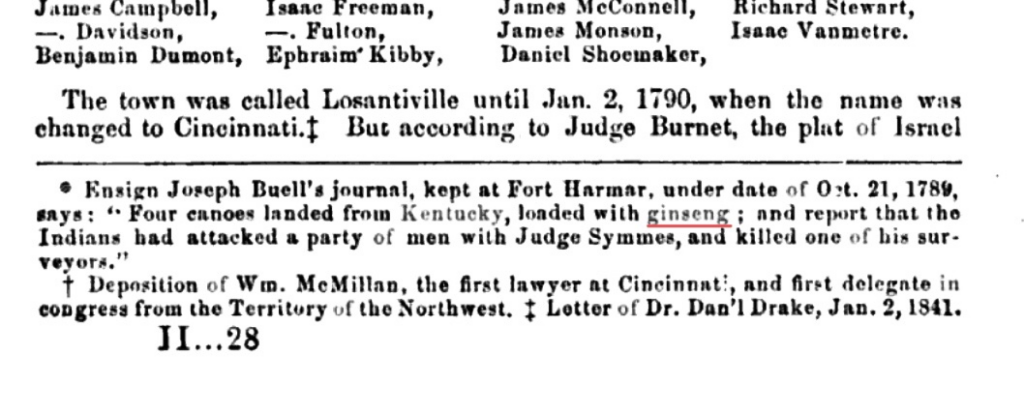
Lewis Collins, in his History of Kentucky, makes reference to a journal kept by then Ensing Joseph Buell. “Four canoes landed from Kentucky loaded with Ginseng,” while a party was surveying. We need to question the purpose of this surveying crew. Were they routinely surveying on the upper Big Sandy Valley, or looking for Ginseng?
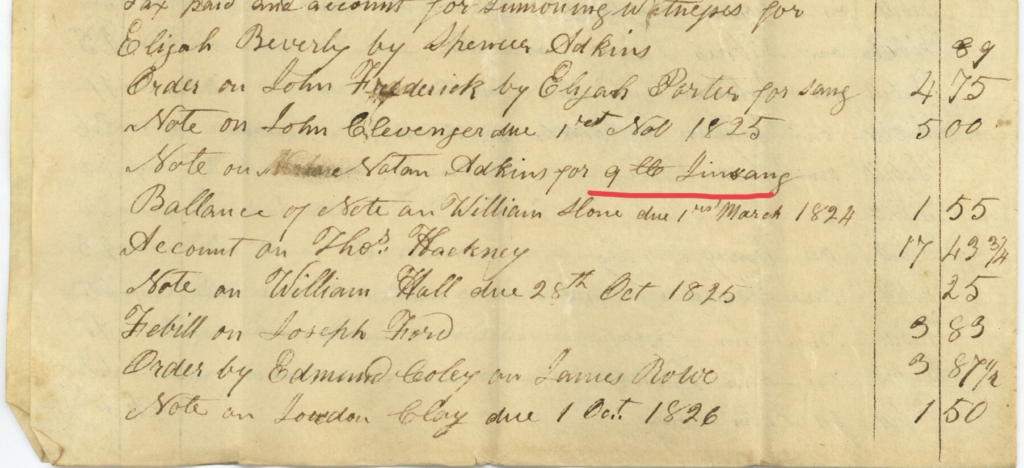
Spencer Adkins’ Estate Appraisal lists numerous notes and free bills still owed to the Estate. Several pages list monies still outstanding, one from Nathan Adkins for nine pounds of Ginseng.
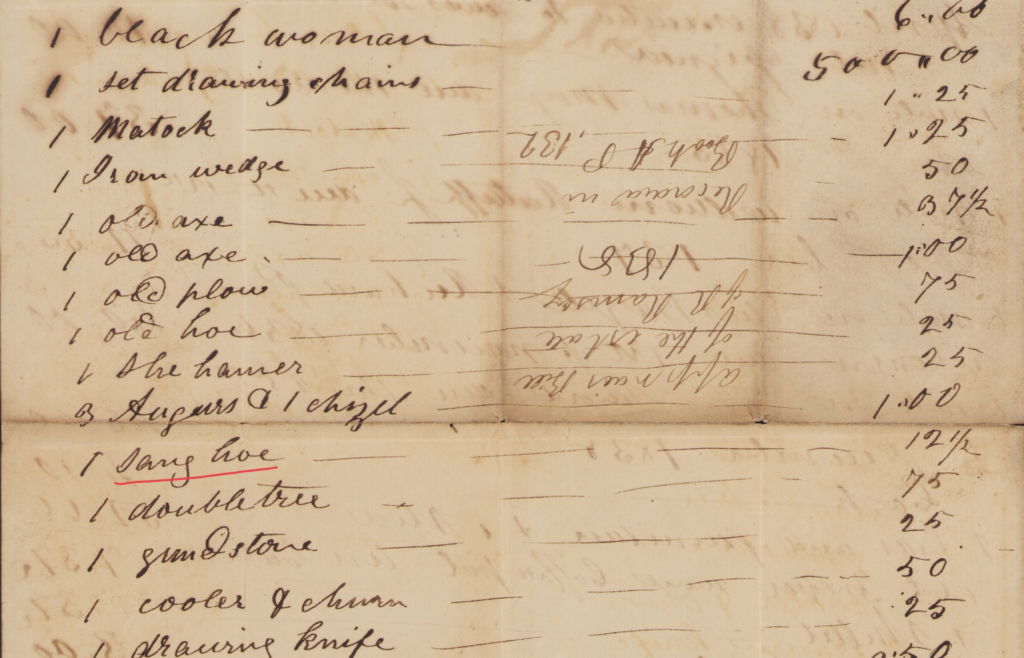
Robert Ramey’s Estate appraisal filed in Pike County Court in 1838, includes a Sang hoe in inventory, appraised at 12 1/5 cents.
For over 270 years Ginseng has been a large part of Pike County’s economic history. Although it is generally agreed that Ginseng has been overly harvested, it manages to survive year after year.