
–
A HITCHHIKER’S GUIDE TO PIKEVILLE, KENTUCKY
The Times They Are A- Changin’
Gayle Compton
(Note: The original version of the following was published in Coal People Magazine in 2015, seven years before Pikeville, Kentucky, would be celebrating its Bicentennial. Changes in the names of some landmarks and certain demographics are slight, and no attempt has been made to update them.)
JONANCY, KENTUCKY: Friday morning, 20 miles west of Pikeville, coal town on the Big Sandy River.
My alarm clock is set for 6:00 a.m., but I am awake at 5:30. Catbirds scold in the maples outside my window. My neighbor’s dog has barked all night at a woolly worm.
I am drifting back into that euphoric dream state when I am jarred awake by the familiar sound of Dry John Elliot’s pickup coming up the road a quarter of a mile away. I hear Old Betsy leave something on the Elwood crossing and keep on coming, missing and back-firing like a flatulent beast of the Apocalypse hell-bent for leather. There is an interlude of silence followed by the sound of an F-150 in the death throes outside my gate. I hear a final gasp for octane, a door slamming, and an emphatically uttered oath followed by a meek “Forgive me, Lord.”
I get up and put on a pot of coffee. Dry John will need a ride.
Dry John Elliott is the only man I know who loves Pike County, Kentucky, as much as I do. It’s not that we haven’t been anywhere else, that we have nothing to compare it to. I’ve been as far north as River Rouge, Michigan, and Dry John rode a boxcar, once, to Bumblebee, Arkansas. We have since concluded that God created Pike County, because the Garden of Eden was such a failure.
While I’m getting ready for work Dry John drinks three cups of Maxwell House coffee, strong and black. He is nervous and fidgety, something to be expected of a man like Dry John, newly converted at the Heaven Bound Pentecostal and facing the world dead sober.
“I should of knowed better than let that wall-eyed bow-legged Verne Slone stick a nozzle in my gas tank,” says Dry John clinching his fist. “He’s destroyed Old Betsy. I was at the mouth of Monkey Town, headed for Pikeville, when I had to turn her around. Weren’t for trying to live right, I’d go down there and shove nozzle, hose and all about halfway–! Never mind. The good Lord says we’re to love our enemies, to pray for those who persecute us. Can I use your phone? I promised Ellis Adkins over on Chloe I’d help him build a deck on his doublewide. He’s supposed to meet me at Jerry’s Restaurant. That little pot gutted Vern–!”
My ’98 Cavalier is sitting on empty, but I prudently drive on by Verne’s Gas, Tire & Pizza at Virgie for a fill-up at Indian Creek Double-Kwik. Carbide Mullins is at the pumps with his thumb up. He puts his head in the window and wants to know if I’m going down toward Pikeville. Carbide has a bad back. Got it messed up when Roman Calhoun’s porch swing broke with him. He says he’s going down and getting him a lawyer, one that won’t sell out on him. I wish him luck.
The trip to Pikeville is considerably shorter should I choose Penny Road, the east- bound two-lane that connects with the Patty Loveless section of Country Music Highway. Penny Road was rebuilt about fifteen years ago at a cost of around 22 million, but the majority of taxpayers consider it money well spent. If there are not more than a dozen four-wheelers on the road, one can make it from Family Dollar on Caney to Save-a-Lot at Virgie in less than ten minutes. Once a year, congressman Hal Rogers dispatches volunteers to Penny Road and parts of U.S. 23 to bag up the beer cartons, soft drink bottles and pizza boxes that choke the ditches, guardrails and $500 Fine for Littering signs. It’s called Kentucky Pride week.
“Did I tell you about getting a date with Alphie Hicks?” asks Dry John, who has simmered down some.
“Alphie Hicks?”
“Alphie Hicks, Pastor Bill Dick Robinson’s niece. She’s a little on the hefty side. Got this eating problem. Told me right up front she’s what they call a phagomaniac. I thought it had something to do with sex, so naturally I was interested. Come to find out she had this eating disorder, love of food or fear of starvation, her doctor said. She kept food hid all over the place–Vienna and potted meat under the mattress, pockets crammed with cakes and candy bars. Purse full of Slim Jims. Brother Bill Dick said it weren’t nothing but a pure old demon in her.”
I decide to take the more scenic two-lane through Robinson Creek.
I slam on my brakes when a mud-spattered ATV comes barreling out of Sugar Camp, the driver standing up in the seat riding a wheelie. Carbide Mullins grabs his back, grits his teeth and delivers a terse opinion of four-wheelers, porch swings and Pike County in general. Dry John gives him a hard look.
I am rather proud of Dry John. This is the first time in six months I don’t smell alcohol on his breath. I ask him how it feels, now that he has joined church and got a new girlfriend.
“Oh, I love church, especially Bible study. That’s where I met Alphie and took a shine to her. We was in the ‘Song of Solomon’ when it happened. They’s some mighty powerful Scriptures in there, I’m here to tell you. All about that little dark dove-eyed girl with teeth white as a flock of sheep, with love better than wine. Raises the sweat on a man!”
We are entering the business district of North Robinson. Big Steve’s junk emporium has spilled over the fence and rusting classics are lined up on both sides of the road. A 1962 International school bus looks nostalgically familiar. Around the curve from Bartley’s Bookkeeping, Hardware, Video and Dental a sign on a fencepost says LAWN MORES REPAIRED. We pass a familiar bootlegger’s joint and Dry John involuntarily reaches for his wallet.
“Did I tell you about Brother Bill Dick trying to pray that food demon out of Alphie?” says Dry John, eager to get back on the subject. “I’ve got my doubts about the whole business. Brother Bill Dick called Alphie up during prayer meeting Wednesday night. He lit in on her praying and didn’t let up for two hours, seemed like. He said a food demon is about as bad to dig in and hang on as your average lust demon. Finally, he said he reckoned he’d got him, praise the Lord. About three days went by. Me and Alphie was snuggled up on the couch watching Andy when, all of a sudden, she started licking her lips, reached down in her b-zeer and pulled out a boloney sandwich!”
Three 18-wheeler coal trucks are coming our way and suddenly we’re engulfed in a cloud of coal dust and diesel smoke. This is Pike County and whether we teach school or drive a rock truck, coal is our business. We take it seriously. Coal is not only our livelihood; it is a proven aphrodisiac. Women are turned on by a man with orange stripes on his coveralls and coal dust in his beard. When a coal boom hits, a baby boom is sure to follow. One young miner, who swears he was conceived in a coal house, got married last spring in a 992G end-loader bucket.
Every now and then on Highway 610 we slip past a fashionable residence with pampered grounds keeping company with a run-down house or trailer, whose yards are loud with hounds or well-fed game roosters living out their short lives tethered to little barrels and boxes.

A four-wheel drive Chevy with a dog box in the back passes in a curve doing 60 or better. The driver, now that he is up front, gets comfortable and decides to drive at 20 miles an hour. His yellow, mud-smeared bumper sticker proudly proclaims: I’M A SCOAL DIPPIN’ MAN! I am able to overlook such brazen arrogance. A man is nothing without his self-esteem.
I find myself missing the names that once identified owners of the mailboxes along this rural route. Behind the 911 numbers are good English and Scotch-Irish names like Akers, Hall, Tackett, Mullins, Compton–names a Pike Countian can wrap his tongue around easy as a chew of Red Man. No Pelosi’s or Ginsburg’s around here.
When I stop at the junction of old and new U.S. 23, my passengers are confused, and I am confronted with another hard choice. I can continue down 610 through Robinson Creek past Riddle’s Crossing, or I can turn right across Red Little’s Bridge onto U.S. 23 towards Sookeys Creek. This is where new U.S. 460 crosses over 23, a road still under construction and not yet named after a country music star. Groundbreaking ceremonies for 460 took place in January 2011 and the modern interchange now connects Sookeys Creek and Marrowbone. Happily, by 2020, at a cost of $706 million, the busy commuter can drive all the way to Grundy, Virginia, thus avoiding Elkhorn City rush hour traffic.
There was a time when the choice was easier. But that was before spring came to the mountains, before April came strewing the slopes and hills of Ford’s Branch and Robinson with redbud and dogwood. That was before May arrived scattering wildflowers about the hills and valleys and hanging blackberry blossoms above the cliffs and along the road. That was before I saw the Sookeys Creek Bridge wreathed in an autumn fog, a primordial mist suffused with sunlight and glowing in alternating tints of gold and green.
I take Riddle’s Crossing.
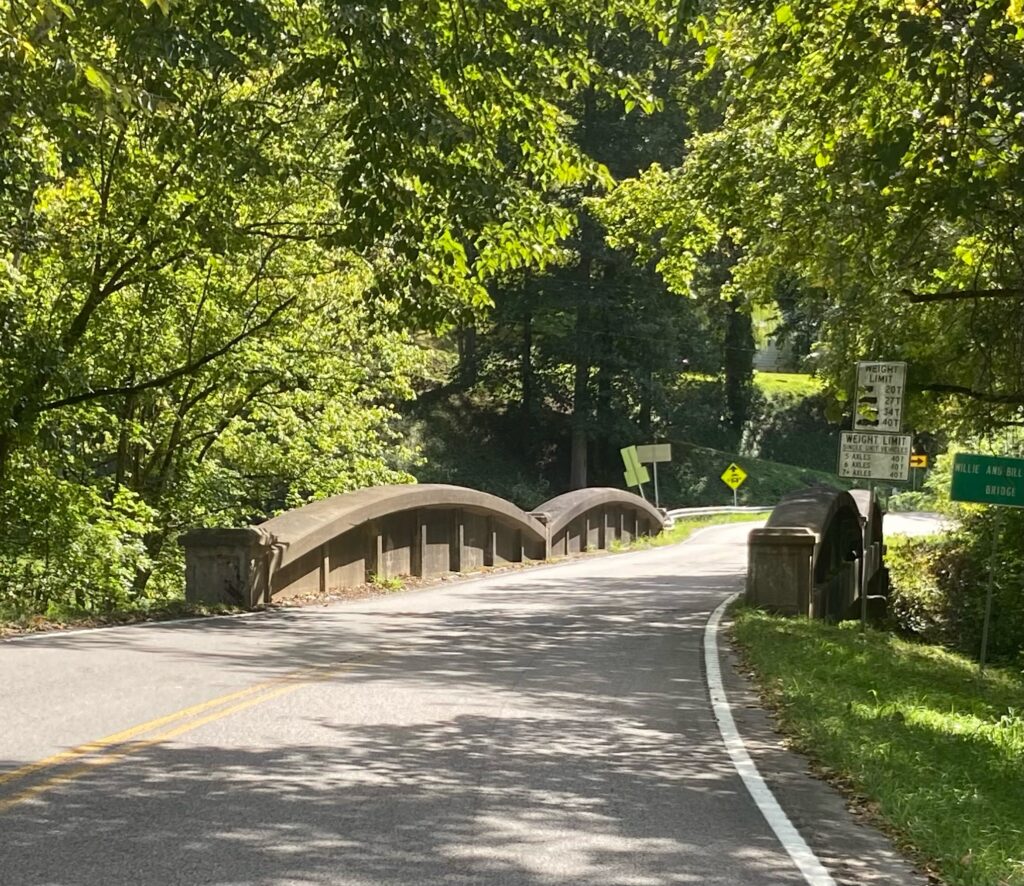
As always, when driving east, I slow down at the narrow time battered WPA bridge, not because of the bone-jarring railroad crossing just ahead, but because the historic bridge is my favorite landmark in Pike County. It is one of two built on Shelby Creek around 1939 by the Works Progress Administration. Its twin at nearby Yeager was lost to road construction. Off to my right a broad meadow stretches away to the creek, railroad track and hills beyond. To my left, on a gentle slope, sits a modern home where the old Walter Riddle home place once stood. Fruit trees shade the weeded earth of its once rich garden. The railroad cuts across the two-lane at a slight angle dividing the Riddle property. Tall hardwoods grow on either side of the road, their tops intertwining leaving the east end in perpetual shade. In a deep hollow to the left a herd of red cows are grazing near the edge of a forest, black with pine.
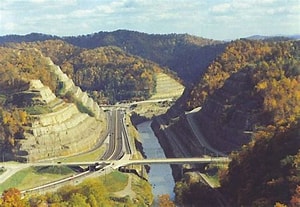
At Shelbina we cross the new concrete bridge over the railroad tracks and the Big Sandy River. I remember an old silver bridge, with its girders and steel arches built in the day of the Model-T Ford, a narrow bridge that didn’t anticipate the modern behemoths that would be leaving their fender paint on its sides. I remember, as a boy, saving my RC bottles and heaving them into the river or tossing them into the moving freight cars below. I remember three other bridges, all steel and silver as well, that crossed the river into Pikeville. And I remember the town, years before a man named William Hambley and his famous Cut-Through Project rechanneled the Big Sandy River and changed it all.
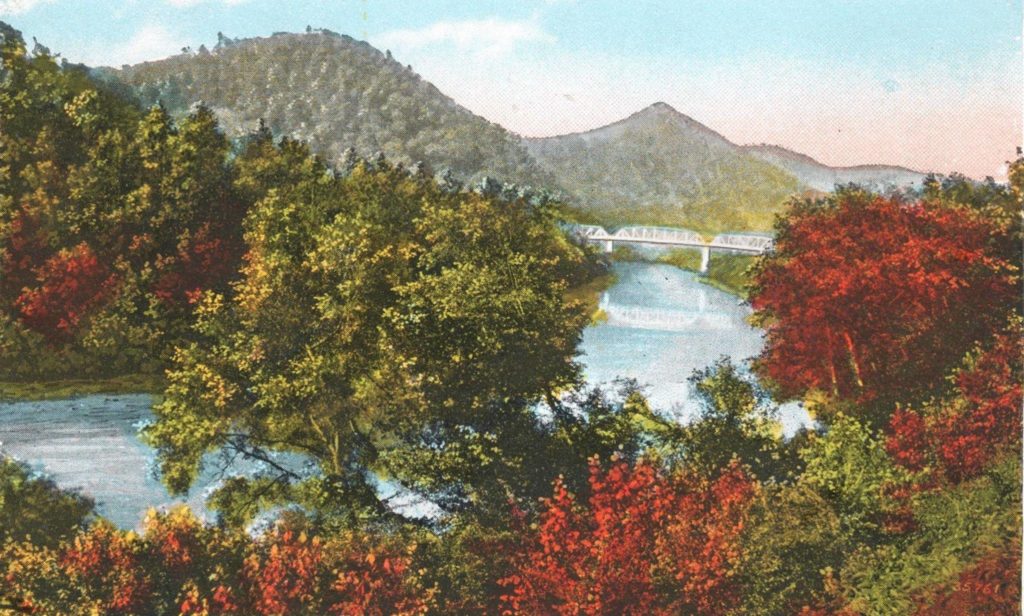
Big Sandy River. Postcard photo, July 11, 1934
From the early forties until the late sixties a trip to the county seat—if you didn’t go by passenger train or bus—meant driving around town waiting for someone to pull out and give you his parking space. It meant walking the crowded sidewalks eying the buxom manikins in the windows of Watson’s and Dawahares, crossing the street in front of the courthouse to avoid the copious expectorations of the tobacco chewing knife traders gathered around the soldier’s statue. It meant turning down Division Street, going into Short’s Drug Store, sitting on a red revolving stool and drinking a vanilla milkshake from a tin cup. It meant shuffling though the discount 45’s at Hobbs record rack or the latest hits at Gene and Mike’s while Fats Domino sang “Blueberry Hill” on the Wurlitzer.
A trip to Pikeville in the 50’s and 60’s meant walking into G.C. Murphy’s where the whole store smelled like roasted peanuts and letting Miss Cricket sell you a dime’s worth of chocolate drops. Or dropping in at Anderson’s Department Store and having the world’s greatest shoe salesman, Stella Blevins, fit you with a pair of white bucks or penny loafers. And if you happened to be a man, it could mean standing in front of a red and white striped barber pole while a crippled boy named Junior Williamson shined your shoes. If you were a young man and lucky enough to have a dollar for show fair and an extra 50 cents for some greasy popcorn, it might mean taking your girl to the Weddington Theater on Second Street for a romantic evening with Roy and Trigger.
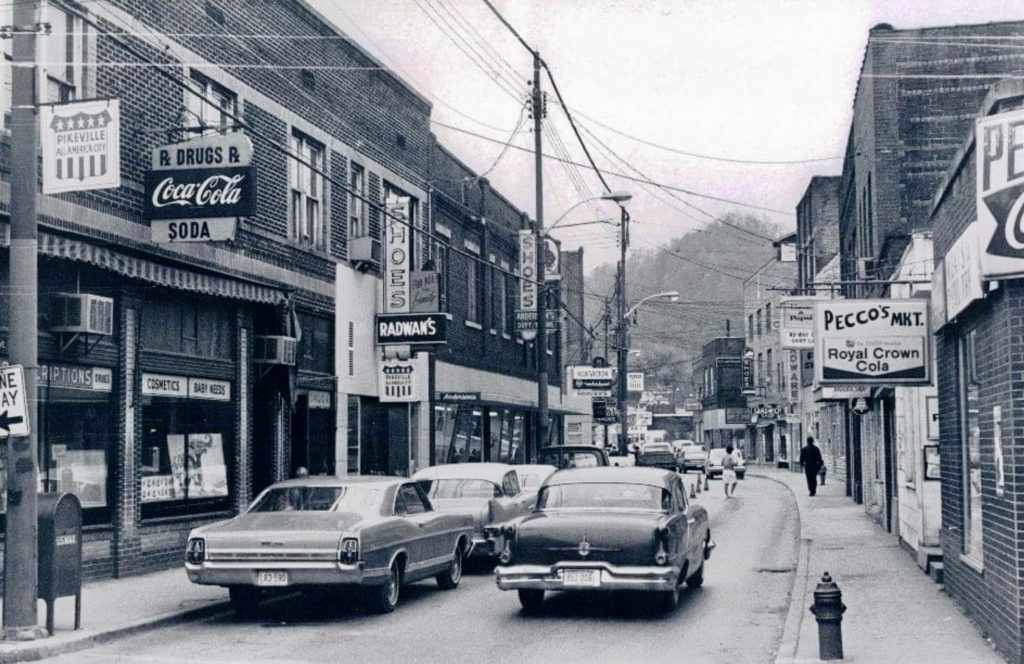
Pikeville on the Big Sandy in those days was bumper to bumper traffic, endless fits of stopping and starting to two traffic lights and one frantic corner cop. It was shuffling along Main and Second streets juggling packages and shopping bags from Hobbs, Krogers and Standard Drug. It was solving the world’s problems while leaning on a parking meter. It was a merry din of laughing, shouting, whistling humanity that paid no attention to the rusty creaking of a little pushcart and its driver’s monotonous “Pike County News! Pike County News!”
And no one heeded the tolling of the big courthouse clock.
Carbide turns on the radio. Garth Brooks comes on singing “Friends in Low Places.” Dry John starts patting his foot. “Gotta watch myself,” he says sheepishly. “Pastor Bill Dick says it’s a sin to dance, except in the spirit. Did I tell you about Alphie Hicks pulling that boloney sandwich out of her b-zeer?”
The times they are a-changin’!
The old Coca Cola plant on Cline Street, Clark’s News Stand, the Betsy Ross bakery, Krogers on Main Street with its rich aroma of Eight O’Clock coffee beans, Hobbs 5 & 10 whose snack bar was a Mecca for the afternoon coffee-cup philosophers, and G.C. Murphy’s have gone the way of the passenger train, the Greyhound bus—and the river. The World War I doughboy that stood sentinel on Main Street for three quarters of a century now guards the back door of the old courthouse. The liars and traders of Courthouse Square are still mad and disoriented like a swarm of wasps whose nest has been torn down.

The sign up ahead says Downtown Pikeville – Historic Site of the Hatfield and McCoy Feud. The Hatfield and McCoy Tour is second only to Hillbilly Days as a municipal effort to preserve our public image, to honor that indomitable mountain spirit we’ve been known for ever since two families spent 30 years fighting and killing one another over a pig. People from everywhere flock to Pikeville to see where old Ran’l is buried, to stand, admire and pay homage at this great shrine, located on the bank above Dorsie’s Dairy Bar. Those with the energy can climb the ninety-nine steps to U-Pike and show the kids where Ellison “Cotton Top” Mounts, a boy with not too much sense, swung from the gallows for killing Allifair McCoy.
Parking, tourist or otherwise, is no longer a problem in Pikeville. Nearly all of the town’s businesses have either closed or moved downriver to the Weddington Plaza. A four-story parking garage has been built to accommodate college commuters and the fans that periodically overflow the Kentucky Exposition Center when the Harlem Globe Trotters or a talent like Kid Rock comes to town. Since 2005, the Kentucky Expo, with a seating of 7000, has been known as a venue where performers literally give fans everything they’ve got. In 2007, the band ZZ Top (sharp dressed men) parted with all the jewelry they had on the tour bus. Some good ole boys from Mud Creek left town with several Hall of Fame diamond rings and a Rolex watch or two, all worth around two hundred bucks at the Bull Creek Flea Market.
Humble Pikeville Methodist Hospital has evolved into the Pikeville Medical Center, billed as one of the greatest health care facilities in the United States–on Harold’s Branch.
Pikeville College is now the University of Pikeville with an osteopathic school graduating more DO’s than it did DA’s (you figure it out) back when I attended.
The mortar has barely dried on the Pike County Judicial Center, a building so large and imposing two historic city blocks were leveled to build it. Some believe the old Pinson Hotel was the greatest loss. The Pinson was not only the cheapest hotel in town, but one that gained national attention on Paul Harvey’s radio show. It happened when two lovers, overcome by heat one summer night, climbed onto the roof for relief. To this day they are remembered as “The Diddlers on the Roof.”

As Pike County prepares to celebrate its two hundredth birthday it has a population of 58,669 and growing. The county seat serves 7,300, with two court houses, 240 lawyers and a seven-story jail. Crime pays.
I drop Carbide off at the Dairy Queen on the South Mayo Trail. Dry John wants out at the old Jerry’s Restaurant building. I hate to tell him it is no longer Jerry’s, home of the famous J-Boy burger, but a new Mexican kitchen serving food he can neither eat nor pronounce.
The light is changing to red when I turn left on Baird Avenue, then right on Hambley Boulevard, named for the mayor who moved a mountain, a river—and a town.