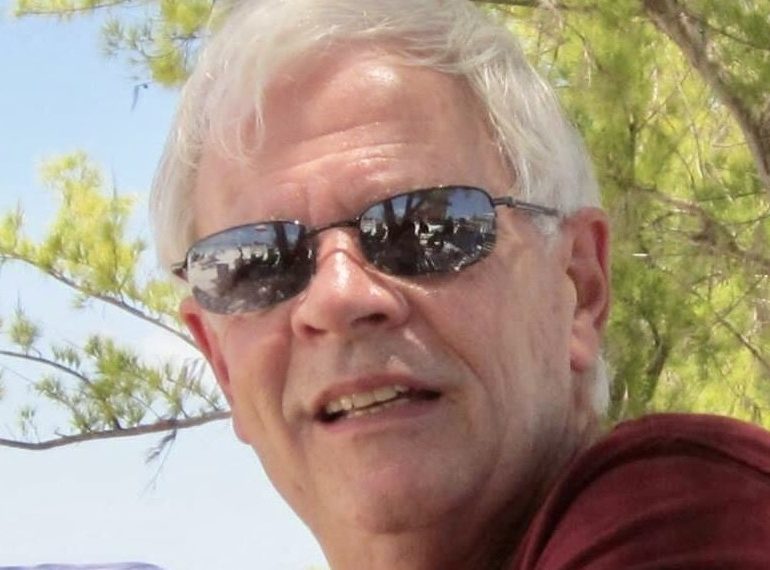
Gayle Compton may be the only politically correct writer working in Appalachia. He is not impressed by the rich and famous. He writes about the most interesting and most misunderstood people in America, the common people of Eastern Kentucky–his people, from the hard-working to the bare-assed and proud. Son of a coal miner, Gayle was born at Big Shoal, Kentucky, on November 3, 1944. Except for one year working in the sweat shops and steel mills of Detroit, Michigan, and East Chicago, Indiana, he has lived in Pike County, Kentucky. A 1970 graduate of Pikeville College, Gayle studied Advanced Writing under poet Bruce Bennett Brown and was a frequent contributor to Twigs, the college literary magazine. He placed first in the Lucy Ellen Hole writing competition in his sophomore year. Following graduation and studies in Linguistics at Morehead State University, he worked as an underground coal miner, rural mail carrier, substitute teacher and instructor of English and Speech at the Kentucky College of Business. He spent fourteen years in radio broadcasting and management.
Compton’s eclectic background has been the source of hundreds of stories, poems and articles appearing in numerous journals and anthologies, including Appalachian Heritage, Now and Then, New Southerner, Main Street Rag, Blue Mountain Review, U.S. 1 Worksheets, Wind Magazine, Kudzu, Adelaide Literary Magazine, Pine Mountain Sand & Gravel and The Kentucky Anthology: Two Hundred Years of Writing in the Bluegrass State. He is a three-time winner of the Appalachian Heritage Plattner Award for Writing Excellence, winner of the George Scarbrough Poetry Prize, the Kudzu Poetry Prize, the New Southerner prize for both fiction and poetry, and a three-time nominee for the Pushcart Prize. His humorous column “Pages from Peabrook,” which ran for many years in the Appalachian News Express, was voted Best One-Subject Column by the Kentucky Weekly Newspaper Association in 1989. Copies of the column and other writings by Gayle Compton are available in the Special Collections section of the University of Pikeville library.
Although Gayle Compton has more than three hundred poems, stories and essays in print, he has not yet published a book. He has several book-length manuscripts of both prose and poetry planned for posthumous publication by an unnamed literary executor. At present, he is occupied researching and writing articles for the Appalachian Arts, Literature and Entertainment division of the Pike County Historical Society.
He lives with his wife Sharon at Jonancy, Kentucky, the “Peabrook” setting for much of his work.
Call Me Ishmael
Once I believed in Endymion.
Once Keats, the bard of Joy,
sang to me in “mused rhyme.”
I read Moby Dick in a front porch swing,
heard the sea’s rolling symphony
beneath the swinging bridge.
Once my mother drew water
and the rusty voice of the well chain
was the Pequoid’s
farewell to Nantucket.
Hanging off a C & O coal gon
I blew in at the Cape,
Bearded and unbathed.
With my clothes in a cardboard box
I rode a Greyhound bus
to the mills of East Chicago, Indiana.
I saw hell fire trundled
on an ingot buggy
and breathed the sulfurous
breath of Satan.
Clinging to a wheel of a ’54 Mercury
like Queequeg’s floating coffin,
I found the return road to Peabrook.
Abraham, my dear old redbone,
rose stiff-legged from the porch,
whining and stretching,
his eyes full of memory and forgiveness.
From Adelaide Literary Magazine
Home Thoughts from a Hillbilly Poet
I have just returned, road weary and glad, from a three-thousand-mile backroads trips to America’s Northwest. A gung-ho Kentucky family of seven in a rented RV, we lost some enthusiasm early on, crossing Indiana, Illinois and Wisconsin. If you’ve seen one “fruited plain” you’ve seen them all. Relief came in the form of a kid’s game, seeing who could count the most lakes in Minnesota. It seems that every home in this soggy state has a lake-front view and a two-boat garage. In our home on wheels with blankets, pillows and assorted plunder shoved up against the windows, we must have looked like a modern version of the Joads as we rolled into the rusty half-naked hills of Billings County, North Dakota. Billings is where Teddy Roosevelt used to dress up and play cowboy, riding and roping and shooting buffalo, bear, moose, porcupine, prairie dogs and anything else he could draw a bead on. Over 110 square miles of parkland is named in his honor.
Glacier National Park in Montana might have been the highlight of our trip had not the most picturesque parts been closed due to snow and ice this first week of June. Never mind, we were in the Great Northwest, the legendary land of Lewis and Clark.
Mute and awestruck by the vastness of this country, I tried to imagine those intrepid souls sallying forth in a keelboat to claim the wilderness back in 1803. Their horses had been stolen by the Indians, and they were being led up the Missouri River by a young Shoshone squaw named Sacagawea with a new papoose strapped to her back. Her husband was a Frenchman and fellow expeditioner who had highly recommended her as a guide. He told William and Meriwether that if anything happened to her, not to feel obligated. He had a spare wife at home. Any misgivings the two might have had about Sacagawea were soon removed. She fearlessly scouted ahead of the expedition, pointing the way and looking out for poisonous snakes, bears, wildcats and hostile Indians. To top it off, she was a damn cook, spoiling the men with savory mountain cuisine such as rotisserie possum and boiled camas roots. Sacagawea was not bad looking, as far as squaws go. She was especially appealing to a healthy bunch of young men who hadn’t seen their wives or girlfriends in over a year.
Yet, in spite of everything the young guide could do, things were tough for Lewis and Clark, but on the bright side they were never stranded for four days in Coeur d’ Alene, Idaho, in a 450 Ford camper with a busted wheel bearing.
Just when we were beginning to feel like natural citizens of the Gem State, a good Samaritan named Moe showed up with a red toolbox. Back on the road, I tried to wrap my mind around the big sky, the emerald lakes and glittering snow crowned mountains of Idaho, Montana and Wyoming. I was in a part of America that was truly frightening in its own grandeur. At Yellowstone I stood with two thousand people and applauded as Old Faithful erupted in a hot and silvery plume seventy feet high. In South Dakota I looked upon the four faces of Mount Rushmore and not knowing whether to bow or salute, went for an ice cream cone.
Among mountains, deserts, canyons and painted hills, among buffalo, moose and prairie dogs, I had enough soul-stirring impressions to make a book. Strange, how I wrote not a single line of poetry until I arrived back home and saw Dry John Elliot’s old yellow Camaro parked in the Elwood curve with the hood up and steam boiling from the radiator.
Old Faithful had nothing on Dry John.
Welcome to Peabrook, Kentucky, stomping ground of Dry John Elliott when he’s not in jail, home of Elster Farmer, inventor of the indoor pig feeder, and Whet Junior Damron whose Ashland service station has a sign in the window that says JUNIOR’S GOT GAS YOU JUST CAN’T PASS.
Peabrook is my own little corner in this place called Appalachia. Dry John, Elster and Whet Junior are my neighbors. The farmer, coal miner, truck driver, schoolteacher, back-slid preacher, head-of-the holler redneck, the washed and unwashed, are my people. Known the world over for our internecine feuding, we would defend our worst enemy against an outsider. Ask ABC’s Diane Sawyer. Ask Robert Schenkkan who wrote The Kentucky Cycle. Ask anybody.
It’s called Kentucky pride.
Knott County, Kentucky, author James Still, whose novel River of Earth stands as a monument to human suffering in these hills, has called Appalachia “that somewhat mythical region with no known borders.” If we insist on boundaries, I believe they exist somewhere deep within the human spirit. The all but forgotten poet Roy Helton spoke of drinking lonesome water “up in a laurel thick, digging for sang.” He claimed that no matter how far we roam, once we’ve tasted lonesome water we are “bound by the hills and can’t get away.”
It is with a sense of urgency that I attempt to preserve something of place, character and language here in Eastern Kentucky where I see my world changing daily into the shapeless and soulless image of mainstream America. I can only take comfort in knowing that, at least in story, my land will always be “somewhat mythical.”
Somewhere in North Montana motorists are clamoring to video a herd of buffalo blocking the road. A prairie dog watches, standing on his hind legs chewing a straw.
Here in Peabrook the sun has gone down over Wildcat Rocks. Down by the creek the frogs are tuning up. Somewhere a dog barks at a wooly worm. The Ashland pumps are idle. Whet Junior and Bill Boy Jones are playing Gin Rummy and swatting gnats by the light of a buzzing Firestone sign. As a final salute to the day, we see the flash of one busted taillight and hear the tortured screeching of tires as an old yellow Camaro lays rubber from the Old Regular Baptist church to the Elwood crossing.
Twilight has come to the Cumberlands. An early moon holds vigil over the purpling hills, over the valley and roof tops of the drowsing village. The late hour thrums with crepuscular wings.
Fox News tells me that far away in Chicago the streets are lit with gunfire, and rioters have taken Portland. I shrug my shoulders and open my window to the night air, cooler now with a hint of honeysuckle.
Dry John Elliott would put it more poetically: “It sure is purty tonight. Look at that damn moon!”
Post Mark Appalachia
You already know me.
Named for two star-crossed lovers, or the place where Great Grand Pap
killed a bear in 1892,
I am the news of Stopover, Kentucky, the town hall of Pilgrims Knob, Virginia,
and the raconteur of Canesville Road in Tennessee.
I bring you word from Bumblebee, Arkansas, Peru, Indiana,
and River Rouge, Michigan:
Dear Irene,
How are you? Fine, I hope. How’s that Raymond? Fine, I hope.
We’re all fine but Virgil. He’s backslid and drinking again.
Up here there’s bars on every corner.
Dear Mildred,
Just a few lines to let you know we’re all fine on Brushy.
Don’t worry none about Virgil.
Sister Slone stood in prayer for him Wednesday night
at Abundant Tithings True Gospel Church of the Heaven Bound.
I started a farm at Greenfly, Tennessee,
with one hundred Pennsylvania Red Top chicks.
It was I who snared widow Haney’s man
with an ostrich feather hat
and a whalebone corset from Montgomery Ward.
When the bombs fell on Iwo Jima and Okinawa,
I crossed an ocean with the hearts of lovers.
From the girls of Red Jacket, West Virginia,
to Polkville, North Carolina,
I sent pressed flowers and lipstick kisses
to our men in the Philippines.
I returned with grass skirts, wooden fans
and promises.
I’m sorry the letter was late from First Sergeant Billy Wayne,
somewhere north of Da Nang:
Mae, my darling, how’s things in old Virgie Town?
It’s bad here in Nam, but we have to be strong.
I’ve been counting the days till May,
counting the days till we can marry…
For seven days that May I flew the stars and stripes at half staff.
From the Back Alleghenies to Iraq, from the Great Smokies to Afghanistan
I joined hands across the water.
They said I was too old at Elwood, Kentucky,
with my sun-bleached face blind with ivy.
So they built me new from cinder blocks
laid in one day by Dry John Elliott
for a case of Pabst Blue Ribbon.
I’m still a bit old-fashioned.
Don’t e-mail me when you’re out of town.
I won’t answer.
Drop me a line—or stop by when you’re back this way.
Brother Milford has saved you some plum granny seeds,
and Sylvia Hall has that recipe for slick dumplings.
Never mind if you can’t come.
Postmaster Lou will feed your cats
and Boone Burke will leave your mail
behind the screen door.
–From Now and Then: The Appalachian Magazine
The Garden
Strip Mining After the Fall
My shoes kick gravel between rusting rails
and I don’t miss the long trains
slow dragging the wealth of Burke Branch
to the tall banks of Tampa, to the fat moguls
who have never watched a mountain die,
never witnessed, with stopped heart,
the bombing of Laurel Mountain, Sunny Ridge
and Raven Rock.
Never saw the black tides of Shelby Creek
or the red rains of Dorton.
The “rough beast” is silent; his black deed done.
I stand in the shade of his lolling tongue
where Marion Post Wolcott stood in 1940,
her color-blind camera scarcely framing
Johnny Wright’s farm, the cornfield ablaze
in frost-dried shocks, the gray barn full with harvest.
The rabbit and the gray squirrel do not live here,
neither the groundhog fat with berries.
Gone are the blacksnake and the terrapin,
the bee that drank dew from the tulip flower
and the robin that laid her blue egg.
I find the gate and the crippled fence,
but not the graves of the Comptons, Halls,
the Burkes and Wrights.
I kneel on this twice stricken ground
where the mourners came before the beast,
to stand solemn faced in the chapel of pine
where the young widow sank to her knees
and an old preacher spoke peace from
the Book of Romans.
This solitary stone is not enough,
this coal-grimed name among the nameless:
Robert Fleming, my Irish father of fathers,
soldier in the War of 1812,
ship stowaway, crossing the ocean with
a loaf of bread, to find America,
Land of Promise, Pike County, Kentucky,
before the serpent walked in the Garden.
From Main Street Rag Magazine
The Insomniac
Not since that August morning in 1945
have I had a good night’s sleep.
The hoot owl never lifts a wing,
nor do the crickets stop in the grass
when I walk the road alone,
another shadow, another creature of the night.
On my knees at odd wakings
I ask the Lord the difference
between heroism and murder,
between duty and desire
and what it means to “love your enemies.”
I can’t sleep.
I saw “Little Boy” coddled, cradled
and waiting.
I felt the innocent dew falling
and heard the croaking of a frog.
They couldn’t have done it without me:
Colonel Tibbets, Einstein—Harry Truman
on the brightest and darkest day
in the history of the world.
You may not wish to shake my hand—
and then again, you might.
It’s the hand that did it.
I’m Private First-Class Sammy Wright
of Three-Mile, Kentucky,
the man who put the fuel in the Enola Gay.
From Saw Poetry Magazine (UK)
The Lord and the Grand Ole Opry
The Night the House Fell
Mother had a bad feeling about the little house from the day she laid eyes on it. She reckoned she’d have herself a good long talk with the Lord before she set foot in it. Although she spent a good deal of time on her knees seeking counsel from the Almighty, I believe she knew, deep down, that my dad would have the final say-so in the matter.
I was a towheaded boy of six the summer of 1951 when my father, mother, two-year-old brother Orville and I, crammed into the cab of a borrowed truck and rode from Ashcamp, Kentucky, to Ferguson Creek with a coal stove, a set of bed springs, a Maytag washer and six live chickens jouncing in the back. It was just one of the many times we had to pack up and move during my dad’s career as a coal miner.
Our new home was tucked in a valley at the foot of Town Mountain, just around the curve from Greer Iron and Metal and the Pike County stockyards. It was an unpainted ten-dollar-a-month shotgun shack built out of hard luck and rough sawmill lumber. The long front porch facing the road was the only part of the house that stood on solid ground. The living quarters, three rooms laid end to end, was propped up on “stilts” and hung over the creek bank at an unnerving elevation. Mother complained of “dizzy spells” every time she slung dishwater out the kitchen window. Not long after we moved in, one of the props worked loose, leaving one corner of the kitchen listing dangerously out of the horizontal. Mother wasn’t joking when she said she had to scotch the dishes to keep them from sliding off the table at supper time. Dad said the floor was so unlevel a man couldn’t pour himself a cup of coffee without running it over. He said he had seen worse. Ever the optimist, he saw the irregularity as a chance to show off his coal miner’s ingenuity.
“Stand clear, boys!” he’d say, hitching up his britches. “Looks like we got us a timber walking on the tramway. Top’s working clean to the face. We either crib’er up or pull the man trip.”
Indoor plumbing was out of the question, at least for us in those days. Our new home came with an outdoor privy which, as far as privies go, was considered upscale by the day’s standards. Designed by the same architect that built the house, it too, faced the road, squatting over the creek bank on two hickory poles. Thus situated, it had its own maintenance-free disposal system, regularly and efficiently sending its burden to folks downstream. It was the type of facility commonly referred to as a “two-holer,” equipped with snobbish side-by-side seating, a cozy arrangement with company in mind. Instead of a wooden door, a foreshortened burlap flap swung on four rusty nails and had a way of fanning out and curling up, whether there was a breeze or not, an amenity that traded privacy for good ventilation and a view. Many a time, upon returning from a visit to this little retreat, Dad was heard to remark that “the man that built that Johnny barn sure knowed what he was doing.”
Ferguson Creek in those days seemed to be the most storm buffeted community in Eastern Kentucky. When the winds came, Mother could be seen scurrying about, pulling down windows, closing curtains, propping furniture against the door, chewing her fingernails and praying. Dad, meanwhile, could be found hunched over his little portable Emerson radio, a Camel hanging out of the corner of his mouth, trying to bring in Nashville.
“Oh, Lord Jesus, what on earth are we going to do?” Mother would whine.
“Let’er rip!” was Dad’s reply, turning up the volume on the radio.
“But Ted honey, it could blow this little house away.”
“It’s been here a hundred years. I reckon it ought to be good for another hundred. Let’er rip!”
Occasionally, Dad would feel sorry for Mother, or else grow tired of hearing her mouth. Losing no time, she would snatch a quilt, curtain or whatever came handy and throw it over my little brother and me. Dad, bare-headed and shirtless, would open the door and yell “Water on number 3 belt head. Man the pumps!” The four of us would make a dash for our little ’36 Ford coupe where we’d huddle until the storm passed.
The storm never failed to work its magic on my young imagination. The crashing thunder, blinding lightning and rain coming down in sheets conjured up a pantheon of heroes from my mother’s bedtime stories. The old Ford became the “beautiful pea-green boat” as I went to sea with the Owl and the Pussy Cat. I became Jim Hawkins in the apple barrel bound for Treasure Island. I was Sinbad the Sailor adrift in a wooden bowl.
Mother, meanwhile, sat with her head bowed, lips moving in silent and fervent prayer. I knew she was asking the Lord to have mercy on us and our little house.
Firing up another Camel, Dad would peer through the windshield at the writhing sycamores and buckeyes and the tall Balm of Gilead and remark with perfect calm that a good little shower in this hot weather is just what we needed. Fanning smoke out of his eyes, he would turn on the radio and start fumbling with the knobs trying to bring in Nashville.
I had an uncle whom Mother found even less sympathetic than Dad during stormy weather. She often said that it was by the mercy of God that lightning didn’t strike our house and kill us all on account of the way Dad’s brother John Lester carried on when he came to our house bringing his bottle and his guitar. John was always drinking a little, always abundantly happy and celebrating, having gone AWOL from the Army or been let out of jail. He was mighty careful about where he left his whiskey because Mother had been known to sling it in the creek or pour it down the toilet hole. Therefore, after a surreptitious drink, he would put me in charge of his bottle with instructions to “hide it from your mother.” Slipping the ill-smelling potable under my shirt, I would sneak out to the coal house where John knew exactly where to look when his throat got dry.
Dragging up a chair, he would take the guitar upon his knee, get a faraway look in his eye and begin to tune and chord, twisting the little white keys and walling his eyes.
The instrument had to be in just the right chord. He was not one to settle for the key of G when he wanted a B flat. Biting his tongue, he would slide match sticks under the strings, start off in high hopes, stop suddenly and shake his head. Sometimes, he’d ask one of us to bring him a fine-tooth comb, a teaspoon or one of Dad’s work socks to bind down the strings for just the right effect.
When he finally got things to suit him, he would throw back his head, roll his eyes in a great passion and his rendition of “Missing in Action” would bring tears. Another twist of the keys and he’d segue to “Mule Train” or “Bilin’ Cabbage Down,” patting his foot until the table rocked.
John played with the guitar behind his back, between his legs and over his head, never missing a beat. He would sing a while, then kick off his shoes and dance a while. He would have everybody just busting a gut–everybody but Mother. He would keep up such a racket that at times even she would forget about the stiff weather outside. Every now and then the thunder would join in like a bass drum, lightning would knock the lights out, or the wind would blow a washtub off its nail at the side of the house and send it rolling and bouncing across the road.
“Please, John,” Mother would plead. “Play us a good sacred song.”
When the tempest was at its height and Mother on the verge of a nervous breakdown, John would fling open the door, shake his fist at the skies, curse the lightning and double dare it to strike him. By and by he would get to missing a special guitar pick he reckoned he’d dropped somewhere on his way in. He couldn’t hit another chord until he found that pick. Ducking his head against the torrent he would disappear into the night. In less than five minutes he would be back with that special pick, a smile on his face and a new song on his heart. Assuming a humble and pious manner, he’d lend his best voice to “Just a Closer Walk with Thee”—dedicated to Mother.
We were listening to the Grand Ole Opry, WSN out of Nashville, the Saturday night it happened. Dad, shucked down to his underwear, was stretched on the bed puffing a Camel wondering what Minnie Pearl and Rod Brasfield were up to this time. Grandma Fleming had come in from Coal Run on the Greyhound bus and was spending the night. She had taken the little cot belonging to my brother and me. Having eaten five ears of pickled corn, she had turned in early and was snoring like a contented sow. Orville and I were sharing a blanket on the floor, keeping company with the mice, roaches, spiders and other boisterous creatures of the night. The little Emerson sat on a nightstand by the old sofa chair where Mother, too nervous to lie down, sat clutching her Bible.
She watched as lightning lit up the old chenille bedspread she’d hung over the window that evening at the first sign of a storm, when dark clouds had gathered on the horizon and the tree leaves turned their undersides. Scooting as far away from the radio as she could get, she listened to the grumble of thunder, heard wind whistling through cracks and the groaning of old timbers. When smoke started blowing down the chimney, she knew it was a bad sign.
“It’s working up a good one,” she said, trying to sound brave. “Ted, don’t you think we ought to turn off that old radio?”
It was no ordinary thunder that drowned her words, but a sound of splitting rails, thunder that shook the earth, rolling and bumping over the mountain as though the fearsome Thor himself were riding the heavens in his iron-wheeled chariot. Lightning turned night turned into day. Rain came down on the tarpaper roof like pitchforks.
“Oh, Jesus, dear Jesus!” cried Mother.
About ten minutes later she became aroused by another sound–water dripping on the cook stove.
“Teddy, I hate to mention it, but it’s sprung an awful leak in the kitchen. There’s water running down the stovepipe…”
“What do you want me to do, woman, get out and patch the roof in this weather? Set a tub. I’ll catch my bath water.”
Once more Dad turned his attention to the radio, which by now had become a jumble of static and electrical havoc. “Avalene,” he said, raising up on one elbow and trying to make himself heard above the thunder, “would you care to crank that radio up a notch? I’d like to hear a little bit of Wayne Raney.”
“Ted, I’ve always heard it’s dangerous to play a radio when it’s…”
Thunder and lightning. Wind screaming like a panther.
Lefty Frizzell was whining, “If you’ve got the money, honey, I’ve got the
ti- hime…!”
More thunder and lightning. Forty-watt light bulb blinking.
“Turn it up. Turn that blasted thing up!”
“We’ll go honky tonking, baby, we’ll have a time…”
“Turn it up, dad burnit! Tennessee Ernie is coming on in a minute. I’d like to hear ‘Shotgun Boogie,’ if you don’t mind.”
“We’ll take your Cadillac and leave my old Ford behind…”
“Lord, help us all!” Mother wailed.
Suddenly, the radio slid off the nightstand, shot across the room and shattered against the wall. A framed picture of The Last Supper above the chifforobe spun on its nail and clattered to the floor. The bedroom chest spilled its drawers, and the big mirror cracked, bringing seven years of bad luck. There was a commotion in the kitchen that must have been the Maytag washing machine, the coal cook stove–or both–heading over, followed by the sound of shattering glass. Pots, pans, buckets and bottles were sliding and rolling in every direction. Mason jars of canned fruit, vegetables and apple butter were exploding like shotgun shells.
Grabbing the leg of Grandma’s cot with one hand and my little brother with the other, I held on for dear life. I felt the house shift on its foundations and heard Dad yelling, “She’s falling to the drift mouth, follow the gob rats!” Mother was screaming something about the end of time. After that, it was everyone for himself.
The little house groaned as though in pain, lurched forward, shifted sideways, swayed drunkenly on its crutches then headed backwards into the troubled waters of Ferguson Creek.
It was only minutes, but seemed hours, before there was a sign of life among the wreckage—only the sound of wind and pouring rain. My first realization was that of being trapped in absolute and suffocating darkness, a condition which persisted until I managed to extract my head from the mouth of a large butter churn. With help from the lightning, I found my brother nearby, unhurt but badly scared. He was hunkering in the remains of the coal bin, a wet and blubbering Tar Baby.
Through a veil of rain, I made out the figure of my dad. Naked, except for a pair of green striped boxers, he was fairly swimming in what remained of Mother’s winter canning, a veritable stew of pickled beets, blackberry jam and sour kraut. He appeared to have been scraped from one end to the other with a cabbage grater and thrown in the soup which, in fact, he had, come to think of it. Seldom had I heard my dad swear. He was a man who stoically bore pain and hardship without the relief of profanity, except for an occasional expletive upon hitting his thumb with a ball peen hammer, cracking his head on the door facing and the like. Until now, I had doubted his capabilities in the medium. However, as soon as he got his jaw working, he gave tongue to some language not heard in church.
Meanwhile, Mother was nowhere to be found. With lightning dancing about his head, Dad scrambled to his feet and began searching frantically in the maze of broken
timbers and tumbled household furnishings. I could see him plain—his wild eyes, his sour kraut and jam smeared face–a visage of anger, confusion and worry rolled into one.
“Has anybody seen my damn britches?” he stammered at last.
Mother appeared, miraculously, poking her head out of an old hair trunk wearing a leopard skin lamp shade like a Sunday hat. Seeing the three of us, alive and whole, she made for us with open arms, heading, pitching and thanking the Lord.
Another stirring among the rubble and Grandma could be seen unrolling her bed covers and rubbing her eyes. Somehow, her bed had landed upright and became buried under a harmless avalanche of quilts, blankets and laundry. She had slept through the whole catastrophe and woke thinking it was all a nightmare. She allowed she was going to have to lay off that pickled corn. When it finally dawned on her that she was the victim of a real calamity she was fighting mad. She swore she would never spend another night with us as long as she lived. She said we were the rowdiest bunch she had ever had any dealings with.
It was only after the storm passed and neighbors came bearing lanterns, ropes, spirits of ammonia and personal commiseration that we began to comprehend what had happened.
A kindly neighbor carried my brother up the creek bank on his shoulders while I followed hanging onto his belt.
Grandma refused all assistance and marched up the bank on her own, mad as a hornet. She told us what she thought about Ferguson Creek. She told us where we could put the little house. She said she was heading straight for Coal Run where people were halfway civilized.
It took my dad and two other men to haul Mother to safety. She had suffered little physical damage, but her nerves were wrecked.
“It’s all on account of that old, wicked music!” she said, wringing her hands. “That Saturday night frolic is the cause of it all. I tell you right now, I’ll never listen to that old devil’s music again the longest day I live!”
Standing in the rain in his striped drawers, Dad surveyed the sad remains of our little home and the bare and muddy creek bank where the little house once stood. His face was clouded with a new concern.
“I think it’s a crying shame,” he said, shaking his head sadly. “We’ve done and missed the Grand Ole Opry.”
–From Wind Magazine
Aladdin’s Lamp
Big Shoal, Kentucky (1918-1949)
I
Let us not forget how the rails came to Big Shoal
on the strong back of the Negro, the Italian and Hungarian,
on the sunbaked shoulders of the mountain men of
Kentucky and West Virginia.
When chimneys smoked with breakfast fires
and a town woke to the rumble of the C&O Mallet
in a dawn that rose swift as fog from the river.
II
Once men’s blood ran quick in the vein
and Big Shoal lived,
burning in the power lines pole to pole,
from the train depot to the boarding house,
from the brass’s plumbed and shingled court
to Snake Eye Williams’ whitewashed shack.
Once men walked in company store boots
from Coal Run and Greenfly,
from the camp house to the drift mouth;
Rode a man trip face down
into the mountain’s cool belly.
Once men stood tall for Aladdin Coal
to get down on their knees
in lamplight and glittering dark.
III
Once women prayed with an eye on the clock,
kneeling bedside in the long nights,
talking to God over the bean kettle
and by the clothesline in the crabgrass yard.
Once mothers rocked babies on a screened porch,
breastfeeding in the dappled shade.
IV
Name’s Pegleg–Pegleg Younce,
all I ever been called since ’41.
I was braking on a Jeffrey for Arnie Bates.
It was twenty minutes till quit time,
boss wanted one more car.
We heard the top a-workin’
and seen the rats a-runnin’.
There was no time to pray.
I got off light compared to Arnie–
Death hung in the mine for the next six months.
You could feel it–and smell it,
my hand to God.
V
Night comes down the mountain.
Raw Head and Bloody Bones
lurks in the tipple’s long shadow.
I am safe,
riding the hip of my young mother,
mocking the hoot owls in the dark oaks.
VI
We was coal miners, and river rats, too.
Big Shoal, Kentucky, was named for the river,
the way Aladdin Coal was named for a lamp.
Some say a magic lamp–
damned carbide lamp if you ask me.
The Big Sandy was our highway in and highway out.
We boated, fished it, swum it, cussed it–
and baptized the saved in its muddy waters.
Company and the river thought they owned us–
our money spent nowhere but the company store.
What we had was one another–
Always somebody staying all night,
bringing a pie or a mess of greens,
tending to the sick or settin’ up with the dead.
Some things money can’t buy.
VII
Uncle John
plays the boarding house square dance,
singing like Bill Monroe.
A merry swain in company store clothes,
sharp creased khakis and starched shirt,
he walks his girl to Coal Run hill
in the June night heavy with honeysuckle.
VIII
Dad’s a fog-blind mariner in a wooden boat.
With a new floor model radio bought on time
he crosses the river by a carbide lamp.
Windows rattle and toes beat time
to the “Wabash Cannonball.”
John dances barefoot on the slick pine floor
and Acuff’s happy hoboes squall.
IX
How soon above the merry din–
how clear the clarion call!
X
I ride my tricycle on the long porch
until the train comes.
Dad and Grandpa Gus help carry the cot.
Mother’s blue hands are raised against the sun.
My new brother is red as a rat,
the life cord curled on his belly like a cabbage worm.
XI
Show fare is 30 cents at the New Drive-In.
We walk the tracks to Little Shoal,
grown men and women, boys and girls
perched like pigeons along the rails,
scanning the dark newsreels of the Great War
for the face of Uncle John.
We laugh at a bouncing Mickey Mouse
and pretend we hear the muted six guns
of Gene Autry and Randolph Scott
in the moon-white plain of the summer night.
XII
When Elmer Hicks got into the 440
old Doc Wheeler rode from Pikeville on a handcar.
Elmer was already gone when he got to him.
The power had done and broke his neck.
He was a big healthy young man
with a wife and two little boys.
He’d just bummed me for a chew of tobaccer
not five minutes before it happened.
Some things a man just can’t forget.
XIII
Christmas morning.
Mother points to reindeer tracks
on the rooftop’s melting snow.
Dad’s gray work sock hangs from the mantle,
heavy with candy and nuts from the North Pole.
Old Santa has brought an electric train,
a smoking Mallet with a red caboose.
I shoot my Gene Autry cap pistol and Dad “falls dead.”
Three men carry Grandpa Archie
from the boarding house frolic to the head of Big Shoal.
The Patillas, red-cheeked and bundled,
sing the carols of their new country.
XIV
We had us thirty good years
before Aladdin’s lamp went out.
I was there when they pulled the last man trip.
I helped them take the equipment to the outside
and load it on a rail car going north;
seen the men come out the drift mouth for the last time,
heads hanging, carrying their dinner buckets.
Some of the camp houses was already empty.
We all shook hands, turned out our lights
and went our separate ways.
XV
Aunt Mag and Cousin Jo
were wearing grass skirts when the tipple burned,
souvenirs from the soldier boys.
Make-believe Hulas with a cheap Kodak,
they caught the day, the hour, the blazing sky,
the stone faces and folded hands,
the unwilling bowing timbers
that farewell summer of ’49.
XVI
Forever stilled in black and white,
an old picture framed and forgot
awaits the stranger’s chance remark:
“I knew this place of smoke and flame;
I knew this time of darkness and burning light.”
—Gayle Compton
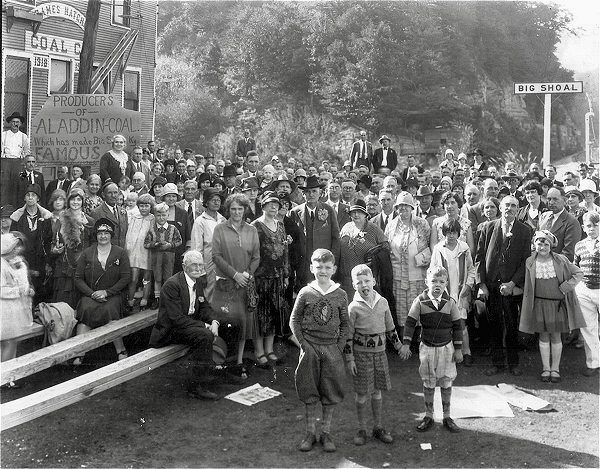
James Hatchers Birthday Party
The entire population of Big Shoal, Kentucky, turned out for “Uncle Jim” Hatcher’s birthday party on September 22nd, 1919, in front of the company store. The party was attended by many of his Floyd County friends and relatives. Hatcher can be seen in the center of the group wearing a black hat and a boutonniere. Sitting in front on the left is Reverend M. C. Reynolds, a revered Methodist minister of Coal Run, Kentucky. The James Hatcher Coal Company, operating at Big Shoal near Pikeville, produced Aladdin Coal, widely sought by buyers.
Photo courtesy of William Pruitt of Abbott Creek.
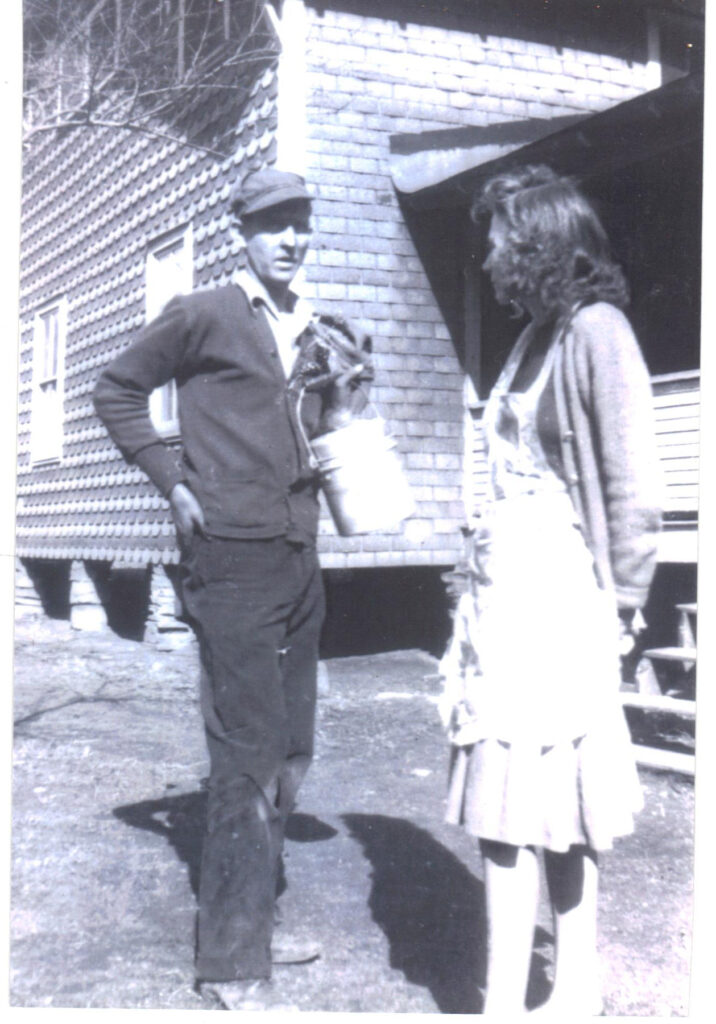
End of Day Shift, Teddy and Avalene Compton, Circa 1947
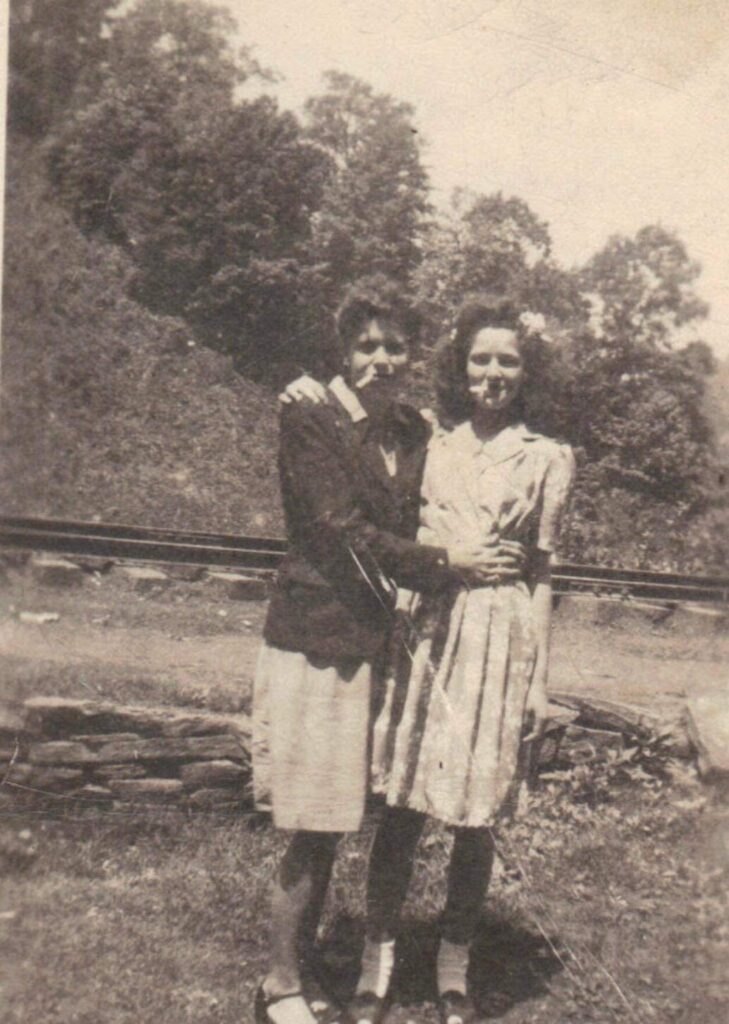
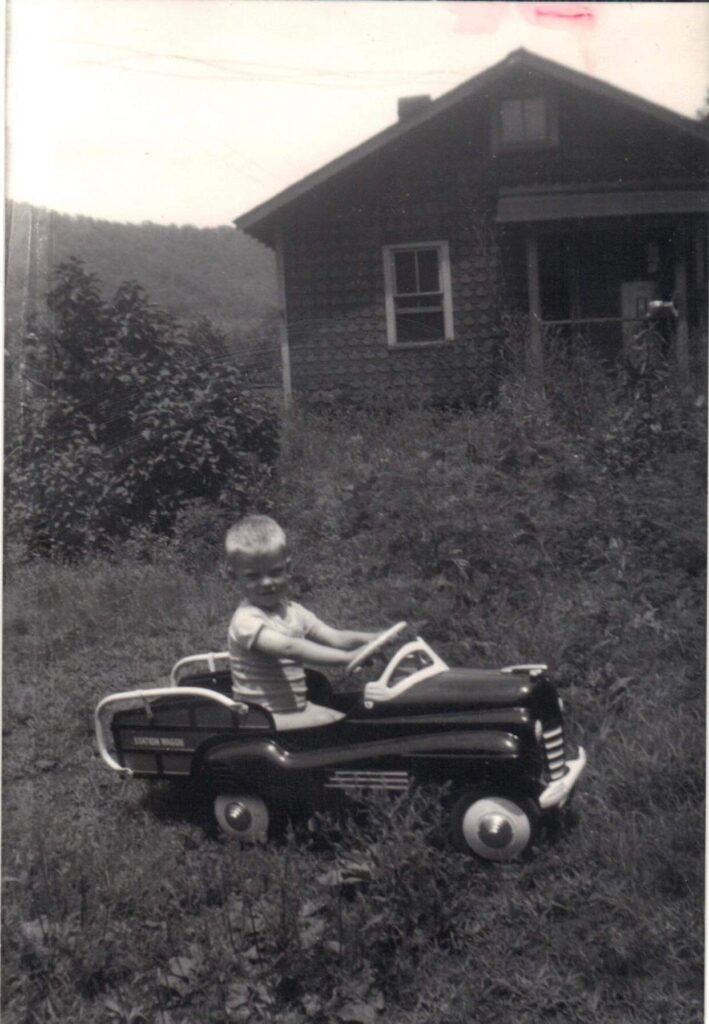
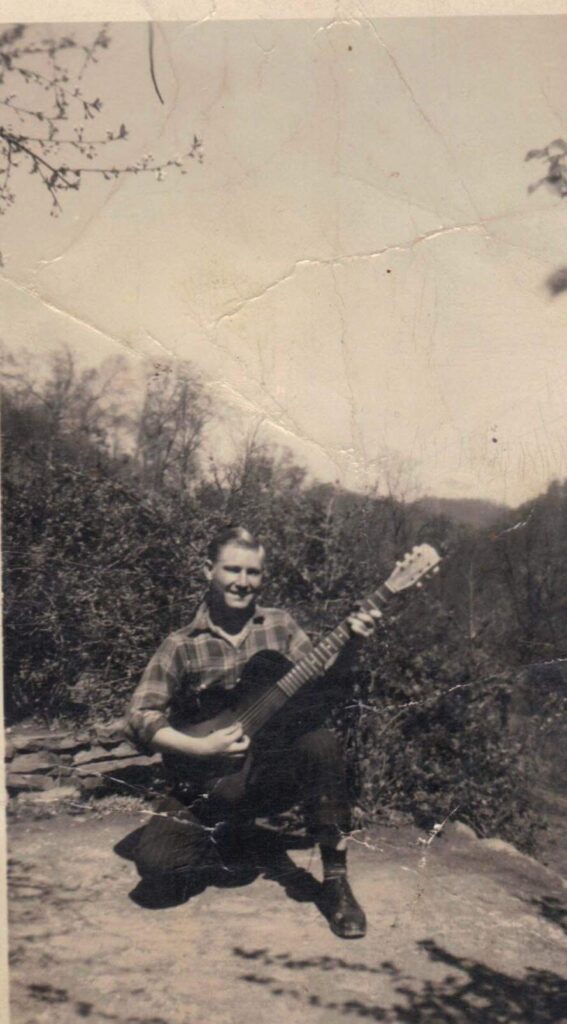
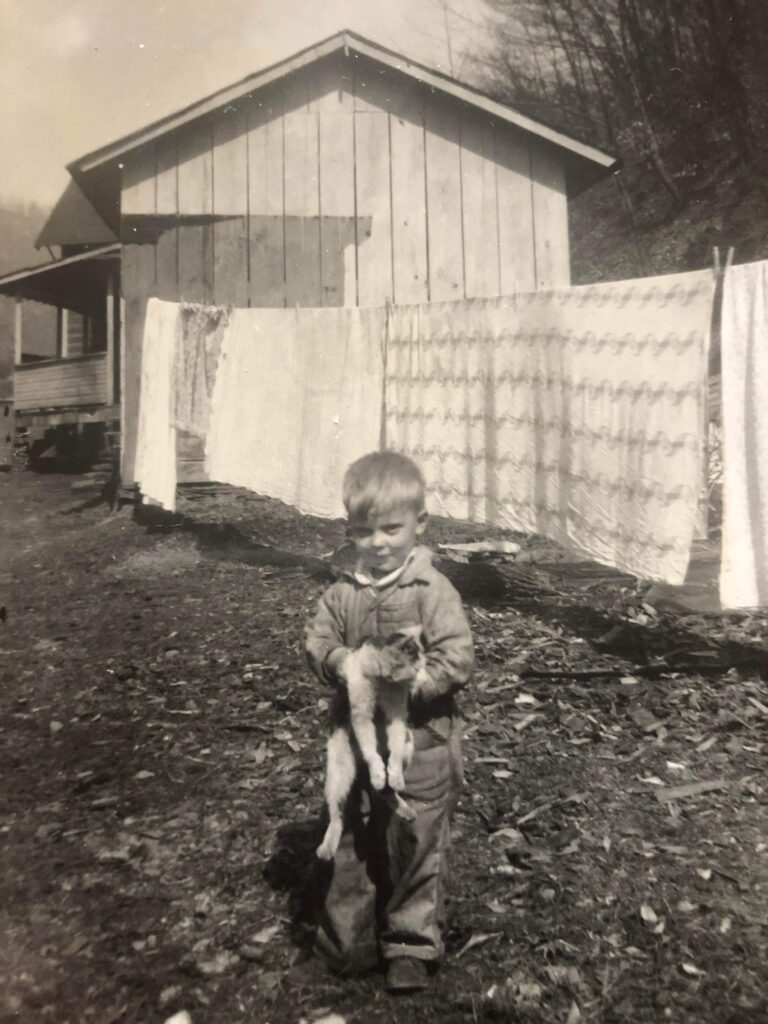
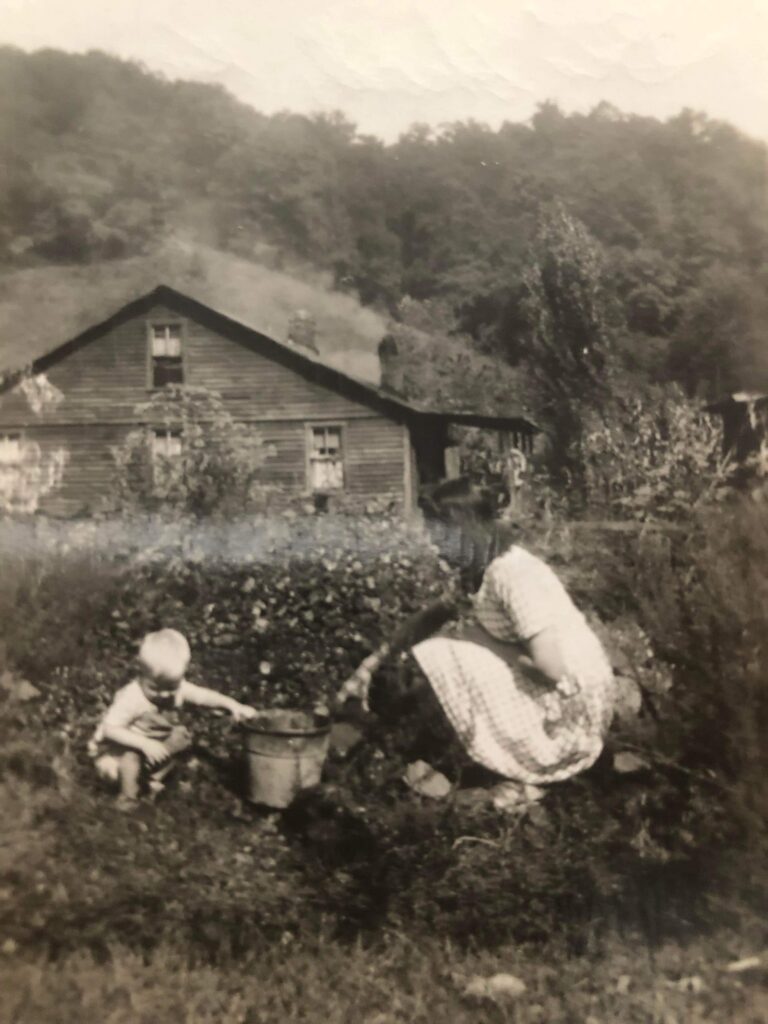
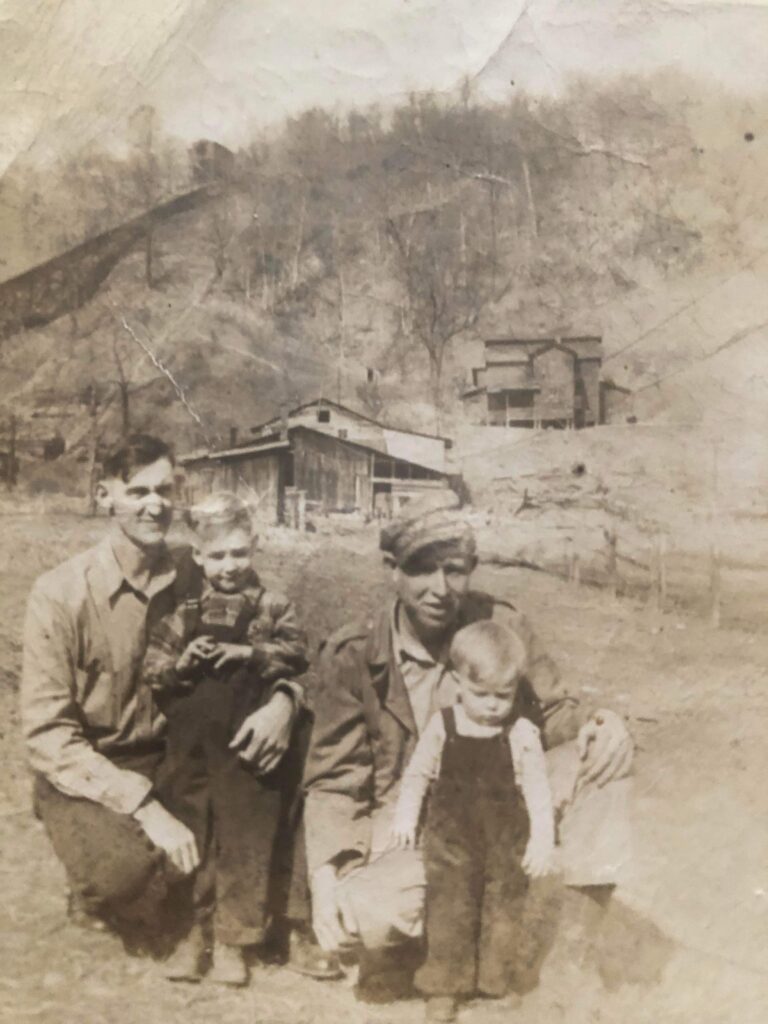
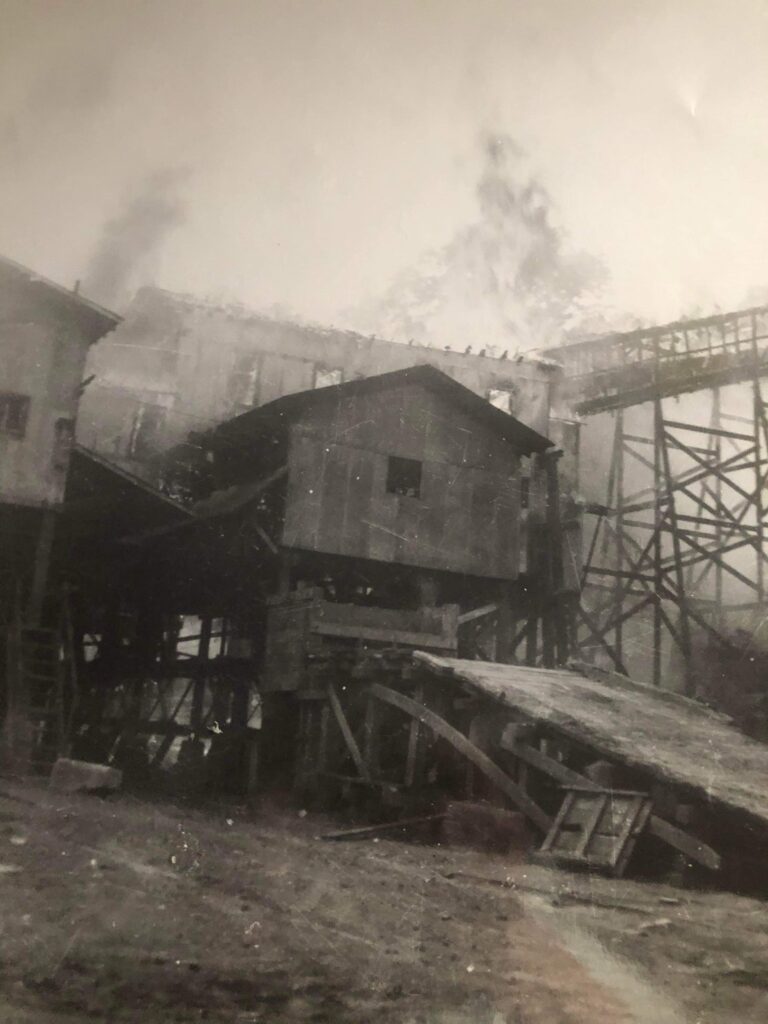
“Aladdin’s Lamp” was a winner in the 2008 Mountain Heritage Literary Festival, sponsored by Lincoln Memorial University. Family photos are from the Ray R. Hall collection.
PCHS Contributor Gayle Compton