Table of Contents
- SPIRITS IN THE FIELD: An Appalachian Family History
- BRIGHT WINGS TO FLY: An Appalachian Family in the Civil War
- HEARTS IN ZION: Steel, Coal, and an Appalachian Family
- Aachem’s Razor at 59
- UNFINISHED MANUSCRIPT
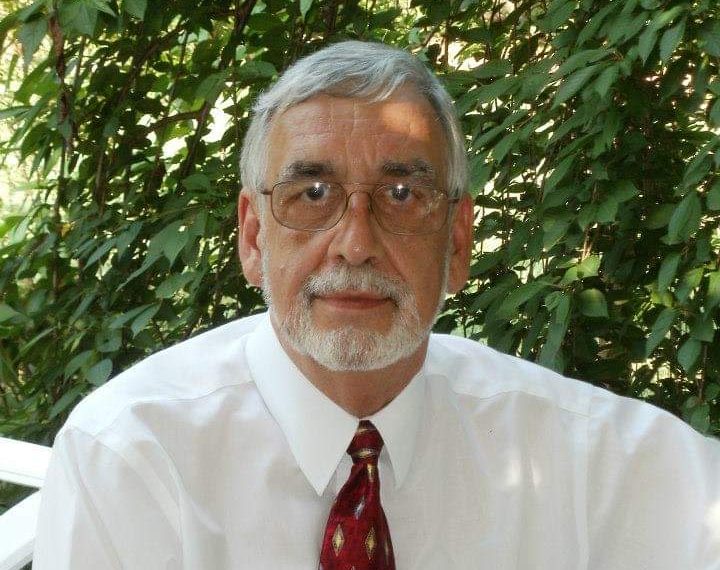
Hopkins is best remembered as the author of three books of local and regional history: Spirits in the Field: An Appalachian Family History, Bright Wings to Fly: An Appalachian Family in the Civil War, and Hearts in Zion: Steel, Coal and an Appalachian Family. He also wrote poetry which appeared in a number of literary journals. His column “Notebook” ran for many years in the Appalachian News Express. He was married to Charlene Adams Hopkins, a Pikeville librarian.
Bruce Hopkins was a well-respected Pike County, Kentucky, educator, administrator, and journalist known for his work in radio, TV and newspapers. The first of three children, he was born September 3, 1946 at Greasy Creek, Kentucky, to Marvin and Pansy Prater Hopkins.
The following is taken from the eulogy I delivered at the funeral of my best friend on a bright Sunday afternoon April 3, 2016.
I became acquainted with Bruce Hopkins in 1964, when we were seniors at Virgie High School. He sat three rolls over from me in Queenie Cox’s English Literature class, in a front seat, as close as he could get to the blackboard. Through the tall windows we could see the 4-H Club’s botanical garden, and the American flag, the same stars and stripes Bruce had lowered to half-mast the day John Kennedy died. There was something different about Bruce. In fact, I was to discover there were many things different about him. In February, a British rock group known as the Beatles had crossed the ocean, introducing American youth to an exciting new sound and a rebellious hair style. Teen-aged boys were considered un-cool if their locks didn’t hang several inches over their collar, ears and eyebrows. Unfazed by the fad, Bruce kept his hair clipped short and severe as an Army private’s. Bruce was from Greasy Creek, and Greasy Creekers were a different breed anyway, just ask anyone.
Our principal, Fred W. Cox, feared that the average student from Greasy Creek would never get a proper education, never amount to anything–and for good reason. The Greasy Creek school bus, the oldest and most dilapidated vehicle in the county system, could be relied upon to arrive on campus every morning around the middle of first period. Several of its seats were missing, having been unbolted and thrown out the emergency door by its passengers. One could hear the old International coming five minutes before it rolled onto campus in a cloud of dust and steam, its cargo of miscreants hanging out the windows, waving and shouting greetings and maledictions like a band of Indians on fire water. Bruce Hopkins was always right in the midst, doing his part in disturbing the peace.
The principal and teachers at Virgie High soon found they had no reason to worry about educating Bruce Hopkins. Their biggest concern was teaching him something he didn’t already know. I saw many a teacher wince when Bruce raised his hand in class. If he didn’t send them to the dictionary, he would challenge their pedagogical credentials by demanding an explanation for such conundrums as why a tiger is a tiger in a possible world. A voracious reader of poetry and the classics, he had no tolerance for teachers of English who had not read Thomas Wolfe, Faulkner and Sherwood Anderson. He wrote poetry when writing poetry was not cool, especially for males. When he found out that I also wrote poetry, and didn’t care who knew it, it was the beginning of a friendship that would last forever.
After graduating high school I would not see Bruce again until my sophomore year at Pikeville College. I met him in the college bookstore where he eagerly showed me his new German language text. He said he couldn’t wait to excoriate some of his professors in a foreign tongue. He had just completed a year at the University of Akron, with the intention of going to medical school. He soon decided that he had neither a taste for the Buckeye State nor medicine, and had come back home to study literature, his first love. Bruce commuted from Greasy Creek in a black 1958 Simca, a French counterfeit of the Henry J. He was not the envy of the campus.
Bruce loved to talk, so it was only natural for him to take a part-time job as announcer at radio station WPRT in Prestonsburg. While driving to class in my dad’s ’63 Plymouth Fury and listening to Bruce spin the hits, I decided to go for my radio license. Broadcasting, like poetry, was just another thing that bound us, another love we would share for life.
After receiving his BA in English, Bruce began teaching at Millard High School in Pike County, Kentucky. He later moved to Lynchburg, Virginia, where he taught at one of the top-rated high schools in the state. Teaching full-time and working part-time at radio station WLLL, he began taking graduate courses at Longwood College leading to a master’s degree in English. When it came time to write his thesis, a task that can take weeks, even months, he borrowed an Underwood manual typewriter and went to work. Three days latter he shocked his professors by showing up with a 70-page first draft on the plight of the proletariat depicted in Sherwood Anderson’s last novel, Kit Brandon.
In 1974 I was working as operations manager for a new radio station in Elkhorn City, Kentucky. I had no shortages of DJ’s, but I couldn’t keep a secretary. The first one had mysteriously disappeared one day. Somebody said she ran off with Paul Revere and the Raiders. Her successor eloped with the music director to Clintwood, Virginia. I figured I’d have to find me an ugly secretary if I planned on keeping one. I spent an entire day interviewing applicants for the job. The ones who were short on looks were even shorter on brains. I ended up hiring a petite nineteen-year-old who was not only pretty, but smart. Her name was Charlene Adams.
Meanwhile, Bruce had become homesick for Pike County. When he heard that I was running a radio station he quit his teaching job in Lynchburg. I told him I would take him on as Sales Manager, only if he promised not to break my one standing rule at WECL. “Hands off the secretary!” Less than a month later he came into my office face glowing like that of Moses coming down from the mount. “G.C.,” he sighed, “I think I’m in love. You sure have good taste in secretaries.”
Bruce and Charlene dated six years, and were married September 20, 1980. Bruce had survived two previous marriages, each of which lasted five years. Charlene confessed that she was nervous and uncomfortable until the five-year trial period had passed. But she had worried needlessly. They had both found true love.
A coal boom was on in the mid and late seventies, and it was prosperous times for most people in Pike County. Bruce Hopkins was a workaholic with a head for business. Like Mark Twain’s Colonel Sellers, he was always coming up with schemes calculated to make money—and sometimes lose it. At various times, and often simultaneously, he ran a photography business, a floral shop and worked as a news stringer for the Lexington Herald Leader, CNN and WSAZ TV in Huntington. Bruce got an urgent call one morning from a disgruntled reader of the Herald. Someone had written an anonymous and excoriating article about the caller’s favorite politician. “You’re a good writer,” he reminded Bruce. “I want you get busy and defend this man at once!”
“Sorry, but I can’t help you,” Bruce told him calmly. “I’m the man that wrote the article.”
I hadn’t been married long when I accompanied Bruce on one of his TV assignments for Channel 3. Someone had robbed a jewelry store in Paintsville. Second only to murder, Bruce loved covering robberies. In order for the story to air on time, we decided to hand deliver the film in Bruce’s aging Pontiac Lemans. I had told my wife earlier that we would be home around 9:00 pm. When our schedule changed I was unable to reach Sharon, and left word with a relative to let her know it would be later. Of course the relative forgot. An unfortunate event caused us to arrive around 2:30 the next morning. Sharon met me at the door. “What kind of excuse have you and Bruce got this time?” she exploded. Instead of lying, as a smart man would have done, I told the truth. “We ran over a horse!”
“Ran over a horse! So help me God, I’ve heard every excuse but that one.”
In 1977 Bruce bought a dry cleaning establishment in Elkhorn City, with a drop-off station in Grundy, Virginia. I was unemployed at the time, and he took me on as a working partner. He ran the plant and I worked the Grundy office. He called me up one evening wanting to know if I had taken in any good suits in his size. “Yep,” I was able to say. The mayor just dropped off a nice sharkskin.”
“Get it cleaned up for me. I got an important meeting this weekend.”
A customer showed up one morning at the Elkhorn plant, proudly carrying a fairly new leather jacket under his arm. “I want it cleaned,” he told Bruce. Bruce read the tag on the collar and handed it back. “I can’t clean this thing. It’s made in Taiwan. Not real leather. Put solvent on it and it’ll set up like concrete.”
“It’s genuine cowhide,” the man insisted. “I want it cleaned.”
When the man showed up three days later to claim his coat, Bruce tried to break it to him easy. He said, considering the complications, he would only charge him ten dollars. “Where’s my coat?” the customer asked, suspiciously.
“Right over there,” Bruce responded with a jab of his thumb. “That’s it, standing over there in the corner.”
In 1993, following a year of teaching in Matewan, West Virginia, Bruce Hopkins was hired as Communications Director at the Pike County Board of Education, working out of the Central Office. He was later put in charge of Risk Management, a position he held until his retirement in 2012.
In 1997 Bruce learned of the Kentucky Department of Transportation’s plans to rebuild highway US- 460 through Pike County to Virginia. He was grieved to discover that the new route would cut through the valley of the Levisa, and the ancestral burying grounds of the Hopkins family since before the Civil War. For six years he worked to unearth the family secrets in the old cemetery and to reclaim his heritage. His hard work and the history of the Hopkins’ and Praters of Greasy Creek are recorded in the beautifully written book Spirits in the Field. Two more ground-breaking works would follow. Bright Wings to Fly is the continuing story of the Hopkins family as they deal with the Civil War and its aftermath. In Hearts in Zion, the family struggles with three “boom and bust” decades of steel and coal, followed by the Depression. A fourth book, which would have taken old Elisha’s progeny into the modern age, is unfinished.
About six months following his retirement in 2012, Bruce called me at work. He had begun to experience back pain and the onset of medical problems that would later claim him. “G.C.” he said jokingly, “It sure sucks getting old.” Then he quoted the famous line from Andrew Marvell’s poem, “To His Coy Mistress.”
“At my back I always hear, time’s winged chariot hurrying near.”
Bruce Hopkins loved life. Weeks before his untimely death he told me that, in spite of the pain of cancer, he managed to find pleasure in every day he lived. From his hospital bed, two days before his death, he spoke these words to his wife Charlene and his brother Paul: “I’m rapidly falling toward death. Go get me a hotdog with mustard!”
Bruce Hopkins died Wednesday, March 30, at the Pikeville Medical Center. He was 69.
In 2003, on one of the last days of summer, Bruce Hopkins stood on the former site of the old Prater cemetery. Only the dust and ghosts of his ancestors remained, and the bulldozers were coming. His thoughts that day are part of the epilogue to Spirits in the Field. May they also stand as a fitting valedictory to a full and productive life.
Dusk comes earlier now; and longer evenings afford more time to total the year’s accounts. The gains and losses, the victories and defeats, the crises and their denouements are no longer urgent, and no longer carry the weight they did when the year was young and the blood was hotter. Now only peace is desired, and if unobtainable, at least rest. It is not merely a summer that ended today…the patch of torn ground I am visiting has been my albatross and my salvation, my unflagging companion awake or in dreams, and now it no longer matters. Now there is no driving compulsion, no fever, no midnight epiphanies; my pursuit is ended. There is nothing more I can do. The moving finger has writ, the poet says, and moved on.
SPIRITS IN THE FIELD: An Appalachian Family History
Bruce Hopkins, Wind Publications 2003
In 1997 the Kentucky Department of Transportation announced plans to rebuild US-460 through Pike County to Virginia. The new route would cut a wide swath through the mountains in the valley of the Levisa, and the ancestral burying grounds of the Hopkins family since before the Civil War was in its path.
For six years Bruce Hopkins worked to discover the family secrets buried in the old cemetery and to reclaim his heritage. This is the story of his struggle with the Kentucky DOT and the unearthing of his family history back to the first settlers who came there after the Revolution. This is but one of the many family histories concealed beneath the mine tailings, highway excavations, or kudzu of the Eastern Kentucky mountains, most of which will remain forever untold and unknown.
From the book jacket review, Wind Publications
BRIGHT WINGS TO FLY: An Appalachian Family in the Civil War
Bruce Hopkins, Wind Publications 2006
In 2003, Bruce Hopkins uncovered more than his ancestors’ bones when his family cemetery was moved for road construction. As a result of that experience, Hopkins wrote Spirits in the Field, which introduced readers to nearly 200 years of his family history.
In Bright Wings to Fly Hopkins returns to the Civil War era for the first of a proposed trilogy dealing with three great periods of Eastern Kentucky history.
The citizens of Pike County, Kentucky, in 1860 considered themselves Virginians more than Kentuckians. Isolated by the mountains, they had little commerce with central Kentucky, but Virginia lay near, just across the Tug Fork of the Big Sandy. Pikeville, the county seat, was a prosperous city on the Levisa Fork of the Big Sandy, and for much of the year was a busy port for the steamboats that plied the river. Historians have essentially ignored the role of Eastern Kentuckians in the Civil War, and the effect of the War on mountain communities. Bruce Hopkins corrects that oversight in Bright Wings to Fly. Here he relates the fierce struggles of the families of Greasy Creek, broken and in poverty, as they deal with the Civil War and its aftermath.
From the book jacket review, Wind Publications
PCHS Contributor – Gayle Compton
HEARTS IN ZION: Steel, Coal, and an Appalachian Family
Bruce Hopkins, Wind Publications 2009
With the coming of the 20th Century, American industry experienced an unprecedented expansion, the greatest in world history, with burgeoning markets and raw materials easily available. The call went out to rural America and the world for working men to operate the factories and mine the coal that powered them.
To house these huge numbers of men and their families, American companies built more than twenty thousand towns. To mine the coal, steel and coal companies built ten thousand of these towns, usually known as “camps,” in the coalfields of the Southern Appalachians. The greatest period of this construction lasted briefly three decades, from the beginning of the Twentieth Century, when the railroads first penetrated into the hills, until the Crash of 1929 ended the time of the great coal camps forever.
With the onset of the Depression, companies ruthlessly closed the mines and demolished the houses, salvaging whatever assets they could from an unfinished experiment, and leaving their former workers to fend for themselves. For the people of the hills, it was the greatest upheaval since the Civil War and the scars of that experience still haunt the people of the coalfields.
In Bright Wings to Fly (2006), Bruce Hopkins recounted the story of his family in the hills of Eastern Kentucky during the Civil War and its aftermath. In their struggle to cope with the unimaginable catastrophe, his family became a metaphor for all the mountain families whose lives were forever changed in the nation’s darkest hour. Now, Hopkins returns with Hearts in Zion, the continuing story of his family, as a strange, new prosperity descends on the hills, and the lessons learned in the aftermath of the Civil War are nearly discarded, until once again the people of his homeland face unbelievable convulsion and abandonment but manage to survive and pass on the stories of their bloodline to yet another generation.
From the book jacket review, Wind Publications
UNFINISHED MANUSCRIPT
Hearts in Zion, Bruce Hopkins’ third book, follows the Hopkins and Prater families of Greasy Creek, Kentucky, through three decades of industrial expansion, lasting from the coming of the railroads until the stock market crash of 1929. It is a story of life in the coal towns, and a humbling allegiance to the moguls who built and controlled them. It was a time of boom and bust, good times and bad. It was at best a home and a regular payday to spend at the company store. At worst it was cut-backs, layoffs, mine closures and “making do.” With his fourth book, Hopkins planned on taking his Appalachian family through the inevitable decline of the coal camp into a promising new century. Unfortunately, he died before the book was finished. “Tell My Father,” the only surviving chapter, was found among his papers by his widow Charlene Hopkins. This brief return to Greasy Creek is the author’s final and loving tribute to his Appalachian family, as well as an unforgettable chapter in Pike County history.
Tell My Father
Blood
Begin at the beginning, I would tell my students, even if you start your story in media res. At some point, you will have to reveal what happened before, what forces played out on the characters before they arrived at the beginning of your story. And write what you know, I told them. If you have never been to the locale of your story, then you will have to rely on some other writer’s description. If it is true and honest, your story should be true and honest. If you can’t do that, you should not be writing.
This presents a problem if you are writing about your father. If you had a bad relationship with him, then your story will inevitably color him as a cad, even if you think it would not. And vice versa, if you feel your father was the most important force for good in your life you may ascribe to him certain heroic virtues that were not entirely deserved.
Is it written somewhere that sons are required to replicate their father’s journeys? Is it some kind of psychic mandate, burned into the subconscious of men, qualified over the eons and inescapable, even if the son does not realize he is required to do so? I never thought I would follow my father’s footsteps to a dialysis machine but considering all the other ways I have followed him and never realized it, maybe dialysis was inevitable. The reasons were different; my father’s kidneys failed because of diabetes, which in his case was caused by scar tissue around his pancreas, scar tissue from an war wound that never quite healed, a last gift from the Battle of the Bulge. In my case, I am not a diabetic and my kidney failure came from a congenital bowel condition that in fact cost me a military career. I can still remember the Naval Surgeon giving me the news in 1972.
“You said you wanted Harriers,” he said. “Yes, Sir,” I replied.
“Jump jets,” he continued. “What did you think, son, that you could drop down anywhere when you needed to take a dump?”
“The thought hadn’t crossed my mind,” I said, when actually it had.
“Sorry, son, but you’re out. There is no cure for this; it’s in your blood and it will only get worse.”
I didn’t believe him, but he was right. Forty years later, after numerous small and larger surgeries, it did get worse and landed me in the hospital only hours from death. Dialysis was the end result.
My father also had a bowel problem, but it was the much later result of a ferocious battle in 1944, with his right side bruised and battered, his gut shattered, and surgery performed by kerosene lamps. It was his first brush with death, as he lay shivering and sweating in a freezing tent as his abdomen swelled to two or three times its size. When the surgeon finally got around to checking on the surgery, he had performed two days before, he took one look at my father and casually sliced open his side, right through the savage bruising, to let it drain, the overpowering smell nauseating only my father, since the surgeon dealt with it constantly. My father vomited repeatedly, with each heave forcing out more blood and corruption.
“Try to hang on, son.” the doctor said. “If we can clear up the infection, you may have a chance.”
Forty years later, my father had another surgery, to clear up the scar tissue from that ancient wound, scar tissue that had caused his diabetes, but by that time vascular damage had accumulated, causing him to shed parts of his body as gangrene coursed through his system. My crisis was also after forty years, but without the glory of anything like my father’s sacrifice. He had beaten the odds in the Ardennes, but at a price, and created an ancient debt that was repaid with his death.
Like most of the men of his generation, my father did not consider his service glorious, but he knew the difference. When I told him I had lost out on my my military career, he said, “Good. Good,” and he never spoke of it again.
I disagreed with him, but I never told him I did. He knew that my war was different from his. It really wasn’t my war; even with fifty thousand of my fellow Boomers dying in Vietnam it never became my war. It wasn’t anyone’s war, except for some of the hawks in Congress. It was never fought with the resolve of World War Two, a war the likes of which will probably never be fought again. What my father and mother did could never be replicated as it was millions of times in World War II, as the boys went off to war and the girls they left behind stepped up to the rivet guns as my mother did, or patiently waited for their men to return.
Tom Brokaw called them as the Greatest Generation, and there has never been one greater. As committed as the country was to victory in World War II, there were other conflicts in that war; conflicts not involving the Germans or the Japanese. There were hints to those conflicts that I did not seize on while growing up, but they were there. Now I can see them falling into place, and the end result is that I stand even further in awe of my parents. Now with both of them gone, I can tell their story. I would not have attempted it if either of them were still on this earth. To retell their story while either of them still lived would be cruel, but their story deserves telling. All the stories of that generation deserve telling, and sadly enough, most of the generation that followed them, Baby Boomers like me, have missed the greatest opportunity of their lives and are passing away themselves every day, leaving those stories untold.
Maybe that bout with infection in 1972 was a warning from whatever Fates that swirled around me, maybe all the signs that I ignored as, one by one, those members of my family that could have told me so much passed away, all those stories that I could have captured forever but were irretrievably lost. Now, with no one left to guide me, I find myself much like Hooker Hopkins, my great-great uncle whom I never knew. He spent his last years searching for the grave of his first child, who lived only three days, forty years before his own death. He had beautiful children I was told, but they all died in infancy except for a son who also went away in World War II, only to come back unable to ever produce a grandchild for his father.
Greasy Creek, the place where we all grew up amid so many ghosts, had so many stories that could be told, but I can tell, with the benefit of certitude, only two. All the rest are accounts I can only relay from what I have been told. In the case of my mother and father, I know their stories first-hand, even though they never told all of them to me. Some I learned in bits and pieces, in silent observations of words and actions, with a final compilation of all of them into a tableau I was able to be a part of.
I don’t believe my parents wanted their stories told, but if I can tell it honestly, truthfully and completely, they deserved telling; all the stories of their generation deserve to be told, it is something that should have been required of their children but was not. As the mortal coils of that glorious generation disappear day by day and their children begin to take their places in the funeral homes, the American lexicon that could have preserved their deeds is lacking. I am not speaking of the statistics of World War II; the libraries are filled with books of the grand movements of armies and men. I speak of the stories of families, the intimate unwritten diaries of men and women, how the children of the Depression, barely removed from poverty and want, saw the task before them and in whose sacrifice a new nation came to be. They would not tell their stories themselves; on their sons rests that burden of history and it will soon be too late. It was nearly too late for me.
My father’s name was Marvin Hopkins. He was born and raised on Greasy Creek in the dense hills of Eastern Kentucky. He married Pansy Prater, also of Greasy Creek, in 1942, before leaving for the war. He died in 1997; Pansy died in 2008. During the life they shared, I was born, then my brother Paul, then my sister Joanetta. She died in 2012, also the result of the family bowel condition. Maybe that was another warning to me to tell the story before no one survives to tell it at all.
And all of it has to be revealed That my parents were happy is only part of it; I remember mostly the happy times, but no life is without its heartache, its tragedies, its remorse. If I force myself, I can remember unhappy moments, but remembering them now merely makes the happy times sweeter. Marvin and Pansy may have been happier than many of their generation and not as happy as others, but I have yet to find a satisfying definition of happiness; it is far too elusive to capture in one book, not even one of Proustian length. There is no doubt they loved each other, but I have yet to find an example of love that has not been challenged. That they survived and still loved each other is also without doubt. But I can see now what they faced as time drew down and what I realize is that they were part of a people that will not come again.
I have often wondered why my generation has been so derelict in telling these stories; one would think the bookstores would be awash in Boomer family histories, but percentagewise, there are relatively few such collections. I attribute that to the better education we had we learned that, historically, such tales were told in poetry and sung by their writers, and we never thought we could approach anything resembling like an Odyssey or an Aeneid, so we never tried.
Now I sit in a comfortable, heated chair three days a week, surrounded by modern miracles, some of which my parents never had: my own television set with cable and a computer to capture my thoughts, but, like my father, attached to a machine that pulses in time with my own heartbeat as it takes in my blood, overburdened with creatinin, the detritus of my muscle activity, which must be expelled if I am to live. For nearly four hours on those three days, I watch my blood flow out of the “fistula” in my arm into that machine and flow back. I sometimes marvel that the tiniest elements of my blood: the DNA of eons that I carry, the signature of all my ancestors, good and bad, traces of whom that are indelible, and I marvel that everything I know of them, everything I have written about them, would comprise only the smallest printout of all the data my blood could reveal.
I sometimes wonder if, in a millennium or so, that science will develop an additional skill, and will be able to download not only eye color or skin color or a propensity to develop this or that type of disease.
Will science be able then to detect from a drop of blood everything that happened or was told to that drop of blood? Would books even be published by then? But right now it is too soon to die without adding something to the compendium of family history, which most of my generation ignores as careens toward infinity without even attempting to leave something behind.
I had the opportunity much earlier, if I had listened more closely to the Homer Fate had given me, and I wonder if all of us Boomers had such a person. Mine was a grandmother, Rissie Hopkins Damron Prater, who tried unsuccessfully to get me interested in family history. But like most Boomers, I had better things to do and did not appreciate the gifts she could had bestowed if I had listened more carefully, if I had understood what she was attempting to tell me.
So perhaps my dialysis sentence is not all that unfair; it gives me pause to ponder what I can say, what I am allowed to know, what my obligation is to tell their story before time passes beyond my ability to save it. Three times I have been on life support; these were warnings that my time is drawing short, and I have yet to tell the stories I have to tell. There is the possibility I may have a kidney transplant or the very remote possibility my renal function will improve, and I can leave this place behind, but for the time being my blood, the gift of my father and mother, courses through my veins and I recognize the imperative it gives me.
I can finally see the answers to at least some of the questions I never thought of asking when I was growing up and I can finally appreciate how important one life can be to another and how one life can nearly obliterate another. I can understand why my father did what he did and I can finally understand why my mother went to her grave never forgiving him.
And I can understand why she went to her grave never forgiving herself for not forgiving him.
Sunday Dinner
Rissie Damron, a young woman a year into widowhood, surveyed the crowd in her dining room again and was satisfied that the two vats of chicken and dumplings would be enough for the crowd that had gathered there. Her oven never cooled as fresh cornbread tumbled out of cast iron skillets as if it were a factory production line. The first shift of diners were scooping the last dollops of gravy from their plates and preparing to exit. These were the elders of the church and of Greasy Creek itself; in a time-honored ritual, the old men ate first, then the young men, and then the women and children. Rissie was proud of her new home and proud of the crowd that had gathered there. Most everyone, it occurred to her, who came was a relative in one way or another; the result of a profligate ancestor who created four families and left his eternal mark on Greasy Creek, even though fewer and fewer of his progeny could remember his name.
Lige, she thought to herself, you would be proud if you were still alive to see this. I can see your children by Sally, by Haley and by Mary. Rissie herself was the product of Lige’s first marriage, to Phoebe, over a hundred years before.
One of the few who sat at Rissie’s table and was not “blood,” although he might as well have been, was the man who sat at the head of it: Peter Prater, whose mother Rissie had spent so much time with while growing up. Rissie, who knew all the stories of the Hopkinses and most of the stories of the other families on Greasy Creek, knew the Prater history as well. Peter’s position was the result of the respect Greasy Creek had for him; twenty years before, he had been the prime contractor building the great coal town that Greasy Creek seemed destined for, even though it had largely disappeared with the Depression. Only a fraction of the sturdy houses he had built for the mine workers were still standing. Rissie’s was one of them and Peter was a regular visitor, often bringing his mother with him for Rissie to sit with and share stories of the old days, as they did when she was a child.
Rissie had wanted the house since she saw the crews tearing down the houses the McKinney Steel Company had built. The one house that remained on the lot in the center of the town was the one she wanted; it sat on almost the exact same spot where her grandmother’s house stood, before it was torn down to build the new town of Greasy Creek. Someone else had bought it but sold it to Rissie after she received the life insurance money from her husband’s death the previous year. On his deathbed, almost delirious from pneumonia, a result secondary to the grievous injury he had received from the rock fall in the mine, he had wits enough to tell her to buy the house.
Rissie’s husband, Harlen Damron, was the last man to die in the Greasy Creek mine, but unlike the other deaths, and there were many, the mine was not producing when the roof caved in on Harlen. The only reason Harlen and the rest of the salvage crew were in the mine was because of orders from the company to junk it and pull all the steel out of the mine and the town to ship to Cleveland where the blast furnace that was built for Greasy Creek’s rich coal still operated. The company had little choice; the mine had not been worked since 1928 and it was unsafe, too far gone after a decade of neglect, to reopen. Greasy Creek had settled into decline and after years of hoping that the mine would reopen and jobs would be created again, the miners of Greasy Creek had to admit the dream was gone.
Although new mines were opening daily and jobs were beginning to become plentiful, few residents of Greasy Creek had enough money accumulated to buy a house, no matter how fine it might have been and despite the cost, which was only a fraction of what it cost the company to build it. But the houses that remained were grand, at least in comparison to the usual farmhouses of Greasy Creek. Substantial and well-built eight-room structures, four rooms upstairs and four rooms downstairs, but divided down the middle so that two families, or more, could live in them. One side was parallel to the other and Rissie’s dining room had been the kitchen for eight years for other families. But now that the town and the mine were gone, Rissie created her new home where now Greasy Creek was returning. It was almost a housewarming dinner for Rissie, and the church members who accepted her invitation were there as much to honor her as to dine on the food Rissie was known for. The congregation had waited for a respectful time following Harlen’s death, and today’s dinner after church was as also a signal to the young people of Greasy Creek that her home was again open to them.
While the church had services for only one weekend a month, the boys and girls of Greasy Creek could once more look forward to Saturday nights, every Saturday night, listening to the radio and swaying to the music. It could not be as it was when Harlen was alive, but the young folk knew that Rissie needed them as much as they needed her. The pilgrims who came to her home today were largely at the end of a life’s journey and the young men and women were only beginning theirs, but they all looked forward to many more Sunday dinners or Saturday nights at a special place known for making everyone welcome.
Although Rissie grieved for the loss of the only man she had ever loved, she took pride in her new home; it had everything she wanted in life. It boasted two stories with identical rooms, land enough for bountiful gardens, and even a sidewalk left over from the days the town boomed. She had purchased a magnificent dining room outfit with what was left from the insurance money, but only because she had promised Harlen she would. Even on his deathbed, he knew that she would never do so on her own, and he made her swear that she would buy it. It had a heavy oak table that nearly filled up the room, a glassed-in chest where Rissie could display her china, and a massive sideboard, now covered with cakes and pies that the parishioners had brought to Rissie’s feast. It was the custom to bring something to assist with feeding the flock, and everyone marveled at the size of the sideboard and the number of desserts it held.
Rissie was justifiably proud of her home; it was a testament to the husband she lost and she had only one reservation about it. If she could have had anything from the tiny house Harlen had built for her on up the creek, it would have been the wide front porch she had asked him for. The new house had two porches instead of one, but they were smaller, with not as much room for the young people of the creek to dance to with the radio playing on Saturday nights until the batteries gave out. Nowhere else on Greasy Creek had as many romances kindled as on Rissie’s front porch and that ritual had disappeared with Harlen’s death, but now it was reforming and Rissie was as pleased to see its return no less than the young people who had mourned Harlen’s passing.
During the week, in addition to a steady stream of visitors, only three people actually lived in Rissie’s house: the widow and her two children, only one of which was her own flesh and blood. But anyone who knew Rissie Damron knew the story of Rissie how she took her brother’s child when he was near death from the pneumonia that killed both his mother and older brother, saving him and raising him to be one of the most handsome young men on the creek. Rissie had taken the child when his real father, crippled by the devastating loss of nearly all his young family could no longer care for him with his monstrous grief. The child himself was near death, but Rissie was determined to save him. Rissie was not yet out of her teens when she shouldered the responsibility of motherhood to a child near death, but she won that battle. Frank eventually had some semblance of recovery, and in fact had married again and had another child by his new wife, but when he asked Rissie for Marvin back, she refused to give him up. She would share him, she told her brother, but he will always be hers. Frank, knowing that Rissie was more deserving of Marvin than him, accepted her terms and would keep Marvin occasionally, but deferred to the baby sister who was more responsible than anyone for giving him a second chance on life.
Marvin would forever be hers until he began his own life without her, and Rissie knew that might not be long in coming. Marvin was as much in love with Peter Prater’s granddaughter as she was in love with him, and Rissie knew that eventually the Hopkins clan would include the Praters as well. Rissie smiled when she thought of her son and his new bride. They would marry in this house, in her living room, she thought, and the young couple would live with her until they found a new place to begin their lives together. It was even more consolation for Rissie’s loss of Harlen; nothing could bring him back, but Harlen would live on in the life of the son who was never really his.
Rissie beamed with pride at what she had accomplished; she would remember this day as long as she lived, and as she bustled from kitchen to dining room and from dining room to kitchen, she listened to the wives chattering in the kitchen and the more serious conversations underway at her brand-new oak table.
“Peter, what do hear from your boy in the army?” asked Frank, who was sitting to the right of Peter in a sort of hierarchy that Rissie knew would be repeated often in the future on special occasions like today. Frank and Peter were friends; if they had not been, Frank would not have asked that question. Peter’s son had slipped off to join the army back in summer without telling his father, and indeed he was not the only young man to give up the toil of hardscrabble farming, work necessary to enable families to survive in a place that no longer offered opportunity and increase as the town promised when it was still alive. But Frank had been a soldier once, and was quietly offering his support if Peter needed it to accept what his son had done. In reality, Peter had come to accept what Oliver had done and remembered a conversation relayed to him second-hand. He regretted only that Oliver had chosen to slip away instead of asking him for permission:
“I’ve had it. Paw is going to kill us this summer,” Oliver said to Ike, his older brother. “Let’s get out of here and go join the army.” The army was one of the few options young men had in the last days of the Depression.
“No, sir,” Ike replied. “You know what’s going on over in Europe. If it keeps up, we’ll be in it soon enough anyway.”
Oliver had not succeeded in getting his brother to join him, but one of his chums, John Ratliff, who was equally dreading the thought of hoeing endless rows of corn as summer deepened, gladly went with him, oblivious to the threat from across the Atlantic.
“His mother got a letter from him this week,” Peter replied. “He’s in the Philippine Islands. He says he is doing very well.”
It was not unexpected to Rissie that most of the conversation of the men at the table was about the war in Europe. While the war had not reached the shores of the United States, the steel mills and munitions factories were beginning to boom again with orders from England. Ironically, if Oliver had stayed on Greasy Creek, he could have found work at a number of mines that seemed to be reopening daily during that hot summer of 1941.
“I never thought they’d have another war over there,” Frank said solemnly. “When I think of all the boys we lost the last time, I thought that would be enough.” Frank and his brother had fought in the Great War and had been gassed, leaving both with scarred lungs, a permanent reminder of the horror they had endured. His brother Bud was already reduced to walking with a cane, and Frank expected that he would soon follow suit.
Greasy Creek had largely been spared during that conflagration; the United States, which turned the tide for the Allies, was in it for too short a time to accumulate the millions of dead that was the lasting legacy on both sides. Where US troops fought, they died and bled as much as their English or French counterparts, but for them the war had lasted only a year. Most of the money appropriated by Congress for war material was never spent, and the two oceans that allowed America to avoid another European entanglement were still there. They had protected the country before, and the country felt secure between them, so far away from the rest of the world. But Greasy Creek was accustomed to loss and everyone at the table silently prayed that their sons would never have to cross those waters.
Rissie did not comment as the men spoke; it was not her place to do more than listen, but she was attune to the topic as she carried food into the dining room and took back the used plates and glasses. In the kitchen, the coal stove had forced Rissie’s volunteers to open the back door to ventilate the house and to open a clear channel for the women who assisted Rissie to go in and out to throw dishwater onto the yard and draw fresh water from the well at the end of the porch. She did not want to to think that Marvin might have to go if war broke out and she was also thankful of those two oceans she would never see. Let those people over there kill themselves all they want to, she thought. Just leave my boy alone.
Rissie’s attitude was shared by most Americans on that Sunday afternoon; especially by the boys who fought in the Great War and the girls who waited at home for their return. Much older now, due as much to the hardships of the Depression as the years that had accumulated, they knew what war would entail if it came. Their sons would be called away if war broke out, just as they were beginning their own lives. The country was finally pulling itself out of poverty and jobs were beginning to be plentiful again as the old mines struggled to meet the new demand of the long-dormant blast furnaces of Ohio and Indiana and Pennsylvania. Although most Americans could see it, they did not want to think that the new economy was the result of building up for war; they felt they had already done their share decades ago and it was simply not fair that they should have to do it again.
Besides, Marvin had a job, a good job, his first real job hauling groceries for E. B. Mullins, the last employee of the coal company that built the coal camp and opened the mine just as the last war broke out. E. B. bought much of the property in the camp from his old employer when the announcement came that the camp would never reopen, and the company would sell the houses it would never need again. When his business grew, he needed someone honest and dependable to assist him and he hired Marvin. In addition to clerking in the store, Marvin’s job included driving E. B.’s truck to Pikeville to pick up stock for the grocery store he opened in what had been the Greasy Creek Hotel. E. B. liked Marvin, respected his family, and recognized how hard Marvin worked for him. Rissie had done well, he often thought to himself, in raising her son.
“Well, Daddy, if we have to go, we’ll just do what you all did,” Marvin said to his father as he took the seat beside him. It was somewhat strange for Marvin to address the man sitting next to him as ‘Daddy,’ since throughout his life he had used that appellation for another man. Marvin occasionally stayed all night at his father’s house, but since Harlen died he had stayed with Rissie every night. He had his mother and his sister to protect, and he took his job seriously. Frank also had a daughter, but Frank was there to protect that family; Rissie and Bobbie Jean had no one and in truth, Marvin was just more comfortable staying with the first family he had ever known, especially since the family had shrunk tragically with Harlen’s death.
“It ain’t that simple,” Frank replied to his son. “It wouldn’t that simple then and I hate to think what it’d be like today.” Frank knew well the price of war and was reminded of it with each rattling breath he took. So did Rissie, who was catching bits and pieces of the conversation as she shuttled between the kitchen and the dining room. She had held her breath while her brothers were called away a little more than twenty years before, but she also knew of an even darker time, told to her by her grandmother, who lived through the great Civil War, when the country made war on itself, and no family was spared its suffering. For a fleeting moment, she imagined someone else at the head of the table. Had he not been gone for nearly forty years, he would have assumed that place, since most of the faces there would have somehow reflected his own.
You were right, Lige, she thought to herself. You tried to keep your brothers out of the War, but you saw two march away to different flags and only one return. And you lived through it, somehow taking care of three families and creating another one before you died.
Around the table, Rissie noted, were the descendants of every family Lige, Elisha, Elisha Hopkins, had created all those years ago. Frank was of the first family, established when Lige married Phoebe in 1833. He was two years younger than his bride and by 1845 was ready to take another. At the other end of the table sat John Robinson, grandson of Lige and Sally Robinson, the Cherokee maiden whose dark eyes and skin had lured him away from Phoebe’s bed. John had married Rissie’s youngest sister Bessie, who helped Rissie raise Marvin and thought of him as nearly her own son as well. Beside John sat Caudill, John and Bessie’s oldest son, named for the brother John who was one of the many casualties of the Greasy Creek mine. John still grieved for his brother, but his namesake was growing up. At fourteen, Caudill considered himself eligible for the company of men and was especially proud of Marvin, whom he considered to be his older brother.
Behind Frank stood Laura Blackburn Hopkins, Frank’s second wife, who descended from the brood of Lige and Mahala Blackburn, whom Lige had taken away from her husband and two children ten years after the family he started with Sally. Mahala, whom everyone referred to in the diminutive ‘Haley,’ might have been a casualty of the Civil War as well, since food was scarce and medical care was nearly non-existent. She was the first of Lige’s wives to die in his arms and like his great-grandson, never truly got over his loss.
Across from Frank sat Will Hopkins, ‘Big’ Will as he was known, who was the oldest child of Elisha’s last marriage to Mary Riley in 1879. When most men were long settled in as a grandfather, and Lige had plenty of grandchildren and great-grandchildren, and maybe great-great grandchildren, he was determined to start new family with Mary Riley and did so, producing three young men before old age finally took its toll.. All of Elisha’s wives, except for Haley, were buried near him on remote Ripley Knob that dominated the tiny valley where a town was born and died prematurely. He could see Virginia, Rissie noted to herself. In the distance, Pine Mountain loomed and on the other side was the Confederate state that his brother had died for.
Maybe that’s why he lived there and wanted to be buried there, Rissie thought. I wonder if he had another family somewhere out there.
Finally, beside Big Will sat Ersal Hopkins, Will’s nephew and the son of his brother Hooker, who may have been named for a Union general in a Confederate fight song. Ersal was born in 1915 and was the only remaining child of Hooker and his wife, Sarah Ann Sparkman. They lived in neighboring Floyd County, the mother county of Pike, and now half the size of its offspring. Ersal often came back to Greasy Creek to stay with his uncle Big Will and his wife Martha Ellen. His visits were a special treat for the boys of Greasy Creek, especially his cousins in the Hopkins clan. Since Ersal was older, the boys all deferred to him as they piled into his car to visit the many honky-tonks of Pike County, where Ersal would often be called up on stage to sing along with the band. He had that good a voice and was considered a star by the girls of Greasy Creek and a good portion of the females at the clubs where he sang. His success with the opposite sex was legendary.
So was Harlen, Rissie thought briefly; even though she knew he loved her best, she knew he had a weakness for the girls of Greasy Creek, many of whom thought they could somehow take him away from Rissie. That never happened and could never happen, Rissie knew, and although often hurt and furious at each tale that found its way back to her, she had to forgive him. He was not universally acclaimed as the most handsome man on Greasy Creek for nothing and his success with the opposite sex was just as legendary as Ersal’s. She sometimes wondered if Harlen’s legacy had passed on to his foster son.
The men at the table finished their repasts and their places were rapidly taken by their spouses and their children. Part of the ritual of Sunday dinners after church on Greasy Creek was a requirement to visit as many other homes as possible, homes where dinners were also large and noisy, if only for a piece of pie or cake, and social obligations forced the women to eat rapidly and then accompany their husbands to another table. As they made their good-byes, new guests would arrive and the tenor of the dining room table stayed loud and welcoming, just as Rissie wanted it to be on this church weekend of 1941. The Greasy Creek Old Regular Baptist Church met once a month, on Saturday and Sunday, in accordance with the circuit-rider schedule established decades before for the churches all over the mountains. The first weekend of the month was the meeting time for Greasy Creek, and it would be the last such meeting of this year. Rissie was more than pleased with her handiwork.
Marvin, Ersal and Caudill had slipped away to the back porch to allow Ersal to retrieve a pack of Pall Malls from his shirt pocket. Although December, the air was not that sharp and indeed the summer had been brutally hot. The trio could stay outside and smoke in only a minimum discomfort. Some cooling was actually appreciated on Greasy Creek, whose fields were now turned to expose the soil to the rain and snows of approaching winter. Ersal did not offer Marvin a cigarette, since Marvin did not smoke, but Caudill gladly took Ersal’s offering. Caudill considered himself older than his years and indeed often was given the privilege of giving lessons to the younger children at the Middle Greasy Creek school. He had decided to become a teacher himself and had the great respect for his principal at the school. He remembered a very telling incident where his teacher, Jesse Mullins, had ‘wore out’ his own brother, a happy-go-lucky, constantly smiling and completely uncoordinated boy named Jack, for crashing into one of the prettiest girls at the school and knocking her to the ground. It might have also been that Jesse was sweet on the girl, Imogene Hopkins, Frank’s daughter and Marvin’s other sister. Whatever the case, Caudill felt that it took a tremendous amount of character to paddle one’s own brother, especially if that brother deserved it, and Caudill wanted the respect that being a teacher would bring him.
“How come you didn’t bring Pansy down?” Ersal asked Marvin as they huddled a bit closer against the wind.
“She had to help her mother,” Marvin said. The Praters had also cooked a big meal that day, and Pansy, being the oldest daughter, had duties that kept her home. At least that was the story, the facts were that the previous night, Marvin, Pansy, Ersal and one of the many young ladies of Greasy Creek who was Ersal’s companion for the night had gotten stuck in the mud when they parked for a quieter interlude, and everyone had to get out of the car to push. Ersal allowed Caudill, as the smallest member of the party to guide the car out of the hole, but unfamiliar with cars, he continued spinning his wheels when the car escaped its temporary prison, covering most of the pushers with mud. Pansy managed to straighten herself up as well as possible, turning her bobby sox inside out to cover the mud, but Marvin was still fearful of what fate would be awaiting him the next time he knocked on the Prater door. Out of earshot of the women and the older generation inside the house, their conversation turned back to the possibility of war.
“What do you think, Ers,” Marvin asked. “You think we’ll get into it?”
“Probably,” Ersal replied. “After the Huns and the Brits wear themselves out, the Huns will do something stupid, and Roosevelt will use that to get us into it.”
“That’s what I figure,” said Marvin. “I just hope it will be for a short time, like it was for Daddy.” Once again, Marvin felt a slight twinge of what he knew was totally unsupported guilt for referring to Frank as ‘Daddy.’ He knew that was what Harlen would have wanted and indeed Frank was his real father. Each time Marvin addressed Frank or mentioned him, he used ‘Daddy’ as a descriptor, and it was becoming less and less alien to him, but it was still enough for him to miss his first father. He knew that would never go away. “I just hope they get it over with before Caudill would have to get into it.” Caudill’s pride in his older brother was matched by Marvin’s pride for him; Marvin would never have a brother and Caudill was a welcome replacement for the sibling he never knew.
Hearing a door slam across the street, Marvin turned toward E. B.’s store and noticed a young boy rushing out of the great building where he worked. The boy ran to the sidewalk that bordered Rissie’s now fallow garden and let himself in through the garden gate. He came breathless into the house and the men tossed away their cigarettes to slip back inside to see what was causing the urgency. The young boy, pushed his way through the crowd in Rissie’s living room, looking for her.
“Aunt Rissie! Aunt Rissie!” the excited messenger exclaimed. He was not Rissie’s nephew, but most of the creek had begun calling her ‘Aunt,’ a term of respect given to all older women and widows.
“What is it, son?” she asked.
“Mr. Mullins said to turn on your radio and get the news. He said something awful has happened.” The murmuring crowd that had infiltrated all of Rissie’s rooms suddenly quietened, to hear
what the boy had to say. Only the children, laughing and stomping around the upstairs rooms would still be heard.
“What’s happened?” Rissie asked.
“I don’t know,” the boy replied. “He just said it was something awful. E. B. wanted to know if you had batteries. He said he’s got some if you don’t.”
“Marvin,” Rissie said, turning to her son. “See if we need batteries and turn on the radio.”
Listening to the radio during the day was a luxury that most people on Greasy Creek eschewed; in addition to the high cost of batteries, the signals of very few stations could be heard in the hills before dark.
“And you don’t know what it’s about?” she asked the boy again.
“I don’t know,” he replied again, now somewhat abashed for not listening to his charge more carefully.
“It was something about…something…have you ever heard of Pearl Harbor?”
Aachem’s Razor at 59
By Bruce Hopkins
Science gives this explanation:
over the lifetime of the body,
different genes assume dominance.
Recessed traits appear unexpectedly.
In the American amalgam,
too few generations separate us
from our forebears; hence the occasional
re-emergence of a particular trait
thought to have been lost.
Yeah, that makes sense.
And in the American amalgam,
some of those forebears
would not have expected their distant progeny
to fall in love.
And I should not be surprised
that my father’s gray hair was given me
and the wet black hair of my mother
taken away before I knew it was changing.
At least the cupped teeth are still there,
and I still see through her eyes,
dark like storm-battered oak leaves,
heavy and black with rain,
but refusing to fall away.
Those were her gifts.
My father’s eyes were Welch skies
overwashed by spring rains,
and skin that would not darken
(although his honest miner’s face
said it rarely had the chance).
I shared none of that.
But I will sometimes glimpse
my father’s strong hands
hanging from my wrists,
replacing the slim bones laced
with the veins of a history
that would not kill for Roses.
And nothing will explain
why I dream of buffalo
rumbling through the mountain passes,
and stopping stone motionless
at the sight of swans
gliding across an English lake.
From Saw: Poetry with an Edge, Spring 2006
Contributor – Gayle Compton