It was January in the El Nino winter of 1977 and Pike County lay prostrate under twelve inches of snow. The creeks were frozen, roads were closed, and all right-thinking humanity had retreated indoors. Nothing seemed to be stirring in this arctic landscape-except me. I was a mail carrier on Route 6, and I had a package to deliver. It lay on the seat beside me, a heavy little box that had traveled all the way from Kansas City, Missouri, and was now within a quarter mile of its destination: Box 456, Upper Chloe Creek, Kentucky.
A rear tire chain had come loose on my ’73 Dodge Charger. It was slapping the fender wall with metallic foreboding as I cautiously made my way toward Upper Chloe, to the “Deep Valley” home of Pike County’s favorite author.
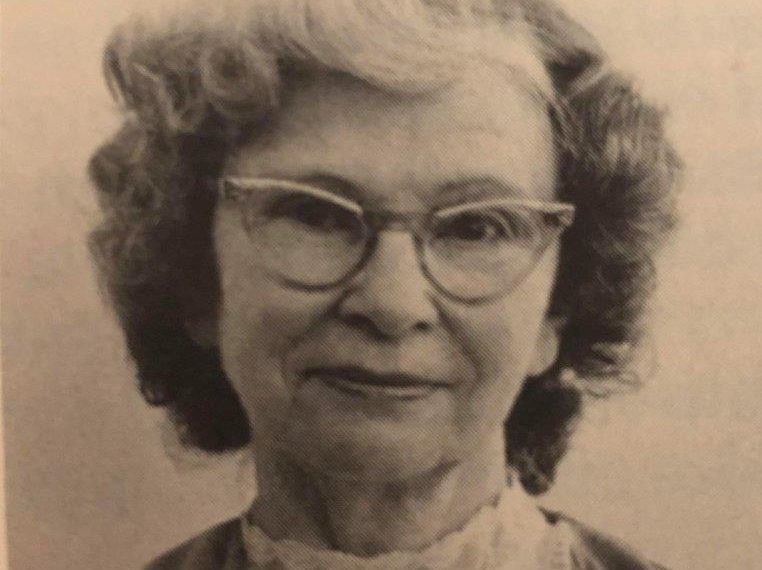
She must have seen me from a window. I watched her cross the yard, a booted and bundled Alice Kinder, making the first human tracks I’d seen all morning. She smiled when she saw the package. Oh, thank you so much, Gayle, and God bless you!” she said. “You have brought the author copies of my little book.”
The “little book” was Mama’s Kitchen Window, published by Beacon Hill Press of Kansas City, the book that would introduce Alice J. Kinder to a broad new readership far beyond Deep Valley.
Alice Kinder was born September 18, 1921, to William McKinley Justice and Ibbie Elizabeth Smith of Upper Chloe Creek in Pike County. Her father, a teacher in the county system and well-known author of five books of poetry, was an early influence on the writer. Surprisingly, Justice’s first book, Tears and Laughter and Other Poems, published in 1934, is dedicated to his youngest daughter Jesse Eleanor: “In her I fondly hope to realize some of the literary dreams I dreamed too late.” Although Jessie became a respected writer in her own right, it was through Alice that her father’s dreams became reality.
Upper Chloe Creek was known as Deep Valley when Alice was growing up on the family farm in the 1930s. In her book, Old Fashioned Mountain Mothers, she describes parents who, in spite of a busy schedule, made time for their children. “My mother made mud pies with us,” the author wrote. “She often made rag dolls for my sister and me.” Without modern conveniences her mother taught Alice and her two sisters how to bake pies and cakes, churn butter and make their own clothes. Bert, the only son, was apprenticed to his father, trimming hedges, feeding stock and learning the responsibilities of a small farm.
In the evenings when the chores were done, “Mama” and “Papa” often gathered the four children around the hearth or kitchen table to sing “Barbara Allen” and “Sourwood Mountain,” while Bert strummed a homemade guitar. Everyone stopped to listen as sister Ruby recited one of her poems or Alice read her latest English composition. They “helped the teachers,” giving out spelling words, diagramming sentences and solving difficult arithmetic problems. “My parents worked with the church to instill God’s word and spiritual values in us,” Alice writes.
Life lived and lessons learned in this simple rural setting were not lost on Alice. At the age of ten she was already writing.
Alice graduated from Pikeville High School in 1940, then enrolled at Pikeville Junior College, which later become Pikeville College. After graduation, she began teaching in the county system. In 1945 she married Hobart Kinder, also a teacher. They had one son. The teacher, housewife and mother was also a writer. Still in her twenties, she began seeing her homespun poems and stories about mountain life appearing in numerous educational, agricultural and literary journals.
The Deep Valley of her childhood became the somewhat mythical setting for most of Kinder’s work. In a career that spanned more than fifty years, she published twelve books and more than a thousand stories and articles. She is best known for the Christian oriented “Mama” and “Papa” books about Depression-era life in Eastern Kentucky. Mama’s Kitchen Window(1977) was followed by Papa’s Neighbors (1979), Mama’s Pathway to Heaven (1983) and Papa’s Walking Shoes (1986).
Of local interest, she wrote Climbing Steps: A History of the Grace Baptist Church and Pikeville College Looks to the Hills, the latter earning her alma mater’s Alumni Literature Award. Kinder wrote three biographies. Willie Boy, published by Kentucky Imprints of Berea, is the rewritten autobiography of her father. The Call of the Mountains is its sequel. Alice was especially proud of her hardback The Mayor Who Moved a Mountain, the story of Pikeville mayor William C. Hambley and the famous Pikeville, Kentucky, Cut-Thru Project.
Meanwhile, Alice was keeping readers of The Appalachian News-Express entertained with “Mountain Roots,” a column she started in the mid-seventies. This popular series, which celebrated the lives and times of common mountain people, ran for nearly two decades.
Kinder had a genuine interest in the work of other local writers, especially that of talented beginners. In the mid-eighties she started the Pike County Writers Group which met periodically in the Pikeville Library. Participants read from their works and shared ideas and information. Alice was there to listen, encourage and offer gentle criticism. A few lucky members saw their stories and poems placed on the Alice Kinder Collection shelf at the University of Pikeville Allara Library, where they are available today.
For her outstanding contribution to Appalachian literature, Alice Kinder was presented a Kentucky Colonel Award in 1986, and again in 1988. In 1989 Pikeville College honored her with a Doctor of Humane Letters Degree.
She continued to write until the time of her death September 22, 1995.
The author of this sketch fondly recalls a meeting with Alice Kinder and other members of Pike County Writers in November 1985. Our hostess had recently undergone eye surgery and was wearing dark glasses. I had just treated the group to a bawdy vignette about a man who’d been run over by a manure spreader. The gentle Alice lifted her Ray-Bans long enough to stare at me with uncharacteristic sternness. “Gayle,” she said, “you know I love your writing, but I just can’t believe such language from a man whose daddy’s a preacher.”