
Calendar of Virginia a State Papers” Volume 4, Page 460
Death of Cornelius Roberts June 24, 1788
That men who had gone to the Black Mountain to dig ginseng had found a camp where one of the Elam’s and 3 of the Breeding’s, of New Garden, and Neal Roberts had been about the same employment, several of whom lay killed and scalped. The Cherokees evidently bent on war and unless means are taken at once to protect that country, great suffering and disaster must follow very soon.
Cornelius Roberts, seen in documents as Neil and Neale, died on Black Mountain. He had been a resident of Russell County, Virginia. He, along with an Elam and three Breedings, had been digging ginseng when attacked and scalped at the hands of Indians. According to the Roberts family, it was a half-breed named Benge. An overview of Cornelius and his wife, Mary, show they were rearing a family of 12 children, all of whom are born in Virginia. Court documents reveal his wife to be Mary (Benton) Roberts, who left records of his holdings in Russell County. After his death, Mary then remarried to one Rev. John Frost, between 1790-1793. In 1796, Mary and Reverend Frost sold 145 acres in Washington County, on North Fork of Holston River, to Michael Fleenor. In March of 1796, Reverend John Frost purchased 800 acres in Knox County, Tennessee. In 1797 and 1798, John was a messenger from the Chestnut Ridge Baptist Church, which is located in Anderson County, Kentucky. By the 1810 census, John Frost is located in the Cumberland County, Kentucky with: one male 16-26; one male over 45; and one female over 45. Mary Roberts Frost would have been about 60 years of age. For the most part, the children of Cornelius moved away from Virginia, except a daughter, Elizabeth (Roberts) Childers, who stayed in Russell for a time before moving to Franklin County, and son, James Roberts, who moved onto Shelby Creek (then Floyd County) Pike County, Kentucky. Exactly when Cornelius Roberts married Mary Benton is not recorded, though his eldest daughter, Elizabeth, was born about 1768.
Cornelius Roberts and Mary Benton had the following children:
i. Elizabeth Roberts was born in about 1768 in Virginia. She died on 17 February,1833 in Perry County, Kentucky (later Letcher County). She married Abraham V. Childers in 1786 in Virginia. He was born on 15 Nov., 1750 in Amherst County, Virginia and on 6 May, 1849 in Letcher County, Kentucky (Revolutionary Soldier). [Author’s note: all references to Childress or Childres have been changed to Childers, as this is the name the family used in years following]
Russell County page 342 – “This Indenture made this 25th of July 1797 between Abraham Childers and Elizabeth his wife of Russell County and state of Virginia of the one part and Luck Kelley of the county aforesaid of the other part witnessed that the said Abram Childers for and in consider of sixty pounds money to him the said Abram Childers paid by the said Luke Kelly the receipt whereof he hath hereby acknowledged hath granted by these present doth grant said Luke Kelly a certain tract or parcel of land lying and being Russell County on Clinch River and bounded as follows to wit; beginning at the mouth of Carrs Creek running up the river east to a cliff of rocks then along a ridge to a back line then down to the beginning containing fifty acres more or less being part of a tract of 260 acres granted by the Commonwealth to Corenlius Roberts by patent bearing the third day of June 1788 for which said fifty acres the said Abram Childers above decree from the worshipful court of Russell at the June term in the year 1797 to have and to hold said tract or parcel of land with its appurtenances unto the said Luke Kelly his heirs and assigns, the said Abram Childers and Elizabeth his wife and their heirs will forever warrant and defend the said tract or parcel of land with its appurtenances as to the said Luke Kelly, his heirs or assigns to claims of all persons whatsoever. In witness whereof the said Abram Childres, Elizabeth his wife all set their names and seas the date written above. Abram Childres, Elizabeth Childres, proven August Court 1797.”
ii. Mary Ellen “Polly” Roberts was born in 1770 in Virginia. She died before 5 May, 1830 in Lee County, Virginia (or Claiborne, Tennessee). She married Shadrick Monk before 1790 in Russell County, Virginia.
iii. James Roberts was born in 1772 in Virginia. He died on 1858 (Estate Probated) in Pike County, Kentucky (Buried Shelby Creek). He married Nancy “Anna” Damron about 1794. She was born about 1775.
Russell County pages 469-470: “An Indenture Sept. 18, 1797 between James Kelley and Susanna his wife and George Ronalds, both of Russell County, 40 acres of land north side of Copper Ridge conditional line between Kelly and James Roberts running south to a white oak standing at the foot of the Copper Ridge thence west to the head of said branch which is the conditional line together will all.”
iv. Nathan Elliott Roberts was born before 1774 in Virginia (Baptist Preacher). He died between 1840-1850 in Choctaw County, Mississippi. He married Abigal Bishop on 10 Nov., 1799 in Knoxville, Knox County, Tennessee.
v. Amelia “Milly” Roberts was born in 1775 in Virginia. She died after 1860 in Alabama. She married Edward Frost on 3 Oct., 1791 in Washington County, Virginia (Married by John Frost). Edward was born between 1770-1780. He died in 1845.
vi. Isaac Roberts was born in 1776 in Virginia. He married Rodey.
vii. Daniel Tipton Roberts was born in 1777 in Virginia (Killed Dick Benge). He died on 26 Nov., 1846 in Winston County, Mississippi. He married: (1) Elizabeth Kyser in 1798 in Virginia. She was born between 1780-1790 and died between 1830-1839 in Pickens County, Alabama; (2) Sarah Swann. She was born on 9 Dec., 1815 in Bedford County, Tennessee. She died in 1892 in Red River County, Texas; (3) Mrs. James.
viii. Jesse Roberts was born in 1778 in Virginia. He died in 1857 in Coakley, Green County, Kentucky (Sand Lick Meeting House Cemetery). He married Mary “Polly” Ann Skaggs, daughter of William Skaggs and Mary Simpson. She was born in 1779 in Virginia and died before 5 Mar., 1866 in Coakley, Green County, Kentucky (Sand Lick Meeting House Cemetery).
ix. Susanna Roberts was born in about 1780 in Virginia. She married Lot Litteral.
x. Sinai Roberts was born on 5 June, 1781 in Virginia. She died on 31 Aug., 1824 in Martin Springs, Marion County, Tennessee (Tate Cemetery). She married: (1) Peter Anderson, who died in Franklin County, Tennessee; (2) John Bowers.
xi. Archibald Roberts was born on 1 March, 1784 in Russell County, Virginia. He died on 10 September, 1860 in Mt. Carmel, Wabash County, Illinois. He married: (1) Sarah Pennington in 1808 in Cumberland County, Kentucky, born in Oct 1790 and died 20 Oct., 1844; (2) Mary Thorpe Ligenfelter.
xii. Mourning Roberts was born on 14 May, 1788 in Russell County, Virginia. She died on 04 May, 1866 in Jackson County, Alabama (Tally Cemetery). She married Jacob Isaac Tally, son of John Tally and Rebecca, about 1808 in Jackson County, Alabama. He was born on 14 Aug., 1784 in Sullivan County, Tennessee and died on 6 April, 1842 in Jackson County, Alabama (Tally Cemetery).
Mary’s father, or at least a close relative, might be Lazarus Benton who received a land grant on Elk Creek in 1774.[1] Titus and John, brothers to Mary, were killed on Lick Branch (of Clinch) in April 1777, where they and Doswell Rogers hunted until the Indians chased away the inhabitants. Doswell Rogers and many others had also lived on Elk Creek, shown in Fincastle. The property of Lazarus Benton aligned with Dr. Thomas Walker, who is well known to have made his way into early Kentucky. Lazarus acquired 116 acres of land: “. . .lying on both sides of Elk Creek, a branch of the New River, and agreeable to an order of Council of the 16th of December 1773, and being part of the Loyal Land Company Grant beginning at a white oak sapling and two pines from one root by a path on the top of a hill a little above a corner of Dr. Walker’s survey and remaining thence;
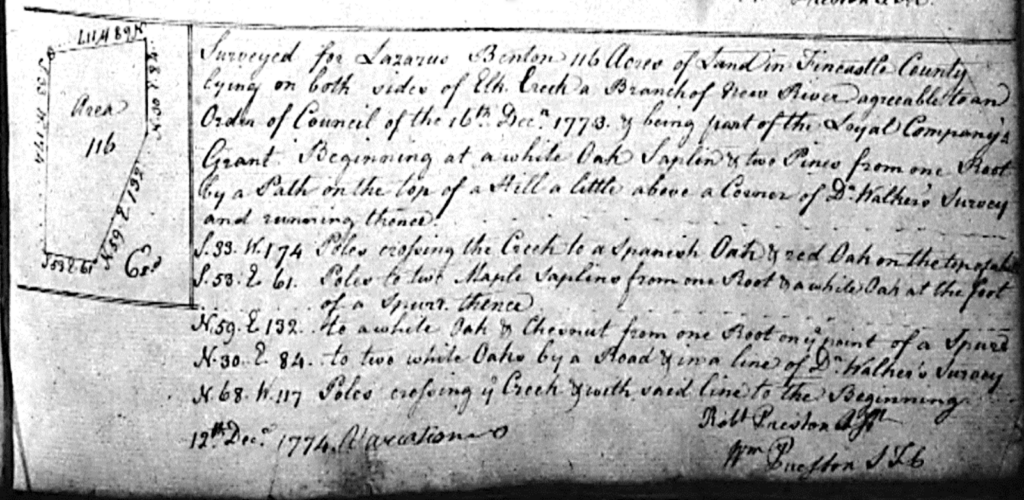
“S33 W174 poles crossing the creek to a Spanish oak and red oak on the top of a _.
“S53 E61 poles to two maple saplings from one shoot and a white oak at the foot.
“N59 E132 to a white oak and chestnut from one shoot on ye point of a _.
“N30 E84 to two white oaks by a road and in a line of Dr. Walker’s survey.
“N68 W117 poles ye creek and with said line to the beginning.
“Dec 12, 1774 Signed by Robt. Preston Assign and Wm. Preston SFC”
C Rogers, Elisha, James, Joseph Wallens, James Bevins, but no Bentons were listed.[2]
[1] Kegley says Eliamus Benton is found in the Botetourt/Fincastle titles. This is a misspelling for Lazarus Benton who is shown as living in Elk Br.
Neal Roberts is listed in the 1767 Pittsylvania County tithes, along with Doswell Rogers, William Bevins, John Cox, John Rice, and John Cox Sr, as taken by Peter Copeland. Also listed is a James, Moal, James, and Joseph Roberts, who it is not believed were connected to Cornelius. There seems to be several Roberts families. One James Roberts moved to North Carolina and a second James Roberts died in Pittsylvania. Moal (probably misspelled by the entry taker) and Joseph Roberts moved into Georgia per British Mercantile Claims. The James Roberts who died in Pittsylvania had once lived in Halifax, and was a sheriff.[2]
Cornelius and William Roberts are listed as soldiers in Captain David Looney’s Company in 1770 and 1771, along with other families of Wallens, Cox, and Rice, where again is found Doswell Roger.[3] In 1772, listed in the Botetourt tithes were Cornelius and William Roberts, along with Doswell
[2] British Mercantile Claims – Pittsylvania Store – British Mercantile Claims, The VA Genealogist, Report of John Dabney – Pg. 35, (Pg.78) James Roberts 4.7.10 pound, Oct. 28th, 1773, same store. He removed to N. Carolina where he died possessed of a considerable estate.
Pittsylvania Store – British Mercantile Claims, The VA Genealogist, Report of John Dabney – Pg. 37 (Pg. 84) Joseph Roberts 63.7.2 Pound 28th June 1774, same store. He removed since the war to Georgia and now resides in Greene County. He was in good circumstances when he removed.
Pittsylvania Store – British Mercantile Claims, The VA Genealogist, Pg. 44, Report of John Dabney – Claims of James Murdock and Company {Pg. 73-127} Pittsylvania Store – (Pg.113) Moal Roberts 1.11.4 pound, 13 Mar. 1773, Pittsylvania Store. He removed to Georgia many years since, it’s believed before conclusion of the war & was able to pay. British Mercantile Claims. The VA Genealogist, Pg. 210, Report of John Dabney – Claims of George Kippen & Company pg.12-19 of Mercantile – (Pg. 16-17) – James Roberts, deceased, 721.9.8 pound. Debt was secured by mortgage on sundry tracts of land & slaves. Suit was brought before the war and judgment obtained.
[2] Soldiers of Fincastle by Mary B. Kegley
Soldiers of Fincastle are below:
Capt. David Looney’s Company – Days Served, Pounds-Shillings-Pence
Dan’l Boone, Lt. 40 days Paid 15-0-0; Jno. Anderson, Ensign 61 days Paid 18-6-0; James Anderson 40 days Paid 3-0-0; Jno. Anderson 36 days Paid 2-14-0; William Anderson 25 days Paid 1-17-6; Joseph Blackmore 42 days Paid 3-3-0; Edward Blackmore 39 days Paid 2-18-6; Israel Boone 40 days Paid 3-0-0; Micajah Bunch 29 days Paid 2-3-6; John Colin 35 days Paid 2-12-6; Samuel Cowan 40 days Paid 3-0-0; David Cowan 40 days Paid 3-0-0; David Cox 35 days Paid 18-6-0; Jno. Cox Sen. 24 days Paid 1-16-0; Enoch Osborne 35 days Paid 4-7-6; Ephraim Osborn 35 days Paid 2-12-6; Stephen Osborne 35 days Paid 2-12-6; Jno Rice 29 days Paid 2-3-6; William Roberts 29 days Paid 2-3-6; Cornelius Roberts 29 days Paid 2-3-6; Henry Roberts 35 days Paid 2-12-6; David Roberts 49 days Paid 3-13-6; William Roberts 49 days Paid 3-13-6; Doswell Rogers 29 days Paid 2-3-6; James Wallin 29 days Paid 2-3-6; Joseph Wallin 29 days Paid 2-3-6; Thomas Wallin 29 days Paid 2-3-6; James Ward 35 days Paid 2-12-6; Ezekiel Young 35 days Paid 2-12-6;Cornelius was a member of Captain David Looney’s Company and served in the militia during Lord Dunmore’s War against the Shawnee. His service apparently terminated with the Battle of Point Pleasant on October 10, 1774. Cornelius is shown with 29 days of service, where others are shown with more. What part of this war Cornelius served cannot be known. He died before any pension papers could be completed. The Battle of Point Pleasant, as it is commonly called, was located on the point where the Ohio and Kanawha rivers join. It stands today as a National Park. If Cornelius Roberts served in any other companies, it is not known. If he participated in the Revolutionary War, it is unknown. Just five years later, in 1780, a Neal Roberts was thought to be a Tory. This one record of Neal Roberts in court asking for and reinstating his property was not enough to prove he was a Tory. In fact, the record cleared him of these charges. Then there is a John Roberts in 1782, Montgomery County, suspected of being a Tory during the war. The fact that Doswell Rogers and John Rice posted their lands as security for 12 months of good behavior by this John Roberts leads to the suspicion that this John was a brother of Cornelius,[5] which was probably the reason why Cornelius was also charged.
Annals of Southwest Virginia, in the November 8, 1780 court; “Ordered that William Roberts, Neal Roberts, Moses Johnson, Richard Green, Richard Wright, Clem Lee, and George Herd be restored their property again, it being lately taken from them by the Militia of Montgomery and Washington Counties, as nothing appears against them with regard of their being enemies of the state.”[6]By the time the revolutionary war was ramping up in 1775, many counties were sending young men to fight in Washington’s army, though the Revolutionary War was not the only conflict raging near the James, Holston, and Clinch rivers. In particularly, the Battle of Long Island Flats happened on July 20, 1776, near Kingsport. There the militia fought with the Cherokee Nation wherein Colonel William Christian led 2,000 men against the Cherokee. When the revolutionary war broke out and men were being called, the British had given the Indians guns. This created havoc among the settlers. These transactions empowered the Cherokee and Shawnee against the settlers in Powells Valley and the Rye Cove near Lick Branch. Thomas Rogers tells us that at this time, the few residents of Lick Branch of Cove Branch on Clinch River had evacuated. Colonel Preston, in a letter to Edmund Pendleton on June 20, 1776, related that Powell Valley was evacuated, except for Rocky Station where Colonel Charles Cocke commanded. Stephen Wallin, who deposed in the 1811 case of McKinney versus Preston, testified that John Benton was under the command of Colonel William Christian, where he helped to bring back the Great Guns of the [Cherokee] Nation to the Long Island [Flats] after the expedition.
[5] Mar. 5, 1782, Court held in Montgomery; Ordered that John Roberts who has been inimical to the American Cause be received as a Citizen of this State and under the protection of the law on taking the oath of Allegiance and giving security for his good behavior for twelve months and one day, whereupon the said John Roberts acknowledges himself indebted to this Commonwealth in the sum of Twenty Pounds in species and Doswell Rogers and John Rice in the sum of ten pounds each to be levied of their respective lands and Chattels and to the Commonwealth rendered, Yet upon condition that John Roberts shall be of the good behavior for twelve months and one day from this time.1
[6] Montgomery County Order Book 2, Page 302, Nov. 8, 1780
Benton family records are scarce. September 14, 1769, Robert Looney wrote his estate in Botetourt, and John Benton, John Smith, James Crow, Elinor Crow,[1] and Thomas Crow witnessed the document. Robert Looney’s appraisement was filed January 11, 1771, by John Smith, John Looney, Jr., and John Mills, Sr., and was witnessed by James Smith, John Looney, and John Mills Sen.[2] Robert Looney was of the Looney family of Looneys Creek in Fincastle/Botetourt and Looney’s Ferry. It was written in the Seed-Bed of the Republic that the Benton’s were in some way related to the Prestons, without further explanation of the relationship except that it was by marriage.[3] The Bentons are an elusive lot to research, and yet they played a role in Virginia’s history when the brothers lost their lives by savagery. What has been found is that a Lazarus Benton acquired land near that of Dr. Thomas Walker, Elisha Wallin, and William and Cornelius Roberts in the area of Elk Creek, which it makes Lazarus a good candidate and certainly related, but just how is not known. There was a Lazarus Benton in Virginia, mentioned as a captain in July of 1780, and part of the Revolutionary War Rolls.
The book Early Adventures of Western Waters Volume II, (page 113) Cornelius Roberts received 400 acres of land on both sides of Beaver Dam Fork of Elk Creek and to include 400 acres surveyed for Pemberton in 1774, settled in 1772. William Roberts (page 115) received 400 acres on both sides of Beaver Dam fork of Elk Creek, including the 230 acres surveyed for Roberts in 1774, settled in 1772. Sye Benton (page 111) received 100 acres on Elk Creek and settled in 1772. This is most likely in error and is Tye (Titus) Benton. Moses Damron, John McKinny, Doswell Rogers, and John and Elisha Wallen all settled in the area of Elk Creek, as well as Lazarus Benton.
A few Elk Creek entries of survey from Kegley’s book:
“Page 111 – page 126 Commissioners Cert. – John McKenny assignee of Jonathan Pratt assignee of Sye Benton, 100 acres on Elk Ck.
“Page 108 – page 89 – John Wallen 200 acres on Nob Fork Elk Creek, settled 1777.
[7] Elinor Crow is formerly Elinor Russell, the daughter of Lt. Col. William Russell.
[8] Botetourt Will Bk 1, page 4 and 4.
[9] Seed-Bed of the Republic – Robert D. Stoner, pg. 407 – Allied by marriage with William Preston are the name of Carrington, Hampton, McDowell, Benton, Fremont, Wallace, Vance, Brown, Wolffe, Bowyer, etc.
“Page 10 – page 88 – Elisha Wallen assignee of John Collins, 200 ac north side of Rocky Creek, settled 1774.
“Page 108 – page 87 – James Wade assignee of Doswell Rogers assignee of James Wallen, 400 acres on Nob Fork, branch of Elk Creek, 180 acres of which were surveyed 1774, settled 1772.
“Page 116 – page 211 – David Fulton assignee of Doswell Rogers assignee of George Keith assignee of Moses Damron, 50 acres above the mouth of Chestnut Creek, settled 1769.”
Soon after, these same men went further west into the wilderness of Rye Cove and tried to set up a settlement when the Benton brothers were killed in April 1777. John McKinney, William Roberts, Elisha Wallen, Thomas Rogers, Doswell Rogers, and others were deposed in 1811 and 1812 in a later Augusta County case between John McKinney versus Robert Preston. The suit contested land ownership on Lick Branch of Cove Branch of Clinch River. In these depositions, they stated that John and Titus (Tye) Benton died at the hands of Indians in April of 1777, just one year after John Benton is found under Colonel Christian at Long Island Flats. Sadly, the case never explains the reason it was important to establish the death dates and where exactly the brothers were killed near Lick Branch, except to say the Hoosier’s (Van Hosier) family lived on Lick Branch, alias Flat Lick Branch (deposed Stephen Wallen), and that the Roberts and Benton families lived six or seven miles up from where Hoosier then lived in 1802.
Colonel William Preston and Captain Evan Shelby were appointed commissioners to negotiate a treaty with the Cherokees at Fort Patrick Henry between January 22 and April 21, 1777. William Barron in 1833 stated that he was at Long Island a few days when an express came to Colonel Preston, from Rye Cove, requesting assistance because the Indians had made some incursions in that quarter and killed a few of the inhabitants. Captain Stevens’ company marched to Rye Cove, giving assistance, where one Mr. Cook, who had been sent out as a spy, but had been killed. So, not only was Rye Cove on alert, but the whole of the valley was under attack. In the war pension of Andrew Lyman, he that troops under the command of John Duncan were sent into Powells Valley in September of 1776 to prevent the Indians from committing outrages upon the defenseless inhabitants, and on their way back they stopped at the station called Rye Cove. James Kincaid stated that Powells Valley was evacuated in June of 1776, prior to the Cherokee campaign. There Robert Bowman and a Johnson were killed. Both were with Dunkins’ militia. Kincaid says that seven or eight families were killed in Castlewood and regretted that he did not name them. John Anderson, who lived near the Long Island, stated that a force of 400 Indians had come within ten miles of his fathers’ home and, immediately after the battle [Long Island Flats], “. . .we continued at Looneys until an army commanded by Col. Christian went against the Cherokee Nation.” Kincaid further stated, “The Indians traveled all over the country in small parties aiming to do us all harm in their power. They killed a considerable quantity of people in different parts of the country who would venture out of the forts to get something to subsist on. After my father and his family had been at Shelby’s Fort for a number of days, we went back to Looney’s Fort, that being more convenient to our home than Shelby’s Fort.” These few mentions of depredations are just a taste of a larger picture of consequences of fighting a war on two battle fronts, that of the Revolutionary War and the mentioned Valley Wars.
Doswell Rogers was deposed and said that he hunted in Rye Cove with the Bentons, and they were killed by the Indians. He then stated, “After these depredations the people left there for many years before returning”. Doswell stated that he never returned to Lick Branch to live. In this McKinney-Preston case were two much later plats, 1811, neither showing Lick Branch, but one does show those men who moved into the Cove as David McKinney, Elisha Wallen, Preston and Wallen, John Daniel, John McKinney in 1811, to name a few. Charles Carter was a clerk in Lee County, and a son of Thomas Carter, on whose land Carters Fort once stood in Rye Cove of Scott County.
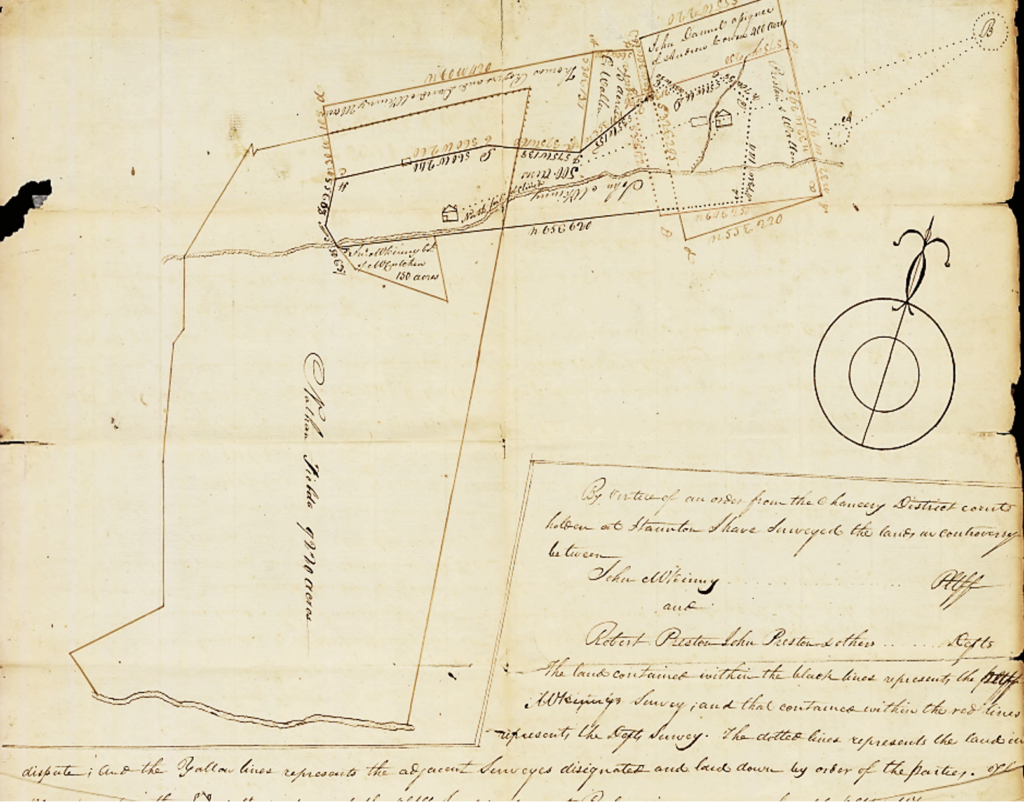
The Benton brothers were in the company of Long Hunters up until their deaths, and, had they lived, may had become legendary and not forgotten to the quiet pages of history. But it seems they feared not. . .when they should have feared. The two died in April of 1777. It was the practice of the settlers to work all winter setting up homes and fences. They knew the Indians would return in the spring. Since testimony tells us they were amid early men like Elisha Wallen and others who went into Rye Cove for settlement, it lends to their bravery because spring is when crops were put to ground. This makes the same men who are shown in 1772-1776 in Fincastle, on Elk Creek, also living and hunting on Lick Branch, in the Rye Cove near Clinch; this according to Doswell Rogers, who said he and the Benton brothers had named the creeks of that section in true Long Hunter style.[10]
[10] The Southwest Virginian – Vol. 2, Number 7 – John and Titus Benton killed in Rye Cove – Compiled by Emory L. Hamilton.
Little is specifically known of the Benton deaths mentioned in the case of John McKinney versus Robert Preston in Augusta court.[11] The deposition testimony in the case is all we have to go on in regards to the Indian attack of the Benton brothers. Nor does the case explain what the deaths mean in relation to the case, except that the Bentons were killed in Rye Cove and, because of these attacks by the Indians, the settlers abandoned Rye Cove. In Washington County, Virginia Survey Book, page 147, is a survey statement which reads: “A survey for William Nash of 343 acres lying in the Rye Cove on the waters of Clinch River, and beginning on a barren ridge above “Tye Benton’s spring” dated 20 November, 1782.” This entry proves that the Bentons had lived in the neighborhood long enough to have left their names attached to a landmark, a small spring.
The witnesses deposed in the Augusta County case of John McKinney vs Robert Preston mentioned the Benton brothers:
- On May 29, 1811, Charles Carter testified “That John and Titus Benton were killed by the Indians in Rye Cove in the spring of 1777.”
- February 26, 1812, Doswell Rogers deposed in the same county, as follows:
Question: “How far from Hoosiers upper improvement to the lower one where John Wallen now lives? “
Answer: Some called one mile and some, one and half miles and some two miles, but my own opinion is one and a half miles.”
Question: “Do you know any place near where John Wallen now lives that was known by the name of the Big Bottom?”
Answer: “I know of no place so called except the bottom in line Jacob Rowlin now lives about the distance of six or seven miles from there down the same creek which name was given to it by myself, same of the Wallens and Benton’s and William Roberts and other as we once passed through it is hunting lands.”
Question: “Do you know any place in Blackwater joining Osburn’s land, called the big bottom?”
[11] 1821-045; Mentioned in this suit are; Adams, Ash, Ask, Balfour, Benton, Bishop, Bowles, Campbell, Carter, Cocke, Cowan, Donnell, Douglas, Dougles, Dysart, Fulkerson, George, Goff, Guttrie, Hale, Hooser, Hoozer, Kane, Lewis. McCutchan, McKenny, McKinney, Montgomery, Neely, Osborn, Preston, Roberts, Robinett, Rodgers, Rogers, Roller, Sharp, Sloane, Spears, Taylor, Wallen, Wallin, Walling.
Answer: “I do.”
Question; ‘Do you know how long it is since John and Titius Benton was killed by the Indians?”
Answer: “I think thirty-five or six years in April next.”
- March 11, 1811, William Wallen (age 50) was deposed, page 44:
Question (By Preston): “When do you think were John and Titus Benton killed by the Indians?”
Answer: “About 32 Years.”
Question: “Have you any particular reason for thinking so?”
Answer: “Yes, his mother gave me his shot bag soon after he was killed and it is about that time since.”
- March 11, 1811, Stephen Wallen (age 54) testified, page 44:
Question: “Did you ever hear of settlers of this country that you knew, call this John Hoosier’s improvement?”
Answer: “Yes, I have heard John Benton and Titus Benton call it so.”
Question: “About what time did you hear them call it so?”
Answer: “About 31 or 32 years ago.”
Question: “Do you known when John Benton and Titus Benton was killed?”
Answer: “It was about 31 or 32 years ago I heard him, John [Benton] say, he was on the Cherokee Expedition, and heard him say also that he helped to bring up the Great Guns from the Nation to the Long Island after the expedition, and was commanded by Col. Christian, and returned, and that I hunted with him on Clinch after his return, and I think it was two or three years after the expedition Roberts was questioned about the surveys of John Belfour’s claim and the survey made by Mr. George (this would be Mr. George George). Per Roberts: “I was there when Fulkerson made his Survey of the land.”[12]
Page 65, Thomas Rogers saysA: “John and Titus Benton were killed by Indians about 36 or 35 years.” When Rogers was asked, “that he was killed.”
Other mentions in the depositions about the Benton brothers;
Pages 54-55, William
[12] Tax Book for Lee County 1815 by Bashie Kincaid in the Southwest Virginian – William Roberts – Blackwater; Thomas Roberts – Blackwater; William Roberts – Blackwater; George Roberts – listed but listed no land – This is the same William Roberts who deposed in John McKinney versus Robert Preston.
“How do you know when they died?” he replied, “I was living here about 35 or 36 years ago when we were driven off by the Indians and to the best of my memory, I heard of them being killed about that time.”
Page 68, James Rogers’ testimony: “Do you know when the Bentons were killed by the Indians?” Answer: “I understood they were killed 35 or 36 years ago.” Question; “By whom did you understand it was 35 or 36 years ago that the Bentons were killed?” Answer: “I understood it by common report and knew nothing of it myself.”
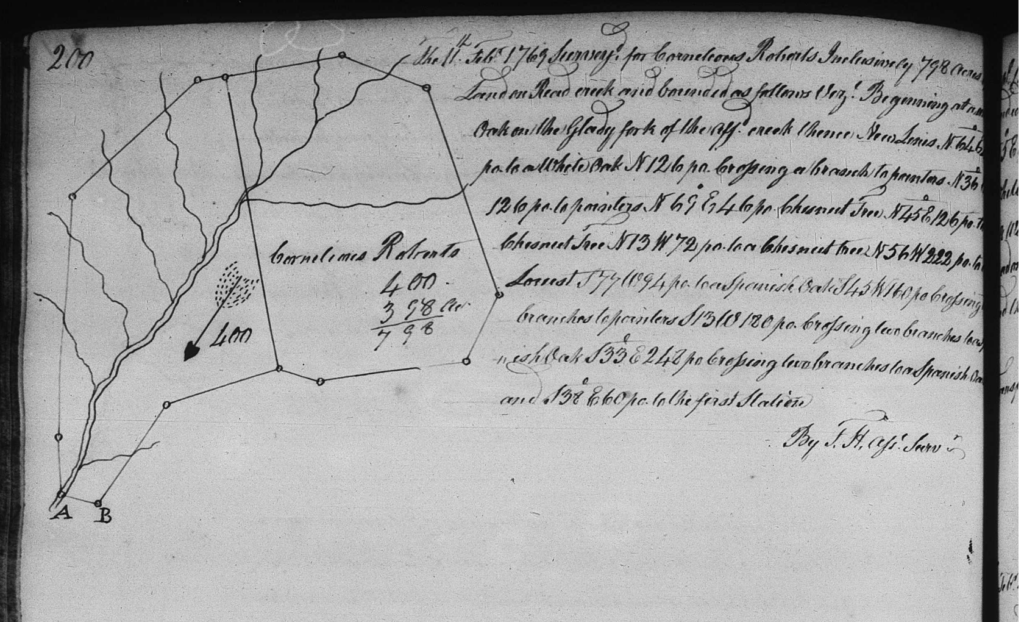
The earliest mention of Cornelius Roberts is in Halifax County Virginia, where he stated that he owned 798 acres on Reed Creek on February 11, 1769. He entered land on July 4, 1767 on page 379. He is shown with 400 acres on a fork of Reedy Fork Creek. This is the same 400 acres of land recorded in both Halifax and Pittsylvania County records because Pittsylvania was formed from Halifax in 1767. Two years later, Cornelius Roberts entered the 798 acres on Glady Fork of Reed Creek. Glady Creek is a larger creek off of Reed. Grassy and Solomons branches are off of Glady. The entries follow below:
“Pittsylvania County, Page 379, August 7, 1767 – Cornelius Roberts 400 acres, on a branch of Reed Creek and Solomon.”
“Pittsylvania County, Page 200, February 12, 1769 – 798 acres surveyed for Cornelius Roberts on Glady Fork of Read Creek.”
Cornelius Roberts is found on a list of tithables taken July 17, 1767 by Peter Copland. The list included names which will be found around Roberts for some years following; James Roberts, Rich White, Captain William Blevins, John Rice, Neil Roberts, James Wallen, Charles Scaggs, Little William Blevins, William Reed, Doswell Rogers, Joseph Wallen, Elisha Wallen Sen., Thomas Cooper, Jr., Charles Mitchell, John Talbot, James Calk, John Cox, Sr., John Cox, Jr., to name just a few from Marion Clements’ book.[13]
[13] History of Pittsylvania County Virginia by Maud Clement.
1771-1772-1773 Fincastle/Botetourt Tithes – William Blevins, John Blevins, James Blevins, John Cox, David Cox, William Cox, Charles Cox, Moses Damron, Enoch Osborn, Neal Roberts, Doswell Rodgers, John Rice.
1782 Land Tax List, Montgomery County, Virginia – James Blevins Jr., John Blevins, James Blevins Sr., James Blevin, John Rice, James Rice, William Roberts 150 acres, Neil Roberts 150 acres, Doswell Rogers 650 acres, Elisha Wallen Sr., Joseph Wallen, John Wallen, and James Wallen.
Washington County Virginia Personal Property Tax Lists 1783 to 1785: 1783 Andrew Cowan List – William Rogers, Shadrack Monk, Cornelius Roberts with 4 horses 12 cattle, John Gibson, John Breeding Sr., John Breeding Jr.1783 Robert Campbell List – John Frost, Thomas Frost, Anthony Linder
1784 Robert Campbell List – John Gibson, John Gibson, Simion Frost, Cornelius Roberts, John Breeding Sr., John Breeding Jr., Spencer Breeding
1784 Joseph Black List – Thomas Frost, Elijah Frost, John Frost
1785 Cowan List – Shadrack Monk – Cornelius Roberts – Abraham Beavers – John Breeding Sr. – John Breeding Jr. – John Cowan – Andrew Cowan – Thomas Colley – William Elam – John Gibson Sr. – John Gibson Jr. – Joseph Kizer
1785 Joseph Black’s List – John Frost – Thomas Frost – Elijah Frost – Micajah Frost
The 1787 Land tax list, Montgomery County, Virginia (Cornelius is shown in both Montgomery and Russell) shows:
“John Blevins 50 acres; Jas. Blevins Jr. 100 acres; Jas. Blevins Sr 100 acres; Jas. Blevins 40 acres; Richard Green 10 acres; Shadrack Green 150 acres; Wm. Green 300 acres; Shadrick Green 212 acres; Clement Lee 130 acres; Wm. Lee 100 acres; George Pemberton 200 acres; John Rice 100 acres; Geo. Reaves 100 acres; Timothy Roark 130 acres; William Roberts 150 acres; Neil Roberts 150 acres; Wm. Rogers 100 acres; John Rogers 200 acres; Wm. Rogers 400 acres; Alexander Rogers 160 acres; Doswell Rogers 650/252 acres; Thos. Rogers 200 acres; Elisha Wallen Sr. 30 acres; Jas. Wallen 500 acres; Jos. Wallen 600 acres; John Wallen 400 acres; Richard Wright 400 acres.”
The same year as the above Montgomery tax list, the 1787 Russell County personal property tax list in the Upper District, shows; Cornelius Roberts, John Elam, William Elam, Shadrack Monk, Wm. Monk, Joseph Kyzer, Jas. Breeding, John Breeding Sr., John Breeding Jr., Spencer Breeding, Jas. Jackson, Simeon Jackson, Jesse Jackson, John Jackson, Lydia Jackson, John Ratliff, Richard Ratliff, Wm. Ratliff Sr., Wm. Ratliff Jr.
In the Russell County, Virginia personal property tax lists are trhe following entries:
1787, William Webb’s Upper Personal Property List – Cornelius Roberts 1 White Male over 21, 3 horse, 3 cattle[14]
1788, William Webb’s Upper Personal Property List – Cornelius Roberts 1 White Male over 21, 3 horses[15]
[14] Vol. 2-7 Southwest Virginian – Abraham Childers, Shadrack Monk, Jas. Breeding, John Breeding Sr, John Breeding Jr, Spencer Breeding, John Elam and William Elam are found in 1787 Russell County Personal Property Tax in the Upper District.
[15] Vol. 2-9 Southwest Virginian – Abraham Childers (1) John Elam (1) Samuel Elam Sr (1) William Elam Sr (1) Shadrack Monk (1)
1789, William Webb’s Personal Property List – Cornelius Roberts 1 White Male over 21, 3 horses[16]
1790, John Weir’s Personal Property List – Martha (error) Roberts Admin of Estate of Neal Roberts – 1 White Male 16-21, 3 horses[17] [18]
By the 1790 Personal Property Tax List, Mary is shown as the administrator of Neal Roberts. She had not only lost her brothers to the Indians, but also became a widow due to the same kind of savagery related in a letter of June 24, 1788, in the Virginia State Papers. The Roberts family recalled that it was a half-breed named Benge who scalped him, along with one Elam and three Breedings. Two Elams, John and Samuel, do not reappear on either the 1788 or the 1789 personal property tax list. Later, contrary to documentation, it was written that Benge was killed by Daniel Roberts.
[16] Vol. 2-10 Southwest Virginian – Abraham Childers (1); Shadrack Monk (1)
[17] Vol. 2-12 Southwest Virginian – William Elam (no John Elam); Shade Monk (1)
[18] Russell County, page 94 – This Indenture made 4 day of Dec. 1787 between Cornelius Roberts and Mary his wife of Russell County, Commonwealth of Virginia of the one part, and Frances Price of the county and aforesaid paid in hand unto said Cornelius Roberts and Mary his wife for and in consideration of the sum of ? pounds current money to him in hand paid by the second Frances Price the receipt whereof they do hereby acknowledge have granted, bargained and sold unto the said Francis Price a certain tract of land containing 352 acres lying and being int eh county of Russell formerly Washington as both sides of the glad hollow situate of the waters of Cedar Creek a branch of Clinch river and bounded as follows to wit; beginning at two white oaks the west side of a hallow corner at Patrick and John Coyle’s and with their line south 5 deg west 147 poles to two walnuts and a cherry tree sapling in a bottom near a branch and leaving said line south 75 deg east 56 poles crossing said branch to two white oaks on the said of a ridge N49 deg east 128 poles to three white oaks S75 deg E73 poles crossing a branch toa Spanish oak an white oak on a rocky spur N21 deg E91 poles to two white oaks on the top of a ridge N65 deg E67 poles to a white oak N28 deg W134 poles to a black oak between two sink holes N23 deg E108 poles to two white oak saplings on the south side of a grassy hill S50 deg W363 poles crossing the spurs of a gravely ridge tot eh beginning, which said land was granted to the aforesaid Cornelius Roberts from the Commonwealth by patent bearing date the sixth of May 1797 to have and to hold the said tract of land with its appurtenances unto the said Francis Price his heirs and assigns to the sole use of the and Francis Price his heirs and assigns etc… Sign Cornelius and Mary Roberts Rec. May 19, 1789.
Russell County, page 293-294 – This Indenture made the 18 day of March in the year of our Lord 1793 between John Frost and Mary Frost, late widow of Cornelius Roberts (dec’d), James Roberts and John Frost of Russell County and Commonwealth of Virginia of the one part and Joseph Kizer of the county of the other part witnessed that the said John Frost and Mary his wife and James Roberts and the said John Frost for and in consideration of the sum of 70 pounds current money to him in hand paid the receipt whereof they do hereby acknowledge have granted bargained and sold and by these present do grant bargain and sell unto this said Joseph Kizer a certain tract of land containing 70 acres situate in the county of Russell bounded as follows; beginning at the mouth of Backs branch on the south side of Clinch River and running to the lower corner of the survey then running cross the river to the other corner and there with a line of the survey to the cliff of rock and from thence to the beginning containing 70 acres be the same more of less together with the appurtenances thereunto belonging to have and to hold the said tract of land with its appurtenances unto the said Joseph Kizer his heirs and assigns, in witness whereof the said John Frost and Mary his wife and James Roberts and John Frost have hereunto subscribed their names. John Frost, Mary Frost. Rec. Oct. 22, 1793.
Calendar of Virginia State Papers, Volume 4, Page 460, contains:
“June 24, 1788 – Thomas Carter, Henry Dickenson, and Andrew Cowen to Gov. Randolph, laying before the Executive Council an account of Indian depredations upon the frontiers of the counties they represent they have reliable information that the savages have lately killed 16 persons on the French Broad and the news had reached them of 80 Indians being on their way against the settlements of the Holston and Cinch. That 4 men had been killed in force could resist. Three men had been killed and scalped on the Black Mountain and David Campbell and his family, Hugh Berry and his family, particular acquaintances of theirs, had also been killed, and the station on French Broad, with many horses from Powell’s Valley, had been captured. Although some of these depredations were not in their immediate neighborhood, nor even in this state, yet, from the enterprising character of these savages, their operations were never of the country in great danger, and especially as Russell County is the barrier to Washington and Montgomery, beg that Scouts and a force of rangers be authorized to go out from these two counties to act in concert with the few who can be raised in Russell. This latter county has a frontier of 150 miles in advance of Washington and Montgomery, and on account of the scattered condition of the Inhabitants they are obliged to live in forts, totally to the neglect of their crops, etc. By enclosed letters they have that Col. Joseph Martin is a prisoner with the Cherokees and may not get out of their hands in safety. The men who had gone to the Black Mountain to dig ginsangue had found a camp where one of the Elimes and 3 of the Breedings of New Garden, and Neale Roberts, had been about the same employment, several of whom lay killed and scalped. The Cherokees evidently bent on war, and unless means are taken at once to protect that country, great suffering and disaster must follow very soon.”
After Cornelius Roberts was killed by the Cherokees, his widow remarried to Reverend John Frost and moved to Anderson County. From there her children split and went their separate directions. James Roberts moved to Pike County, Kentucky with the Damrons and others. It is obvious that the family of Cornelius Roberts carried that scar and wrote about his death in a memoir of W. Powell Roberts in 1924.[1]
It should be noted that a writer can only print what is shared by others, thus the account of Mr. W. Powell Roberts is dubious at best. It was confirmed by eyewitness accounts and records, and recognized by both Virginia and the U.S. government, that Lieutenant Vincent Hobbs killed Robert Benge. However, in a letter of January 24, 1813, the names of Daniel Roberts, son of Cornelius, Jacob Tally, husband of Mourning Roberts and daughter of Cornelius, Jeremiah Jeffrey, father-in-law of Abraham Roberts, who married Cynthia Jeffrey, James Corvan, a Condry, and a Ragsdale were listed as having participated in the killing of one Dick Benge. It is found in an Indian Agency letter of Colonel Jonathan Meigs, who stated that Daniel Roberts and Jacob Tally were present. This does not prove that Dick Benge killed the men on Black Mountain, but a heretofore unknown named Dick Benge could have been present. If true, that scenario would add credibility to the stories passed down by Powell and those told by the Pike
County Roberts descendants. Jacob Talley and Daniel Roberts were both living in Franklin County, Tennessee in 1813.
W. Powell Roberts wrote in 1924 that “Daniel Roberts returned to Virginia and killed Dick Benge, the half-breed Indian leader who killed his father.” W. Powell Roberts, a great-grandson of Cornelius Roberts, continued: “The trouble with the Indians began at the opening of the spring in the year of 1793. On Sunday about the first day of April, Ensign Moses Cockrell and 2 men were passing from the Rye Cove to Powell’s Valley, with several loaded horses. On the top of the Powell Mountain, they were fired on by 12 Indians. The 2 men who accompanied Cockrell were shot dead on the spot, and Cockrell himself was pursued to the foot of the mountain. Two of his horses were killed and all the loads lost. Captain Neal, with a party, pursued the Indians but did not succeed in overtaking them. The Chief who led this company of Indians was a half-breed Shawnee by the name of Benge.”
[19] History of White County, Illinois, page 519 (biography of Archibald Roberts, son of Cornelius Roberts). Archibald Roberts says his father had built a fort on a Dan River to protect from the Indians and while gathering herbs was killed by Indians.
The passage above is part of Lewis Summers’ history of Southwest Virginia and Washington County, which was written in 1903, some twenty-one years before W. Powell Roberts’ account. The Roberts story is suspiciously parallel to that of Summers.
Report in a letter from Col. Jonathan Meigs, Agent to the Cherokees 1801-1823:
“Names of persons who were present & acting in the killing of two Cherokees on or about the 24th January 1813 in the Cherokee nation. The names of the Cherokees who were killed were Dick Benge a half Blood Cherokee and a Cherokee named Jacket. Viz; Jeremiah Jeffrey and his son in law name not known at this time, Daniel Roberts, Talley, Ragsdale, James Corvan, Condry.” [20]
Survey for Washington County Virginia:
“Surveyed for Cornelius Roberts assignee of William Smith 352 acres of land in Washington County by virtue of a Certificate from the Commissioners for the district of Washington and Montgomery Counties and agreeable to an Act of the General Assembly of Virginia passed in May 1779, lying on both sides of the Glade Hollow branch of the waters of Cedar Creek, a branch of Clinch River:
“Beginning at 2 white oaks on the West side of a hollow a corner of Patrick and John Coyls land and with their line; S 5 W 147 poles to 2 walnuts and a cherry tree sapling in a bottom near a branch; and leaving said line S 75 E 56 poles crossing said branch to 2 white oaks on the side of a Ridge; N 49 E 128 poles to 3 white oaks; S 75 E 78 poles crossing a branch to a Spanish oak and white oak on a rocky spur; N 21 E 91 poles to 2 white oaks on the top of a ridge; N 65 E 67 poles to a white oak; N 28 W 134 poles to a triple black oak between 2 sink holes; N 23 E 108 poles to 2 white oaks saplings on the South side of Glade Hill; S 50 W 363 poles crossing the spur of a gravely ridge to the Beginning.”
[20] Abstracted from the Records of the Cherokee Agency in Tennessee – Correspondence and Miscellaneous Records, National Archives – Col Return Jonathan Meigs of Middletown, Conn., was the agent to the Cherokees; Roll 6 1813-1815
Surveyed Jan. 14th 1783 Benj. Sharp, Asst. Robt. Preston SWC [Surveyor of Washington County].” [21]
The Virginia Land Grants, book 7, page 537, Washington County, has the above 352 acres entered on May 5, 1787. Cornelius sold this land to Francis Price December 4, 1787. Another grant took place June 3, 1788 on both sides of Clinch River, at the mouth of Beck and Dump Creek in Washington County. He received a third property just two days later on June 5, 1788, for 260 acres on Beck and Dump Creek in Washington County.[22]
There was a lapse of time in the estate of Cornelius Roberts. It wasn’t until July 7, 1807 that Archibald Roberts and Mourning Roberts conveyed the land of Cornelius to Abraham Childers, husband of Eliabeth Roberts Childers. It seems that Abraham Childers and James Robert stayed upon the land at least until 1807.[23]
Another deed names the children of Cornelius and Mary, as well as one entered to Joseph Kizer in Oct. 1829. This was a very special deed which named all the children and where they were living in 1829: “In Russell County, Virginia –“ Deed Book 8, page 234 – “5th day of October 1829 – Between Joseph Riddle and Rhonda his wife, formerly Rhoda Monk of the state of Tennessee; John Monk; Biddy Smith, formerly Biddy Monk; Holt Colley and Betsy his wife, formerly Betsy Monk; Ezekiel Monk; Gibson and Peggy his wife, formerly Peggy Monk; Polly Monk; and Milly Monk all of Lee County, Virginia, children and heirs at law of Polly Monk, formerly Polly Roberts, deceased. Abraham Childers and Elizabeth his wife, formerly Elizabeth Roberts of Perry County, Kentucky; James Roberts of Pike County, Ky.; Jesse Roberts of Green County, Ky; Edward Frost and Milly his wife, formerly Milly Roberts of the State of Tennessee; Nathan Roberts; Daniel Roberts; Peter Anderson and Sina his wife, formerly Sina Roberts; Isaac Roberts; Jacob Talley and Mourning his wife, formerly Mourning Roberts; all of the state of Alabama; Archibald Roberts of the State of Indiana; Lot Literal and Susanna his wife, formerly Susan Roberts of the state of Ohio.
[21] Washington County Surveyors Record by Rhonda Robertson, Page 73, says; Cornelius Roberts, assignee of William Smith… 352 acres…Commissioners Certificate. on both sides of Glade Hollow branch, waters of Cedar Creek, branch of Clinch River… Beginning on the west side of a hollow, corner to Patrick & John Coils (Coyle) land… January 14, 1783 – William Smith, assignee of John Hays – 400 acres – head of Glade Hollow joining Robert Dean, includes improvements, actual settlement made in 1776… Sept. 1, 1781.
[22] Russell County Virginia Deed Bk. 1, pg. 94.
[23] Russell County Will Book 2, page 144, dated July 7, 1807, is this order. Henry Dickenson, power of attorney for Archibald Roberts, of Cumberland County, KY., and Mouring Robert of Russell County., Va., to convey to Abraham Childers; and on conditional line between Childers and Cornelius Roberts, deceased.
Said Polly Roberts, Elizabeth Roberts, James Roberts, Jesse Roberts, Milly Roberts, Nathan Roberts, Daniel Roberts, Archibald Roberts, Sina Roberts, Susanna Roberts, Isaac Roberts, and Mouring Roberts, being all the children and heirs at law of Cornelius Roberts, late of Russell County, VA., deceased, of the first part, and Joseph Kiser of the second part, for and in consideration of the sum of 1100.00 dollars, to them presents, the receipt where of is hereby acknowledged, have granted, bargained, and sold, and by these presents do grant, bargain and sell unto the said Joseph Kizer, his heirs and assigns, all their interest in sixty acres more or less, part of a tract of 260 acres, granted by the said Cornelius Roberts from this Commonwealth by patent bearing the date the 3r day of June 1788, lying and being in the said county of Russell on the north side of Clinch River, and bounded as followeth, to wit; Beginning on the River on a line of said Joseph Kizer and with the same a north course to the patent line of said 260 acres., and with the lines thereof to John Kizer’s line, on the top of a ridge, thence leaving the patent line and with said John Kizer’s line to a cliff of rocks at the river, and thence up the river with the meanders thereof to the beginning. With the appurtenances unto the said Joseph Kizer his heirs and assigns. In witness whereof the said parties of the 1st part have hereunto subscribed their names and affix their seals. s/Abrahan Childers and James Roberts – James P. Carrell Clerk.”
On October 5, 1829, the heirs of Cornelius were mentioned in a deed to Joseph Kizer, 60 acres of Cornelius Roberts land, part of the 260 acres. Those mentioned were: Joseph Riddle and Rhoda his wife formerly Rhoda Monk of the State of TN; John Monk; Biddy Smith formerly Biddy Monk; Holt Colley and Betsy his wife, formerly Betsy Monk; Ezekiel Monk; Gibson and Peggy his wife formerly Peggy Monk; Polly Monk; and Milly Monk, all of Lee County VA, children and heirs at law of Polly Monk, formerly Polly Roberts deceased. Abraham Childers and Elizabeth, his wife formerly Elizabeth Roberts of Perry County KY, James Roberts of Pike County KY, Jesse Roberts of Green County KY, Edward Frost and Milly his wife, formerly Milly Roberts, of the State of TN, Nathan Roberts, Daniel Roberts, Peter Anderson and Sina his wife formerly Sina Roberts, Isaac Roberts, Jacob Talley and Mourning his wife, formerly Mourning Roberts, all of the State of AL. Archibald Roberts of the State of IN. Lot Literal [Luttrell] and Susanna his wife, formerly Susanna Roberts, of the State of OH. Said Polly Roberts, Elizabeth Roberts, James Roberts, Jesse Roberts, Milly Roberts, Nathan Roberts, Daniel Roberts, Archibald Roberts, Sina Roberts, Susanna Roberts, Isaac Roberts and Mourning Roberts, being all the children and heirs at law of Cornelius Roberts late of Russell County, VA, deceased.[24]
The administration of Cornelius Roberts’ estate fell to his wife, Mary Roberts, on January 19, 1790. Her sureties were Richard Price, Shadrack Monk, and Abraham Childres, the last two being her sons-in-law.[25] It was then ordered that Benjamin Alderson, Edward Kelly, William Emett, and Thomas Colley (any three) appraise the estate of Cornelius Roberts. The action languished until January Court 1793, three years later. The court then ordered the estate of Cornelius Roberts, deceased, and returned it to the next court. Henry Dickerson was then appointed guardian of the heirs of Cornelius on October 22, 1793, and a deed made to Abraham Childers (husband of Elizabeth Roberts), for land sold to Abraham by Corenelius in his lifetime (there was no deed made when he was alive). Also sold were 70 acres to Joseph Kyser on March 18, 1793, by John Frost and Mary Frost. Dickerson also sold another 50 acres to Edward Kelly on August 28, 1798.
JAMES ROBERTS of Pike County, Kentucky, son of Cornelius Roberts and Mary Benton
Descendants of James Roberts:
- James Roberts Sr., son of Cornelius Roberts, was born in 1772 in Virginia. He died in 1858 (Estate probated in Pike County) and buried on Shelby Creek. He married Nancy “Anna”, probably the daughter of Moses Damron.
[24] October 5, 1829 – Russell County Virginia Deed Book 8, page 234.
[25] Russell County Virginia Order Book 1, pages181 and 182. Order Bk 2, pages 53 and 117. Deed Book 1, page 293, Kyser deed. Book 2, page 547, Kelly Deed. Will Book 2, page 144, power of attorney to Dickerson and rights to confirm land to Abraham Childres, with a conditional line to the other children. Deed Book 4, page 440, Abraham Childres to Michael Kelly, 2 tracts of land, on September4, 1811. By 1830, Abraham and Elizabeth Childers are shown in Perry County, Kentucky.
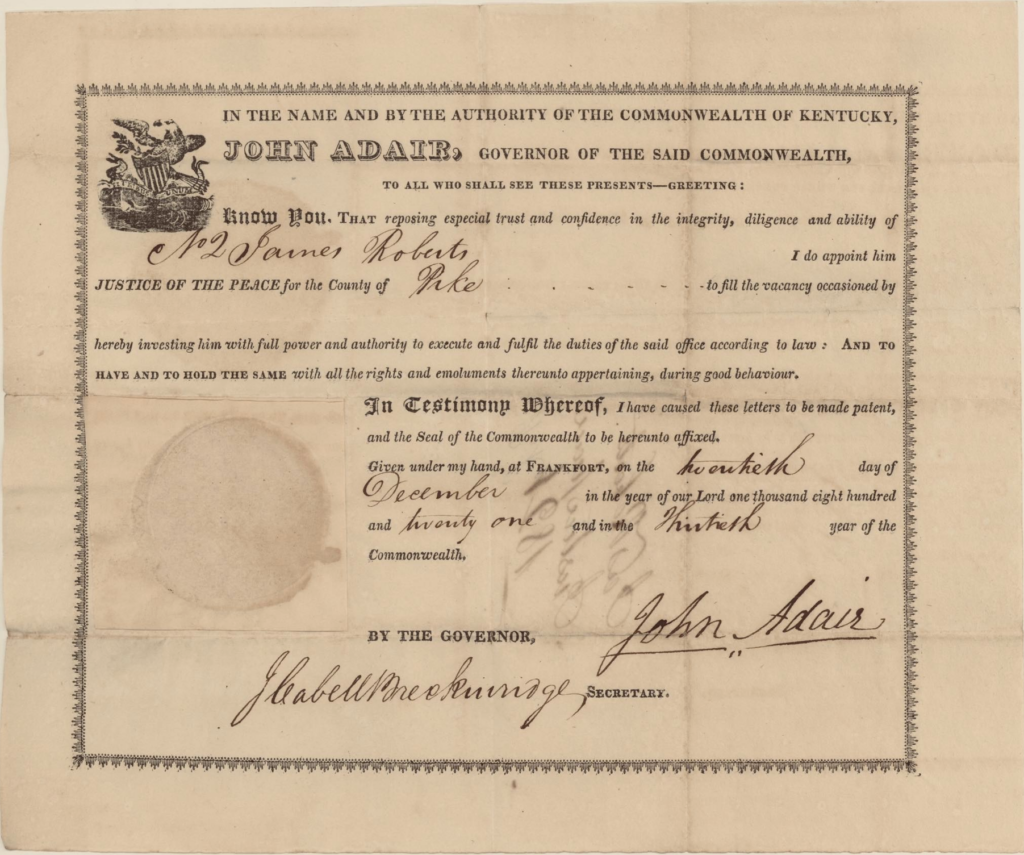
When Pike County was legislatively formed on December 19, 1821, the first order of business was to form a county government. Having no county seat, the first county court meeting was held at the home of Spencer Adkins on March 4, 1822. The county court consisted of justices of the peace: Simeon Justice, James Roberts, Reuben Rutherford, John Hunt, and John Bevins. James Roberts’ certificate of appointment (above) was signed by Governor John Adair the day following legislative approval.The second county court meeting was held on April 1, 1822 at the same location. James Roberts was then appointed one of 10 commissioners to appraise property values taken by the county. Roberts at this time was given leave to “obtain testimonials to solemnize the rites of matrimony. . .” Spencer Adkins and Simeon Justice were his sureties who signed a bond of 500 pounds on his behalf. Clyde Runyon’s book, “Marriage Bonds of Pike County, Kentucky – 1822-1865” lists James Roberts as performing 17 marriages between April 17, 1822 and May 12, 1825.
The next court meeting was on June 3, 1822. During that meeting, Stephen Harper, deputy surveyor, moved to lay off a public square for the county. Motion was carried. James Roberts was one of five commissioners appointed to attend the surveyor in laying off the public square. The county was then divided into 16 public school districts.
James Roberts continued to serve as a justice of the peace until the January 9, 1826 court meeting. At that time, “James Roberts produced a commission from under the hand of Joseph Desha, governor of the Commonwealth of Kentucky, thereto affixed, appointing him as sheriff of Pike County.” Five men guaranteed his bond of $3,000. William Ratliff, Jr. and William Weddington were appointed his deputies at the February meeting. Henry Weddington became his deputy in June. In January 1827 he renewed his sheriff’s bond.
During the same year, 1827, James Roberts’ sons, Cornelius and James, Jr., became road surveyors for their districts.
At the November 1827 meeting, James Roberts’ term as sheriff expired. He did not seek another appointment. He was replaced by John Bevins in February 1828, making his term as sheriff two years and two months.
LAND OF JAMES ROBERTS:
James Roberts – Bradley Collins – April 18, 1823 – A/60 – 50 on Shelby Creek, branch of Sandy, part of 200 acres granted to Richard Damron assign of John Graham issued by John Preston, att. Cornelius Roberts and George Tackett.
James Roberts – Cornelius Roberts – October 14, 1825 – A/161 – 100 on Shelby Creek, Caney Creek waters of Shelby; 100 acres; line of John Mullins.
James Roberts – Bradley Collins – November 12, 1825 – A/181 – 50 acres on Shelby Creek, Bradley Collins of Clay County, Kentucky; branch of Sandy; part of a 200-acre survey granted to Richard Damron of John Graham, which was assigned to John Preston. Line of Richard Damron; conditional line of Damron and Merideth Collins; Madison Line; 50 acres.
James Roberts – William Little – Apr. 22, 1826 – A/202 – 13 Shelby Creek (book says 100 acres), branch of Sandy, part of 700 acres Madison survey bearing Jan. 1796; corner to Isaac Little; 13 acres.
James Roberts Sr. – David Branham – May 2, 1826 – A1/458 – 8 acres on Caney Creek, mouth of left-hand fork of Caney creek, waters of Shelby Creek, part of a 50-acre grant by the commonwealth to James Roberts; deed of 8 acres; divisional line of Roberts and Branham. Att. by Booker Mullins, Cornelius Roberts, Wm. Branham, Jas. Branham.
Cornelius Roberts – Richard Damron – November 11, 1828 – A1/36 – 30 Shelby Creek, waters of Sandy, conditional line of Booker Mullins, James Little and Merideth Collins.
James Roberts – David Branham – March 28, 1831 – A1/157 – 25 Caney Fork of Shelby Creek line of David Branham. Corner fork of Shelby Creek. Att. by John Damron, Josh??? Mullins, Samuel Hall.
James Roberts Sr. – James Jr. – September 23, 1840 – B/150 – 20 on Shelby Creek, $60.00 above what Corelius paid other children, his siblings; waters of Sandy, line of Wm. Little on Creek; Att. by Wm. Little, James Damron.
James Roberts – Isaac Moore – Apr. 14, 1845 – B397 – 50 on Elkhorn Creek.
James Roberts Sr. and Nancy – Richard Damron – Jan. 3, 1849 – C/242 – 35 Shelby Creek, Madison property, part of 700-acre survey.
James Roberts Sr. & Nancy – James Roberts Jr. – April 11, 1854 – D/26 – 150 Caney Creek.
James Roberts Sr. – Sherd Mullins – April 15, 1855 – D/207 – 75 Shelby Creek.
James Roberts Sr. and James Roberts Jr. – Cornelius Roberts – August 20, 1849 – C/279 – 100 Shelby Creek. Bradley Collins sold this to Cornelius; also says that James Roberts Sr. is his father, and that he has received all of his part of his estate.
James Roberts Jr. James Roberts Sr. – September 23, 1840 – B/150 – 20 Shelby Creek, Wm. Little Line.
James Roberts Jr. – James Roberts Sr. – April 11, 1854 -D/206 – 150 Caney Creek.
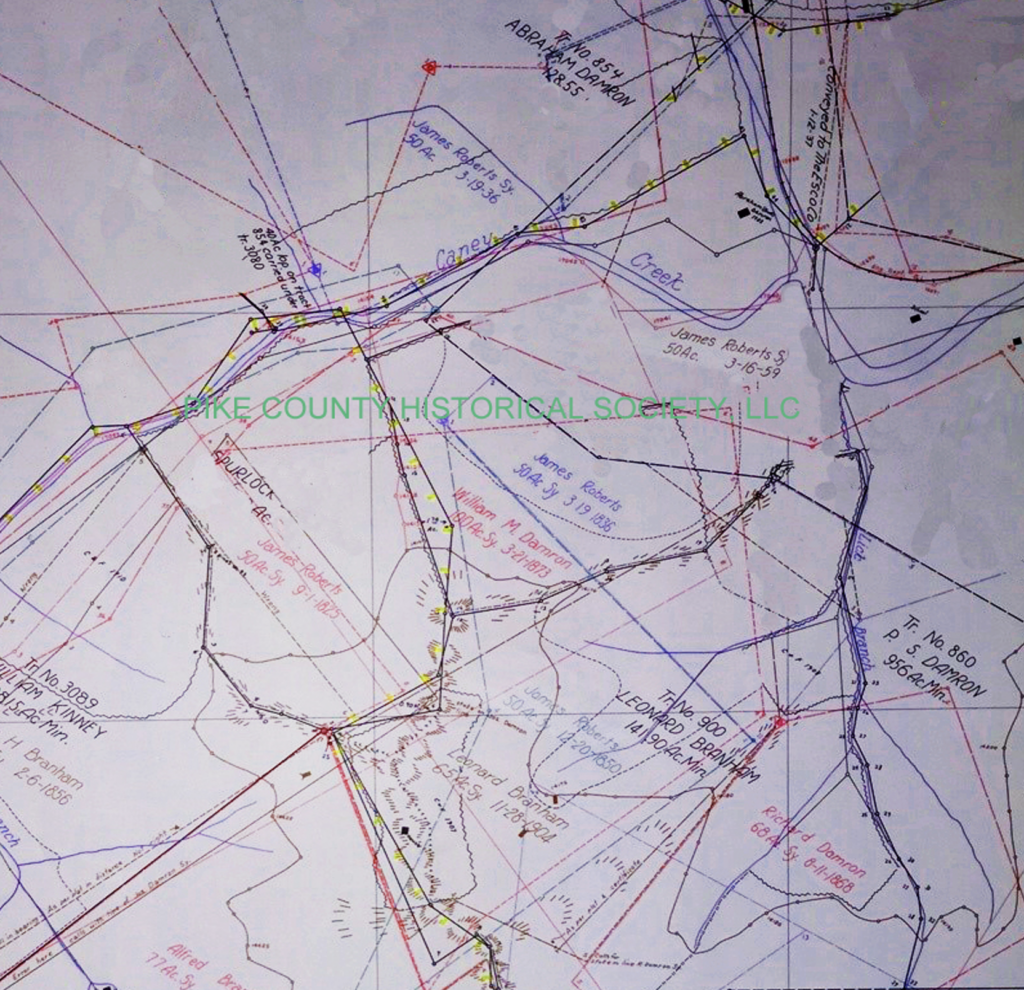
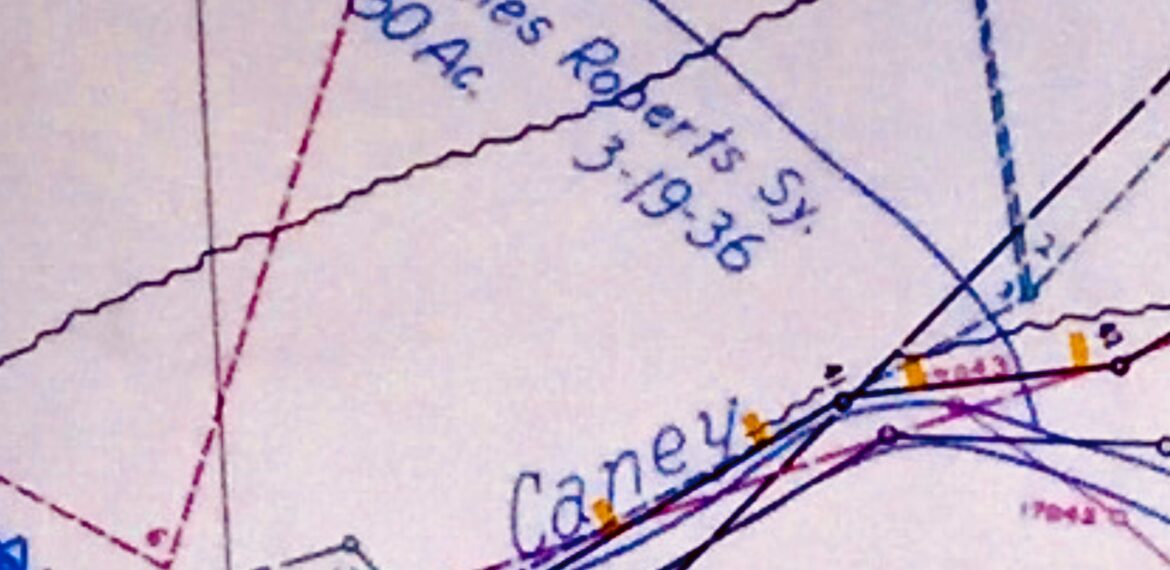
Map showing the Roberts’ property lines near the mouth of Caney Creek
James Roberts, Sr. and Nancy “Anna” Damron had the following children:
I Cornelius Roberts was born about 1791 in Russell County, Virginia. He died in July 1849 in Pike County, Kentucky. (Listed as 56 Years Old – Estate was in Wyoming County). He married Nancy Stanley on 16 April, 1820 in Floyd (later Pike) County, Kentucky. She died between 1843-1850.
1850 – Wyoming County (Virginia) Bond Book 1, page 23: “We, Isaac Roberts, Marshall Roberts, and Marshall Mullins acknowledge ourselves to owe and be indebted to the creditors and distributes and all their persons who are or may become interested in the estate of Cornelius Roberts deceased in the just and full sum of three hundred dollars for the payment whereof will and truly to be made we bind our heirs and c. sealed with our seals and dated this 23rd day of August 1850. The condition of the above obligation is such that whereas the above bound Isaac Roberts hath this day been appointed administrator of the estate of Cornelius Roberts deceased. Now if the said Roberts shall will and truly perform all the duties of administrator of and apply the estate of said Roberts deceased to the purposes required by law then this obligation shall be void else to remain in full force and virtue. Signed in open court} Isaac Roberts, Marshall Roberts, Marshall Mullins.”
Wyoming Will Book 1, pages 1 – 3: “Inventory of the personal and real estate of Cornelius Roberts, Deceased November 23, 1850 – Personal Estate – One sorrel horse, one bay two year old filly, one cow, one red bull, one one-year- old steer, one large sow and pigs, one other small sow and pigs, five head of hogs, eleven other head of hogs, nine head of sheep, one pair of drawing chains, one oven and lid, one pot, two other head of hogs, one other one- year-old bull, three bee hives, one beef hide, one hoe, three tin trunks, one pair of steel yards, one hand saw and chisel, and one drawing knife, five other hogs, one log chain, one cow and one mare, one sixty five dollar note bought of Jospeh Cline on William Riffe, one ten dollar note to be paid in work.”
Real Estate – “Bond for twenty-five acres of land situated on muzzle creek said bond executed by Moses Cartwright. Entry of one hundred and twenty-five acres of land situated on muzzle creek said entry in the name of Marshall Roberts. But transferred to deceased, but transfer order has not come to administrator. Appraisement Bill of the property of Cornelius Roberts deceased on page 2.” On page 3 is the sale of goods which listed John Evin Stacy, Ewin Ellis, James Roberts, William Lester, Thomas Buchannan, Mastin Lester, David Cornet, Joseph Roberts, Isaac Roberts, Joseph Lester, Harvey Stacy, Thomas Godfrey, Pricy Roberts. Attest Alex Laidley Department Clerk.
LAND OF CORNELIUS ROBERTS
Cornelius Roberts – James Roberts – October 14, 1825 – A/161 – 100 on Shelby Creek.
Cornelius Roberts – Bradley Elswick – November 7, 1833 – A1/327 – 100 in the flat woods and head of Marrowbone, head of Trace fork and Caney.
Cornelius Roberts – James Taylor and Sally, Harvey Smith, Peggy Smith of Virginia – November 5, 1834 – A1/383 – 800 on Elkhorn, Anderson’s corner with is line; Madison 600 acres survey which is supposed to be 800 acres.
Cornelius Roberts – Bradley and Elizabeth Collins (Clay County) – October 25, 1837- B/25 – 50 Shelby Creek on line of Bradley and Merideth Collins.
Cornelius Roberts – Henry Newsom – March 16, 1835 – March 16, 1835 – A1/429 – 65 on Caney Creek waters of Shelby Creek; lines of William Branham and John Johnson; divisional line between Roberts and Johnson. Att. James Roberts Jr., James Roberts Sr., James Branham.
Cornelius Roberts – John Johnson – March 7, 1836 – A1/445 – 55 on Caney Creek, branch of Shelby Creek, includes 4 acres of another survey of James Roberts, tree on Camp Branch.
Cornelius Roberts – William Branham – February 8, 1837 – A1/509 – 32 on Caney Creek bordering William and James Branham. Caney Creek waters of Shelby Creek, part of a 100-acre survey granted by commonwealth to James Roberts, 32 acres more or less. (Another deed said 18 acres on page 507).
Cornelius Roberts– Isaac Moore – July 22, 1839 – B/78 – 400 on Elkhorn Creek, Elkhorn Creek, where William Ramey/Ramsey formerly lived, dividing. Signed by Cornelius and Nancy Roberts.
Cornelius Roberts – Benjamin Short – November 2, 1843 – B/311 – 100 on Elkhorn Creek, (Neal Roberts), both sides of Elkhorn Creek, division line of Isaac Moore and Cornelius; attested by James Roberts Sr., John Mullins, Jack Mullins, and James Roberts. (Went to Logan/Wyoming County)
Cornelius Roberts – Thomas J. Sanders – Dec. 7, 1845 – C/3 – 100 Caney Creek, between Cornelius Roberts of Logan County; head of Marrowbone Creek, and head of Trace Fork and Caney Fork of Shelby; (Cornelius died in Wyoming)
Cornelius Roberts – John Clay – April 11, 1849 – C/256 – 75 Elkhorn Creek, Charles Anderson corner, conditional line between Roberts and Clay, down old Madison line, 600 acres.
Cornelius Roberts – James Roberts Sr. and James Roberts Jr. – August 30, 1849 – C/279 – 100 Shelby Creek. Bradley Collins sold this to Cornelius. This also says that James Roberts Sr. is his father, and that he has received all of his part of his estate.
ii. Elizabeth Roberts was born between 1795-1798 in Russell County, Virginia. She died after 1843 and before her father in 1850, as she is not mentioned in his estate, but her husband was mentioned. She married William Mullins on 1 September, 1818 in Floyd County, Kentucky.
iii. Winney Roberts was born about 1796 in Russell County, Virginia. She married George Stanley. He was born in 1793 in Franklin County, Virginia.
iv. Mary “Polly” Roberts was born about 1800 in Russell County, Virginia. She married Sherwood Mullins, son of Booker Mullins, on 8 April, 1813 in Floyd County, Kentucky. He was born in 1793 and died in 1881.
A land indenture, page 110, in 1824 an Isham Mullins deed is attested by James Roberts and Isaac Roberts; on page 111 was the indenture in 1824, a John Mullins Sr. deed with John Mullins, attested by James Roberts, William Mullins, and Cornelius Roberts; page 108, James Little deeded to John Mullins, with lines of Booker Mullins and James Mullins, attested by James Roberts, Williamm Tackett, and Ruben May.
v. Isaac Roberts was born about 1801 In Russell County, Virginia. He died after 1860. He married Dorcus Mullins on 10 January, 1846 in Tazewell County, Virginia. He is mentioned in his fathers’ estate. Isaac can be found in a suit against William Justice, regarding a plea of trespass, in the Kentucky Archives November 4, 1822.
vi. James (Jr) Roberts was born about 1811 in Shelby Creek District, Floyd (Pike) Co, Kentucky. He died in 1880 in Pike County, Kentucky. He married (1) Nancy Boney, daughter of Joseph Boney and Sarah Mullins, on 27 July, 1826 in Pike County, Kentucky. She was born between 1804-1810 and died about 1848. These are in no particular order. He married (2) Mary Potter, born in 1834. He had children with (3) Tabitha Swiney, but never married. It is also believed he had children with an (4) unknown Elkins, but never married. He lived with (5) Henrietta “Ritty” Crabtree, but never married. She was born about1805.
The 1830 Pike County census showed James Roberts, Jr. living beside Hiram Boney, who is next door to Ritty Crabtree. She was an unmarried head of household, between 15 and 20 years of age, and had one infant male between one and five years of age. In 1850 she was living downriver near the Floyd County line, unmarried, with seven children between six and 20 years of age.
James Roberts Jr – James Damron – Mar. 25, 1844 – B/340 – 20 on Shelby Creek, waters of Sandy, William Little’s line, 20 acres. Attested by Lee Cumpton, Thos. J. Sanders, and David Sanders.
James Roberts Jr. – Samuel Write – February 22, 1849 – C/282 – 50 Beef Hide Creek, bordering Frances Mullins, oath of Booker and John Mullins
James Roberts Jr. and Nancy – Richard Damron – February 3, 1855 -D/161 – 50 Shelby Creek
James Roberts Jr. & James Sr. – Henry Hall – October 15, 1857 – K/198 – 100 on Shelby Creek
James Roberts Jr. – Richard Damron – January 27, 1859 – E/213 – 4 Tracts Caney Creek
James Roberts Sr. was born in Virginia and married to Anne, also shown as Nancy. James can be found in 1794 Russell County Personal Property Tax List in the Upper District – James Roberts (1) Abraham Childers (1) Shadrack Monk (1)[26]. He is again in 1795 Russell County Personal Property Tax List of William Webb – shows James Roberts (1)[27]By August 6, 1810, James Roberts Sr. is located in the Floyd County census with 2 males under 10; 1 male 16 to 25; and himself 26 to 44 years old; 1 female under 10; 3 females 10 to 15; his wife 26 to 44 years of age. 1820 Census of Shelby, Kentucky has 3 males under 10; 1 male 10 to 15; with James over the age of 45; 1 female 10 to 15; and one female 25 to 44. The 1830 census James is 50 to 59 years of age, with I female 5 to 9 year of land and 1 female 15 to 19 years old; 1 female 50 to 59. In 1840 the U.S. Census listed 4 males 10 to 14; 1 male 15 to 19; and James at the age of 60 to 69; with 2 females 10 to 14; 1 female 15 to 10; and 1 female 40 to 49; and his wife 50 to 59 years old. The 1850 census has James at 78 years of age, making his year of birth 1772, and says he was born in Virginia. He owns 1,000 acres of land and his employment is a farmer. Nancy is shown as 75 years old making her year of birth about 1775. James was always shown as a farmer in the census records, although he served as one of the first justices of the peace and one term as county sheriff.
[26] Vol. VI – Number 29 Southwest Virginian
[27] Vol. VI – Number 31 Southwest Virginian
Other polls show James Roberts in a Pike County Tax Poll 1828, still in Shelby, on land surveyed by Madison. He has four surveys, totaling 196 acres. His son, James, is shown as owning six acres on Shelby. Son Cornelius also is on Shelby, with 210 total acres listed under three separate surveys. This is a listing of the Tax Polls for James Roberts and his sons shown from 1828 to 1836.
1828 Pike County Tax Poll:
James Roberts Sr. (1st rate) 33 acres – Pike – Shelby – Name entered Madison – Name Surveyed Madison – Name Patented Madison
James Roberts Sr. (1st rate) 90 acres – same – same – same – same – same
James Roberts Sr. (3rd rate) 50 acres – same – same – Roberts – Roberts – Roberts
James Roberts Sr. (3rd rate) 50 acres – same – conveyed – Roberts/Perkins – same – same
James Roberts Sr. (2nd rate) 6 acres – same – Shelby – Preston – Damron – Damron
James Roberts Jr. six acres – same – same – same -same – same
Cornelius Roberts (2nd rate) 100 acres – Pike – Shelby – Preston – Johnson – Johnson
Cornelius Roberts (3rd rate) 60 acres – same conveyed – Roberts – Roberts
Cornelius Roberts (3rd rate) 50 acres – same Conveyed – Roberts
Isaac Roberts (same, same, same)
1831 Pike County Tax Poll:
James Roberts Sr. 90 acres – Pike – Shelby – Madison – Madison – Madison
James Roberts Sr. 35 acres – Pike – Shelby – Madison – Madison – Madison
James Roberts Sr. 50 acres – Pike – Shelby – Roberts – Roberts – Roberts
James Roberts Sr. 25 acres – Pike – Caney – Roberts – Roberts – Roberts
Cornelius Roberts 75 acres – Pike – Caney – Roberts – Roberts – Roberts
Cornelius Roberts 50 acres – Pike Caney – Roberts – Roberts – Roberts
Cornelius Roberts 40 acres – Pike – Indian Creek – Johnson – Johnson – Johnson
1835 Pike County Tax Poll:
James Roberts Sr. 90 acres – Pike – Shelby – Madison – Madison – Madison
James Roberts Sr. 30 acres – Pike – Shelby – Madison – Madison – Madison
James Roberts Sr. 50 acres – Pike – Shelby – Roberts – Roberts – Roberts
James Roberts Sr. 25 acres – Pike – Caney – Roberts – Roberts – Roberts
James Roberts Jr. – 50 acres – Shelby – Roberts – Roberts – Roberts
James Roberts Jr. – 50 acres – Pike – Elkhorn – Boney – Boney – Boney
Cornelius Roberts 75 acres – Pike – Caney Creek -Roberts – Roberts – Roberts
Cornelius Roberts 25 acres – Pike – Caney – Roberts – Roberts – Roberts
Cornelius Roberts 100 acres – Pike – Flat ? – Damron – Damron – Damron
Cornelius Roberts 200 acres – Pike – Elkhorn – Madison – Madison – Madison
1836 Pike County Tax Poll:
James Roberts Sr. 90 acres – Pike – Shelby – Madison – Madison – Madison
James Roberts Sr. 30 acres – Pike – Shelby – Preston – Preston – Preston
James Roberts Sr. 75 acres – Pike – Shelby – Roberts – Roberts – Roberts
James Roberts Jr. – 50 acres – Pike – Beefhide – Roberts – Roberts – Roberts
Cornelius Roberts 800 acres – Pike – Elkhorn – Madison – Madison – Madison
Pike County had the 1844 General Election where James voted for William O. Cutter for Governor of Kentucky and Wm. S. Pilcher for Lieutenant Governor. In the Presidential Election of 1848, James voted along the lines of the Free-Soil Party of Martin Van Buren, a previous Democrat, and known as the party of Barnburners. They opposed the extension of slavery. The Barnburners were a short-lived extremist political group. Their tactics were compared to farmers who were so focused on getting rats out of the barns that they would burn the barn in consequence.
1844 Voters Roll General Election:
Voting was held at the house of Elisha Johnson; it being the place designated by law for holding elections that the forgoing votes was justly and accurately taken this 5th day of August 1844.
Governor – Lieutenant Governor
James Roberts Sr. – Wm. O. Cutter – Wm. S. Pilcher
James Robert Jr. – Same – Same
1848 Voter Roll – President and Vice President Election Martin Van Buren and Johnson vs Harrison and Tyler:
“We the judges of the Shelby Precinct Election do hereby certify that the foregoing votes have been justly taken to the cost of and skill and Judgment according to law given our hand this 2nd day of November 1848, Thomas May and William Tacket Judges, James Roberts Jr., Clerk. In the handwriting of James Roberts Jr.”
Both James Roberts Sr. and Jr. voted for Van Buren.
1852 County Election:
James Roberts Sr. not listed
James Roberts – Daniel Roberts – Cornelius Roberts listed
1854 Pike Tax Poll:
James Roberts Jr. 50 acres – Pike – Shelby
James Roberts Jr. 180 acres – Pike – Caney
James Roberts Sr. – 75 acres – Pike – Shelby
James Roberts Sr. – 100 acres – Pike – Caney
Daniel Roberts – 550 acres – Pike – Caney
Cornelius Roberts – 100 acres – Pike – Caney
1855 August General Election – Shelby Creek Precinct:
James Roberts Jr. – Anti Know Nothing and Cornelius Roberts – Anti Know Nothing
1856 Poll Book:
Names of voters at August Election at the Shelby Precinct on the 4th day 1856 for August Judge of Commonwealth, sheriff, clerk of Circuit court and constable.
Neal Roberts and James Roberts Jr. Clerk of Election and Daniel Roberts
James Roberts Sr. wrote his will in June of 1858 in Pike County. He mentioned: Winney Stanley his daughter; William Mullins, the husband of Elizabeth; his sons, James and Isaac. His son Cornelius had passed away in July 1849. His daughter Mary Mullins was not mentioned. She was the wife of Sherwood Mullins. The will was entered into the Pike Will Book in September of 1858.
1858 – James Roberts Sr. – Estate in Pike County, Kentucky:
“In the name of God, Amen – I James Roberts Sen being weak of bodily breath and knowing that I have not long to live and being of sound mind after first paying all my just debts do make my last will and testament in the manner following Viz; First, I will and bequeath to my daughter Winney Stanley all that portion of land lying below Shelby Creek opposite the mouth of the Caney Fork of Shelby, by the said Winney and George Stanley paying the heirs of William Mullens the sum of $15.00. 2nd, I will and bequeath unto my son James Roberts Jr. all the land lying above or at the mouth of Caney Creek of Shelby and all the property that remains at my death I want it equally divided between James Roberts Jr., George Stanley, and Isaac Roberts. Thirdly, the lot of land on which I live with all the Orchard in my possession, I retain for the use of myself and wife during our natural lives and at her death I want my son James Roberts Jr. to have the same and on other side of the cross fence from the house I want James Roberts Jr. to attend or occupy the said in witness whereof. I being in my proper mind have thereunto set my hand and seal the first day of June 1858. James Roberts Sen.
Att. John H. Casebolt, J.J Mitchell, Edward Branham
“State of Kentucky, Pike County to wit; I, John W. Emmert clerk of the county court in and for the county aforesaid do certify that this will of James Roberts Sen., was produced in open court upon the 21st day of Sept., and proven by the oaths of J.J. Casebolt and J.J. Mitchell, two of the subscribing witnesses thereto and ordered of record whereupon said will wit this certificate hath said duly admitted of record in my office this 25th Sept.1858. John W. Emmert.”
County Court Cases:
James Roberts Sr., son of Cornelius and Mary, can be found in numerous court cases. Civil Case 5, entered Sept. 13, 1822, tells us James Roberts was suing Moses Damron and Henry Weddington over $152, a loan to Thomas Price for land on Shelby Creek containing 50 acres sold to Price by Roberts.
A Second case on July 5, 1823, Case File 26A, was Robert Hopkins vs James Roberts in Pike County Court. Hopkins complained of James Roberts over a trespass, and that James was indebted to Hopkins in the amount of $100. Hopkins was a doctor who had treated Anne, his wife, with an ailment he called “gravel stone,” which afflicted Anne greatly.
A third case was from May 18, 1833, Case File 326 in Pike County. In this action, George Tackett complained of James Roberts in a case of trespass. As Tackett told his side, Roberts had called him malicious names, in a defamatory method, telling that Tackett had committed larceny. “The plaintiff [Tackett] and of concerning stealing of the said beehive, these other false and slanderous words to wit; ‘Did you [plaintiff] steal a beehive, they say you did (meaning thereby plaintiff stole a beehive) and that he (the defendant-Roberts) had heard and so reported. And whereas afterwards to wit on the _ day of _ at the county circuit aforesaid – the said defendant falsely spoke uttered and published to wit; ‘George Tackett the plaintiff is perjured, he has willfully committed perjury when he spoke in circuit court, and I (meaning the defendant) can prove it. By means of the speaking and publishing of the said several defamatory words the said plaintiff hath been greatly injured in his aforesaid good name, fame and credit, and hath sustained damage to the value of $1000 and therefore he sues.”
A fourth case on April 9, 1844, Case File 663, William Ratliff and Colbert Cecil versus James Roberts Sr. and James Roberts Jr., a chancery case over land James Junior possessed but still owned money to Cecil.
Isaac Roberts in Case 79, September 1826, complained of Solomon Mullins, Eli Mullins, and Peter Mullins, in a case of trespass, used force and arms unlawfully and without provocation bruised and ill treated him.
* * * * *
The half-breed who killed Cornelius Roberts on Black Mountain in June 1788 was one of the last Native American leaders to oppose white settlers in southwest Virginia and eastern Kentucky. His life is a fascinating story, one of a half-breed youngster forced to choose between two conflicting cultures. Following is a presentation given several years ago to the Big Sandy Chapter of the Sons of the American Revolution. It was taken almost entirely from Lawrence J. Fleenor, Jr.’s excellent biography entitled “Benge.”
THE RED-HEADED CHEROKEE
Benge established a home with his new wife. When the season came to renew his inventory, he returned to white civilization and his white spouse, Elizabeth Lewis Benge. The dual-family arrangement lasted for five years and produced three half-breed children: Bob, Lucy, and a male known as The Tail.
John Benge had married into a culture whose marriage customs were totally unlike those he had known. A Cherokee woman was head of her household and within a year may have more than one husband. Divorce was achieved when the wife put her man’s belongings outside the doorway. The mother raised her children, but in the case of divorce her sons went to live with her brothers.
Bob Benge, the son of John Benge and his Indian wife, Elizabeth Watts Benge, was born around 1760 in a Cherokee town southeast of present Knoxville. Soon thereafter, his mother put John Benge’s belongings outside the door and a year later was living in white society with William Dorton in Wilkes County, North Carolina. Bob Benge was raised by his uncles, Man Killer and Pumpkin Boy, both of whom were chiefs in their own right. He was a first cousin to George Gist, inventor of the Cherokee alphabet and grandson of Christopher Gist.
Young Bob absorbed Cherokee culture but carried one trait which betrayed his white ancestry: red hair. At this time half-breed children were becoming more common on the Virginia frontier, but a red-headed Cherokee was an exception. As a youth he spent time enough with his Cherokee mother and white stepfather to speak perfect English, but by his teenage years had totally committed himself to life as a Cherokee. His grandfather, Old Tassel, gave the Cherokee concession speech at the Long Island Treaty ceremony in May 1777. Benge had unsuccessfully planned a raid against Fort Blackmore a month earlier, but the taking of Indian land by Whites further embittered him and he became even more determined to drive the white game poachers and land stealers from southwest Virginia and upper east Tennessee.
Chief Benge, as he came to be known by Whites, had begun his mission a month prior to Old Tassel ceding land to settlers. In early April he and a handful of youthful followers staked out a raid on Fort Blackmore, but, with the militiamen and their families inside the fort, he changed plans and led his warriors toward Fort Moore at Castlewood. There Benge captured two young females and made his escape by way of Guest’s Station, the Breaks, and down Big Sandy to Ohio. The girls eventually escaped, reversed their route up Big Sandy, ascended Elkhorn Creek, passed through Pound Gap, and reached home in September after a month-long journey.
In the spring of 1785, Bob Benge and a dozen followers attacked the cabin of Archibald Scott on the head of Wallens Creek. The home was situated so as to have “plenty of visitors on their way to Kentucky.” Once the assault began, Mr. Scott was killed instantly. Four children were either tomahawked or had their throats slashed. Mrs. Scott was taken hostage. Accounts of her capture suggest that Benge planned to pass through Pound Gap, then on to Payne Gap. From there they would have taken the buffalo trail just below the ridge top toward Hen Pen, down Left Beaver to the Big Sandy, and finally north to the Ohio country where, had the plan worked, Mrs. Scott would have become a Shawnee wife. Instead, she escaped from an old Indian left to guard her. From the meager details of her story, she probably made her way down Left Beaver to Levisa Fork, then up Levisa to Russell Fork and through the Breaks to the headwaters of Clinch River and home.
A member of Benge’s band was Whiteside Hargis, the son of a white man. He had been in the party when Daniel Boone’s son, James, was killed on October 10, 1773 while on the way to Kentucky. Hargis was captured, raised as a Cherokee, and had adopted their ways. He hated whites with as much passion as his chief.
For nine years Benge led intermittent attacks against settlers in southwest Virginia. He became a one-man deterrent to potential homesteaders who would have crossed Pine Mountain to establish homes in modern Floyd, Pike, Letcher, and Perry counties. Tales of the cabins he burned, along with the men and children he murdered, as well as the Negroes he captured and sold as slaves, prevented many home seekers from making the trip into Kentucky. Most discouraging of all were the tales of captured White women who were either sold to become Indian wives/slaves or died from torture.
On April 6, 1794, Benge, Hargis, and a small party of braves attacked the Peter Livingston home about 15 miles west of Abingdon, Virginia. They plundered the house and took as hostages Mrs. Livingston, her children, and the family Negroes. Benge would have taken his familiar trail by modern Norton, Virginia, down Indian Creek, and up Pine Mountain to Pound Gap. From there he would have taken Elkhorn Creek to reach Levisa Fork or possibly a shortcut down Shelby Creek to Levisa. Alternatively, he would have taken the buffalo trail along the ridge line to Hen Pen, then down Left Beaver to Levisa Fork at present day Allen, Kentucky. But it was not to be.
A detachment of Holston militia under Lieutenant Vincent Hobbs, Jr. had taken up pursuit. They were close on the raiders’ heels. Hobbs had sent a second group by way of a detour to cut off the Indians in case they took an alternate route. This second party was led by Benge’s half-brother, William Dorton, Jr. Benge took his usual trail and so chance prevented Dorton from a deadly confrontation with his renegade sibling.
Hobbs spied the party climbing toward Little Stone Gap only seconds before Benge caught sight of Hobbs. Benge retraced his steps and ran straight into the sights of the lieutenant’s rifle. Legend has it that Hobbs was aiming for Benge’s spine, but, during the split second before he fired, the fleeing Indian stepped into a hole left by an uprooted tree. The folk tale further says that Benge carried a silver drinking cup tied by a string to his waist belt, and when he went into the hole the cup flew upward. The cup was smashed by the bullet from Hobbs’s bear rifle a millisecond before it crashed through the skull of the red-headed Cherokee.
The cultural clash involving the land northwest of Pine Mountain had been settled in favor of the white man. After Benge’s death, his followers spread to either the Shawnee country of Ohio or down the Little Tennessee River to Cherokee territory. The white settlers who had for so long delayed their Kentucky pilgrimage for fear of death or capture at the hands of Chief Bob Benge began to stream over Pine Mountain and into the Big Sandy, North Fork of the Kentucky, and Cumberland river valleys. Many of them would take the same route the buffalo had made centuries earlier and pass by the same camp on the ridge above Hen Pen Branch of Beaver Creek where native hunters had once napped arrowheads while awaiting their shaggy prey.
Wonderfully Researched & Written by Barbara Vance Cherep and historical information by
Randall Osborne


I am a descendant of Cornelius Roberts and came across this while researching family history. Thank you for sharing this information, it has been incredibly helpful and interesting.