
When The World Was Flat
More than sixty years have passed, but the memory lingers, indelible as a bottle of blue ink spilled on a 5-cent pack of Lucky Star writing paper. I remember the blackboard, the pull-down map of the world, a frieze of paper cardinals, listing ships and crooked Crayola houses.
I remember the perfectly lettered lesson and the ghost of “Jerry loves Susie” hastily erased at the ringing of the class bell. I can hear the wheezing of the steam radiators under the tall windows and smell the cloying odor of books and crayons.
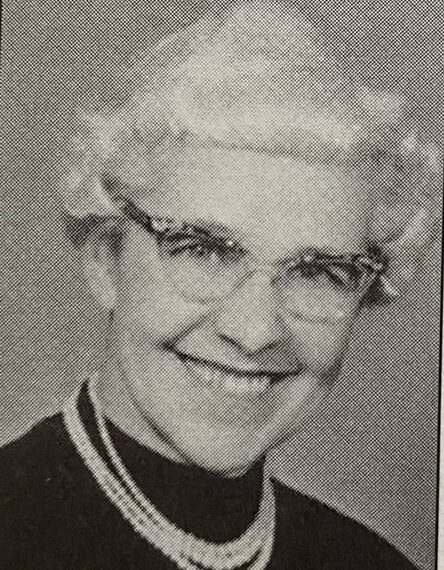
And I can see the teacher, young but with stunningly white hair, chalk dust on her sleeve, pointing with her yardstick to Madagascar on the map.
The year was 1958. The school was Virgie Grade School in Pike County, Kentucky, a school unfettered by government bureaucracy, poor only by standards of the community it served, a coal community, struggling as it does today with the vagaries of the industry. The teacher was Marie Tackett, and I, a shy eleven-year-old boy in the sixth grade who thought she was the smartest, most wonderful person in all the world.
Mrs. Tackett, like most teachers of the period, was expected to be a paragon of knowledge, teaching every subject from English composition to arithmetic to as many as forty students in a single classroom. She was, indeed, that rare teacher whose interests and erudition seemed unlimited. The discovery of a spring flower or a new word was received with a joy that inspired the dullest among us.
Her classroom was a citadel of learning, a library and a museum. Rattlesnakes, copperheads and water moccasins coiled within glass jugs of formaldehyde. Frogs and lizards peered with dead eyes from Mason jars. Hundreds of moths, beetles and butterflies, who had given their lives for science, lay entombed in glass cases with pins in their backs. Courtesy of Mrs. Tackett’s son who was a medical student, we had a grisly exhibit of bad tonsils, failed appendices, gall bladders, severed thumbs and other human offal. Such specimens were intended for the edification of future surgeons. In most cases they were used by the nascent doctor to send some girl screaming down the hall. Our parents wondered aloud why such a nice lady insisted on keeping “all them nasty things.”
Surprisingly, Marie Tackett’s room never once reeked of chemicals or little decomposing corpses. Instead, it was filled with the tantalizing aroma of fresh popcorn. We had the only popcorn machine in the school, probably the only one in the county. It was not your one-horse popper, either, but the kind you’d find in a movie theater. During recess and lunch we were told to help ourselves. Anyone else who happened by was welcome. Mrs. Tackett paid for it all out of her own meager salary. She was willing to treat us all, so that a few would have something for lunch.
In Marie Tackett’s class we said the Lord’s Prayer, pledged allegiance to the flag and sang “My Country ‘Tis of Thee.” Sex education was an independent study held behind the band room or in the nearby railroad tunnel. Discipline came in the form of a mammoth wooden paddle worn smooth from daily collision with young bottoms.
Mrs. Tackett could silence a class of thirty with a mere finger across the lips, but when the time came she was not one to spare the rod. Nearly every other day, following recess or lunch, she held court to determine who hit who first, who took whose marbles, or who peed in the aquarium.
When the jury deadlocked and a verdict couldn’t be reached, she lined up the accused, the prosecution, the defense and half the witnesses and wore out two yardsticks getting to her paddle. She administered justice with an authority that resounded from one end of the hall to the other.
Incredibly, in 1958, Mrs. Tackett was confronted with the task of convincing some of us that the earth was round. When the Russians launched the Sputnik into orbit the year before, she was filled with optimism. It was the evidence she needed to prove to us that Columbus was right. However, when we told our parents about this wonderful scientific breakthrough, they dismissed it as just another trick of that “lying, bald-headed Khrushchev.”
History in Marie Tackett’s class was a subject not dead, but alive with flesh and blood. Under her teaching, I became Abe Lincoln and studied by firelight. I became Dan’l Boone building forts against the red man and slaying a nation of Shawnee with my broomstick rifle. To my father’s chagrin, I cut down three fruit trees and nine rows of young corn blazing a trail through “Cumberland Gap.”
Our geography lessons were vicarious journeys to Brittany, Lapland and Holland. We were ever in awe of our teacher who had seen the big world–Mammoth Cave, the Great Smoky Mountains and Seven States from Rock City. Only the more traveled among us had been to the Breaks of the Big Sandy or seen Dewey Dam in Floyd County. One boy claimed he had been clear to Florida once. We nicknamed him Ponce de Leon and told him to go jump in Dewey Lake.
When our textbooks grew wearisome, Mrs. Tackett shoved them aside and read to us from Uncle Remus, the Sugar Creek Gang and the poems of James Whitcomb Riley. If the class scored well on an achievement test, she was likely to plug in the hi-fi, play “Froggie Went A-Courtin’,” “Camptown Races,” or “Dance With Me Henry.”
Although she had more than thirty students, she got to know each of them. When I missed school two days in a row, she assumed I was sick. On the third day she came to my house carrying an armload of magazines, books–and homework. Discovering that it wasn’t illness that kept me home, she bought me a lunch ticket. When I came to school one cold November day wearing a thin sweater and pretending to have lost my coat, she paid me another visit. Along with more books, pencils and homework, she brought two warm winter coats–one for me and another for my brother Orville.
At Christmas, when the class drew names to buy gifts, she purposely drew mine and surprised me with a wonderful Viewmaster projector so that, I too, could see the Great Smoky Mountains and Seven States from Rock City.
“Read and read and read!” she kept telling me. When I had exhausted the contents of the classroom shelves: the Hardy Boys, Tom Swift and the Grosset and Dunlap classics, she began bringing me volumes from the high school library.
When school turned out for the summer, she invited me into her home where I read from her private library and watched “My Little Margie” on her black and white TV. Recognizing my penchant for writing, she introduced me to the poetry of Robert Frost and Carl Sandburg, the works of Mark Twain and Kentucky author Jesse Stuart. My life was changed forever.
Today, when I consider how prayer and the paddle have been replaced in the classroom by radical sex education, drug counseling and metal detectors, I imagine Marie Tackett bending half a dozen miscreants across her old wooden desk. I can almost see the dust from her paddle as some poor soul pays in hide for smoking Viceroys behind the band room, playing the punchboard or dancing to the jukebox at Candy Jack’s restaurant. And when I hear of major universities conferring degrees upon students who can barely read their diplomas, I can hear Mrs. Tackett proclaiming: “Read and read and read!”
How swiftly comes the day when the books are closed and the last bell has rung. How soon must we enter life’s hard school, where we can no longer raise our hands for answers. When that day comes, may we take with us more than rote learning, more than memories between the covers of dusty yearbooks. Might we also come away with a knowledge of self worth, something inside us that lives and sings, something warm to wrap around us when we stand shivering in a November wind.
Marie Tackett, a great teacher, gave me that. It was her gift to all who would listen. If it is all I ever have, I will never again be poor.
First published in Appalachian Heritage, Fall 1999
PCHS Contributor: Gayle Compton