Table of Contents
Artist Biography by Paul Roberts
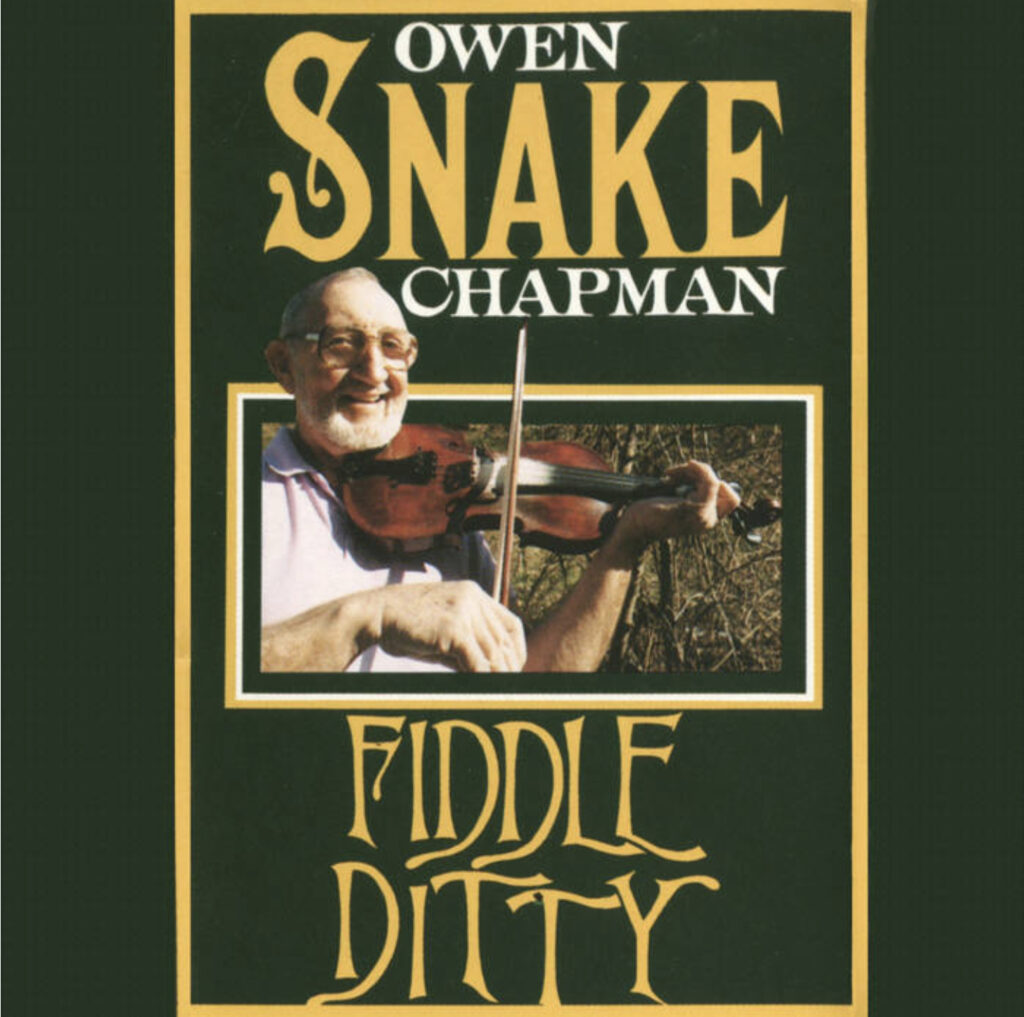
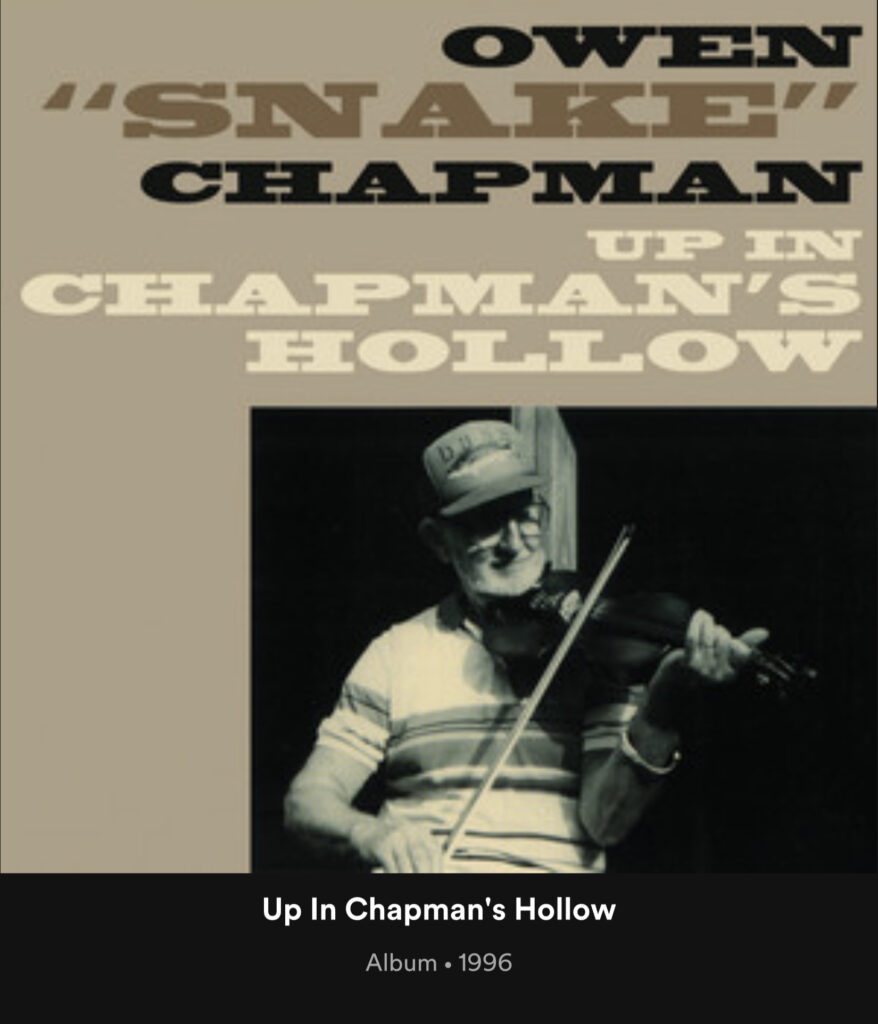
Owen ‘Snake’ Chapman was born in 1919 near Canada in north-eastern Kentucky, and the music presented on these two CDs, recorded between 1995 and 1998, reflects a lifetime’s immersion in the rich and creative Southern fiddle tradition. His personal story is almost an archetype for the experience of the Kentucky mountain people in the 20th century – born and raised in a log cabin, he worked as a coal miner from late teens to middle-age, retiring early with black lung and working briefly in the auto plants of Detroit before returning to the family home in Chapman’s Hollow sometime in the late ’60s. Whilst ‘archetype’ isn’t the first word that springs to mind to describe his highly individual fiddle style, Snake’s musical history also runs the gamut of all the key developments and changes in Appalachian tradition during this period, and being gifted with an exceptional musical memory his playing is a kind of living archive of 20th century Kentucky fiddling.
His immediate family heritage probably reaches back as far as anyone still alive at the end of the 20th century. His father, George ‘Doc’ Chapman, was born around 1850 (he was 67 when Snake was born) and thus learnt his music from the antebellum generation. Consider this – Snake learnt fiddle when he was “eleven or twelve” off a father who must have been around 78 by then. If Doc had done the same he would have been learning off someone born in 1783, a mere seven years after the Declaration of Independence! On one level this is nothing special – many of the older fiddlers recorded in the 1920s and 30s played music rooted in the antebellum era – but there can be few fiddlers still alive able to claim this level of musical antiquity. It is a sobering thought that two of Snake’s uncles fought in the Civil War!
Snake, however, is a 20th century musician. Whilst his initial influences were his father and the older players he met around Williamson (notably Ed Haley), it was the great Radio and Contest fiddlers of the thirties and forties he most tried to emulate in his youth, particularly (and predictably) Arthur Smith. For a long time he played little of his older heritage, his main interest lying in the popular ‘Hillbilly’ music of the era, playing first with Clayton and Russell West as the Kentucky Redbirds (heavily influenced by the Delmore Brothers and the Dixieliners) , and then with Molly O’Day (Laverne Williamson) and her brother Cecil, though his music never lost the connection with dancing – much of this work seems to have been for square dances, and not just for radio and concerts. In the ’60s Snake almost inevitably got into Bluegrass, and one gets the impression he was a decent Bluegrass fiddler – he remains good friends with Kenny Baker – while in more recent times he has rediscovered the music of his father’s generation and become involved in the Old Time revival – full circle.
It’s clear Snake’s playing has gone through many changes of repertoire and style. In particular it seems he aped Arthur Smith’s so-called long-bow technique for a long time. Nowadays he reckons to have totally abandoned long-bow and to be playing very like his father, though he stresses that ultimately he plays most ‘like himself’ – i.e. after a lifteime’s immersion in this music he inevitably has his own distinct style. If we are to broadly categorize this style then Snake is, I think, what south-easterners call a ‘hornpipe fiddler’. This doesn’t mean he plays midwestern style music – southeastern hornpipes are usually the simpler 18th century type, the complex Victorian ‘Competition Hornpipes’ favoured in the mid-west are rarely heared in the South. Indeed, it doesn’t always mean someone who plays mainly hornpipes (though a large number of Snake’s tunes are either hornpipes or ‘quasi-hornpipes’) it refers to a ‘notey’ approach that gives even reels, polkas and the simpler breakdowns a hornpipe feel.
‘Hornpipe fiddlers’ typically make less use of drones and chords and it’s very noticeable that the more hornpipey Snake’s material the less he uses double strings. The hornpipe feel to his playing is definately accentuated by the bowing style which he claims to have inherited from his father – and which he stresses was not shared by other local fiddlers. It has a choppy character that he calls ‘heckling’ and Paul Smith describes as ‘digging it out’. From Snake’s description this seems to be the result of playing backwards – pushing (upbow) when most fiddlers pull (downbow). Interestingly, this is very like contemporary descriptions of Niel Gow’s strathspey bowing, and exactly like Honeyman’s description of the ‘Newcastle style’ of Hornpipe bowing – though Snake of course plays his tunes ‘undotted’, heavily accented tunes like the Strathspey and ‘Newcastle’ Hornpipe are rare in the South.
Judging from the content of these two CDs, nowadays Snake’s repertoire seems too fall into three main categories. Firstly, the music he learnt off his father and the older generation of local fiddlers at the very start of his career, secondly a number of rare and excellent tunes learnt in the ’30s and ’40s off radio programmes like the Opry and the Renfro Valley Barn Dance, and thirdly his own compositions. Whilst I personally am more interested in the first two groups, in many ways it is his own compositions that best demonstrate both his impressive technical skill and his keen musical ear and memory. The bulk of the self-compositions presented here consist of the ‘progressive old time’ that younger fiddlers rely on in contests or use to make people sit up and take notice when the session is waning at 3 a.m. It’s the sort of music Old Time fiddlers play to sound progressive and Bluegrass fiddlers play to sound old-time. The chief characteristics of the genre are melodic complexity and the heavy use of attention grabbing devices like minor keys, key changes, the inversion of conventional chordal patterns, and the insertion of unusual or eccentric passages – tunes like the minor-key Gina Lisa, or Molly’s Tune with its semitonal runs, or the dual-key Cat Tracks with it’s unusual phrasing and chord sequences, amply demonstrate his mastery of this genre.
But Snake’s keen ear has grasped considerably more than this. His ability to compose completely traditional sounding material is evident from the parts he has added to some older tunes and which blend perfectly – his B-part to the old children’s rhyme Go in and Out the Window is a cracker, the hornpipey notiness forming a lovely contrast to the simplicity of the basic melody. Among his compositions you will also find brilliant copies of Victorian ballroom waltzes (Jenny’s Waltz, Taras Waltz), a classic ‘southernised’ polka (Walnut Gap), an excellent Opry style C-Rag (Blackie) and a quite astonishing imitation of a modern Irish reel (he calls it Half Irish – ‘three-quarters’ or even ‘seven-eighths’ would be more accurate – the illusion is helped by banjo accompanist Paul Smith’s clever imitation of Irish tenor banjo style). I was particularly taken with his Jerry and Tom – with it’s distant echoes of My Love She’s But a Lassie Yet and Lea Rigs, it sounds like a typical Anglo-Scots border air or march and would fit straight into a lowland Scots or northern English repertoire without altering a note. Possibly Snake has heard this kind of music recently and instinctively absorbed its fundamentals, yet the thought nags that it could reflect seeds planted in his fathers day – like some of his father’s tunes it is somewhat reminiscent of a long forgotten form called the ‘Scotch Measure’.
Though ‘Hillbilly’ fiddling was the chief inspiration in his youth, nowadays Snake feels he played much of that music in an attempt to be fashionable. This is hardly a relevant factor when your in your seventies and the style is half a century old, and to a great extent he seems to have abandoned it. He does however continue to play a number of rare traditional tunes picked up off Country Music radio back in the thirties and forties. As the notes point out, much of this music documents west Tennessee low country tradition – many of the Opry bands hailed from the region west of Nashville, and even from the Nashville urban area, though the Opry management insisted on presenting them as ‘genuine back country musicians’ and ‘mountaineers’. I find this music fascinating – like much southern low-country music (listen to Hack’s String Band or the Madisonville String Band on Wink the Other Eye for a Kentucky parallel) it is heavy in rags and blues and often has a strong bluesy edge even when the melody is ostensibly a breakdown: listen to Snake play such Opry derived breakdowns as Jack of Diamonds or Old Joe, where the strong hornpipe flavour is matched by an equally strong blues/rag flavour (both of these tunes are significantly in the key of C, rare for breakdowns but absolutely typical of ragtime/blues fiddle).
That Snake remembers this stuff today is quite astonishing as it seems it was not the staple of his repertoire even in his ‘radio fiddler’ days – as some indication of the vast amount of music stored in his head and the sort of changes it’s seen, a local admirer actually compiled a list of Snake’s then repertoire back in 1958. It reads like a summary of mid-20th century Southern fiddle ‘standards’, consisting overwhelmingly of popular breakdowns like 8th of January, Chicken Reel, Flop Eared Mule, Mississipi Sawyer, and Turkey in the Straw, spiced with ragtime and blues favourites – Goofus, Whistling Rufus, Carroll County Blues, Peacock Rag and the like. There is only the slightest overlap with the music on these two CDs – the list contains around 130 tunes but I spotted only three or four in common, not counting the little group of five tunes at the end marked as from his father. Indeed, Mark Wilson comments that he has recorded over 200 tunes from Snake with very little overlap with the 1958 list, testimony to the man’s incredible musical memory.
Ultimately the heart of these two CDs has to be the large body of older material derived from players like Ed Haley, Thaddeus Baker, and above all Doc Chapman. Indeed, Doc’s tunes are as musically exciting and academically interesting as anything I’ve heard in recent Southern tradition. Like many Southern tunes they often contain strong echoes of old British melodies – for example, my ears detect echoes of Steamboat Hornpipe in Doc Chapman’s Breakdown, of Dance to Your Daddy and Morpeth Rant in Old Baldy, and of Moneymusk in Can you Dance at Tobacco Hill (Snake also plays Moneymusk), and the beautiful The Darker the Nights has got me quite frustrated with it’s close similarity to an English hornpipe which I can’t quite place – at first I thought it was Cuckoo’s Nest (if any inveterate tune spotters can help I’ll be glad to hear from them). There are even stronger echoes of several American tunes, and one or two of Doc’s melodies have been collected elsewhere in the South in very similar versions. But in general they form as original a body of music as I’ve heard in a long time.
They do, however, present certain problems. Firstly, there has to be some question as to how far they represent Kentucky tradition or Illinois tradition, because Doc’s father came from Illinois. Though Snake reckons his grandad probably wasn’t a fiddler, he does confess to some uncertainty and to knowing little about his grandparents (not surprising when you’re born to a 67 year old father). Whilst basic musical ability isn’t that rare, in Snake and Doc’s music I detect a special quality – a particular creative genius – and the phrase ‘must run in the family’ keeps nagging! When you read that Doc’s brother Hense was possibly an even better fiddler than Doc you do start to wonder. Certainly I think we have to admit the slight but definite possibility that Doc’s tunes and style derived from his family rather than his neighbours and were rooted in Illinois.
What is not open to doubt is that much of the special character of Doc’s music derives from Doc himself, who seems to have possessed a deeply original and creative musical mind quite equal to his son’s. At least two tunes here are credited as original Doc Chapman compositions (Pat Him on the Back and Doc Chapman’s Breakdown) and they are possibly the two most fascinating and unique melodies in the entire collection, particularly the latter with it’s striking key shift within the part. To give you some idea of the tune’s unique and weird character, Snake recalls “I thought he was just practicing … I didn’t think he was even playing a tune”. The creative input of Doc Chapman in much of his other material shows in the repeated appearance of elements of Old Molly Hare/Fairy Dance, strong echoes of which occur in at least five out of the 18 tunes stated to be sourced from Doc, which seems beyond the bounds of coincidence. There is also the question of Snake’s input – Snake is after all another intensely creative musician. For example, does the strong hornpipe flavour to Doc’s tunes represent their original form or Snake’s interpretation? Snake is notorious for imparting a hornpipe feel to all his material and for making simple tunes complex (“sometimes if I play a tune and it ain’t got enough in it, I’ll put more in it to make the tune …”) and many of these tunes he has hardly played since childhood. Still, Snake himself seems fairly certain he plays this stuff very like his father.
Most of Doc’s tunes are probably classifiable as hornpipes and there is a strong hornpipey character to all his material, though one or two tunes are more like reels, at least in part – indeed several tunes combine typical reel and hornpipe features together. The simple pentatonic children’s song In Come a Beewith its gentle, bluesy syncopation certainly stands out from the trend, but even this converts to a passable reel by changing the tempo and squaring the structure. Whilst Doc’s tunes favour G there are almost as many in A, some of which have to my ears a certain bagpipe flavour (e.g. Rock Andy, Johnny Booker, Brushy Fork of John’s Creek). This relates to containment within an 8 or 9 note scale and certain structural features I could demonstrate in practice but don’t have the musical theory to describe in words. Whilst none of these tunes make much sense on the pipe chanter as Snake gives them I could easily bodge them around and produce passable pipe tunes out of them and I suspect a distant bagpipe origin for some of this music. ‘A’ is of course the best key for imitating bagpipes and is almost invariably used for pipe tunes by fiddlers in the British Isles – low D or low G finger and bow the same but lack the high screaming quality of A.
If the dominent tendency in Doc’s music is the hornpipe, some of his tunes are probably better classed as quasi-hornpipes or perhaps proto-hornpipes. One or two remind me somewhat of the melodies used for a dance called the Scotch Measure, which was extremely popular during the late 17th/early 18th centuries, especially in southern England. The main difference between the Scotch Measure and the later Hornpipe is simply the former’s old-fashioned reliance on gapped scales – that is, they appear to be early hornpipes, and it seems they were occassionally called hornpipes even in the 17th century. Unfortunately, a quick play through two of the tunes in question (Johhny Booker and Little Sally Ann) reveals the use of the complete scale. Even so, I think this is something that may be worth following up, for I suspect Southern fiddle music in general often relates closely to ‘early music’, i.e. the stuff that came before hornpipes and reels (of which, unfortunately, we know very little).
All in all, these are two remarkable CDs which seem to improve with every hearing. The back-up musicians, Snake’s friends and neighbours Bert Hatfield and Paul Smith (joined on Walnut Gap by Roger Cooper) are excellent, getting the balance between letting the fiddler shine and playing good, creative music just about right; the presentation and notes are as superb as in all Mark Wilson’s projects; Snake’s personal memories are an absolute goldmine of information; and for anyone interested in the roots of Southern fiddle music a thorough musicological analysis of Doc Chapman’s tunes should be extremely revealing. I personally found Chapman’s Hollow the most entertaining and the most interesting, as it contains the highest proportion of Doc Chapman’s tunes and other older material – indeed, I’m inclined to think it should be in the collection of any serious Old Time fiddle fan – but both albums are absolutely, totally, unreservedly recommended.
Paul Roberts – 11/3/2000
Music
Snake Chapman & Paul Smith – Kentucky Fiddle & Banjo Music “Katy Hill”. – https://youtu.be/Lci7T24JSZY
Snake Chapman – Old-Time Fiddle Style – https://youtu.be/hfY0TOpj7hQ
Snake Chapman – Rock Andy Fiddle Tune Video – https://youtu.be/k3J3gImIeSg