Table of Contents
- TAPESTRIES OF DARKNESS
- OUTSIDE OF HEAVEN
- VICTORIOUS
- WHEN I AM DEAD
- Excerpt from The McCoys: Their Story
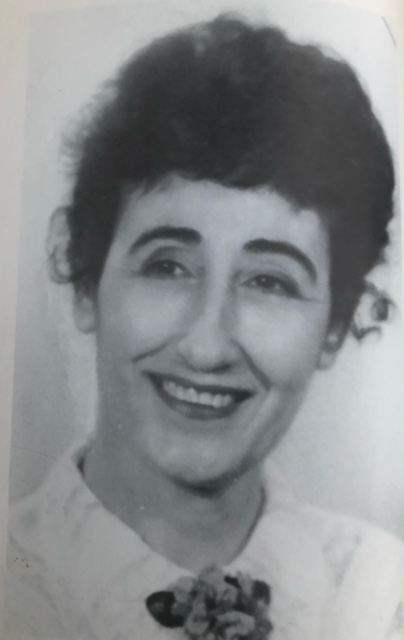
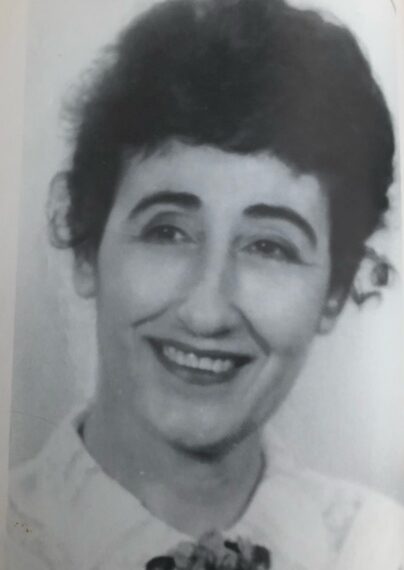
The first half of the twentieth century saw the emergence of several notable Appalachian poets and local colorists, including John Fox, Jr., Charles Neville Buck, Jesse Stuart and James Still. With her poems appearing in an array of newspapers and national journals, Truda McCoy of Pikeville was one of the most promising. However, her ties to the most famous family in Kentucky, and the book she wrote about them, would ultimately overshadow all else she had written.
The first of seven children, Truda was born February 3, 1902 to James and Charlotta Williams of Pikeville. She was a descendent of John McCoy, uncle of legendary feud leader Randolph (Ran’l) McCoy. She was educated in the Pikeville public schools and graduated from Pikeville College with a degree in teaching. At the age of twenty she became a teacher in a rural district of Pike County. In less than a year her dark features and dazzling smile caught the attention of Rex Calvin McCoy, a handsome swain who, like her, was a descendent of the notorious Randolph. They were married in 1921. Together they would have three children: Rex Samuel and twins Paul Ronald and Judith Diana.
Like many Pike Countians, Truda had grown up listening to sensational and often conflicting stories of the Hatfield and McCoy feud. After marrying into the McCoy family she was surprised by their silence on the subject.
Most of the sporadic thirty-year conflict took place in Pike County, including the Hatfield trials and the hanging of Ellison Mounts. There were those who would have it otherwise. Reporters from big-city newspapers, including the Louisville Courier Journal, visited Pikeville in the late 1880s and wrote, almost exclusively, about the evils of the West Virginia Hatfields. Their sources were not the McCoys, but the Pikeville elite who were careful not to dirty their own turf.
Thirty years after the feud ended in 1891, the McCoys refused to talk about it. With her newly acquired status in the iconic family, a good education and a winning personality, Truda soon earned the trust of the tight-lipped clan. She was invited into their homes to hear eye-witness accounts of the most publicized and misrepresented feud in American history. It appeared that the McCoy side of the story would finally be told.
Truda spent the next fifteen years collecting stories, poring over public records and writing until she had completed nearly three hundred pages of the manuscript she called The McCoys: Their Story. After receiving a number of rejection slips from major publishers, she became discouraged. She placed the book in a drawer where it remained, unread and forgotten, until forty years later.
Meanwhile, Truda turned her attention to teaching, and writing poetry. She had been writing poems all of her adult life, but did not start publishing until 1950. Her traditional and free verse poems on mountain themes, and rueful love sonnets began appearing in dozens of literary magazines and newspapers, including Poetry Digest, Writer’s Journal, The American Bard, and Washington Evening Star.
She saw her first book in print in 1952, a thin volume titled Till the Frost. The poem “My Songs” and others in this book suggest a poet in an experimental stage, vaguely aware of her potential but lacking the confidence she would acquire later:
	I sing my songs so low, so low,
	That they are never heard
	Save by the wind caressing me,
	Or by the sweet wild bird.
She is especially self-deprecating in the title poem, “Till the Frost”:
	I shall be one among you at the feast,
	But all unnoticed...being but the least.
Her well-crafted love sonnets, did not always win favor with publishers and readers. Frequently maudlin and self-indulgent, they seemed to be a cathartic outpouring of a young woman caught in a tumultuous and unhappy relationship.
Robert Frost has said: “A poem begins as a lump in the throat.” It takes the next step in these tear-soaked lines from the aptly titled book, The Tempter’s Harvest, published in 1954:
	Unfathomed emptiness is all I own;
	In this stark world of living, I have lost
	The fruit of love before my life was grown...

	Tonight, among all women I am one
	Of the most miserable upon the earth.
	I look toward evening, view the setting sun
	Enringed in cerements of doubtful worth.

	I'll walk the earth as one who never knew:
	Most men are false and gods are proved untrue.
No doubt, Cupid has shot the author with a poisoned arrow. Unless the reader wishes to share a towel with the broken-hearted, he will not travel far in this damp climate.
Surcease of sorrow comes at last in “Fulfillment,” the final poem in the sequence:
	Let time's sharp clipping shears come closer still;
	Deception is no more; the rose is mine.
	My wild heartbeat is yours...I know the thrill
	Of unity...Let sordid souls malign
	My happiness; I have fulfilled my quest.
The poem was published in Different, and won that publication’s prize, one of many McCoy would earn over the years.
McCoy’s later poems are the work of a more mature and self-assured poet, with an optimism that’s missing in many of her earlier poems. “Victorious” from Tempter’s Harvest is testament:
	There shall be seekers of beauty as long
	As the sun-god smiles on the changing earth;
	There shall be makers of laughter and song,
	As long as the Spring-god whispers, "Rebirth."
McCoy’s last book, Winds Will Quote, published in 1962, is a compendium of her best work. Like her previous books it is out of print, but can be found in Special Collections of the Frank M. Allara Library at the University of Pikeville.
Truda taught in the Pikeville school system for over twenty years and continued to write poetry until her death in 1974.
She was a member of Pen Women’s Association of America and the Eastern Kentucky Writers League. She was listed in Who’s Who in American Women and The International Who’s Who of Women. What many believe to be her greatest accomplishment was yet to come, although she would not live to see it.
Not long after her mother’s death, Judith McCoy Bowling of Pikeville, was watching TV when she heard a statement that caused her to turn up the volume. Members of the Preservation Council of Pike County were being interviewed and the subject was the Hatfield and McCoy feud and the dearth of information on the McCoy side of the conflict. Judith wasted no time. She called the Council president and happily informed him that the McCoy side of the story had already been written. All that was needed was a publisher.
In her will, Truda had left the manuscript to her son Paul, twin brother of Judith. He immediately contacted Dr. Leonard Roberts, a folklorist and professor at Pikeville College who had already published an account of the Hatfields involvement in the feud. Roberts read the manuscript and prepared it for publication, complete with a foreword, rare family photographs and a McCoy genealogy. The book was published by the Preservation Council Press in 1976, the first ever written from the McCoy point of view.
Dr. Roberts describes both the feud and the book in his “Afterwards,”: “As literature it has the breadth of a folk epic. As art it has the cleansing force of a classical tragedy.”
Truda McCoy was 72 when she died in 1974. She is buried near the place of her birth, on a hillside overlooking Town Mountain Road in Pikeville. Although it is not engraved on her headstone, she penned her own epitaph many years ago in the poem “When I am Dead.”:
	Death is a name: a withered flower,
	     Sunset or falling leaf;
	When I am dead, grieve not for me
	     Who am beyond all grief.
Historians and others will forever owe a debt to Truda McCoy for writing the final chapter of the Hatfield and McCoy saga and closing a gap in the feud’s history. We must not forget that she was also a poet, one of the first to capture in verse the intricate story of these hills. The following lines from “Our Hills” is a fitting denouement to that story. It is also a pattern for living in harmony.
	These hills are ours;
	We have given our blood, our dusts have mingled
	through generations.

	These hills are ours,
	For we have met their challenge,
	worked through the test of strength
	and we belong together.
TAPESTRIES OF DARKNESS
You pressed hot-burning kisses on my mouth,
Till I was near consumed by living fire;
Your voice was warm as dawnlight from the south;
Convention left us with our wild desire.
We met in sweet communion...we were one;
Dark heavenly nectar for a little spell;
The writhing serpent dragged the fiery sun
From off his orbit...substituted hell.
Now in the evening...on a lonely street,
I see you walking, feel the arrow pain
Straight through my heart...And when we sometimes meet,
You speak...but all is over...that is plain.
I who have woven moonbeams into lace,
Make tapestries of darkness for your face.

From The Tempter's Harvest
OUTSIDE OF HEAVEN
Tonight among all women I am one
Of the most miserable upon the earth.
I look toward evening, view the setting sun
Enringed in cerements of doubtful worth.
I know the dark immensity of night,
And loneliness where jungled shadows creep,
And past mistakes return to rush and riot
Across my brain to rob me of my sleep.
My hours on purpled mountains have been brief;
I gathered neither rose nor asphodel;
My bludgeonings are almost past belief;
I know the tortures of a soul in hell.
I am a fool:  I stood outside of heaven,
Refused the entrance that my god had given.

From The Tempter's Harvest
VICTORIOUS
There shall be seekers of beauty as long
As the sun-god smiles on the changing earth;
There shall be makers of laughter and song,
As long as the Spring-god whispers "Rebirth."

There shall be Titans who hold to the truth,
Though heralding trumpets shall brand it lies;
There shall be triumphant leaders of youth,
Though blood-red gorgons arise...arise...

And there shall be victory over defeat,
And there shall be flame-spun banners of faith;
There shall be guardians arising to greet
The life that flowers from the dust of death.

From The Tempter's Harvest
WHEN I AM DEAD
When I am dead and winter blows
    His sharp and chilly breath,
Remember, I went unafraid
    Because there is no death.

Death is a name:  A withered flower,
    Sunset or falling leaf;
When I am dead, grieve not for me
    Who am beyond all grief.

From Echoes of West Virginia
Excerpt from The McCoys: Their Story
It happened in 1878, about 13 years after Harmon was killed. Fall roundup had come. Ranel had all his hogs to be used for meat shut up in their pens. He had marked several litters of pigs and turned the out on the range; but one sow and pigs refused to turn up. He had been out in the hills for a week, looking for his lost property without results. His three sons, Pharmer, Calvin and Bill, had also spent several days looking, but with the same results. They told their father after a week of fruitless searching: “We’ve looked high and low for em. It just looks like they must a-went straight up for we can’t find nide nor hair of em”
Ranel was puzzled, and admitted that it did look that way. Hogs, even when out on range, have a certain boundary in which they use; a certain rock cliff, cave or sinkhole that they return to at night for shelter and bed. They rarely wander off, but these must have. Not once had he thought of his hogs as stolen, for as a general rule, mountain people were honest. They knew their own property and would go out of the way to return a stray animal to its owner. Ranel, being an honest man himself, was loth to accuse anyone of stealing.
The sow and pigs were gone. They were not on Ranel’s range, nor were they on the adjoining ranges. They were gone. Somebody had taken them. At last Ranel was forced to admit that a hog thief lived in or near his vicinity.
A few days later, Bill visited an aunt in Stringtown on the Tug,
passed Floyd Hatfield’s cabin and noticed a sow and pigs that looked remarkably like the lost ones of his father’s. Could they have wandered plumb over the ridge? On his way back home, he stopped and examined the hogs carefully. He was sure they were the same that he had been hunting for the last three weeks. Arriving home, he told Ranel of his find.
Without a word, Randolph saddled his horse, rode down Blackberry Fork ad over the mountain trail to Stringtown. He reined in at Floyd Hatfield’s cabin.
Floyd came out, unkempt, unshaven. He slouched lazily toward the gate, looked up and squinted at Ranel. “Howdy, Ranel,” he drawled. “Where are ye going?”
Ranel looked at him coldly before answering. Then: “I’ve been a-going hog hunting for the last three weeks, but I’ve found em.” And raising his hand he pointed to the sow and pigs eating slop. That’s my sow and pigs. I’ve come after em.”
PCHS Contributor Gayle Compton