As signs of division turned into warnings and obstinate attitudes increasingly found confrontation during the year before the Civil War, Kentuckians assumed the role of mediator with increasing frequency. Some have interpreted this as a continuation of the legacy of Henry Clay, the Great Compromiser, but, to an equal or greater extent, it stemmed from the alarming realization that the Commonwealth was in a no-man’s land. The fact that Kentucky had strong ties to both North and South, but allegiance to neither, was not lost on its citizens. It had little true dependence upon slavery to identify it with the deep South, yet its economic and industrial development lagged behind that of the North. Keeping the status quo, i.e. preserving the Union and remaining neutral, seemed to most Kentuckians the most logical way to avoid making a decision which would put them in what they perceived to be a no-win situation. If war came, they would literally be caught in the geographic middle. Almost concurrent with the beginning of the new decade came the first of what would eventually prove to be over a year and a half of conventions and conferences, most conceived in the name of peace but some seemingly with the sole purpose of dividing the nation.
The fireworks were barely extinguished and New Year’s Eve libations still cobwebbed many people’s minds when on January 2, 1860, a great Union meeting was held in Maysville. Speakers orated and crowds listened, but history leaves no record of proposals offered or resolutions adopted. The Mason County conference had required a relatively short time to organize, but within the following week a more formalized Kentucky conclave was held. The impetus for this convention had been building during the previous four years.
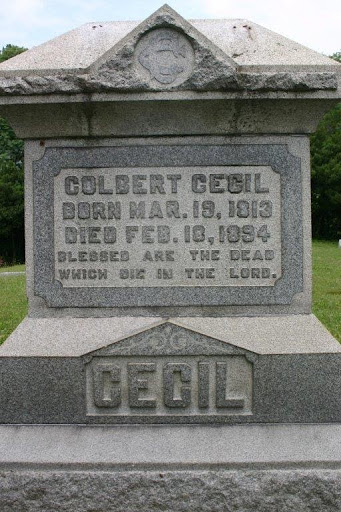
Kentucky Democrats met in Frankfort on January 9. Their purpose was to select delegates to attend the national party convention scheduled for Charleston, South Carolina, in May. The man who represented the easternmost district of the state was Colbert Cecil, a merchant and land speculator from Pikeville. He was the wealthiest man in Pike County. To that point he had led a somewhat unusual, though largely unremarkable, life. During the following six months Cecil would play a role in shaping events which would affect America’s future course.
Cecil was not a native Kentuckian, but that was nothing unusual. Many men living in Pike and other border counties along the Big Sandy during the years preceding the war were not born in the state. Cecil was a native of Tazewell County, Virginia. Born in 1813, his family came to Pike County when he was still a youngster. They were part of the migration of Virginians who came down Levisa Fork once the availability and attractiveness of the upper Big Sandy was broadcast. He served as first lieutenant of a Pike County militia outfit during the Mexican War, but a small Kentucky quota combined with an outpouring of volunteers in the state’s cities kept the Big Sandy men at home.
During the decade following the War with Mexico, people began to claim the best remaining bottomland along the rivers and creeks of the Big Sandy country. As opposed to speculators like John Graham who hoarded land, most original settlers of Kentucky’s eastern mountains had generally patented or purchased farms large enough for their needs, but these holdings had been divided and subdivided during the half century preceding 1860 to the point that they were rather meager by earlier standards. When their children reached the age of majority, they were not satisfied with inheriting their parents’ farms or carving off a piece of the home place for themselves. Along with such families as the Leslies of Johns Creek, the Weddingtons around Coal Run, the Mays of Robinson and Shelby, and the Rameys at the mouth of Elkhorn Creek, Colbert Cecil realized that prime farmland was a solid investment for the future. By 1860 he had patented 1,600 acres of Pike County property ranging from Big Shelby to Johns Creek and from Robinson Creek to Cumberland Mountain. His total Pike County acreage was second only to that of his brother, William, who had patented property valued at over $21,000. During the coming five years, land proved to be one of the few investments to withstand the uncertainties of a wartime economy and regain its value during the Reconstruction era.
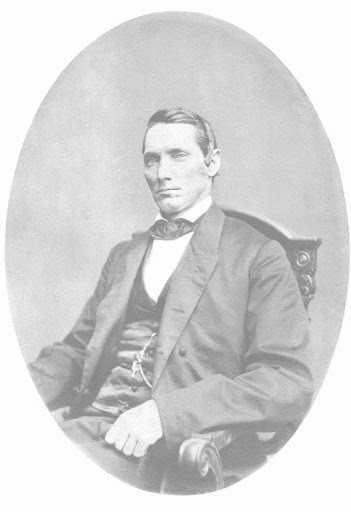
The real property Cecil owned was a hedge against an uncertain future, but the ready cash to finance the land deals came from his Pikeville mercantile business located on the downriver corner of present-day Main and Division streets. During those days when most Pike County men his age would have had a farmstead, wife, and several children, Colbert Cecil had never
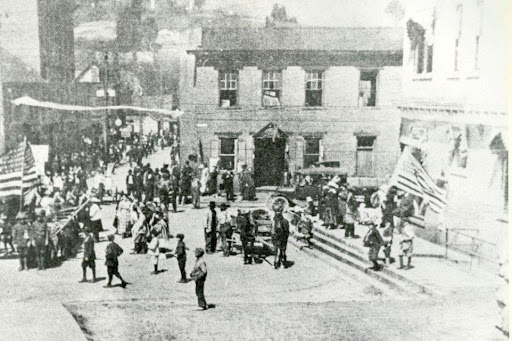
(Photo Courtesy of Debbie Huffman)
married and did not own a home of his own. He resided in a Pikeville boarding house operated by Dr. John W. Emmert. Renting rooms under the same roof were fellow merchants Thomas C. Cecil, a nephew, and Richard Brown. Another nephew, Colbert Cecil Jr., who was Cecil’s store clerk, had a room in the same establishment. The fact that he had never married, however, did not detract from the esteem in which he was held by others.
Delegates to Kentucky’s Democratic convention were selected on the most obvious bases, those of political affiliation and influence. Cecil met both qualifications. Influence wise, he rubbed shoulders with the most powerful men of the valley. For instance, he was a close personal friend of George N. Brown, an attorney who practiced law along the Big Sandy from Pikeville to Catlettsburg. Brown thought so highly of Cecil that he named his son, born in October 1861, Colbert Cecil Brown. Local voters regarded Cecil highly enough to elect him to a term in the state legislature. His land dealings and business interests introduced him to most men on the upper Big Sandy. Existing County Court records from the pre-war years reveal that he loaned money to scores of Pike and Floyd Countians. One contemporary historian stated of Cecil, “He has been for many years the most potent and well-known Democratic politician in the Sandy Valley.”
The Frankfort convention chose a true Southern Democrat when Cecil was named as one of the Commonwealth’s envoys to Charleston. His views on issues of the day, like those of his family, were open to anyone who cared to look. Cecil was both a supporter and a practitioner of slavery. His record of slave ownership indicates that he was a master who seldom traded in the human commodity. During the three years preceding the war, he consistently owned but one human chattel. The value of $1,000 for that servant implied a person of some skill. During the Frankfort convention, Cecil supported a man whose views on the issues of the day paralleled his own. When that gathering ended, 24 men who shared political principles were chosen to attend the South Carolina national convention. Cecil’s political ideas were indeed known among his fellow Democrats, but two conventions would pass into history before people realized the extent of his devotion to the Southern states.
Each of Kentucky’s two dozen Democratic delegates supported James Guthrie, Kentucky’s native son and presidential hopeful. Born in 1792, Guthrie was as old as Kentucky and had been a Democrat since he became old enough to vote. He served as Treasury Secretary under President Franklin Pierce and, prior to that, was both a state senator and representative and a practicing attorney. A supporter of slavery, Guthrie presided over the 1849 Kentucky constitutional convention and saw to it that support for human bondage was written into the state’s new charter. Prior to the war, Kentucky’s nascent railroad industry was largely a result of Guthrie’s efforts. He was the driving force behind completion of the rail line between Louisville and Nashville immediately prior to the war and at the time of the 1860 convention was president of the L&N Railroad.
The delegates of the Commonwealth were committed to Guthrie when they left Frankfort and they remained so throughout the coming storm in Charleston.
When Colbert Cecil set out from Pikeville to attend the Charleston convention, the first leg of his trip took him along Levisa Fork into Virginia, the route by which he had come to Kentucky as a child. It was the same trail over which his brother, William, had driven hogs to Tazewell County during the 1830s while, back in Pikeville, it was alleged that his wife bedded down with another man.
From Tazewell Courthouse, he went to Abingdon, where the horseback part of the journey ended. Also leaving for Charleston at or near the same time
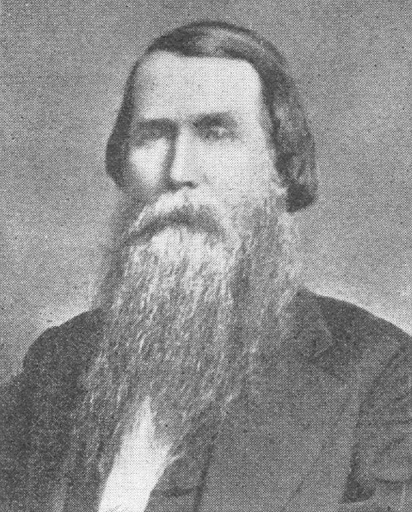
was William P. Cecil [LEFT], cousin of Colbert and Virginia delegate from Tazewell County. From Abingdon, the Tennessee-Virginia Railroad carried the cousins along to Knoxville, skirting the northern edge of the Great Smoky Mountains for that leg of the trip. In Knoxville they made a connection for Charleston, most likely by way of Chattanooga to the South Carolina coast. Four days out of Abingdon, the Cecil cousins arrived in what was probably the most active American seaport between New York City and New Orleans.
Monday, April 23, 1860, signaled the final real chance for America’s oldest existing political party to reconcile its differences and make peace within its ranks. At noon, delegates from 32 states took their seats in the hall of the South Carolina Institute. Following introductory remarks and the selection of officers, the convention began to grapple with seemingly minor problems.
The first topic of discussion centered around the qualifications of certain delegates. Questions had been raised concerning the legitimacy of some members’ selection process while other delegates were examined over more mundane issues. To determine who among those challenged would be allowed to sit as part of the convention, a Committee on Credentials, consisting of one delegate from each state, was chosen. G.T. Wood of Munfordville was Kentucky’s selection to help resolve the questions surrounding qualifications. At first glance, the Credentials Committee seemingly had the more important role of the two committees chosen on the first day.
The second panel selected during the opening session was known as the Committee on Permanent Organization. Its members had the responsibility of adopting the rules and regulations by which both the convention as a whole and the delegates individually would conduct themselves. Until the Charleston convention of 1860, this committee had usually met, voted to accept the guidelines of the preceding convention, announced their decision to the assembly as a whole, and then rejoined their home state delegates on the floor of the hall. When John Cessna of Pennsylvania was chosen chairman, most assumed the 1860 convention would follow suit.
Veteran politicians as well as newspaper reporters probably drew a blank when the Kentucky member of Permanent Organization was announced. He was a thirty-seven-year-old businessman named Colbert Cecil. He had practically no national and very little statewide exposure. The only thing known for sure was that he was a Guthrie man, since the Kentucky delegation as a group supported the venerable old Democrat. What people did not know about Cecil and the Committee on Permanent Organization was that they were devising a plan to circumvent the traditional block voting procedures and, by so doing, hopefully nominate a pro-slavery man who would be more sympathetic to the South but not so radical as to alienate the opposing faction.
The Committee on Permanent Organization worked quickly. Cessna and his committee announced they were finished within a few minutes following opening prayer on the second day. By their quick decision and obvious lack of debate, it seemed that it would be a repeat of years past. When Cessna took the podium to present his committee’s report, there was little reason to listen closely, at least until the final rule was read. Cessna concluded the report by announcing that his panel had decided “in any State which has not provided or directed by its State Convention how its vote may be given, the Convention will recognize the right of each Delegate to cast his individual vote.”
Eyebrows and voices were immediately raised. One of the first protests against the Committee on Permanent Organization’s final rule came from Mr. Clark of Mississippi, one of the rare cotton state supporters of Stephen A. Douglas, known as the Little Giant of Illinois. Douglas had been one half of the famous Lincoln-Douglas debates two years before and had built his grass roots support among state delegates and had become the man to beat for the party’s nomination. Douglas, in the words of a historian of the time, was recognized in the South as “a man of vigorous and able mind, yet more of the shifty politician than the sagacious and discreet statesman.” The publicly unspoken problem was that Douglas’s views regarding both slavery in the territories and the Fugitive Slave Law would only deepen the party split. Further, it was a common realization that most of the state delegations which stood solidly behind Douglas were from states with Republican majorities and therefore “could not give him or any Democratic candidate a single electoral vote.” Consequently, pro-slavery Southerners felt their party’s future depended on someone other than Douglas being nominated.
The purpose of the final rule offered by the Committee on Permanent Organization was simple in its wording, but the potential it held was powerful. The rule was intended to make it possible for independent-minded delegates to vote for a moderate Southern Democrat. Almost all states had stipulated that all their delegates vote for the same candidate, but some had not. These untethered delegates were the ones for whom the rule was intended. Breckinridge of Kentucky was often mentioned as one of a few potential candidates who would do justice to the agrarian South while maintaining the allegiance of the industrial North. Given the right circumstances, such as Douglas being pressured into a withdrawal, Guthrie himself could have been the man to heal the Democrats’ wounds. Some delegates from Ohio, Pennsylvania, New York, and other states, if given the freedom to vote for the man of their choice, would have abandoned Douglas without a second thought. An intimation of that dissatisfaction with the man from Illinois came three days before the convention opening when Robert Tooms of Georgia publicly insisted that Breckinridge could “get Pennsylvania” should his name be offered for consideration. Colbert Cecil had come to Charleston as a Guthrie supporter and would remain so throughout the convention, but, like so many others there, he was prepared to shift his loyalty if the right candidate appeared and forced Kentucky’s senior Democrat out of contention. Unlike so many who only hoped a mutually acceptable man would be found, the delegate from Pikeville, Kentucky, and the Committee on Permanent Organization as a whole, had taken a totally unexpected step which made that possibility a bit less remote. There soon arose another, heretofore unseen, effect of the rule.
In the opinion of ex-President James Buchanan, it was the lack of block voting which ultimately produced the disastrous results in Charleston. In retrospect, six years following the convention, he wrote:
“. . .whilst New York indorsed with her entire thirty-five votes the peculiar views of Mr. Douglas, notwithstanding there was in her delegation a majority of only five votes in their favor on the question of Territorial sovereignty, the effective strength of Pennsylvania . . . was reduced to three votes, this being the majority of fifteen on one side over twelve on the other.
Colbert Cecil and his fellow committeemen had conceived a plan to stop Douglas, but in so doing had disassembled the solid block votes from states which could have potentially offered unanimity in favor of the Southern platform. The remainder of the week was spent with the moderate and radical wings of the party jockeying for advantage. The final rule of the Committee on Permanent Organization was enacted several times during the convention.
On the third day, no committee was ready to report and no business could be done while so many delegates were relegated to committee work. With back-room maneuvering ongoing, the remaining conventioneers adjourned the morning session and accepted an invitation to tour the Orphan Asylum of Charleston. The third day ended with the Credentials Committee sustaining no protests and all members agreeing to attend the removal from Charleston of the body of former Governor Robinson of Vermont, a delegate who had died in his sleep the previous night. The following three days were marked by attempts to reach agreement on proposed amendments to the Fugitive Slave Law and by presentation of the majority and minority reports and platforms. On Thursday, April 26, Mr. Greenfield of Kentucky proposed an unacceptable modification of the fugitive law. That day’s second session was short, as were tempers and patience. Frustration was beginning to build. The evening session on Friday was the close of an essentially wasted day insofar as progress and production were concerned. The day ended with three hours of speeches from the floor. Saturday’s session began with a foreboding journal entry which related that, in the absence of a clergyman, the convention proceeded to do business without an opening prayer. The day was fraught with emotional outbursts and unchecked remarks. Caleb Cushing, the convention president, admonished the members of the necessity of preserving order in their deliberations. The session on Saturday, April 28, saw delegates demonstrating the darker sides of their personalities. Following the weekend’s reprieve, the contagion spread from individuals to infect entire delegations.
Monday, April 30, marked the beginning of the end of the familiar Democrat party. Points of contention between the Northern and Southern Democrats were presented in a letter to the president of the convention from the Alabama delegation. It was read from the floor and emphasized two points:
The points of difference between the Northern and Southern Democracy are:
1st. As regards the status of slavery as a political institution in the Territories, whilst they remain in the Territories, and the power of the people of a Territory to exclude it by unfriendly legislation;
And 2d. As regards the duty of the Federal Government to protect the owner of slaves in the enjoyment of his property in the Territories, as long as they remain such.”
Alabama and the other states of the deep South demanded constitutional, legislative, and judicial protection of slavery. The Douglas Democrats, in order to moderate their view and appeal to a national audience, asserted that such matters should be left to the United States Supreme Court. Each branch of the party had come to Charleston to secure an affirmation of support for their viewpoint. In the final result, one faction was necessarily going to be bitterly disappointed. Once the vote was taken, it became clear that the moderate platform was the choice of the convention and the issue would not be settled in favor of the South. Mr. Walker of Alabama then arose and addressed the delegates. He delivered a bombshell that would not be matched until the attack upon Fort Sumter a year later when he announced, “Instructed, as we are, not to waive this issue, the contingency therefore has arisen when, in our opinion, it becomes our duty to withdraw from this convention.”
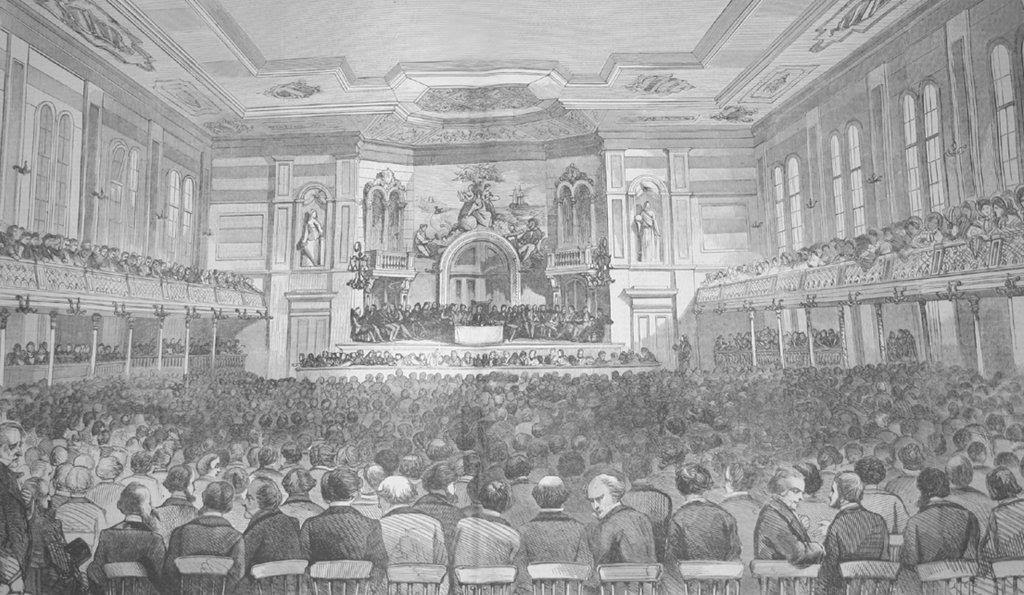
Walker ended by asserting that no other individual or delegation would be allowed to represent Alabama upon the floor of the convention. Alabama’s withdrawal was quickly followed by the departure of Mississippi, Louisiana, South Carolina, Florida, Texas, and Arkansas. Georgia’s delegates were allowed to withdraw in order to consult among themselves. It was then announced that Delaware would also withdraw. The deserters’ bloodletting was finally stopped by adoption of a motion to adjourn until Tuesday, May 1. Douglas supporters at once began to feel smug with the missing fifty-plus Southerners. They felt the nomination was now within reach and that their man would be the party’s candidate. Their delight turned to despair when the convention ruled that a two-thirds majority of the original delegation of 303, rather than the remaining 251, would be necessary for nomination. When balloting began on Wednesday, May 3, deadlock was the operative word of the day.
The Kentuckians in Charleston remained committed to Guthrie through 57 ballots. Guthrie remained second to Douglas throughout the ordeal, never getting more than 66-1/2, which came on the fortieth ballot. On the other hand, Douglas was the consistent front runner but never came close to the required majority. At the end of the day, his highest total on any ballot had been 151-1/2 votes. Although the conciliatory candidate who could bring the warring factions of the party together was never found, Colbert Cecil and the Committee on Permanent Organization had left the door ajar in anticipation of his appearance in such a situation.
Thursday, May 3, was the tenth, final, and most welcome session of the Charleston convention. The day’s proceedings were as short as some delegates’ tempers during the Saturday past. Mr. Russell of Virginia offered a resolution that the convention adjourn and reconvene in Baltimore on June 18. Once the proposal was offered for a vote, it carried with only nominal opposition.
During the coming days, retracing the route which had brought them to Charleston, Colbert and William P. Cecil saw the South Carolina, Georgia, Tennessee, and southwest Virginia landscapes from an entirely different perspective than on their earlier trip. Likewise, they most likely viewed prospects for success in Baltimore, as well as any promise of a peaceful future for the Union, from a less optimistic point of view.
With William back in Tazewell by approximately May 7 and Colbert in Pikeville shortly thereafter, the Cecil cousins were able to spend approximately four weeks among friends and family. During the interim, Republicans met in their Chicago wigwam and nominated Abraham Lincoln. Democrats now had an identified adversary for the November election.
The Baltimore convention was scheduled to open on June 18, so by the end of the first week of the month the cousins were traveling again. The horseback leg of Cecil’s trip ended in Wytheville, Virginia. There he boarded a train headed for Washington, D.C. From there the trip continued on to Baltimore, whose Maryland coast weather was markedly different than that of South Carolina. Baltimore was indeed a different city with a different climate and its Front Street Theater was a different setting, but the environment inside the convention hall was little changed from the atmosphere the cousins had left in Charleston only a few weeks earlier.
During the first day, sectional differences again overshadowed all other matters. Delegates who had voluntarily vacated their seats before the lights went out for the final time in Charleston were not announced when opening roll was called. Mr. Russell of Virginia ignited the credentials issue anew when he asked how, since Virginia’s delegates were admitted, the convention could forbid the other Southern representatives from participating. The issue was opened for discussion and the remainder of June 18, as well as the following two days, was taken up entirely by matters of who should and should not be permitted to hold voting positions in the convention. There were many questions, but little agreement. No official business could be done because the composition of the assembly had not been determined.
The fourth day, June 21, began with a literal crash. Following prayer, just as Chairman Cushing was beginning his report, a 50-foot-wide section of the stage and orchestra cover collapsed. After a team of carpenters had repaired the stage, both the majority and minority reports of the Credentials Committee were finally presented during the early afternoon. The reports contained no surprises and voting followed sectional lines. The majority report stated that none of the Louisiana Democrats who had bolted the Charleston convention would be admitted at Baltimore. When a vote was taken on the matter, Kentucky’s delegates voted 10-2 against admission of the substitute delegates, all of whom were hand-picked Douglas men. The majority report recommended the same treatment for Alabama’s delegation. Kentucky voted 10-1/2-1-1/2 in favor of seating that state’s original members and denying the pro-Douglas substitutes. By that point, it was apparent that the Douglas people had done their homework since Charleston. Representatives of cotton states who had abdicated Charleston were being replaced by Douglas supporters. As an example, the only member of the original Mississippi delegation to be seated in both conventions was Mr. Clark, the same man who had been so quick to criticize the final rule of the Committee on Permanent Organization. Kentucky’s representatives had no active part in the fight since they held strong for Guthrie, but their opposition to the pro-Douglas substitutes left no doubt as to which way they would have voted had they been free to do so. Other states’ representatives did not take the situation as calmly as did those from Kentucky.
Late in the evening of Friday, June 22, well past 7 o’clock, Mr. Russell of Virginia addressed the assembly and announced that he, along with part of the Virginians in the hall, could no longer participate with a clear conscience in view of the treatment their companion states in the South had received. He bid adieu to those in attendance and walked out of the theater with several Old Dominion delegates in tow. What most anticipated, and feared, had happened; history had repeated itself. There had never been a question of whether the Southerners would abandon the convention, but simply one of when and who would take the lead. As if awaiting a predetermined signal, or maybe just holding back until someone else made the first move, North Carolina’s chairman took the floor. After protesting the wrongs committed against the South by the convention as a whole, he led a majority of the North Carolinians from the building. Tennessee was next, with its chairman announcing a vote of 20-4 in favor of retiring from the assembly. Mr. Caldwell of Kentucky followed Tennessee and announced that his delegates had expressed doubt as to whether they should continue, whereupon permission was granted the Kentuckians leave to retire and consult among themselves.
While the men from the Bluegrass state were in their closed session, more drama was developing on the floor of the hall. Maryland’s chairman announced that a portion of his colleagues considered further efforts useless. Oregon’s chairman was next, taking the floor and stating that Southern men, who had as much right to be seated in the convention as his own deputation, had been denied entry. In protest of the wrongs the convention had allegedly committed and the insults inherent in the votes it had made, the Oregon Democrats had agreed to participate no further. While Kentucky’s assembly was deliberating, the exodus, including one one California member, continued. Just as Mr. Caldwell returned to the floor and requested recognition from the chair in order to announce Kentucky’s decision, a vote to adjourn until 10:30 Friday morning stopped the hemorrhage of disaffected delegates.
On Saturday morning, June 23, Mr. Caldwell of Kentucky was among the first to address the assembly. His first statement received premature applause when he stated that Kentucky would remain in the assembly. Then, prophesying the strife and division which would pervade his state during the coming five years, Caldwell announced that there were three distinct opinions within his group. He first announced that there were 10 who wished to withdraw. Another group of five, including Caldwell himself, had voted to suspend their involvement for the time being, but left open the possibility that they would return if conditions showed more promise. The third group had voted to remain in the convention.
The 10 Kentuckians who walked out of the theater had written a statement of explanation which Mr. Caldwell requested be read on their behalf. It was handed to the convention secretary, who then announced:
Resolved, That the Chairman of our delegation be instructed to inform the Convention in our behalf that in the present condition of that body we deem it inconsistent with our duty to ourselves and our constituents to participate further in its deliberations. Our reasons for so doing will be given to the Democracy of Kentucky.
JNO. DISHMAN, J.S. KENDALL,
JOS. B. BECK, D.W. QUARLES,
COLBERT CECIL, L. GREEN,
R.M. JOHNSON, CAL. BUTLER,
R. NICKEE, JAS. G. LEACH
Not that it would have made a difference, but with that announcement Pike County and the Big Sandy country had no further voice in the decisions of that convention. In Charleston, Colbert Cecil had been part of a scheme to nominate a moderate pro-slavery candidate to bring the Democrats together. During the Baltimore convention, he was probably haunted by the suspicion that the die had already been cast and his participation was for naught. Insofar as choosing a Democratic candidate, the 10 Kentuckians were never missed. On the first ballot, Kentucky again stayed with Guthrie and gave him its remaining 4-1/2 votes. Douglas was nominated on the second ballot with Kentucky split 3/1/2-1-1/2 in favor of Douglas. A candidate had been chosen, but not all Democrats were finished.
The delegations which walked out of the Front Street Theater were not acting indiscriminately and without forethought. There had been behind- the-scenes planning before the first defection by Virginia. The 105 seceders, including the original Alabama and Louisiana delegations who had walked out in Charleston and been refused seats in Baltimore, found a new meeting hall at the Maryland Institute. They chose Caleb Cushing, the same man who had chaired the Front Street convention, as their presiding officer. Their search for the man who could cure the Democrats’ dilemma had not been abandoned. They accomplished their goal in a single session. Working quickly and smoothly, they had no credentials to validate; abdicating their seats in the Front Street assembly had been validation enough.
Toward evening on Saturday, June 23, three names were put into nomination. John C. Breckinridge of Kentucky was chosen as their candidate for chief executive. Joseph Lane of Oregon was selected as his running mate. The initiative which was born weeks before in Charleston with the final rule of the Committee on Permanent Organization ended in Baltimore in the assembly hall of the Maryland Institute. Colbert Cecil and his fellow dissenters who had found it impossible to work within the structure of the National Democratic Convention had decided to work outside that body. In the process, they finally found the candidate who had eluded them for much of the late spring and summer.
The trip home from Baltimore was undoubtedly more satisfying for Colbert Cecil than the return from Charleston. The impasse had been overcome. Holding out hopes that Breckinridge’s popular support would force Douglas to withdraw from consideration, thus reuniting the Democrats and ultimately the nation, Cecil had no idea that within less than a year the reverse would be true.
The two Democratic conventions marked the end of Colbert Cecil’s active political participation. Shortly after the war began, he suffered illness for several months. He later married Kate Ratliff, daughter of William General Ratliff of Pikeville. Ironically, this marriage made him the brother-in-law of John Dils, guiding light of Union sympathy along the upper Big Sandy.
On a Saturday afternoon in the early 2000s, David Deskins and I sat in the Catlettsburg McDonald’s and interviewed a descendant relative of the Cecil family. That interviewee told us that, following the Civil War, Colbert Cecil had decided that life among belligerent Union boasters and struggling in a war-torn economy offered few bright prospects. He then chartered a steamboat, loaded up his wife and possessions, and moved to Catlettsburg where he lived the rest of his life. He is buried in the Cecil section of the Old Catlettsburg Cemetery.
After both sets of Democratic conventioneers, the Chicago Republicans, and the Union Party had made their choices, the final determination was left to the voters. As summer passed and election day drew closer, the Douglas faction edged consistently closer to the Union Party platform while chastising the Breckinridge wing as secessionists. In the final analysis, Kentuckians were faced with four options for President: Douglas, who would ally them solidly with the industrial North; the Union Party under Bell and Everett, which essentially meant preserving the Union as it was; Breckinridge, who, despite disinformation from Republicans, meant basically preserving the Union with a guarantee of slavery; and, finally, the party of Lincoln. Within both the Lincoln and Breckinridge parties were radical groups, each willing to see the nation divided in the name of slavery.
By summer’s end, despite the fact that Breckinridge was probably as pro-Union as any other man on the ballot, a prediction of his ultimate failure was being made by a Tennessee preacher. Parson William Brownlow was best known for his rabble-rousing sociopolitical diatribes which embraced the Union and spewed animosity toward those who disagreed with him. Following the Baltimore conventions, he told anyone who would listen the real reason, as he perceived it, behind the seceders’ convention and Breckinridge’s nomination. Brownlow personally supported the Union ticket of Bell and Everett, but his reasoning fit within the more powerful Douglas propaganda machine like a hand in a glove. The focal point of Brownlow’s contention was that the Kentuckian had simply been used by the radical Southerners. Instead of supporting Breckinridge in order to persuade Douglas to eventually withdraw, the Tennessee minister asserted that disunion had been the ultimate plan of the Baltimore self-exiles. Operating upon the pretext that a Lincoln victory would lead to secession of the cotton states, Brownlow asserted, the radicals had thrown their support to Breckinridge in order to assure a Republican win. Brownlow and Douglas Democrats saw Breckinridge’s candidacy as nothing more than insurance on behalf of those he called Yanceyites, men dedicated to Southern secession.
Men along the Big Sandy considered their options and voted in a manner they hoped would follow the established precedent; the five counties on the Kentucky side had supported presidential victors since 1840. There had been exceptions such as Lawrence and Pike going for Clay in 1844, Johnson supporting Cass in 1848, and Lawrence and Pike again bucking the trend and giving a majority to Scott, the Whig, in 1852. But in the fall of 1860 there were no exceptions. Neither Lincoln nor Douglas stood a chance in the valley.
Pike County Democrats held a rally on July 16. The proceedings were detailed in a letter by Judge Cecil which was carried in Louisville’s Weekly Courier of August 4:
At a large and enthusiastic meeting of the Democracy of Pike County held at the courthouse in Pikeville, on Monday, the 16th of July, (being county court day). The meeting was organized by calling Judge William Cecil to the Chair, and the appointment of John W. Emmert Secretary. Colbert Cecil (a delegate to the Democratic National Convention), explained the causes which led to the withdrawal of himself and colleagues, and defended in an able manner those who withdrew from the convention; after which John M. Rice, Esq., being called for, addressed the meeting in a speech of some length, reviewing the platforms of the political parties, and vindicated the Breckinridge and Lane ticket from the charge of sectionalism. In conclusion, he offered the following resolutions:
The first resolution was a pledge of support for the Democratic candidate for the clerk of the Court of Appeals to be chosen by a Frankfort convention on July 18. It amounted to a rebuff of the Know Nothing candidate, Leslie Combs.
The second resolution set out the sentiment of most Big Sandy Democrats in the upcoming November election:
. . . we heartily and enthusiastically ratify and indorse the platform of principles adopted by the Democratic National Convention at Baltimore; that we view them as eminently national and conservative, and a just rebuke to the sectionalism of “Douglas Squatter Sovereignty,” and that the nominees of said Convention – Breckinridge and Lane – standing upon the Constitutional platform, are deserving and should receive the support of the true Democracy throughout the Union.
The valley’s only newspaper on the Kentucky side was the Sandy Valley Advocate. In its August 28 editorial, seemingly aimed at the Pike County Democrats’ resolutions of July, the Advocate attempted to sway voters away from Breckinridge in favor of the Union ticket. In response to the announcement of a peace meeting to be held a short time later in Greenupsburg, a few miles north of Catlettsburg, the editorial asserted:
There is but one peace party on a permanent and honorable basis and that is the great Union party. To them is Ky. this day indebted for her present peace and security and had it not been for their efforts Ky. this day would have been involved in the horrors of that civil war which is devastating Ka. and Mo. The Union party has been the salvation of Ky., and we know there is not an honest mountaineer who has not always prayed for peace, and would at any time sacrifice all he had if it would have secured it to his distracted country. Mountaineers we beseech you, look with suspicion on every man who proposes to you to join a peace party; tell him you now belong to the only party – the Union party – which is really for peace, and that the only condition on which peace can be obtained is by the rebels laying down their arms and submitting to the Constitution of their country. If peace ever again dawns upon our unhappy land it must be by the submission of the rebels.
Reaching full stride, the writer continued by characterizing any and all who favored reaching a peaceful resolution of the civil conflict as traitors, giving special attention to one who would be a participant in a last-ditch effort to avoid war during the coming months:
Who are they who are now crying for peace? John C. Breckinridge is also an advocate of this treasonable party, and failing in every other attempt, hopes by this measure to seduce loyal men into this Secession snare. Jim Clay is another of the advocates of this Secession trap. Is there a loyal man in Ky. who would go where Jim Clay leads? Look all over the State, look into your own county, and see who are the advocates of a peace party or peace meetings, but those who are either open Secessionists and enemies of the Union, or sympathizes with the rebellion in the South.
The author then moved on to deal with activist groups who, although not materially supporting the Confederacy, refused to pay taxes based on a principle called “Peace and No War Taxes.” He equated that movement with nothing more than secessionist propaganda by declaring that a refusal to pay taxes for the war effort against the South was rebellion, an attempt to nullify an act of Congress. With a full head of self-righteous steam, the author continued:
It will be said that we refused to furnish troops, and this was not treated as rebellion. True it was not. It was an act of non- performance. The act of Congress requires that the tax shall be collected. It must be done unless we are guilty of the folly, worse than madness, of resistance . . . pause and consider well before you commit yourselves to the schemes of the Secessionists.
True to Parson Brownlow’s prediction, the actions of the Southern Democrats in the Maryland Institute, combined with savvy publicity such as that in the Big Sandy Advocate which cast suspicion upon Breckinridge’s loyalty, helped turn the election into a Republican victory. By dividing the Democratic vote, and with Bell and Everett on the ballot, Lincoln was elected without a majority.
When election totals were announced, Democrats took little solace in the fact that Lincoln received but one vote in Pike County. Abner Justice, obviously contemptuous of overwhelming Southern feelings among the electorate, announced to the election clerk his vote for the Republican candidate. That trend held true for the counties along both sides of the Big Sandy, with Boyd giving the Republican candidate his largest total of 18. Lincoln received no votes in Lawrence, Letcher, Johnson, or Floyd, nor did he receive a single vote in any of the western Virginia counties along the Big Sandy.
Many men in the upper valley chose not to vote for a presidential candidate. Whether due to confusion over which of four candidates to support, the volatility of issues, or the fact that voting was by open ballot and it was often more prudent to simply not vote than expose one’s self to later recrimination, turnout was less than in 1856. In that year’s contest between Buchanan and Fillmore, the counties of Pike, Floyd, Johnson, and Letcher had cast a combined total of 2,979 votes. In November 1860 the same four counties, with slightly larger populations, saw only 2,513 voters. The pre-1850 Kentucky constitution had given men a three-day span in which to cast their votes. Such a luxury was not afforded under the new constitution. At first glance it would seem that with road conditions, distance from polling places, and the newly-imposed time constraint, many would have found it too troublesome to vote. Such was not the case in 1856 and it is doubtful that these factors alone kept voters away from the 1860 polls.
The November 6 election made war frighteningly more imminent. In response, there was a surge of pro-Union meetings across Kentucky. On November 19, crowds convened in Frankfort, Newport, Hardinsburg, Brooksville, Maysville, Mount Sterling, and Vanceburg. All were held to show support for keeping the nation intact, not necessarily for the party which had carried the state during the recent presidential election.
Results of the election along Big Sandy are below.
LINCOLN BELL DOUGLAS BRECKINRIDGE
(KENTUCKY)
PIKE 1 73 1 726
FLOYD 0 64 0 609
JOHNSON 0 22 26 618
BOYD 18 488 115 191
LAWRENCE 0 433 10 515
LETCHER 0 91 1 281
BIG SANDY 19 1,171 153 2,940
STATEWIDE 1,364 66,058 25,651 53,143
(VIRGINIA)
BUCHANAN 0 14 19 134
WISE 0 102 8 363
TAZEWELL 0 306 0 934
RUSSELL 0 473 34 526
LOGAN 0 100 6 271
WAYNE 0 326 82 166
BIG SANDY 0 1,321 168 2,394
STATEWIDE 1,997 74,481 16,198 74,325
On December 9, Governor Magoffin tried his hand at interstate mediation by sending out a circular to his slaveholding counterparts. His letter contained six proposals which, if adopted, would protect the South, institutionalize slavery, promote commerce, and assure peace C or so he thought. Four of his proposals would have required amendments to the Constitution while two others would have required Congress to amend the Fugitive Slave Law and provide for delivering up anyone indicted for stealing slaves or enticing them to escape. None of his proposals were adopted.
Just over a week after Magoffin’s futile attempt, Senator John J. Crittenden of Kentucky offered his own compromise. He advocated: renewing the Missouri line at thirty-six/thirty; outlawing slavery north of that line and allowing it to the south; admitting new states with freedom to accept or reject slavery in their constitutions; prohibiting Congress from abolishing slavery in the states; prohibiting Congress from abolishing slavery in Washington so long as it existed in Maryland and Virginia; permitting free transport of slaves by land or water in any state; paying for fugitive slaves rescued after arrest; repealing fugitive slave commissioners’ fees; and repealing personal liberty bills in the North. Like the majority of Magoffin’s proposals, Crittenden’s points would have, if ultimately enacted, required amending the Constitution. His proposals were supported by the majority of Kentuckians as well as the major figures in both the Union and Democratic parties of the state. The United States Senate, however, responded that the Constitution was good enough and that secession should be put down. Crittenden’s compromise was rejected.
The year 1861 began as 1860 had ended, with the nation searching for a way out of its predicament. President Buchanan proclaimed January 4 a day of fast. It was observed in Kentucky and the other border states, probably more fervently than in the North or the deep South. On January 7, a committee of 14 Congressmen, one from each of 14 selected states, was chosen to devise an agreeable solution to the sectional differences which had evaded Americans for decades. Their offering was called the Border State Proposition. Kentucky’s member was Senator Crittenden, the man who had only weeks before introduced his own plan which was still showing signs of life in the Senate. Like a true statesman, Crittenden deferred to the Border State plan and recommended that it be substituted for his own. It, too, was rejected. The plan of another of its sons had been denied, but Kentucky would persist.
February 4, 1861, marked a beginning and an end in American history. That date, which coincided with President Buchanan’s day of fast, saw the Confederate States of America formally began its struggle for existence and ended any possibility of a peaceful conflict resolution. The secessionist states’ delegates met and established a central government in Montgomery, Alabama. Other states were creeping closer and closer to declaring themselves part of the new government, but Kentucky was not among them. Its legislature had substantially decided that secession was not in Kentucky’s future. Within a week, the state’s lawmakers declared that a convention to discuss taking her out of the Union was both unnecessary and impractical. Other states, however, still wavered. One of those on the cusp of an irreversible decision was Pike County’s neighbor, Virginia. The Mother State, in a last desperate effort, organized a peace conference to assemble in Washington on February 4.
The Washington Peace Conference hosted a mix of men. The chairman of the Virginia council was James Seddon, who eventually became Confederate Secretary of War. Another delegate was Felix K. Zolicoffer, a relative unknown from Tennessee who would, within the next several months, become a Southern martyr. He was killed in battle in southeastern Kentucky before the end of the year. Altogether, 21 states responded by sending a total of 131 representatives. Most delegates were men of moderate political attitudes, hand-picked by their state legislatures in order to offend no one. On the other hand, they would please few. Interestingly enough, research shows that the selection of Peace Conference delegates was the first time a Big Sandy citizen had been mentioned and actually considered for participation in the interstate peace conferences and conventions of 1860 and 1861. He was a man of both state and national renown.
John P. Martin was a Virginian by birth. He came to Harlan County in 1828 and at the age of 19 ran a losing campaign for the state legislature. He moved to Floyd County when he was 24 and at 31 was elected to the Kentucky legislature. From 1845 to 1847 he was a US Congressman. In 1856, Martin was a delegate to the Cincinnati Democratic convention where William Preston placed the name of John C. Breckinridge into nomination for vice president. Martin family history preserves a story which states that he came within one vote of being nominated for vice president on a ticket with Linn Boyd, the man who opposed James Buchanan for the nomination. Martin later lost an 1858 lieutenant-governor race. He established himself as eastern Kentucky’s most vocal enemy of the Know Nothing party during the late 1850s and shared his antagonism toward the party of Humphrey Marshall during his term in the Kentucky Senate beginning in 1857.
When the time came for Kentucky to select its representatives to participate in the last substantial multi-state effort to stave off impending disaster, its lawmakers considered this Floyd County man who had extensive experience at all levels of government, a man whose prestige had put him among the elite of state Democrats on more than one occasion. But consideration was the extent of Martin’s involvement. Instead, the state assembly chose men whose money, connections, and reputations carried them to Washington.
Upon accepting her sister commonwealth’s call to convene in the name of peace, Kentucky’s legislature chose six to sit in council with a like number from the states still in the Union. Those half dozen were household names, but not necessarily the best qualified. They included: a former soldier who had never held public office; a man who inherited his money, property, and reputation from his famous father, but who would never come close to filling the shoes of his sire; a former governor of Kentucky who had been elected under the banner of a party which essentially promoted bigotry and religious discrimination; a politician who had made a name for himself by losing the 1850 election for governor; another ex-governor who had become chief of state government when the sitting executive died in office; and, finally, a man who desperately wanted to become president and whose outstanding qualifications were his personal fortune and a losing bid for that office during the 1860 Democratic presidential conventions.
At one time, more than a dozen years earlier, William Orlando Butler had been an American hero. After being seriously wounded at the battle of Monterey, Mexico, he was soon promoted to major general. Butler accepted the surrender of Santa Anna’s army and rode his popularity to a vice-presidential nomination alongside Lewis Cass on the 1850 Democratic ticket. His defeat in that race was his first and only entry into national politics.
James B. Clay was the son of Henry Clay, Kentucky’s most famous statesman. He moved to St. Louis to practice law during the 1840s and returned to Lexington after inheriting his father’s home. He had been a member of the Whig party until 1856, when he joined the Democrats in order to support John C. Breckinridge for vice president. Since that time, he had been on the fringe of Kentucky politics, but had neither developed the affability nor earned the peer respect which distinguished his father. The Washington Peace Conference would be no different.
Charles Slaughter Morehead was elected governor in 1855 on the anti-foreigner/anti-Catholic platform of the Know-Nothing party. He was pro-Southern in sympathy but favored neutrality as a practical matter. During the war, his criticism of the Lincoln administration would lead to four years of imprisonment.
Joshua Fry Bell began his political career as a Whig and later aligned himself with Kentucky’s Opposition party, which simply meant that he was opposed to the Democrats. He entered the political spotlight by losing the 1858 governor’s race to Beriah Magoffin.
Charles A. Wickliffe was four years older than his native state and had been a lawyer since the year Abraham Lincoln was born. In 1839 he became head of state government by succession when Governor James Clark died in office. He served the final year of Clark’s term. He was a Unionist in sympathy and ran for governor in 1863, but was labeled as a subversive by Kentucky’s Union military leaders, who helped ensure his defeat.
James Guthrie had been the state Democrats’ standard bearer during the ill-fated Charleston and Baltimore conventions of the past year. His string of losing efforts would continue in the nation’s capital.
There was neither a fire-breathing secessionist nor radical abolitionist among the legislature’s choices. All of the state’s delegates were men who would have thought it strange to walk the streets of any city or town in Kentucky and not see evidence of slavery. They realized that extreme ideas such as those which had brought their country to its present crisis would serve no positive purpose. Above all, they were men who knew their geography and understood the implications for their home state should civil war erupt. During the last week of January 1861, charged with a duty by the legislature and each carrying $500 of taxpayers’ money for expenses, Kentucky’s commissioners to the Peace Conference departed for Washington, D.C.
Former President John Tyler presided over the conference and directed the participants in some frank discussion and honest efforts to pull the nation back from the brink of self destruction, but no new or novel suggestions were offered. Most of the proposals and voting centered around small revisions to the Constitution, most of which involved no more than two or three words. Aside from proposed micromanagement of Constitutional amendments, the high points of the conference were the death of one of its members, Judge Wright of Cincinnati, and a visit to the White House to meet with President Buchanan. Butler and Clay often found themselves voting against the other four members of their delegation and ultimately filed a minority report with Governor Magoffin. Overall, despite their differences, the six Kentuckians generally upheld the principles of the Crittenden Compromise; the convention’s final offering was basically a rewording of the Kentucky senator’s proposals. Once the Peace Conference reached its conclusions and agreed upon an amendment, which if passed would have been Article XIII to the Constitution, its work was finished. The onus was shifted.
Senator Lazarus Powell of Kentucky introduced the proposed amendment on February 27. Senate Republicans, evidently weary of extending the olive branch to appease the states which had seceded, were in no mood to coddle those who were considering the same fateful plunge. Lincolnites in the upper chamber tersely declared that no outside body had the right to offer proposed Constitutional amendments. On the other hand, Southern senators would have rather faced secession than live under an amendment not supported by the opposition. The proposition fared no better in the lower chamber. During the third week of February, several unsuccessful attempts were made to introduce it in the House of Representatives. As it had been with Maysville’s great Union meeting, those who hoped to find some acceptable formula for saving the Union went home with nothing of substance to show for their efforts.
Despite the defeat of proposals sponsored by the Kentuckian who inherited the role of Henry Clay, efforts to find solutions were ongoing. One such attempt which garnered interest along the Big Sandy was held early the following year at Catlettsburg. In February 1861, a citizen of Wayne County, Virginia, decided to reinforce the support for preserving American integrity along the Big Sandy watershed. The fact that such a convention was called was not at all unusual. People were grasping at straws and searching for any hope that hostilities could be averted. The man who called the meeting was one of the more colorful figures in the valley. Before the war, Kellian Verplanck Whaley was one of the Big Sandy’s more vehement critics of Washington, D.C.’s suppression of states’ rights. One observer said Whaley’s politics were, “. . . one-third Whig, one-third Native American, and one-third Democrat, but more Whaley than all together.” Whaley’s invitations went out to men of southern Ohio, northeastern Kentucky, and western Virginia. There is no record that either John P. Martin, John Milton Elliott, or Colbert Cecil, three of the best-known Democrats in the valley at the time and men who had received more convention experience within the past few years than most in attendance would get in a lifetime, were invited.
When the convention principals arrived in Catlettsburg, they were greeted by hundreds of people, most of whom shared a vague hope that the assemblage could somehow succeed where men in seats of power had thus far failed. The speakers, who ranged in profession from doctors to judges to politicians, were decidedly, according to one in attendance, the most earnest set of men ever assembled in that town. The invitees met in the local church and on February 22, once proceedings began, an Ohio gentleman by the name of Cushing was elected chairman. His election ultimately proved to be the highest accomplishment of the gathering.
Like the Democratic conventions of the past spring and summer, the speakers’ political positions could be determined by their residences. Those from south of the Ohio River, reflecting the ideas of moderate Democrats countrywide, thought the Southern states had no right to secede, but that the federal government had no power under the Constitution to coerce them back into the Union should secession become
KELLIAN VERPLANK WHALEY
(Courtesy WVU)
reality. The men from Ohio, on the other hand, were firm believers in the sanctity of the American government. They asserted that Washington had not only the power under the Constitution to subdue attempts at secession, but that it possessed the inherent privilege to put down any force which opposed it. In response to the Ohioans’ belief in the natural integrity of the Union, Whaley wrapped his reply in the principle of state sovereignty and promised that the men of Wayne County would rally from every hill and valley and greet the invaders with gleaming bayonets and welcome them to inhospitable graves.
When the last orator spode the last words, the audience disbanded and scattered toward home, probably knowing little more about the questions of slavery, states’ rights, and preservation of the Union than before the meeting. It is doubtful that many opinions were changed. Thousands of words had been uttered, but few concerns had been alleviated and the first workable solution to the problems of the nation had not been proposed. That gathering was Kentucky’s first documented peace effort in 1861. Like Maysville’s Great Union meeting which had opened the previous year, the Catlettsburg convention ushered in yet another by providing an arena for people to share their worries and offering living proof that misery indeed loves company. Despite the fact that, in the words of one historian who participated in the Catlettsburg search for solutions, the people there were “at sea, without chart or compass,” the Catlettsburg forum would not be Kentuckians’ last effort at a peaceful resolution of the nation’s problems.
The rejection of the Washington Peace Conference proposal and the frustration of the Catlettsburg pro-Union meeting were dark omens for the Big Sandy country as well as the nation. If 131 political moderates could not present an acceptable solution of the slavery issue, what chance did Democrats and Republicans in Frankfort and Washington have? John P. Martin, upon hearing that the Virginia convention had voted for secession on April 17, was undoubtedly concerned at the prospects of what lay ahead for his country and the two states to which he was attached by birth and residence. On the other hand, from a purely selfish standpoint, he would have been perfectly justified in breathing a sigh of relief that his name had not been permanently associated with such a disappointing failure as the Washington Peace Conference.
Randall Osborne 08/14/2021
BIBLIOGRAPHY
Antebellum county court records for Pike County, Kentucky, Allara Library Special Collections, University of Pikeville (since removed to the Kentucky Department of Libraries and Archives)
Biographical Encyclopedia of Kentucky
Brownlow, Parson Brownlow’s Book
Buchanan, Mr. Buchanan’s Administration on the Eve of Rebellion
Collins, History of Kentucky, Vol. I
Coulter, The Civil War and Readjustment in Kentucky
Court case of Cecil versus Cecil, 1838, KDLA, Frankfort, Kentucky
Davis, Breckinridge: Statesman, Soldier, Symbol
Deskins, Pike County, Kentucky, a Very Different Place
Ely, The Big Sandy Valley
Greeley, et al, Political Text-Book for 1860
Greeley, Tribune Almanac, 1861
Holt, Michael F, The Rise and Fall of the American Whig Party
Interview with the late Betsy Venters, Pikeville historian and Cecil Family genealogist
Ironton Register (newspaper)
Jillson, The Kentucky Land Grants, Vol. I
Kleber, The Kentucky Encyclopedia
Official Proceedings of the Democratic National Convention held in 1860, at Charleston and Baltimore
Report of the Kentucky Commissioners to the Late Peace Conference Held at Washington City
Scalf, Kentucky’s Last Frontier
Smith, Z.F., The History of Kentucky
1860 federal census for Pike County, Kentucky
1861 Pike County, Kentucky, tax list